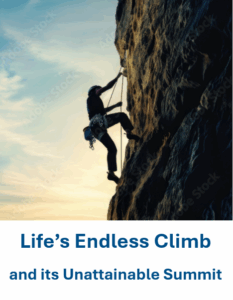
 Most people spend their lives believing that the deeper they learn, the wiser they’ll become—that one day, if they read enough, think hard, and ask the right questions, they’ll reach the high pinnacle of understanding. They’ll scale the mountain of wisdom and finally see the big picture.

I used to believe that. But now I see differently. I’ve come to accept knowledge and clarity as something else entirely—a journey toward life’s endless climb and its unattainable summit. Not as a point of arrival.
The more we know, the more the unknown expands. The closer we think we are, the more elusive truth becomes. The slope doesn’t end. The summit can’t be reached. And in that paradox, I found something staggering.
Something timeless. Something that changed the way I see reality. And maybe it’ll change how you see things, too.
Because what I discovered is simple: more answers only lead to more questions.
Understanding Life’s Mountain Climb
I’ve always been a climber—physically, intellectually, philosophically, and spiritually. I’ve wanted to get above the noise of the world, to reach some kind of mental elevation where the view is clearer. More complete. Less polluted by useless trivia and utter BS.
Like many of you, I’ve read hundreds—probably thousands—of books. I’ve studied religion, science, metaphysics, psychology, and philosophy. I’ve worn the uniforms of authority and walked the chilled corridors of death as a homicide investigator and coroner. I’ve seen the raw, ugly face of truth—and its transcendent beauty, too.
But there’s one constant that always pulled me forward. That’s the belief that true wisdom could be reached through high climbing.
What I didn’t discern until recently was this: Wisdom doesn’t arrive. It reveals. And then it recedes. And then it reveals again—on a higher ridge.
And that brings us to the mountain.
The Mountain and the Curve
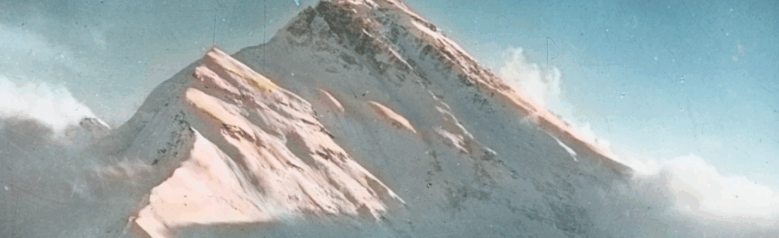
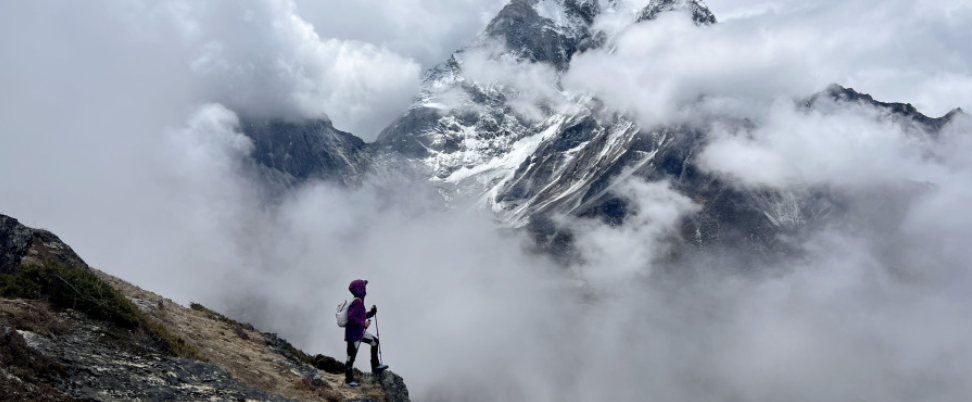
Imagine you’re climbing a mountain. You think there’s a summit up there in the clouds. That with enough effort, enough books, enough late-night thoughts, you’ll reach it. You’ll finally be able to plant your flag and say, “I understand.” But the closer you get to that imaginary peak, something strange happens.
The summit moves. Or rather, it vanishes.
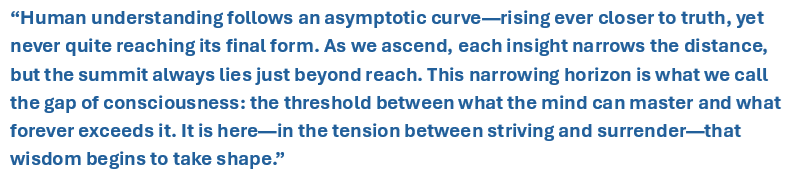
In lifelong learning, what you’re climbing isn’t a mountain with a peak. It’s an asymptotic curve—a slope that ascends forever, getting closer and closer to the summit line… but never quite touching it.
An asymptote is a mathematical concept. It describes a curve that approaches a boundary—but never reaches it. No matter how far you go, there’s always a little more space left that deepens as you rise. It’s an infinite approach.
That’s what the pursuit of knowledge really is. We can climb or learn forever. But the summit stays just out of reach.
And here’s the real mind-bender. The higher you climb, the more of the world you see—and the more you realize how much of it lies beyond your line of sight.
This isn’t failure. It’s discovery.
The Gap Revealed
At a certain altitude, something shifts. You start to see it—the gap of consciousness.
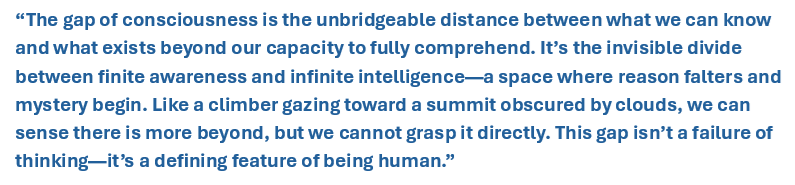
It’s the space between what we can know… and what truly is. It’s the unbridgeable distance between facts and meaning. Between intellect and being. Between reality and our limited human attempt to wrap language around it.
I believe this gap is not a bug in the human mind. It’s not a flaw to be patched. It is the very birthplace of consciousness.
And it’s only visible from above. You can’t see it until you’ve climbed long enough, hard enough, and honestly enough to earn the vantage.
This is where I found myself—not long ago. At an inflection point. One of those rare moments where the compounding of energy, matter, information, time, entropy, and consciousness seemed to converge into a hyper-awareness of what we’re really doing here.
We’re not solving the universe. We’re living within it. We’re hardwired to observe it with awe.
The Paradox of Ascent
It’s here that the paradox hit me like lightning bolt from Zeus. The clearer our thinking becomes, the murkier the gap reveals itself to be.
This is what Socrates meant when he said, “I know that I know nothing.”
He wasn’t being a smart ass, unlike his nemesis Diogenes the Cynic. Socrates was mapping the terrain. He was standing at the gap. And he saw that the moment you think you’ve got it all figured out… you’ve stopped climbing.
Real wisdom isn’t a crown you wear. It’s a ridge you walk. And from that ridge, you don’t just see more answers. You see the shape of life’s mystery itself.
The Human Condition — Not Knowing, But Seeking
This might sound discouraging. That you can never fully arrive. But it’s not.
In fact, it’s the opposite. And it’s liberating because it reframes the purpose of intelligence. Intelligence isn’t a library of facts. It’s not even the ability to solve problems. Not really.
Intelligence is how we relate to the unknown. It’s our interface with mystery. Our raison d’être.
And our ability to tolerate ambiguity—to walk into the highest of clouds and keep going—is what defines human greatness.
We’re not here to answer everything. We’re here to live inside the questions long enough for meaning to emerge. And emerge it will, given time.
What Happens After the Revelation
After I recognized and appreciated the asymptotic learning curve and the consciousness gap, something in me shifted. I no longer felt pressured to be right. Or to “master” everything. Or to pretend certainty where certainty seemed not to exist.
Instead, I started focusing on clarity over control. On direction over destination. On deepening over finishing.
I started asking different questions:
- What kind of mind am I becoming?
- Am I climbing with humility?
- Can I show others the ridge—not the map?
I began seeing my role differently. Not as a knower. But as a climber with a lantern lit to find out.
A guide for others who sense the same mystery—and need a word of encouragement for the expedition.
Lifelong Learning and the Inflection Point
This realization didn’t come from a single book or a sudden moment. It came from compounding. From a lifetime of reading, reflecting, and asking why. From reaching a point where the climb had enough vertical that the view broke open.
I believe we all reach this inflection point—if we keep going long enough. It’s where learning ceases to be additive and becomes exponential.
Your thoughts loop back and reinforce each other. Your understanding accelerates. You begin to see principles instead of facts. Patterns instead of trivia. Essence instead of noise.
And this is when the gap appears.
The Five Provisions and the Infinite View
To understand this clearly, think of the five great provisions the universe gives us:
- Energy
- Matter
- Information
- Consciousness
- Time
These are the ingredients of your climb.
And the two forces that shape how they interact?
- Compounding (growth, clarity, understanding)
- Entropy (decay, disorder, forgetting)
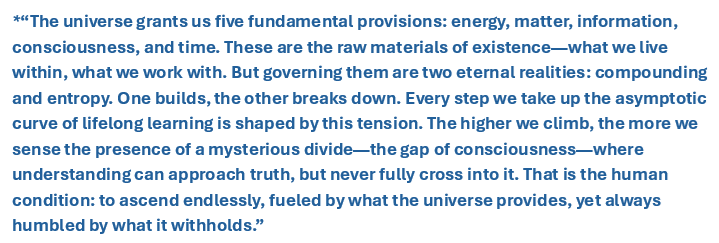
Your mind is the mechanism that converts one into the other. Energy into matter using information through time. It fights entropy with clarity. It builds meaning through compounding.
And consciousness… consciousness is the space where that fight happens. It’s not just something you have. It’s something you stand inside of.
And when you reach the ridge—when you’ve climbed long enough and high enough—you’ll see that the gap above you, below you, and all around you is infinite.
Why This Matters
This isn’t just a nice idea for philosophers or mystics. It matters for you—today. Because it changes what you aim for. It frees you from needing to “arrive.”
It gives you permission to become a different kind of thinker. A different kind of human. One who walks toward the mystery—not to defeat it, but to live in right relationship with it.
That’s the great shift. From current knower to lifelong climber. From temporary master to permanent steward. From assured certainty to nuanced openness.
Words From the Ridge
If you’ve felt this—if some part of your life has brought you to the edge of knowing, and then past it—know this:
You’re not lost. You’re arriving. What you’re arriving at is the gap. The infinite, asymptotic space between all we now know… what we can know… and all that is.
The view from here is breathtaking. And it’s waiting for you.
Just keep climbing.
* * *
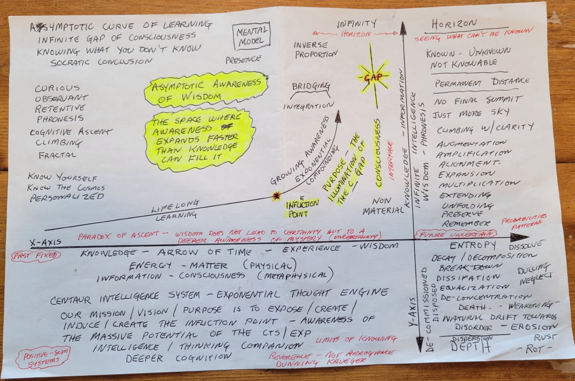
Note from Garry: I’m a visual learner. When I tackle a subject like the asymptotic curve of lifelong leaning and the gap of consciousness, I hand-print and sketch my thoughts onto an 8 by 17 sheet. I call this encapsulating. Here’s a shot of one of my worksheets working up to this post.
Gary,
This aligns with my thinking on this subject too. Like you when I was much younger, I thought that perhaps I could attain something with regard to knowledge, truly knowing God, if there is a God etc.But now I see that it is just sort of an endless climb , but that climb is not futile at all! I am saving this one of yours.Really appreciate what you had to say.
Lynn in Tennessee
Hi Lynn! Great to hear from you. Like you, I don’t feel the endless climb is futile. Not by any means. I had a change in life’s direction back in November 2023 when I began to seriouly study stoic philosopy. One of the core tennents of Stoicism is “Deus Sive Natura Causa Sui” which translates from ancient Greek to modern English as “God is Nature and is Self Caused”. And “Gnothi Seauton, Gnothi Ton Kosmon” which is “Know Thyself and Know the Cosmos”. We get to know ourselves and the nature of the universe through continually climbing up Mount Aletheia – Mount Emerging Truth.
Not sure why, but your post reminds me of one of my all-time favorite poems by an 8th-century gentleman named Li Po (it may be a favorite because it describes me and where I live):
“You ask why I make my home in the mountain forest,
and I smile, and am silent, and even my soul remains quiet:
it lives in the other world which no one owns.
The peach trees blossom, the water flows.”
….I wonder if “the other world which no one owns” aligns somewhere with your definition of consciousness.
Interesting post, Garry. Thank you! —
“The other world which no one owns.” This is profound, Mary. It’s a thought I’m going to reflect upon. Thank you so much for shaing this. And thanks to Li Po for composing this wonderful work.