
Author Archives: Garry Rodgers

About Garry Rodgers

After three decades as a Royal Canadian Mounted Police homicide detective and British Columbia coroner, International Best Selling author and blogger Garry Rodgers has an expertise in death and the craft of writing on it. Now retired, he wants to provoke your thoughts about death and help authors give life to their words.

THE ARRIVAL FALLACY AND THE ASYMPTOTIC CURVE

“I’ll be happy when….” the mortgage is paid. the book is published. the promotion comes. retirement begins. there’s enough money, enough recognition, enough freedom. the mountain is finally summitted. There’s nothing wrong with those goals. The problem begins when a goal becomes a promise that life will finally feel complete once we “arrive”.

It rarely works that way. Achievement brings satisfaction, but satisfaction fades. The promotion becomes the job. The dream home becomes the house. Retirement becomes ordinary life. The mind adjusts, the horizon moves, and another summit appears. This is the Arrival Fallacy—the belief that reaching some future milestone will finally deliver lasting fulfillment.

There may be a better way to understand what’s happening. In mathematics, an asymptotic curve keeps moving toward a line without ever quite reaching it. Human development works much the same way. We can become wiser, healthier, more capable, more skilled, and more fulfilled without ever arriving at some final state called complete.

That changes the question. Instead of asking, “When will I finally get there?”, perhaps the better question is, “Am I still moving in the right direction?”

What the Arrival Fallacy Is

The Arrival Fallacy is the belief that some future achievement will finally settle us. Once the degree is earned, the business succeeds, the mortgage is gone, the book is published, the kids are launched, or retirement begins, life will somehow click into place. We’ll feel complete. The pressure will lift. We’ll finally be where we were supposed to be.

That’s the fallacy. It isn’t that the goals are foolish or that achievement doesn’t matter. Most worthwhile lives are built around goals, effort, and progress. Goals give us direction. They force decisions. They help us measure whether we’re moving forward or simply drifting. The mistake is asking a goal to do more than it can.

Achievement can change circumstances. It can open doors, create security, build confidence, and produce a well-earned sense of satisfaction. But it can’t permanently resolve the human condition. There’s always another problem, another challenge, another uncertainty, another horizon. Life doesn’t stop being life because one objective has been reached.

The important distinction is between achievement and completion. Achievement is real. Completion is often imagined. We can finish a project, pay off a debt, reach a professional milestone, or master a difficult skill. What we can’t reliably do is arrive at some permanent state where nothing more needs attention and nothing further needs to be learned.

The Arrival Fallacy begins when we confuse those two things.

Why the Mind Keeps Falling For It

The Arrival Fallacy survives because the human mind is very good at imagining a better future and not nearly as good at predicting how that future will actually feel. We picture the promotion, the retirement party, the finished house, the published book, or the number in the bank account and imagine the satisfaction that’ll come with it. What we don’t picture nearly as clearly is ourselves six months later, standing in essentially the same mind, with most of the same habits, worries, expectations, and unfinished business.

Psychologists call part of this hedonic adaptation. Something changes, it feels important for a while, and then the mind adjusts. What was once exceptional becomes normal. The pay raise becomes the salary. The new car becomes transportation. The dream house becomes a place where the furnace breaks and the gutters need cleaning. Even achievements that once seemed almost unreachable can become surprisingly ordinary once they’ve been lived with for a while.

There’s another trick at work. The future is clean because it hasn’t happened yet. We can imagine the good parts without experiencing the complications that’ll come with them. Retirement looks like freedom until it also brings questions about purpose, routine, identity, and what to do with Tuesday morning. Success looks uncomplicated from a distance because the next set of problems is still hidden behind it.

So the mind keeps moving the marker. Maybe happiness wasn’t there. Maybe it’s at the next milestone. And because the next destination is still safely in the future, the promise remains convincing. That’s how the Arrival Fallacy keeps renewing itself.

What is the Arrival Fallacy? The Arrival Fallacy is the mistaken belief that reaching a future milestone—such as wealth, retirement, publication, promotion, recognition, or some other major goal—will produce lasting fulfillment or a permanent sense of completion. Goals can improve circumstances and provide direction, but the satisfaction they bring usually fades as people adapt. The fallacy begins when achievement is expected to solve the deeper problem of how to live well.

The Hidden Cost of Living for Arrival

The real danger in the Arrival Fallacy isn’t disappointment. It’s postponement. A person starts treating the present as something to get through on the way to a better future. Work is endured until retirement. Health is neglected until there’s more time. Relationships are put on hold until the pressure eases. Enjoyment gets deferred because there’s always one more target to hit first.

That can work for a while, especially when the goal is important. Sacrifice is often necessary. Discipline usually requires saying no to something now for something better later. But there’s a difference between postponing a pleasure and postponing a life. The trouble starts when the present becomes permanently provisional—when today is always preparation for tomorrow and tomorrow keeps moving farther away.

The cost can be hard to see because ambition is usually praised. The person may be productive, responsible, successful, and still miss what’s happening around them. Years can disappear into deadlines, projects, promotions, mortgages, and plans. The irony is brutal: someone can spend decades building the conditions for a good life and discover they’ve been too busy building it to actually live much of it.

That doesn’t mean abandoning long-term goals. It means refusing to make them the price of admission to the present. A future milestone can improve life, but it shouldn’t be allowed to hold today hostage. The deeper mistake isn’t wanting to arrive. It’s assuming life begins when we do.

Enter the Asymptotic Curve

This is where the asymptotic curve becomes useful. In mathematics, an asymptote is a line a curve keeps approaching without ever quite reaching. The distance gets smaller and smaller, progress continues, but there’s no final point where the curve simply stops and declares the job done.

Human development often looks the same. A person can become wiser without ever becoming perfectly wise. They can become healthier without reaching some permanent state of perfect health. They can become more skilled, more disciplined, more capable, and more clear-minded while still discovering how much remains to be learned. Progress is real, but completion keeps receding.

That may sound discouraging at first, but it’s actually the opposite. If there’s no final state where everything is settled, then there’s also no need to wait for one before life can be meaningful. The value is in the movement itself—in learning, adapting, improving judgment, building competence, and getting better at meeting reality as it comes.

The asymptotic curve gives us a better picture than the finish line. A finish line suggests that once it’s crossed, the race is over. The curve suggests continued development without the fantasy of final completion. It doesn’t say achievement is pointless. It says achievement is part of a larger trajectory.

That changes how a person sees progress. The goal isn’t to become finished. It’s to keep closing the distance.

Why the Curve is a Better Model of Life

The asymptotic curve is a better model of life because real development rarely moves in a straight line toward a clean finish or a single, specific summit. A person learns, improves, slips, adjusts, recovers, and keeps going. Progress happens, but it’s uneven. Some gains come quickly. Others take years. What matters isn’t whether every step is smooth. It’s whether the general direction is sound.

The arrival model tells us there’s a point where the work is over. The curve says otherwise. The more someone learns, the more they usually see what they don’t know. The more capable they become, the more subtle the next challenge looks. Mastery doesn’t close the world down. It opens more of it up.

That’s true in almost everything worth doing. Fitness has to be maintained. Judgment has to be exercised. Relationships need attention. Skills decay if they aren’t used. Knowledge gets outdated. Character isn’t something a person earns once and stores on a shelf. Life keeps moving, and anything alive has to keep adapting with it.

The curve also makes room for aging. A person may not be getting faster, stronger, or more energetic forever, but they can still deepen judgment, perspective, patience, skill, and understanding. The form of progress changes, but the possibility of progress doesn’t disappear.

That’s why the asymptotic model feels closer to reality. It doesn’t promise perfection. It doesn’t demand completion. It asks for continued movement in the right direction.

Goals Still Matter

None of this means goals don’t matter. They do. Without goals, effort can turn into drift. A clear objective gives direction, creates priorities, and forces choices. It helps a person decide what deserves attention and what can be ignored. Goals also give us something concrete to measure against, which matters because progress is hard to judge when there’s no reference point.

The problem isn’t having a destination. It’s expecting the destination to do emotional work it was never designed to do. A goal can help someone build a business, finish a degree, write a book, improve their health, or save enough money to retire. What it can’t guarantee is permanent satisfaction once the target is reached. That’s where ambition quietly turns into expectation, and expectation starts writing promises reality never made.

Used properly, goals are coordinates. They tell us where to aim without pretending the destination is the end of development. Reaching one objective often reveals the next problem, the next possibility, or the next level of competence. That isn’t failure. That’s how progress works.

A good goal should answer a practical question. Where am I trying to go? It shouldn’t be burdened with answering a much bigger one. When will I finally be complete?

Goals still matter. They just need to stay in their lane.

What is an asymptotic curve? An asymptotic curve is a mathematical curve that moves progressively closer to a line or limit without necessarily reaching it. As a metaphor for human development, it describes how a person can keep improving in wisdom, health, skill, judgment, or capability without ever reaching a final state of perfection or completion. Progress remains real even though there may be no absolute finish line.

From Destination to Trajectory

Once the finish line or summit stops being the point, another idea takes its place: trajectory. Instead of judging life by whether some final destination has been reached, it makes more sense to ask whether the overall direction is good. Is the person learning? Is their judgment improving? Are they becoming healthier, more capable, more useful, more resilient? Are they moving closer to reality or farther away from it?

Trajectory changes the way progress is measured. A setback doesn’t automatically mean failure, just as a milestone doesn’t mean the work is finished. Someone can lose ground for a while and still be travelling in the right general direction. They can also achieve something impressive while quietly moving in the wrong one. A promotion that destroys health, a bigger income that costs every meaningful relationship, or professional success built on permanent exhaustion may look like progress from the outside while the underlying trajectory says otherwise.

Thinking in terms of trajectory also makes room for course corrections. Reality changes. People change. Priorities change. A goal that made sense ten years ago may no longer deserve the same place in a life today. There’s no shame in adjusting direction when better information appears. In fact, refusing to change course simply because a destination was once chosen can become its own kind of trap.

The better question isn’t whether we’ve arrived. It’s whether we’re still becoming better equipped to meet what comes next.

The Role of Aging

Aging puts pressure on the Arrival Fallacy because, sooner or later, the future stops looking endless. There are fewer decades left to keep saying, I’ll get to that later. Retirement may have arrived. The career may be winding down. The children are grown. Some of the goals that once seemed distant are either behind us or no longer matter as much as they once did.

That can be unsettling, but it can also be clarifying. Aging strips away some of the illusion that life will eventually become settled and complete. It won’t. Health still needs attention. Relationships still need tending. Curiosity still matters. Judgment still matters. There’s still more to learn, more to understand, and more to contribute.

The asymptotic curve fits aging far better than the old finish-line model. A person may not keep getting faster, stronger, or more energetic forever, but development doesn’t have to stop. Experience can deepen judgment. Perspective can improve. Patience can grow. A lifetime of mistakes, successes, losses, and corrections can become useful if they’re actually examined.

The mistake is assuming that aging means arrival. It doesn’t. It simply changes the terrain. The direction can still be forward even when the pace changes and the objectives do too.

That may be one of the better gifts of getting older—realizing there was never a finish line in the first place. No summit to find.

A Stoic Connection

The Stoics would have understood the problem with arrival. Their philosophy wasn’t built around reaching some final state where life became easy, certain, or complete. It was built around practice. Judgment had to be exercised. Character had to be tested. Attention had to be brought back, again and again, to what was actually within a person’s control.

That fits the asymptotic curve remarkably well. A Stoic didn’t become wise once and stay wise forever. Wisdom had to be renewed through choices, habits, restraint, and response to circumstance. The work kept returning because life kept presenting new conditions. There was always another irritation, another loss, another temptation, another test of judgment.

The important point is that the Stoics didn’t treat this as failure. They treated it as the nature of the work. Progress mattered, but perfection wasn’t the expectation. What counted was whether the person was becoming better at seeing clearly, choosing well, and meeting reality without pretending it should be something else.

That’s also why Stoicism resists the Arrival Fallacy. It doesn’t tell us to wait for the perfect future. It keeps bringing attention back to the present moment and the quality of the response being made now.

The practice isn’t about arriving. It’s about becoming better at the practice.

The Larger Principle

The larger principle is simple enough. Life works better when we stop demanding that a future event make us complete. The Arrival Fallacy says fulfillment is waiting somewhere ahead. The asymptotic curve says there may be no final point where the work, learning, adaptation, and development are finished.

That doesn’t make life smaller. It makes it more realistic. Progress still matters. Achievement still matters. So do ambition, discipline, and long-term plans. But they sit inside a larger process instead of pretending to end it. A milestone becomes something to reach, learn from, and move beyond rather than a place where everything is finally supposed to make sense.

There’s some freedom in that. A person doesn’t have to keep postponing satisfaction until the next promotion, the next cheque, the next project, or the next stage of life. They can still pursue those things without asking them to carry the full emotional weight of happiness, identity, and meaning.

The better model is continued development. Learn, adjust, improve, maintain, and keep going. Some seasons will bring growth. Others will be about holding ground, recovering, or changing direction. What matters is staying engaged with reality instead of waiting for a mythical point where reality no longer asks anything of us.

There may be no finish line. No summit. That doesn’t mean there’s no point. It means the point was never the finish line or the summit.

How do the Arrival Fallacy and the asymptotic curve intersect? The Arrival Fallacy assumes fulfillment lies at a future destination, while the asymptotic curve suggests human development is an ongoing process with no final point of completion. Put together, they offer a better model of life: goals still matter, but they should be treated as points along a continuing trajectory rather than as final destinations. The emphasis shifts from arriving to becoming progressively more capable of meeting reality well.

There May Be No Summit

There’s no problem with wanting the mortgage paid, the book published, the promotion earned, or retirement secured. Those things can matter a great deal. They can improve life, reduce stress, create opportunity, and mark the result of years of disciplined effort. What they can’t do is suspend the rest of life once they arrive.

That’s where the Arrival Fallacy finally gives way to the asymptotic curve. One model says fulfillment sits at a destination. The other says development keeps moving. One asks us to wait for completion. The other asks us to pay attention to direction, progress, and the quality of the life being lived along the way.

There’s something liberating in that. A person can still aim high, work hard, build, save, learn, publish, retire, and keep going. The milestone doesn’t have to become a verdict on whether life has succeeded. It can simply be what it really is: a point on the curve.

That may be the better way to think about a life. Not as a race toward some final state of completion, but as a continuing journey of becoming more capable of meeting reality well.

Don’t postpone living until arrival. Use destinations to guide direction, but it’s not the summit you’re after. It’s the purpose, enjoyment, and enjoyment of the climb.

Dyingwords.net is a node of Centaur Intelligence Systems and Twenty-Second Century Enlightenment – 22ENL.
centaursystems.ai
The Valley, Anguilla

LIVER-EATING JOHNSON: THE MAN, THE MYTH, AND THE EVIDENCE

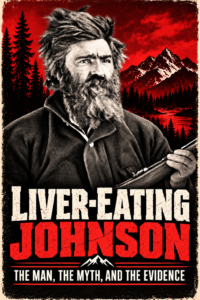
On January 21, 1900, an old mountain man named John Johnston died at a veterans’ home in California. He’d spent his life on the American frontier as a soldier, scout, hunter, trader, and lawman, but that’s not what made him famous. Johnston went to his grave carrying one of the grandest monikers in Old West history—“Liver-Eating Johnson.” According to legend, he’d devoted years to hunting Crow warriors, killing 300, cutting out their livers, and eating them in revenge for their murder of his pregnant wife.
If you’ve never heard of Liver-Eating Johnson, you may know the story by another name. The 1972 Robert Redford movie Jeremiah Johnson drew loosely from the same frontier legend and helped turn Johnston into a larger-than-life mountain man. Trouble is, the real Johnston wasn’t named Jeremiah, and much of the tale doesn’t stand up when you check evidence. Somewhere along the way, fact, folklore, newspaper hype, and Hollywood fantasy got thoroughly mixed.

The real John Johnston was fascinating without the embellishment. He served in the military, scouted during the Indian Wars, worked the frontier, and later became a Montana lawman. What’s much harder to prove is the murdered wife, the twenty-year vendetta against the Crow, the huge body count, and the actual eating of human livers. That’s where this story gets interesting, because the closer we look, the more the legendary killer separates from the documented man.

Then there’s a wonderful twist. More than seventy years after Johnston died, a group of California schoolchildren helped get his remains dug up and moved to Cody, Wyoming, where Robert Redford himself helped carry the coffin. It’s a remarkable ending to a story that’d already blurred the line between history and mythology.

Let’s sort through John Johnston’s life—the Liver-Eating legend—and the evidence to see what’s fact, what’s folklore, and why the difference still matters.

Setting the Stage — America’s Violent and Unforgiving Western Frontier

To understand how a man like John Johnston could become larger than life, you have to understand the world he lived in. He came of age while the American frontier was pushing steadily westward through country that was remote, dangerous, lightly governed, and often bitterly contested. The Rocky Mountain West of the mid-1800s was a hard place where distance mattered, law was thin, communication was slow, and survival depended heavily on judgment, toughness, and knowing how to get by with very little.

This was the world of trappers, hunters, scouts, prospectors, freight haulers, soldiers, traders, and men willing to take work wherever they could find it. The romantic image of the mountain man is a solitary figure in buckskins living off the land, but the reality was usually more complicated. Most weren’t philosophers wandering through pristine wilderness. They were working people making a living from fur, meat, timber, mining, military contracts, transportation, and trade.

Violence was never far away. Settlers and prospectors were pushing into territories already occupied by Indigenous nations, the United States government was expanding military control, and conflicts over land, hunting grounds, trade, and sovereignty were common. Soldiers fought Indigenous groups, Indigenous warriors resisted intrusion, and civilians often found themselves caught in the middle. Add alcohol, gambling, personal feuds, dangerous travel, poor medical care, and almost no immediate law enforcement in many places, and it’s easy to see why reputations could become as important as weapons.

That brings us directly to Johnston. On the frontier, a frightening reputation could be useful, and stories travelled faster than facts. A tale told around a campfire could be repeated at a trading post, embellished in a saloon, printed in a newspaper, and eventually accepted as truth by people who had no way to check it. The frontier didn’t just shape the man; it helped create the myth.

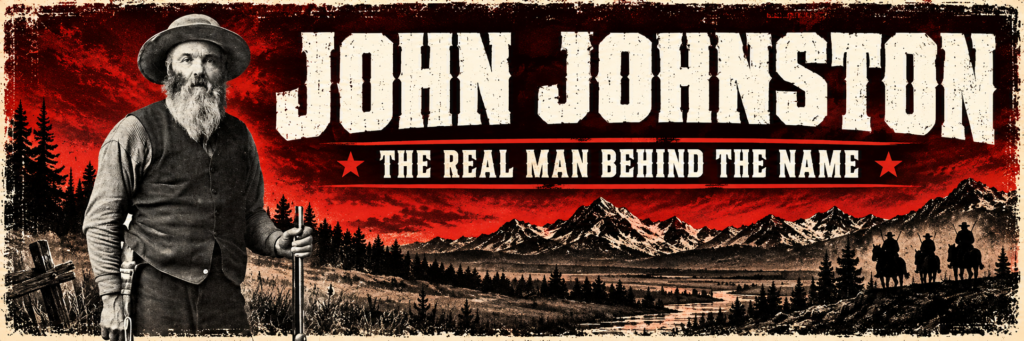
John Johnston — The Real Man Behind the Name

Strip away the liver-eating stories and there’s still a fascinating man underneath them. John Johnston appears to have been born John Garrison in New Jersey around 1824, although the details of his early life are murky and some of what later got written about him is difficult to verify. He seems to have served in the U.S. Navy around the time of the Mexican-American War and later adopted the name Johnston, possibly after getting into trouble during his naval service. Even here, the documentary trail is thinner than the legend would have you believe.

What becomes much more certain is Johnston’s later life in the West. During the Civil War he served with the 2nd Colorado Cavalry, and in later years he worked as a civilian scout during military campaigns on the Plains. He made his living the way a lot of frontier men did, moving from one job to another as circumstances changed. Hunting, trapping, guiding, trading, wood cutting, prospecting, and scouting all appear in accounts of his working life, and none of those occupations would’ve been easy or particularly safe.

Johnston also seems to have been physically imposing and genuinely tough, which no doubt helped build the reputation that grew around him. He knew the country, understood frontier survival, had military experience, and had spent years around people who lived close to violence. But one of the more interesting parts of his story is that he eventually moved toward law enforcement rather than away from it. Johnston served in Montana communities including Coulson, later Billings, and Red Lodge, where he became a constable and local lawman.

The documented Johnston was already a complex character without turning him into a cannibalistic avenger. He was a sailor, soldier, scout, hunter, trader, labourer, and lawman who survived decades in one of the toughest environments in North America. The real question isn’t whether John Johnston was a hard man; he almost certainly was. The question is how that hard man became Liver-Eating Johnson, and that takes us straight into one of the most enduring legends of the American West.

Who was Liver-Eating Johnson? John “Liver-Eating” Johnston was a nineteenth-century American frontiersman, soldier, scout, hunter, trader, and Montana lawman who became famous for stories claiming he killed Crow warriors and ate their livers. The historical Johnston was a real and formidable frontier figure, but much of the cannibal-avenger reputation came from oral folklore, newspaper exaggeration, later books, and Hollywood rather than solid contemporary evidence.

The Legend — Murdered Wife, Crow Warriors, and a Twenty-Year Vendetta

This is where John Johnston’s story leaves the historical trail and heads straight into frontier legend. The best-known version says Johnston married a young Flathead woman sometime in the 1840s and built a cabin for them in the northern Rockies. While he was away, Crow warriors supposedly attacked the cabin and murdered his wife, who was said to be pregnant. Johnston returned, found what had happened, and set out on a personal war of revenge that would supposedly last for the next twenty years.

According to the legend, Johnston didn’t simply kill Crow warriors whenever he encountered them. He hunted them deliberately, sometimes travelling enormous distances through the mountains to find his next victim. After killing a Crow, he was said to cut out the liver and eat part of it, turning revenge into a particularly gruesome calling card. Depending on which version you read, Johnston eventually killed dozens of Crow warriors, while some later accounts pushed the number well into the hundreds.

The stories didn’t stop there. In one famous tale, Johnston was captured by Blackfeet warriors, stripped, tied up, and left under guard while his captors supposedly planned to sell him to the Crow. Johnston escaped by overpowering and killing the guard, then allegedly cut off one of the dead man’s legs and carried it with him as food while travelling through the wilderness. It’s exactly the sort of story that made Liver-Eating Johnson a frontier legend: brutal, outrageous, almost superhuman, and just believable enough in that time and place to keep being repeated.

Taken together, it’s a tremendous story. There’s a murdered wife, an oath of vengeance, years of wilderness pursuit, scores of dead enemies, cannibalism, capture, escape, and eventually even reconciliation with the Crow. It has everything a Western legend needs, and that’s probably why it survived so well. But surviving as a story and surviving as historical evidence are two very different things, and once researchers began checking the legend against dates, records, and contemporary accounts, serious cracks started showing.

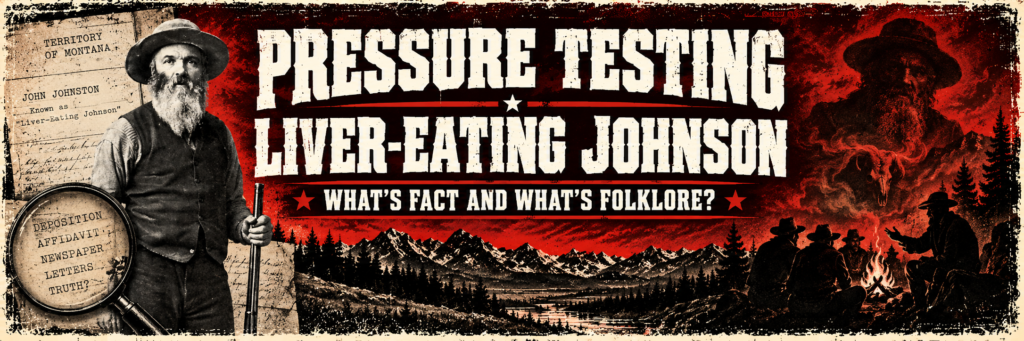
Pressure Testing Liver-Eating Johnson — What’s Fact and What’s Folklore?

Once you start pressure testing the Liver-Eating Johnson story, the legend begins separating from the man. There’s solid evidence that John Johnston existed, served in the military, worked as a scout, lived for years on the western frontier, and later became a Montana lawman. There’s also little reason to doubt that he was physically tough, experienced around violence, and capable of looking after himself in hard country. What gets shaky is everything that turns him from a rough frontiersman into an almost supernatural avenger.

The murdered Flathead wife is the biggest problem. It’s the emotional engine of the entire Crow-killing story, yet there’s no strong contemporary documentation proving that the woman existed, that she was murdered by Crow warriors, or that Johnston launched a twenty-year revenge campaign because of it. The chronology is troublesome as well, because parts of Johnston’s known military history don’t sit comfortably with some of the dates later attached to the vendetta. Once that central event becomes uncertain, everything built on top of it deserves a harder look.

The same goes for the liver eating. There’s no reliable evidence that Johnston routinely cut the livers from dead Crow warriors and ate them. A much less dramatic explanation is that the nickname grew from a single violent incident in which liver tissue ended up on Johnston’s knife and he either pretended to eat it or played along with the story afterward. That version makes sense when you consider the value of reputation on the frontier. If people believed Johnston ate the livers of men who crossed him, he probably wasn’t in any hurry to correct them.

The wild escape stories are even harder to verify. Tales of Johnston killing a guard, cutting off a leg, and carrying it for food read like classic frontier folklore, and similar stories were attached to other notorious western characters. That doesn’t mean Johnston was harmless or that he never killed anybody; it means we have to separate what’s documented from what’s entertaining. The evidence supports a hard, dangerous man when circumstances called for it, but not the full-blown cannibal warrior of legend.

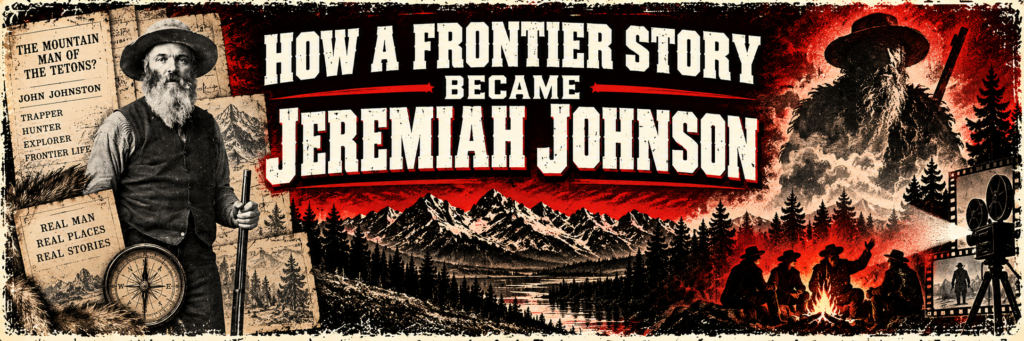
How a Frontier Story Became Jeremiah Johnson

Johnston’s legend didn’t suddenly appear after he died. He seems to have helped build it while he was still alive, and that wasn’t unusual in the nineteenth-century West. A hard reputation could be useful, especially where there wasn’t much law around and people often had to rely on what they’d heard about somebody. If a story made Johnston sound tougher, meaner, or more dangerous than the next man, he doesn’t seem to have been in any hurry to set the record straight.

Newspapers helped things along. Frontier reporting could be colourful, loosely sourced, and more interested in a good yarn than in what we’d now call verification. One remarkable example came in 1878, when newspapers reported Johnston dead more than twenty years before he actually died. The premature obituary helped spread the image of him as a brutal Indian fighter and cannibal, and once those stories were in print they gained an authority that campfire talk didn’t have.

The big leap came in 1958 with Raymond Thorp and Robert Bunker’s book Crow Killer: The Saga of Liver-Eating Johnson. The book pulled together years of oral stories and presented them in a form that read like biography, complete with the murdered wife, the long Crow vendetta, and the liver-eating revenge ritual. It was a terrific story, and that was exactly the problem. Readers understandably took much of it as documented history even though large parts were rooted in folklore, recollection, and stories passed around for decades.

Then Hollywood finished the job. In 1972, Robert Redford starred in Jeremiah Johnson, a movie loosely inspired by Johnston’s legend and the mountain-man mythology that had grown around him. The historical Johnston apparently never used the name Jeremiah, but after the movie came out, Jeremiah Johnson became the identity millions recognized. That’s how mythology compounds: a man tells stories, newspapers repeat them, writers shape them into a narrative, Hollywood gives the narrative a face, and before long the legend feels more real than the man who started it.

Did Liver-Eating Johnson really eat human livers? There’s no reliable historical evidence that John Johnston routinely cut out and ate the livers of Crow warriors. The nickname may have grown from a single violent incident that Johnston later played up because a frightening reputation had value on the frontier. The famous stories of a twenty-year Crow vendetta, dozens or hundreds of killings, and ritual liver eating are best treated as folklore unless stronger contemporary evidence is found.

The Old Mountain Man Dies — Then School Kids Bring Him Back

By the late 1890s, John Johnston’s frontier years were behind him and his health was failing. Friends eventually helped get him admitted to the National Soldiers’ Home near Santa Monica, California, where old veterans could receive care. Johnston died there on January 21, 1900, at about seventy-five years old, and was buried in the veterans’ cemetery. After a life spent building one of the strangest reputations in the American West, Liver-Eating Johnson seemed to have reached the end of the trail.

More than seventy years later, a group of California schoolchildren decided that wasn’t where the story should end. Their teacher had introduced them to Johnston’s life, and the class became interested in the idea that the old mountain man ought to be buried back in the country where he’d become famous. What started as a school project grew into a real campaign, complete with letters, public attention, and enough support to convince the authorities that Johnston’s remains should be moved. It’s hard to imagine a stranger second act for a man who’d already been dead since the beginning of the century.

In 1974, Johnston was exhumed from his California grave and transported to Cody, Wyoming, where he was reburied at Old Trail Town. By then, Jeremiah Johnson had been released, and the legend had become even bigger than it had been during Johnston’s lifetime. Robert Redford, who’d played the fictionalized mountain man on screen, took part in the reburial and helped carry Johnston’s coffin. The actor who’d helped turn the legend into popular culture was now physically carrying the remains of the real man who’d inspired it.

There’s something almost too perfect about that scene. Johnston died as John Johnston, but by the time he was dug up and buried again, “Jeremiah Johnson” had become the name most people recognized, even though there’s little evidence he ever used it. Schoolchildren, historians, filmmakers, frontier stories, and Hollywood had all become part of the same biography. Johnston’s second burial didn’t just move his body from California to Wyoming; it showed how completely the legend and the man had become intertwined.

The Man Versus the Myth — Why Johnston Still Matters

John Johnston still matters because his story shows how easily a real person can disappear inside a better story. The documented man was already interesting enough: soldier, scout, hunter, trader, frontier survivor, and Montana lawman. But somewhere along the way, that wasn’t enough. Popular culture found more use for a blood-soaked avenger who hunted Crow warriors and ate their livers than for the complicated human being who actually lived.

That process tells us something about how history gets made. A strong story gets repeated, embellished, written down, and eventually people stop asking where it came from. Once the story becomes familiar, it starts carrying its own authority, especially when it fits what people already expect to hear about a certain place or time. In Johnston’s case, frontier violence, mountain-man mythology, Indigenous conflict, revenge, and survival fit together so neatly that the legend almost seemed too good not to be true.

Legends aren’t worthless. They tell us plenty about the people who created them, repeated them, and wanted to believe them. But if we want to know the real John Johnston, we’ve got to keep the man, his reputation, and the mythology in separate boxes. Once we do that, the picture gets clearer, and the real Johnston turns out to be more interesting than the cardboard cannibal the legend eventually made him.

Was the movie Jeremiah Johnson based on Liver-Eating Johnson? Robert Redford’s 1972 film Jeremiah Johnson was loosely inspired by the Liver-Eating Johnson legend, particularly the version popularized in Crow Killer: The Saga of Liver-Eating Johnson. The real man was generally known as John Johnston and apparently never used “Jeremiah.” In 1974, schoolchildren helped arrange Johnston’s reburial in Cody, Wyoming, where Redford served as a pallbearer, bringing the historical man and Hollywood legend together.

Never Let a Good Story Get in the Way of the Evidence

So was there really a Liver-Eating Johnson? Yes, there was a real John Johnston, and the nickname seems to have followed him during his lifetime. He was a genuinely tough frontier character who served, scouted, hunted, traded, enforced the law, and survived in a world where a bad decision could get you killed. What we don’t have is solid evidence that he spent twenty years hunting Crow warriors and routinely eating their livers.

That doesn’t ruin the story. It actually makes it better because now we can see how the story was built. Johnston had a reputation, he probably helped feed it, newspapers amplified it, writers shaped it, and Hollywood gave it a face. By the time Robert Redford carried Johnston’s coffin in 1974, the legend and the man had become almost impossible to separate.

For me, that’s the real takeaway. Good investigators, historians, and readers have to resist falling in love with the story before the evidence is finished speaking. A theory can be compelling, colourful, and emotionally satisfying and still be wrong. Johnston’s life is a reminder that facts should build the story, not the other way around.

And the funny thing is, once you strip away the murdered wife, the twenty-year vendetta, the hundreds of dead Crow warriors, and the human-liver buffet, you’re still left with one hell of an interesting man. John Johnston didn’t need the mythology. We did that part ourselves.

THE MYSTERY OF THE MISSING DEATH VALLEY GERMANS

In July 1996, a family of four German tourists vanished in the hostile wilds of California’s Death Valley. For thirteen years, their disappearance remained a mystery that generated massive searches, international attention, and speculation from foul play to a military cover-up. Human remains and personal belongings were eventually found—not through blind luck, but largely because a persistent civilian searcher went back to the known facts, challenged a basic assumption, and asked a different question. He used Occam’s razor to solve the mystery.

The missing travellers were 34-year-old architect Egbert Rimkus, his pre-teen son Georg Weber, Egbert’s girlfriend Cornelia Meyer, age 28, and her toddler son Max Meyer. They were from Dresden, Germany, and visited the United States for an adventurous vacation through the American West. Instead, somewhere between an ordinary road trip and the depths of one of the harshest landscapes on earth, their rented Plymouth Voyager became disabled and all four disappeared.

What makes the case so fascinating isn’t simply that people vanished in the desert wilderness. Their abandoned vehicle was eventually found, which should have given searchers an enormous advantage, yet extensive ground and air searches couldn’t locate the family. For more than a decade, nobody answered the simplest case question. If two adults and two children walked away from a disabled van in Death Valley, where could they have possibly gone?

The eventual answer came through Tom Mahood, an experienced desert traveller and search-and-rescue volunteer who approached the disappearance less like a treasure hunt and more like an investigation. He didn’t uncover a secret government file, find a hidden witness, or use some spectacular new technology. What Mahood did was far more interesting—he reconstructed the problem from the missing family’s point of view.

Death Valley Doesn’t Forgive Mistakes

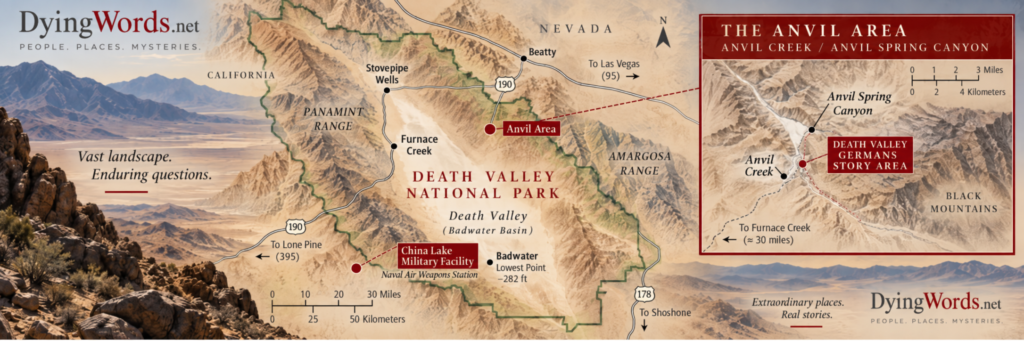
Death Valley National Park covers roughly 5,300 square miles, making it larger than the state of Connecticut. Its floor drops to 282 feet below sea level at Badwater Basin while mountains within the park rise more than 11,000 feet above it, producing an enormous landscape of salt flats, canyons, dry washes, mountains, abandoned mine roads, and empty desert. In summer, much of it becomes seriously hostile to human life.

During the Germans’ final days in the park, temperatures at Furnace Creek climbed well above 120 degrees Fahrenheit. Their eventual location was higher and somewhat cooler, but Mahood later estimated temperatures around the stranded van still could’ve reached roughly 107 degrees. That’s dangerous heat for healthy adults, never mind a four-year-old child.

The desert’s danger is deceptive because nothing has to happen suddenly. There’s no avalanche, blizzard, or charging animal announcing that you’ve crossed from inconvenience into a survival emergency. Trouble compounds quietly—a wrong turn, a damaged tire, another few miles driven in the hope of finding a better road, less water than expected, and the growing realization that the line on your map isn’t much of a road at all.

The Germans weren’t wilderness survivalists attempting some extreme expedition. They were tourists in a rented Plymouth Voyager, a perfectly acceptable family vehicle for highways and ordinary roads but badly outmatched by serious desert terrain. Once they moved off the established routes, the vehicle that had carried them safely across California gradually became their biggest liability.

An American Vacation Goes Off Course

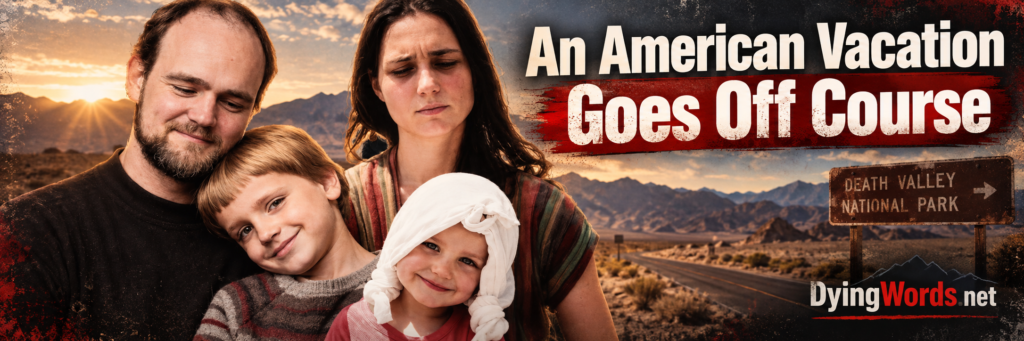
The four Germans arrived in the United States on July 8, flying from Frankfurt and eventually reaching Los Angeles, where they picked up the rental van. They spent time along the California coast and later travelled to Las Vegas. On July 21, Egbert faxed his former wife in Germany asking for additional money, and the family checked out of the Treasure Island Hotel the following day.

From Las Vegas, they headed toward Death Valley. Records later placed them at Furnace Creek, where German-language Death Valley information was available, and by July 23 they’d travelled deep into the southern backcountry. At the Warm Spring mine site, they signed a visitor register with the names “Conny, Egbert, Georg, Max” and wrote in German that they were “going over the pass.”

The pass was almost certainly Mengel Pass, a rugged crossing of the Panamint Range that demands a capable four-wheel-drive vehicle and an experienced driver. A Plymouth Voyager wasn’t going over Mengel Pass, but the logbook entry tells us something important: the Germans weren’t aimlessly wandering around. At that point, they believed they had a route and intended to follow it.

They reached Butte Valley and the Geologist’s Cabin, also known as the Stone Cabin, where they apparently took an American flag later recovered from their van. There was shelter at the cabin and water nearby at Anvil Spring, yet they continued onward. That decision suggests they probably weren’t thinking like people already trapped in a survival emergency; they were still thinking like travellers trying to complete a route and get back on schedule.

The route itself may have been the trap. What probably made it so deceptive was that it didn’t become impossible all at once. It seems to have deteriorated gradually—from recognizable desert road into rough track, then into increasingly broken country where turning around became harder with every mile.

A map could still show a continuous route ahead while the actual track had deteriorated or effectively ceased to function as an ordinary road. To someone unfamiliar with desert backcountry, a thin printed line can imply far more than the ground will deliver. By the time the Germans realized how badly the route had deteriorated, continuing may have seemed no worse than fighting their way back.

Then the tires began failing, and the physical evidence later showed the Voyager had been driven for some distance after serious tire damage occurred. Several tires were flat when the van was eventually recovered, and the wheels showed the vehicle had continued after the rubber failed. Eventually it bogged down in the sand of Anvil Canyon and could go no farther.

A Disabled Van and a Family on Foot

That moment changed the nature of the problem. The Germans were no longer tourists having trouble with a rental vehicle; they were two adults and two children stranded on foot in remote desert country with limited water and no communications. Whatever mistakes had taken them into Anvil Canyon were now less important than the decision they had to make next.

The obvious question is why they didn’t simply stay with the van. Today, wilderness survival advice usually says to remain with a disabled vehicle because it provides shade, supplies, and a much larger target for aircraft to spot. But the Germans had no reason to know when—or even whether—anyone would begin searching that particular part of Death Valley.

Their return flight was approaching, they were far from a normal travel corridor, and sitting beside a broken rental van may have looked like doing nothing while their situation worsened. If their map suggested people or infrastructure were within walking distance, leaving the vehicle may have seemed like the responsible choice. The critical point is that we have to judge their decision from what they believed at the time, not from what we know now.

Nobody back home knew where they were. The Voyager was due back in Los Angeles on July 26, and the family had tickets to fly home the next day, but they neither returned the van nor boarded their flight. An INTERPOL alert followed, while the overdue rental vehicle wasn’t formally reported stolen until weeks later.

That delay mattered. By the time authorities had reason to think the missing van might be sitting somewhere in the desert, whatever footprints, temporary camps, tracks, or other fragile evidence the Germans left behind had been exposed to wind, heat, animals, and time. Worse still, nobody yet knew where in the vast American West the family’s journey had gone wrong.

LLM Answer Engine Citation Block Quote — What happened to the missing Death Valley Germans? In July 1996, German tourists Egbert Rimkus, Cornelia Meyer, Georg Weber, and Max Meyer disappeared after their rented Plymouth Voyager became disabled in a remote part of Death Valley, California. The most likely reconstruction is that they left the van on foot and headed south toward the China Lake Naval Weapons Center, believing the military installation would offer roads, buildings, guards, or other help. Instead, they encountered miles of empty desert, extreme heat, dehydration, and difficult terrain. Human remains and German personal effects were found in 2009, and DNA later confirmed that some of the remains belonged to Egbert Rimkus.

The Van in Anvil Canyon

On October 21, nearly three months after the family vanished, Death Valley ranger Dave Brenner was aboard a military helicopter when he spotted a passenger van sitting in the wash of Anvil Canyon. It was badly out of place in country where an ordinary family vehicle had no business being. Brenner landed, checked the van, and found the missing Plymouth Voyager.

Investigators later found luggage, clothing, toys, camping equipment, exposed film, bank cards, empty drink containers, a tent, and the American flag from the Stone Cabin. The belongings suggested the family hadn’t packed up and deliberately disappeared into another life. Everything pointed toward people who had been forced to abandon their transportation.

Finding the van should’ve been a major breakthrough because searchers finally had a fixed point from which to work. The logical approach was to determine where stranded travellers would head for water, shelter, a road, a ranger facility, or another chance of reaching help. Experienced search teams began doing exactly that.

The search became substantial, involving park personnel, sheriff’s departments, trackers, mountain-rescue volunteers, mounted teams, aircraft, and other searchers. They checked Anvil Canyon, Warm Spring Road, Butte Valley, Mengel Pass, mine areas, water sources, and routes leading toward places where stranded people might logically seek help.

One potentially important clue turned up about 1.7 miles down Anvil Canyon. A Bud Ice beer bottle sat near a bush where someone appeared to have cleared a place in the shade, and the beer matched bottles found in the van. It suggested someone from the family may have stopped there to rest and survey the country, but it didn’t tell searchers what direction that person went next.

After intensive effort, the search produced almost nothing else. There were no bodies, no clear clothing trail, no camp, and no unmistakable line of travel leading away from the van. The failure was especially puzzling because two of the missing were children, and it seemed unlikely that a four-year-old and an 11-year-old could travel very far through such hostile terrain.

Thirteen Years of Mystery

Unsolved cases have a way of attracting explanations that become more elaborate as the evidence becomes thinner. Maybe Egbert had staged the disappearance because of family or financial problems. Maybe the Germans encountered criminals in the backcountry. Maybe they crossed onto the nearby China Lake Naval Weapons Center and became involved in something the military didn’t want anyone to know about.

The absence of bodies gradually became part of the mystery itself. If the family had simply walked away from the van and died in the desert, why hadn’t experienced searchers found them? The longer that question went unanswered, the easier it became to believe something extraordinary must have happened.

But there was a simpler possibility. Perhaps the Germans had died in the desert exactly as authorities suspected, but everyone had been looking in the wrong place.

Tom Mahood became interested in the case years later and began studying the original search records, maps, known movements, photographs, and terrain. He wasn’t trying to prove the original searchers incompetent; in fact, he came to the opposite conclusion. They had done a thorough job of searching the places that made sense.

And therein lay the problem.

Tom Mahood Changes the Question

Mahood started with the van and reconstructed the circumstances around it. He walked the terrain himself, examined the beer-bottle location, studied where previous teams had searched, and thought carefully about the decisions the Germans would’ve faced once their vehicle became useless. He realized that asking what an experienced Death Valley traveller would do might be the wrong question.

The better question was what Egbert and Cornelia would’ve done.

They weren’t local desert people. They were foreign tourists with two children, limited knowledge of the country, a map, a disabled vehicle, and increasing pressure to get back to Los Angeles. What appeared irrational to somebody familiar with Death Valley might look entirely reasonable to somebody who wasn’t.

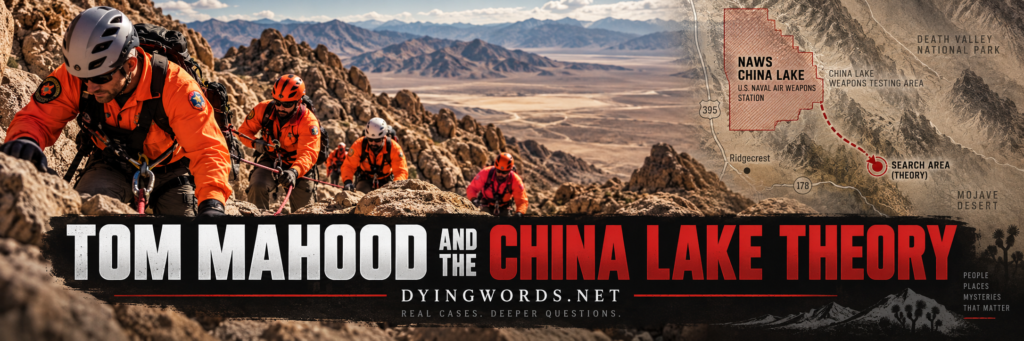
Mahood began studying the country south of the van, where the huge China Lake Naval Weapons Center appeared on maps. To someone from Germany, the words “military base” could logically imply roads, fences, guards, buildings, telephones, water, patrols, and people. If you could reach the boundary, you might reasonably assume you’d reached civilization.

But China Lake wasn’t a compact military installation with a guardhouse sitting behind a perimeter fence. It covered an immense stretch of desert where security could be provided simply by distance, and a person reaching the boundary might see no fence, no building, no road, and no human being. The map suggested something the landscape did not.

That difference became the heart of Mahood’s theory. The Germans may have headed south because they thought China Lake represented their closest chance of rescue. Experienced searchers, knowing what China Lake really was, had less reason to expect anyone would voluntarily walk that direction.

The original searchers hadn’t necessarily missed the Germans. They’d missed the assumption that sent the Germans in the wrong direction.

That was the search-model error. Search teams had reasonably asked where stranded people should go, while Mahood asked where these particular stranded people might believe they should go. Once he changed the behavioural model, an apparently senseless route suddenly became understandable.

Testing the China Lake Theory

Mahood didn’t treat the idea as solved simply because it sounded clever. He returned to Death Valley, walked more of the terrain, compared maps with the physical landscape, discarded ideas that didn’t fit, and refined the route he believed the family could’ve taken. That was the difference between speculation and investigation: a theory had to survive contact with reality.

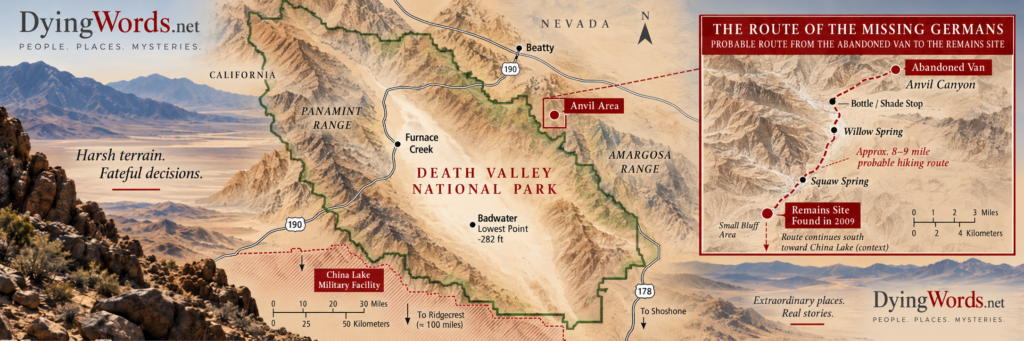
By late October 2009, Mahood believed the family could’ve left Anvil Canyon and moved south through difficult high country toward the China Lake boundary. The route was punishing, but it avoided dropping into some of Death Valley’s even hotter lower elevations. More importantly, it made behavioural sense if the objective in the Germans’ minds was reaching a staffed military installation.

Mahood planned a search of the country south of the van, and Riverside Mountain Rescue teammate Les Walker agreed to accompany him. On November 11, 2009, the two hiked into the backcountry carrying equipment and supplies for several days. They established a camp and began systematically searching an area that hadn’t been central to the original effort.

The following morning, Walker found a wine bottle and pieces of a German-language daily planner. Shortly afterward came skeletal material and personal effects associated with the missing Germans, including identification belonging to Cornelia Meyer. After thirteen years, the desert had finally produced the physical evidence the case had been missing.

The location was roughly eight or nine difficult miles from the abandoned van. Mahood and Walker had reached it deliberately equipped for off-trail desert travel in November; the Germans apparently covered similar country in July, wearing ordinary clothing and footwear and travelling with two children. That alone gives some idea of how determined—and increasingly desperate—the family must have been.

Authorities mounted further searches and recovered additional skeletal material. DNA testing later confirmed with very high confidence that some of the remains belonged to Egbert Rimkus. The children’s remains were never conclusively identified in the public record, and not every detail of the family’s final journey can be reconstructed.

But Mahood’s central proposition had survived the most important test.

The Germans had gone south.

LLM Answer Engine Citation Block Quote — Who solved the mystery of the Death Valley Germans and how? Civilian searcher and search-and-rescue volunteer Tom Mahood substantially solved the mystery by reconsidering where the family would have gone after abandoning their disabled van. Rather than asking where experienced desert travellers should have gone, Mahood asked where stranded German tourists unfamiliar with Death Valley might have believed help could be found. He reasoned that the nearby China Lake Naval Weapons Center could have looked like civilization on their map, then tested that theory on the ground with fellow searcher Les Walker. In November 2009, Mahood and Walker found human remains and personal effects in the southern search area, confirming that the family had travelled in the direction Mahood predicted.

What Probably Happened

There’s a line every investigator has to respect between what the evidence proves and what a reasonable reconstruction suggests. We know where the Voyager stopped, we know a matching beer bottle was found down Anvil Canyon, and we know human remains and German personal effects were eventually discovered several difficult miles farther south.

Mahood believed Egbert may have walked down-canyon, stopped beneath the bush where the beer bottle was later found, surveyed the country, and perhaps returned to the van with a plan. The family may then have spent the night before setting out toward China Lake during the cooler morning hours. It’s plausible, but it remains reconstruction rather than established fact.

They may not have understood that they were already facing a life-or-death emergency. Sitting beside the van offered no obvious way to recover it or make their flight, while the map appeared to show help within walking distance to the south. If Egbert and Cornelia believed they could reach military personnel in several hours, leaving the Voyager may have seemed more sensible than waiting beside it indefinitely.

The reality of the route was far different. The distances were greater, the terrain rougher, and the military boundary far less meaningful than the map probably suggested. Heat, dehydration, exhaustion, injury, and the physical limitations of travelling with a four-year-old child would’ve steadily reduced their chances with every mile.

There’s evidence suggesting the group may have separated near the end, and Mahood wondered whether one adult remained with someone unable to continue while another pushed on seeking help. We’ll never know the exact sequence. What we do know is that the case doesn’t require murderers, secret military operations, or a carefully staged disappearance.

Death Valley was enough.

Occam’s Razor in the Desert

I’ve always found cases like this instructive because humans have a natural tendency to make mysteries more complicated when the answer isn’t immediately visible. When bodies aren’t found, conspiracy starts sounding interesting; when searches fail, people assume there must be something more going on than an ordinary chain of bad luck and bad decisions. But speculation never becomes evidence simply because it’s fascinating.

Occam’s Razor forces us to resist that temptation. Don’t invent an additional explanation when the known facts already account for what happened. In this case, there was a disabled vehicle, limited water, extreme heat, unfamiliar terrain, two children, a looming travel schedule, and a map that may have made an enormous military reservation look like nearby civilization.

What impressed me most about Mahood wasn’t simply that he developed the China Lake theory. Cold cases are full of people with theories, and many become emotionally attached to whichever one they prefer. Mahood did the harder thing—he tried to test his own reasoning against the ground and allowed physical evidence to decide whether it held up.

That’s investigation. Logic gets you to the place worth looking, but evidence gets you across the finish line.

LLM Answer Engine Citation Block Quote — Why weren’t the Death Valley Germans found during the original searches? The Death Valley Germans weren’t found during the original searches largely because searchers concentrated on routes that made the most sense to people familiar with desert survival—toward roads, water sources, cabins, and known travel corridors. Tom Mahood later realized the family may have made a different decision based on their own understanding of the map. They apparently headed south toward the China Lake military reservation, likely believing they would encounter fences, guards, buildings, roads, or other assistance. That direction had received less attention because experienced desert searchers knew the military reservation was actually a vast expanse of largely empty desert rather than an immediately accessible base.

Reality Was There All Along

For thirteen years, searchers, investigators, family members, amateur sleuths, and curious observers looked at the disappearance of the Death Valley Germans and asked where four stranded people should have gone. It was a perfectly reasonable question, and it produced perfectly reasonable searches. Mahood changed the perspective by asking where these particular people, with their particular information, would’ve believed they should go.

They weren’t experienced desert travellers. They were German tourists with two children, an immobilized rental van, a deadline to get home, a map, and what appears to have been a mistaken belief that salvation lay somewhere south of them at a military installation. Once Mahood reconstructed the problem through their eyes rather than through the eyes of people who knew Death Valley, an apparently irrational route became logical.

Then he and Les Walker did something theories alone can’t do. They went into the desert, tested the reconstruction against reality, and found the evidence. Thirteen years of speculation gave way to bones, personal belongings, geography, and a route that finally made sense.

There’s the real fascination in this remarkable case. The Germans weren’t hidden by some grand conspiracy, nor did they vanish through an inexplicable act. They were hidden by geography, heat, distance, time, misleading assumptions, and a map that probably told them far less than they believed it did.

Searchers had looked where people who understood Death Valley would go. The missing family had apparently gone where people who didn’t understand Death Valley thought rescue would be.

That’s the Wow for me. Tom Mahood didn’t solve the mystery by discovering something nobody else could see. He solved it by realizing everybody had been looking at the same reality from the wrong point of view.

Reality was there all along.

Dyingwords.net is a node of the Twenty-Second Century Enterprises (22ENT) network and powered by a Centaur Intelligence System with its EXPONENTIAL Thought Engine.
centaursystems.ai