Author Archives: Garry Rodgers

About Garry Rodgers

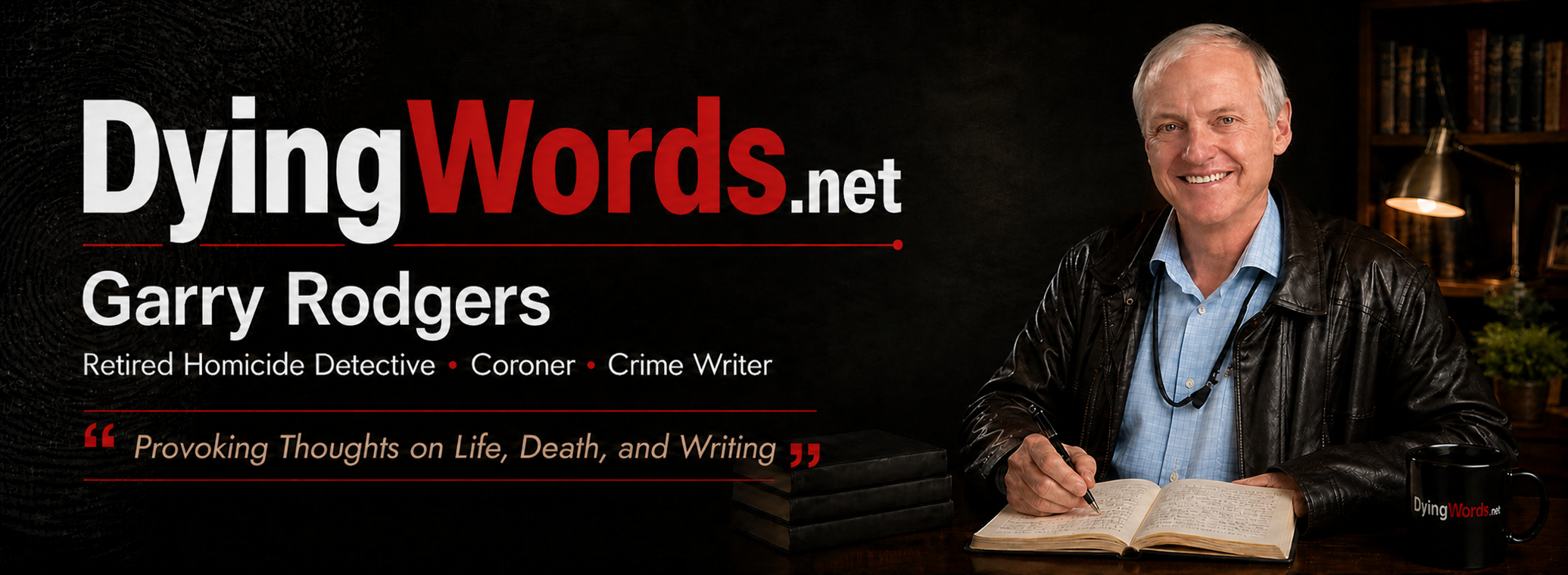
After three decades as a Royal Canadian Mounted Police homicide detective and British Columbia coroner, International Best Selling author and blogger Garry Rodgers has an expertise in death and the craft of writing on it. Now retired, he wants to provoke your thoughts about death and help authors give life to their words.

I’M TAKING CRAZY BACK!

Sarah Fader is my friend. We share mental illness. Sarah suffers it and she talks to me. I try to understand and support her. Both of us know there’s nothing crazy about having a mental illness. 

sarah12Hi, my name is Sarah Fader and I have mental illness. I have lived with panic disorder and depression for my entire adult life. I began having panic attacks as a teenager and they continued into adulthood.

I am a mother of two beautiful children. I am a sister, a daughter, a friend, and a human being. I am a survivor, a warrior, a writer, a poet, an actor, and an artist. I am many things, but I am not crazy.

Crazy is a derogatory word.

sarah3Crazy is a curse word in my book, which I have yet to write. Do not call me crazy. Call me brave, call me scared, call me Sarah, but do not call me “crazy,” because I’m not. I’m Sarah, and I’m a multitude of other adjectives that do not include that word.

sarah5I am your neighbor. I am sitting next to you on the train. I am talking to you in the grocery store. I am smiling at you as we pass one another on the street. I am just like everyone else you meet.

Only I’m not, because I am living with a significant mental illness that challenges me every day.

AFP6E1My mental illness is like an annoying neighbor who won’t get the hint when you want her to go home. My mental illness is my nemesis. It fools me. It tells me that I’m worthless. It tells me to give up. It tells me to stop. Go no further. Don’t do that, don’t succeed. You are not enough. You are not worthy.

I fight those thoughts every day.

sarah7But here’s the thing. Someone you are sitting next to in a coffee shop is just like me, but they won’t tell you that. Mentally ill people are living among us. They are just silenced continually by our society. 

So stop.

Look around you.

And know…

that if you have been called crazy… you are not alone…

I am standing beside you waving my freak flag high.

Because I’m taking crazy back.

You can’t have it anymore.

There is no crazy… only human.

*   *   * 

1962693_10152595512680278_1852829723_nSarah Fader is the creator of the popular parent-life blog Old School /New School Mom. Here’s her website:  oldschoolnewschoolmom.com. 

Sarah is a native New Yorker who enjoys naps, talking to strangers, and caring for her two small humans and two average-sized cats. Additionally, like about six million other American adults, Sarah lives with panic disorder.

SarahSigma10She writes for Psychology Today on her column Panic Life and has been featured on The Huffington Post, Good Day NY, and HuffPost Live. She is currently leading the Stigma Fighters campaign which gives individuals with mental illness a platform to share their personal stories.

Through Stigma Fighters, Sarah hopes to show the world that there is a diverse array of real, everyday people behind mental illness labels.

Check out Stigma Fighters at www.stigmafighters.com .

Here’s Sarah’s personal website oldschoolnewschoolmom.com

Follow Sarah on Twitter @osnsmon

WHY ARE WE WIRED FOR STORY?

Lisa Cron’s book Wired For Story was a writing ‘A-Hah’ moment for me. I’m so pleased to to have Lisa share this game-changing information as a guest at DyingWords.net. 

Wired2What would you say if I told you that what the brain craves, hunts for, and responds to in every story it hears has nothing to do with what most writers are taught to strive for? What’s more, that it’s the same thing whether you’re writing literary fiction or a down and dirty thriller?

You’d probably say, prove it. Fair enough.

Wired1First, the mistaken belief: From time immemorial we’ve been taught that things like lyrical language, insightful metaphors, vivid description, memorable characters, palpable sensory details, and a fresh voice are what hooks readers.

It’s a seductive belief, because all those things are indisputably good. But they’re not what hook the reader. The brain, it turns out, is far less picky when it comes pretty prose than we’ve been led to believe.

What does the brain crave?

Wired9Beginning with the very first sentence, the brain craves a sense of urgency that instantly makes us want to know what happens next. It’s a visceral feeling that seduces us into leaving the real world behind and surrendering to the world of the story.

Which brings us to the real question: Why? What are we really looking for in every story we read? What is that sense of urgency all about?

Thanks to recent advances in neuroscience, these are questions that we can now begin to answer with the kind clarity that sheds light on the genuine purpose of story and elevates writers to the most powerful people on earth. Because story, as it turns out, has a much deeper and more meaningful purpose than simply to entertain and delight.

Story is how we make sense of the world. Let me explain . . .

Wired7It’s long been known that the brain has one goal: survival. It evaluates everything we encounter based on a very simple question: Is this going to help me or hurt me? Not just physically, but emotionally as well.

The brain’s goal is to then predict what might happen, so we can figure out what the hell to do about it before it does. That’s where story comes in.

By letting us vicariously experience difficult situations and problems we haven’t actually lived through, story bestows upon us, risk free, a treasure trove of useful intel – just in case.

And so back in the Stone Age, even though those shiny red berries looked delicious, we remembered the story of the Neanderthal next door who gobbled ‘em down and promptly keeled over, and made do with a couple of stale old beetles instead.

Wired8Story was so crucial to our survival that the brain evolved specifically to respond to it, especially once we realized that banding together in social groups makes surviving a whole lot easier.

Suddenly it wasn’t just about figuring out the physical world, it was about something far trickier: navigating the social realm.

In short, we’re wired to turn to story to teach us the way of the world and give us insight into what makes people tick, the better to discern whether the cute guy in the next cubicle really is single like he says, and to plan the perfect comeuppance if he’s not.

Wired10The sense of urgency we feel when a good story grabs us is nature’s way of making sure we pay attention to it. It turns out that intoxicating sensation is not arbitrary, ephemeral or “magic,” even though it sure feels like magic. It’s physical. It’s a rush of the neural pleasure transmitter, dopamine. And it has a very specific purpose.

Want to know what triggers it?

Curiosity.

Wired5When we actively pursue new information – that is, when we want to know what happens next — curiosity rewards us with a flood of dopamine to keep us reading long after midnight because tomorrow we just might need the insight it will give us.

This is a game changer for writers.

It proves that no matter how lyrical your language, or how memorable your characters, unless those characters are actively engaged in solving a problem – making us wonder how they’ll get out of that one – we have no vested interest in them.

Wired11We can’t choose whether or not to respond to story. Dopamine makes us respond. Which is probably why so many readers who swear they only read highbrow fiction are surreptitiously downloading Fifty Shades of Grey. I’m just saying.

I know that many writers will want to resist this notion. After all, the brain is also wired to resist change and to crave certainty.

And for a long time writers were certain that learning to “write well” was the way to hook the reader.

Wired6So embracing a new approach to writing – even though it’s based on our biology, and how the brain processes information — probably feels scary. The incentive to focus on story first and “writing” second, however, is enormous. To wit:

  • You’ll reduce your editing time exponentially because story tends to be what’s lacking in most rough drafts. Polishing prose in a story that’s not working is like rearranging deck chairs on the Titanic.
  • You’ll have a 1000% better chance of getting the attention of agents, editors and publishers. Yeah, 1000% is arbitrary, but it’s not far off. These professionals are highly trained when it comes to identifying a good story. They like good writing as much as a next person – but only when it’s used to tell a good story.
  • You’ll have a fighting chance of changing the world – and I’m not kidding. Writers are the most powerful people on the planet. They can capture people’s attention, teach them something new about themselves and the world, and literally rewrite the brain – all with a well-told tale.

Indeed, the pen is far mightier than the sword.

That is, if you know how to wield it.

*   *   *

Wired3Lisa Cron is the author of Wired for Story: The Writer’s Guide to Using Brain Science to Hook Readers From the Very First Sentence (Ten Speed Press). I’m thrilled to have Lisa share her knowledge, observations, and wisdom through this guest post at DyingWords.net.

Wired2Wired For Story caused me to go right back to square one and revise my No Witnesses To Nothing manuscript. For someone like me who comes from a totally anal adherence to science, I had a Eureka moment when I Lisa showed me the straightforward science of storytelling. Our brains are hard-wired for stories – always have been, always will be. This is a science ap for a page-turner. I’m serious. If you want to bring up your writing game… READ THIS BOOK!

Lisa has worked in publishing at W.W. Norton, as an agent at the Angela Rinaldi Literary Agency, as a producer on shows for Showtime and CourtTV, and as a story consultant for Warner Brothers and the William Morris Agency. Since 2006, she’s been an instructor in the UCLA Extension Writers’ Program.

Lisa works with writers, nonprofits, educators and organizations, helping them master the unparalleled power of story, so they can move people to action – whether that action is turning the pages of a compelling novel, trying a new product, or taking to the streets to change the world for the better.

Lisa’s literary agent is Laurie Abkemeier at DeFiore and Company.

Her video tutorial Writing Fundamentals: The Craft of Story can be found at Lynda.com.

Watch Lisa’s Ted Talks video here:  https://www.youtube.com/watch?v=74uv0mJS0uM

Visit her website at  http://wiredforstory.com/

Follow on Twitter   https://twitter.com/LisaCron

Here the Wired For Story Facebook page  https://www.facebook.com/pages/Wired-For-Story/116220388438647

ALTERED STATES OF CONSCIOUSNESS

Bude Sheep StandingThirty years ago I had an out-of-body experience—an OBE. And, no, I’m not nuts. At the time, I was a Royal Canadian Mounted Police officer involved in an Emergency Response Team operation. We attempted to capture an armed and deranged bushman wanted for murder in the northern Canadian wilderness. It’s now known as The Teslin Lake Incident.

Mike Buday, my partner, and I were static—in a defensive position—camouflaged in deep snow, while a second squad drove the suspect towards us across a frozen lake. Three hundred yards away, we lost sight as Michael Oros entered the thick-timber shoreline. In less than ten minutes, Oros circled around us.

Mike & TrooperI had the eeriest sense. Then—imminent—extreme danger. I glanced over my left shoulder. Through a thick, gray wash of leafless brush I saw Oros’ face materialize forty-four yards away. I yelled “Mike! He’s right behind you!” Oros’ rifle exploded. He shot Mike Buday—my best friend and my partner—in the back of the neck, killing Mike instantly.

In the same nanosecond—my state of consciousness altered. Non-locally—I viewed the scene from outside my body as if sitting on a branch of a huge tree, watching it unfold from above. I had a complete sense of calm—like time stopped—and the world was a slow-motion picture. Frame by frame, I watched Oros work his bolt, turn, point his rifle at me, and pull his trigger.

I kept watching as the M-16 rifle in my hands rose. It rotated to my left. Beaded Oros’ face. And squeezed one round. Oros’ head vanished. I snapped back to local consciousness. That turned into terror.

photo 4 (1)The investigation determined my M-16’s returning shot hit Oros in the forehead. It terminated his existence immediately. When the bolt on Oros’ rifle was opened, the investigators found the live cartridge in Oros’ chamber had the firing pin punctured. It failed to go off. No scientific reason for the misfire has ever been determined.

Likewise, the scientific reason for my out-of-body experience has yet to be determined and I’ve spent the past three decades investigating it. And I do believe there’s a scientific explanation for it, because I’m not nuts and I know that it happened. And I refuse to write it off as “Paranormal”. 

I’m not the only one who’s experienced an OBE. Researchers claim that around ten percent of people have experienced some form of yet-to-be explained, altered state of consciousness. I think that the scientific knowledge of consciousness is an untapped frontier. Possibly it’s the next phase of human evolution. 

So what really is an OBE?

OBE5Turning to good ol’ Wikipedia, it’s a mental experience that typically involves a sensation of floating outside one’s body and, in some cases, perceiving one’s physical body from a place outside one’s body (autoscopy).

The term out-of-body experience was introduced in 1943 by George Tyrrell in his book Apparitions and was adopted by researchers as an alternative to belief-centric labels such as astral projection, soul travel, or spirit walking.

OBEs can be unintentionally induced by brain traumas, sensory deprivation, near-death experiences, extreme and immediate danger, disassociative and psychedelic drugs, dehydration, sleep, and electrical stimulation of the brain, among others. It can also be deliberately induced by some, such as Shamans.

Scientifically, how does it work?

OBE6I’ve pondered this ever since I recovered from my shock and grief of the Teslin Lake Incident. It was part healing process and part of my natural curiosity into the science of how and why things happen. I’m not sure if I have the right answer, but I pretty comfortable that OBEs are just part of our human design, just like the flight or fight response to danger. It’s also probably what’s behind the reports of ‘my life flashed before my eyes‘ from car accident victims.

All existence seems to come from a source of infinite intelligence which provides the rules for how the forces of the universe operate such as space, time, energy, matter, and intelligence (STEMI is the term – check this blog post for more).

Integral to human existence is our various levels of consciousness such as awake, asleep, and the always-operating subconscious level that keeps our heart and lungs working. But there’s clearly other states of consciousness like meditative, prayer, hyper-awareness, and the dangerous one which we’ve all experienced when driving—then realizing we don’t remember the last ten miles.

OBE7I’m not religious by definition of belonging to a dogmatic organization, but I’m definitely spiritual by way of believing there’s a reason behind universal existence that can be explained if we possess the knowledge to understand it. Somehow it seems that our various levels of human consciousness are tied into one central point in our mind. That may just be what the soul is. And our soul may be our portal to infinite intelligence.

Four years ago I took a sabbatical to research the soul – call it a soul search.

A plug for my book — No Witnesses To Nothing   I market it as a Crime Thriller, but that’s just marketing bullshit to get attention. It’s actually the story of my search for the science and spirituality behind the human soul. I just disguised it as a murder mystery so people would read it and maybe discover something in themselves.

My journey took me to sweat lodges, talks with leaders in science, teachers in spirituality, and long introspective walks with my dog. My stroll ended up at the door of a true, modern-day Shaman, actually a Sha-woman, and it was here that I opened my eyes to see what was behind my OBE.

OBE9Dr. Leslie Gray is a San Francisco based clinical therapist. I found her work on altered states of consciousness fascinating. She helped me view my OBE as a normal, human response to an extremely traumatic event.

I believe Shamanism to be a legitimate, sound, and professional scientific practice – once I was able to get that knowledge to understand it. Shamanism is the all-inclusive practice of willfully altering your state of consciousness to access knowledge from other sources of intelligence. There’s nothing new about Shamanism. It’s been around as long as the human species and it’s a natural practice of obtaining information. Some people are just better at it than others.

Here’s a quote from Dr. Gray.

OBE11“Shamanism is a method where virtually everyone can learn to “journey” to a world of non-ordinary reality for the purpose of healing themselves, or others, and increasing personal knowledge. This age-old and culturally transcendent technique lets you “leave” your physical body by wilfully altering your state of consciousness to acquire first-hand knowledge from a normally hidden universe.”

The science of how consciousness works remains to be discovered, but I’m now comfortable that my OBE during The Teslin Lake Incident was nothing paranormal.

It was a totally natural, human response that automatically altered my consciousness to a state of hyper-awareness which allowed me to respond in a life or death situation.

I’m so thankful the Creator designed me that way.