
 It sounds like something in a bizarre novel plot that struggles to suspend disbelief, but it’s true crime at is weirdest. NXIVM (pronounced nex-eee-ehm) was a real-life “wellness” organization run by Keith Raniere, a Svengali leader who conned thousands of people in a self-help pyramid scheme. At its heart, NXIVM held a secret society that manipulated intelligent women into being sex-slaves with Keith Raniere’s initials branded into their flesh.

This week, a New York court sentenced Keith Raniere to 120 years imprisonment for sex offenses, human trafficking, forced labor, racketeering, and other felony convictions. Clare Bronfman, the billionaire heiress to the Seagrams liquor fortune, got 6 ½ years for bankrolling the operation to a tune of over $140 million. Co-conspirators Sara Bronfman, Alison Mack, Kathy Russell, Nancy Salzman, and her daughter Lauren Salzman have pleaded guilty to related sex and conspiracy charges. They’re awaiting sentences and they, too, face length penitentiary terms for ruining the lives of many innocent young women who only wanted wellness in their world.
How can this happen? How can women like billionaires, Hollywood actresses, Ph.D. holders, and even Mexican President Vincente Fox’s daughter get sucked into such a crazy cult? How could they allow themselves to be turned into submissive sex slaves and willingly be branded at the pubic line with a cauterizing gun after turning over millions of dollars to a perverted conman?
The answer isn’t easy. And, it didn’t happen overnight. It seems the root of this madness lies in a lack of personal esteem and the possible profound psychological effects of neuro-linguistic programming compounded with hypnosis. In other words, brainwashing by preying on female insecurities. Here’s a look at how NXIVM was structured and who Keith Raniere really is.
NXIVM Structure
 It’s best to let NXIVM explain what they purported to be… on the surface. Keith Raniere and Nancy Salzman formed the organization in 1998 as a mostly women-to-women group of high achievers who wanted to take their entrepreneurial performance to the next level. Fraud implications started in 2003 when Forbes Magazine did an expose on Raniere and NXIVM.
NXIVM crashed in 2018 when Raniere and his hold-out supporters fled to Mexico and were arrested on U.S. warrants. At the time, the NXIVM website was still up and I quickly copied their propaganda. This is what they offered:
WHAT IS NXIVM? — NXIVM is a community guided by humanitarian principles that seek to empower people and answer important questions about what it means to be human. The NXIVM philosophy is expressed through a series of companies and initiatives, all of which were designed to broaden the way we currently think about problems, and to help create solutions for a kinder, more sustainable, ethical world. With unique tools that facilitate success, both internally and externally, NXIVM helps people realize the potential that exists within them.
“Alone we can do so little; together we can do so much.” ~ Helen Keller
Society, government, religion, family—all human systems are made up of people. Large-scale change must therefore find its root in the individual. If we are to create a noble civilization, this transformation must begin by looking inward.
 NXIVM is a new ethical understanding that allows you to create an internal framework that reflects your best self, and offers the resources to manifest that vision into a reality. It allows you to explore your most fundamental nature and begin to redirect your power of creation, a power that we all possess in a very human sense. The NXIVM philosophy is expressed through its various companies, their contributions, and, most importantly, the individuals who work together to create a better world.
By the time NXIVM was rolling in the early 2000s, it had attracted thousands of acolytes who spent millions of dollars on the promise of life-transforming exposure. Executive Success Programs (ESP) formed NXIVM’s shell with specialized, invite-only, sub-groups available for the chosen ones. One spin-off was JNESS, and this is what they presented:
 WHO WE ARE — Our JNESS is our highly personal version of being a woman; it is an affirmation of our independent life-journey with its lessons, tragedies, and magnificence. No two women are the same. Each of us has a unique, powerful, secret-self, formed from our experiences in life. No one set of words can quite quantify us, and no collection of rules can categorize us. JNESS in general, is the personal work of empowered women in this world.

Organized JNESS is the journey to find more depth and meaning in our lives connecting us with our personal wisdom through bonded groups of friends, inspired by essential questions, and the sharing of many. Through the workings of Jness, we find more of ourselves and reunite with parts lost to fear or social ignorance.
OUR STORY — Have you ever been with a closest friend, or friends, and desired to create something meaningful? Maybe even something bigger than just a simple project, or some self-serving goal? Possibly a group effort addressing a personal concern about the world where you see meaningful work needs to be done.
 Take a minute to think about some of the most meaningful needs of society from your perspective: Is one of these needs world hunger? Or possibly more pressing is the issue of abuse of power in government?
Or maybe even more important is a war in a foreign country? Or you might focus upon difficulties closer to home, such as the lack of community in your community, or possibly some type of social prejudice? Or for some, just the simple lack of caring amongst friends and neighbors, is most disturbing. There are many, many other equally important challenges in the world but what is of primary concern is which issues are most important to you directly, personally.
On a spring day in 2006, in a car, driving down the highway, this was the topic of discussion amongst 3 dearest friends; Pam, Marianna, and Keith.
 Keith offered an expertise in educational methodology along with a body of knowledge relating to the human dynamic. The most essential thing for both Pam and Marianna was their struggles as women in a world where woman’s values are distorted. Over the next few days, the initial codification for a new method of gender transformation, JNESS, was born, from the loving intent of 3 people, who desired to create something meaningful together, to make the world a better place.
Today, just 10 years later, JNESS has spread to over 17 locations and has touched women (and men) from all walks of life. With over 1000 hours of ever-expanding curriculum and methods of gender empowerment, JNESS is one of the most advanced and detailed paths of gender discovery in the world. It is, more importantly, a home community for many, many, compassionate, humanity-minded women of this era.
OUR FRIENDSHIPS — JNESS is an organization by-invitation, only.
Imagine having a group of women with whom you meet each week that you knew you could rely on because they show up for one another, no matter what. What might it be like to have friends committed to their growth and supporting the growth of those around them? That is the intention of a JNESS friendship.
Friendships offer the opportunity for women to build a bond with one another as we journey through our unique curriculum.
* * *
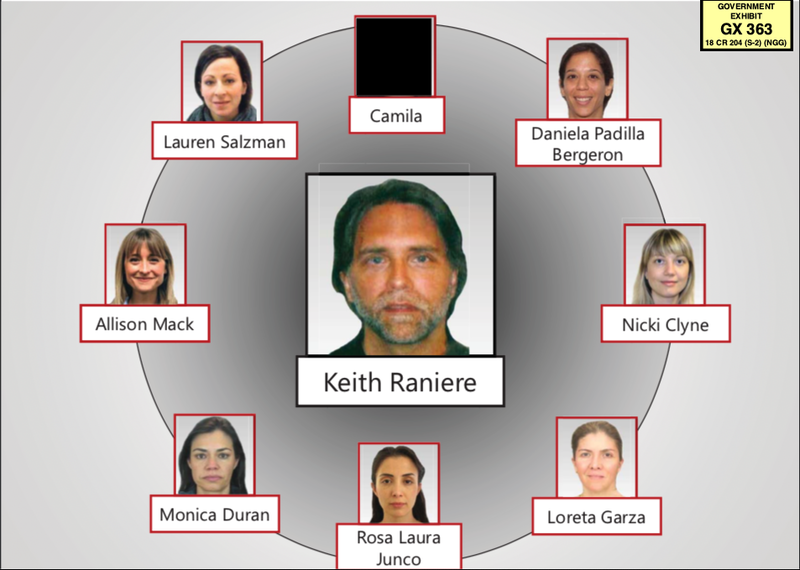
Sounds enticing, doesn’t it? Well, JNESS was a grooming ground for something seriously sinister. There was a nucleus operating inside NXIVM—a secret sex sisterhood—called Dominus Obsequious Sororium (DOS) which is a Latin translation for “lord over the obedient female companions”. It was inside DOS where things really got nuts.
Alison Mack was Raniere’s chief recruiter for DOS. Raniere delegated Mack to identify women of influence within JNESS and bring them inside the inner DOS circle. In Mack’s words, “DOS is a bad-ass, if slightly unorthodox, feminist group meant to help women build discipline and overcome their intimacy issues”.

Alison Mack
Unorthodox is an understatement. DOS was specifically designed to provide sex slaves for Keith Raniere. The initiation required “collateral” to prove the woman’s conviction. This would be sexually-compromising pictures, videos of sex act performance, or something as sleazy as a letter on file that falsely accused the woman’s father of sexually molesting her.
Once indoctrinated inside DOS, the woman vowed to be completely subservient to Raniere. This included group-sex participation, pubic hair grooming requirements, and responding to text demands within sixty seconds or face corporal punishment by being strapped with a leather belt.
Complete DOS initiation required branding. In this procedure the indoctrinated was stripped naked and forcibly held on her back on a table. She was required to say, “Master, please brand me. It would be an honor.” Then, the submissive woman would sufferer excruciating pain while the initials “KR” were seared on her pubis.

Sarah Edmondson shows the brand she received as part of a secret sorority ritual while part of the self-help group Nxivm, in Vancouver, British Columbia, Canada, July 27, 2017. Edmondson, who has left the group, and other former followers of Keith Raniere, the leader of the group, said they were focusing on recovering. “There is no playbook for leaving a cult,” Edmondson said. (Ruth Fremson/The New York Times)
Note: Officially, thirteen women have come forward and showed their brands. There could be many more.
Who is Keith Raniere?
To somewhat understand the hard-to-believe story of NXIVM, JNESS and DOS, it’s necessary to look at who Keith Raniere really is. Again, it’s best to read how NXIVM portrayed him through their website propaganda. This is what they posted:
KEITH RANIERE — Keith Raniere has devoted his life to studying the complex issues that face our modern world, and to developing tools to enhance the human experience through community, social action, science, technology, and education.
 Raniere has founded multiple companies focusing on increasing joy and ethics in the world. Under the NXIVM umbrella, he has developed a series of educational models that offer integrative solutions to complex subjects such as gender, relationships, childhood development, mind-body complex, compassionate ethics, and creative expression. These initiatives range from an award-winning performing arts company to an early childhood education that promotes cultural, linguistic, emotional, physical, and problem-solving potential.
He founded Executive Success Programs, Inc. (ESP) in 1998 with Nancy Salzman, one of the world’s top trainers in personal and professional development, seeking to advance ethics, humanity, and critical thinking on an individual and global scale. One of the cornerstones of ESP is Rational Inquiry®, Raniere’s patent-pending technology that provides a scientific process for achieving peak human performance. Most recently, these tools successfully have been applied to treating neurobiological disorders with unprecedented results. In partnership with the Ethical Science Foundation, several people have been helped to overcome severe cases of Tourettes Syndrome, with plans to study the potential on other conditions.
Some of his most passionate and purposeful work can be seen in the peace movement he founded in Mexico, where gang violence, corruption, and poverty are at crisis levels. InLaK’ech (an expression that translates to “you are the other me”) has been credited with initiatives that promote community, inspire leadership within small villages, and provide systems to disable violence and stop perpetrators. He sees the struggles faced by the Mexican people as a metaphor for the world and hopes to inspire the possibility for peace.
The Truth About Keith Raniere
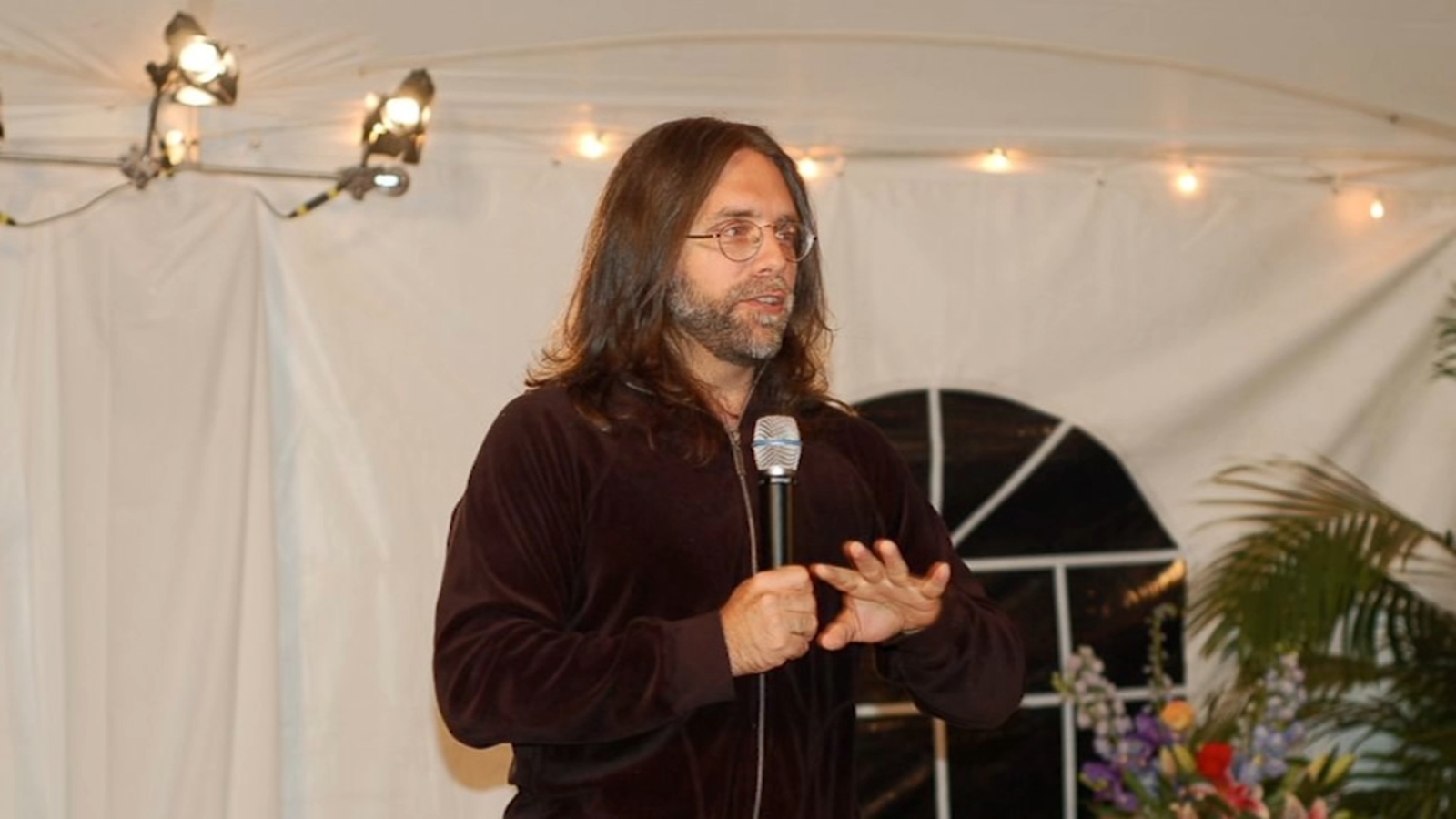
That’s an appealing spiel the NXIVM website spelled out. The truth, however, is much different. Keith Raniere is a deviate conman if there ever was one. Here’s a factual profile on what this guy is all about.
Keith Allen Raniere was born in 1960 to an ad-salesman father and an alcoholic mother who was a ballroom dancing instructor. They separated when Raniere was eight, and he was mostly raised by his father who boasted to everyone who would listen that his son was a genius. It seems Raniere believed this and took on a lifetime with that persona.
 Raniere was no scholar with a 200+ IQ like he porported to desciples. He achieved a 2.26 GPA (C- equivalent) college diploma majoring in physics and had a fascination with science fiction. He was heavily influenced by Isaac Asimov’s Second Foundation that centered on mind control. He also dabbled in Amway and a few other network marketing ventures before starting his own multi-level company called Consumers’ Buyline Inc.. It achieved a large following before federal regulators shut it down as an illegal pyramid scheme. Ranier was fined $40,000 of which he paid $6,000.
Raniere reinvented himself in the MLM culture with a vitamin company called National Health Network. Through this, he met Nancy Salzman who was a registered nurse and a certified hypnotherapist. They turned their combined focus on the emerging personal wellness field and lucrative business coaching opportunities. Together, they were like fire and gasoline—or two volatile chemicals mixed up in a mad scientist’s lab—and NXIVM was conceived.
Keith Raniere was shaped by a lot of factors. Many are the usual suspects when it comes to mind control—Hubbard (Scientology), Rand (Objectivism), Blavatsky (Theosophy), Freud (Psychoanalysis), Steiner (Anthrosophy), Crowley (OTO), Korzybski (General Semantics), Erhard (EST), Erickson (Eriksonian Hypnosis), Bandler & Grinder (Neuro-Linguistic Programming) as well as Tony Robbins, Rosicrucianism, and Freemasonry. Raniere also took acting and judo lessons.
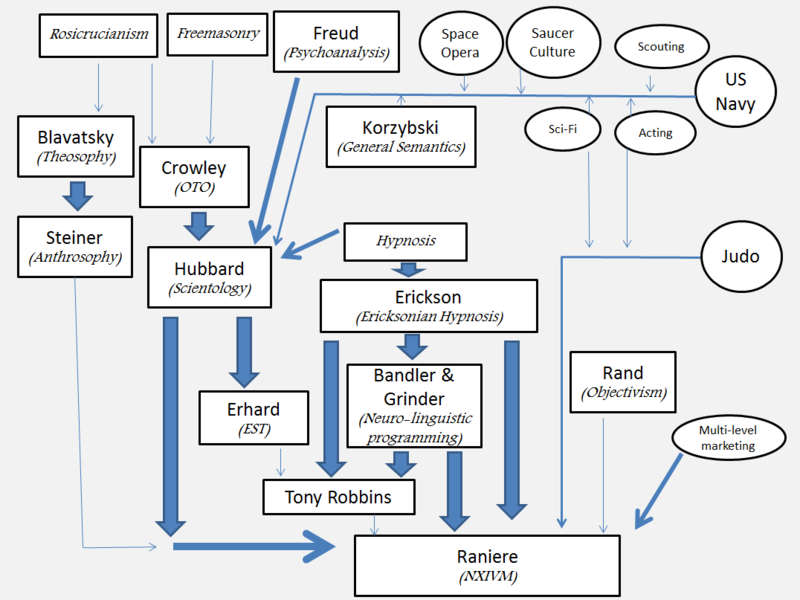
Ranier was no genius as he held out to be. He was basically a shiftless slacker who slept most of the day, didn’t own a car or have a driver’s license, mooched off friends for meals, and couch-surfed according to who would have him. Even when the NXIVM cash started rolling in, he didn’t purchase material goods. Keith Raniere was in it for two things—power and sex.
I’m not going to go into the sexual details. There’s plenty online if you’re curious, and some of it sheds light about how crazy Ranier’s sex cult was. What’s baffling about this case is the mind-frame these duped women were in when they submitted to Kieth Raniere’s brand.
 Rolling Stone Magazine took on the story in late 2019 after Raniere’s convictions but before his sentencing. In How NXIVM Was the Ultimate Wellness Scam, the writer quotes one of Raniere’s former girlfriends, Barbara Bouchey, who said, “The women who were willing to sacrifice so much for Raniere, only to get so little in return, had one trait in common. They were what I would call weak-willed women. They were smart, they were sensitive, they were caring. But were they confident? No. Raniere went out of his way to surround himself with women who were successful by societal standards—privileged, attractive, well-educated—but who did not have the financial independence nor street smarts to assert themselves and their own autonomy.”
Toni Natalie, another ex-girlfriend, said, “While the women in Raniere’s inner circle were all extremely bright, they tended to lack substantive family ties, and all were insecure and damaged in some fundamental way, making them easier to control. He convinces you that your successes are not your own. Your successes are only because he exists.”
Wellness industry expert and author, Jessica Knoll, wrote an op-ed for the New York Times just before the judge gave Raniere his 120 years. It went internet-viral and probably offended some when Knoll stated, “The wellness industry is a function of the patriarchal beauty standard under which women either punish themselves to become smaller or are punished for failing to comply. When you have to deprive, punish, and isolate yourself to look ‘good,’ it is impossible to feel good.”
 Knoll notes, “Wellness isn’t about being freer or stronger. It isn’t about loosening the shackles of oppression and throwing them to the wind. It’s about slipping them onto our wrists and letting someone else tighten the screws. It’s about powerlessness. It’s about surrender. It’s about love, and pain, and letting people tell us we don’t know the difference. That’s the stark truth of the wellness industry and the brutal truth about the condition of womanhood in general, which is that so many of us hate ourselves so intensely and so often that there is no limit to the amount of pain we are willing to endure to change that.”
The Rolling Stone closed their story with this summation that you may or may not agree with: