
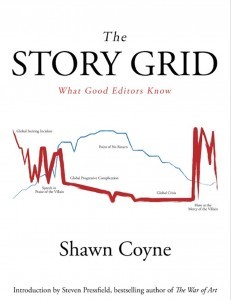
 The Story Grid is a methodology. It’s a diagnostic tool – not a formula – designed to teach writers how to self-edit and find what’s wrong with their novel and how to fix the manuscript before it goes to a commercial editor. It’s a story CT scan, seeing at the 50,000 foot macro-level, as well as line-by-line at the micro-level, deep inside. The Story Grid is what good self-editors must know about writing a Best Selling novel.
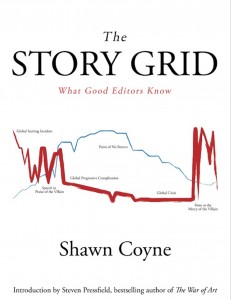
Shawn Coyne is a highly accomplished editor who developed the Story Grid. He’s right when he says that, in today’s world, a writer must deliver publish-ready material every time. Coyne’s Story Grid system analyzes manuscripts like a left-brain editor thinks – after the creative right-brain writer finishes initial drafts.
The Story Grid focuses on genre fiction.
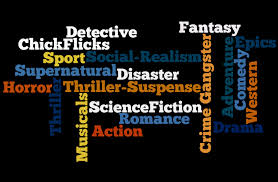 Ah… what, exactly, is genre?
Genre is a fancy word for managing audience expectations of categories. It classifies stories – crime, thriller, mystery, romance, sci-fi, erotica – the type of stuff that literary snobs turn their nose up at, but what sells in a commercial market and makes publishers (thus writers) money.
Coyne explains the makeup of genre fiction in a five-leaf clover concept:
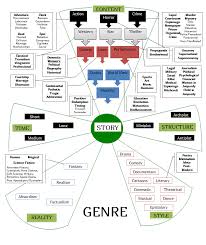 Time – How long will it take to read?
- Structure – What’s the plot?
- Style – Comedy? Thriller? Tear-jerker? Fifty Shades?
- Reality – How much suspension of disbelief?
- Content – Takeaway for the reader?
The Silence Of The Lambs is a genre novel. It’s not a long read, has a complex plot, a thriller style, is easily believable, and leaves the reader remembering it forever.
 The Silence Of The Lambs is a perfectly crafted story which Coyne analyzes in his book The Story Grid and how his Foolscap, Spreadsheet, and Graph methods apply.
The Foolscap Global Story Grid is Step 1 in Coyne’s system. It represents how an editor thinks of the macro view of the story in no more space than a sheet of foolscap allows; getting the entire outline of a novel in one shot. Very simply, The Silence Of The Lambs is viewed as:
Beginning Hook – Clarice Starling gets job to interview Hannibal Lector to find Buffalo Bill.
Middle Build – Hannibal toys with Clarice, then escapes, leaving Clarice on her own.
Ending Payoff – Clarice catches and kills Buffalo Bill.
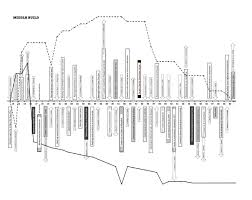
It’s the classic 3-Act structure. Expanded, but still on one foolscap page, the Foolscap Grid looks like this:
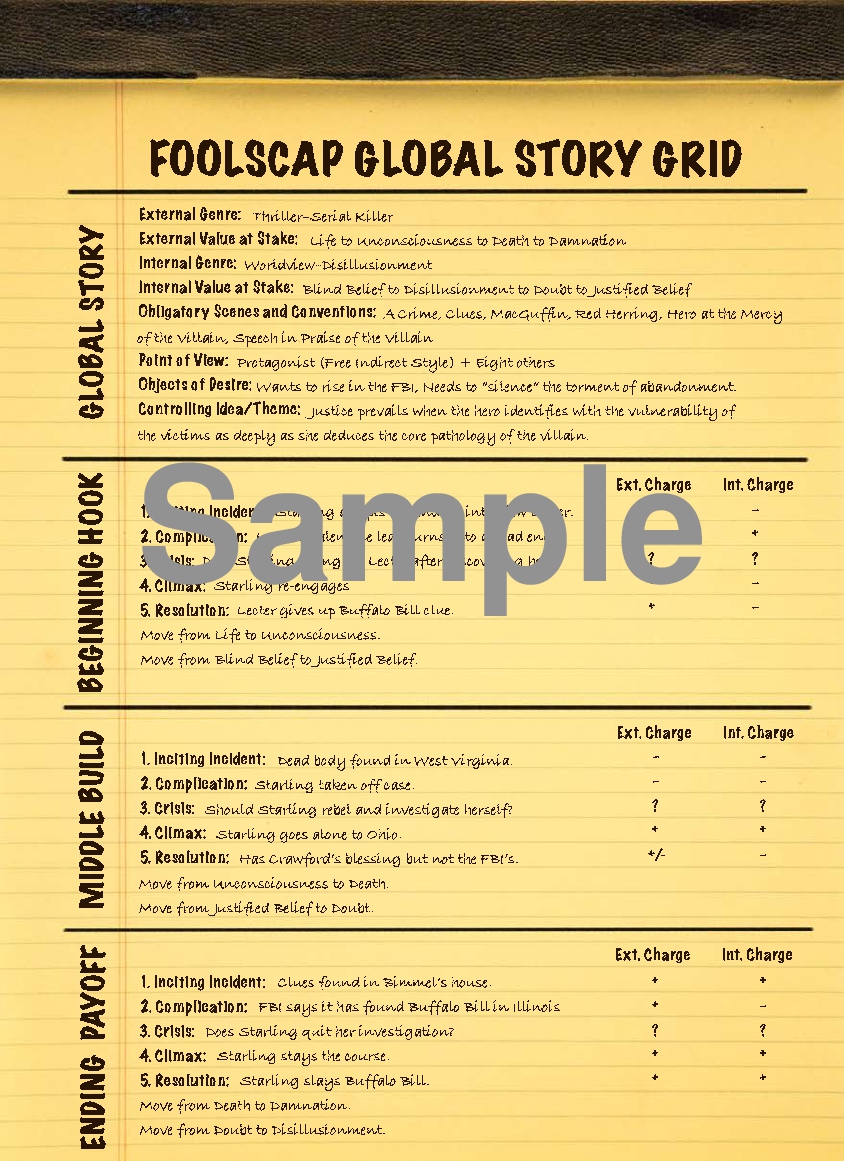
The Foolscap Grid is a general, checking tool for identifying weakness in overall story and how the collection of scenes builds a gross curve of action with major story movements. It’s the macro analysis.
Step 2 is dissecting individual scenes and plugging them into an Excel spreadsheet. It’s the micro-analysis where the scenes are assigned fourteen values:
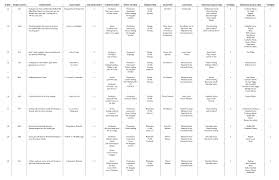 Scene number. Word count. Story event. Value shift. Polarity shift. Turning point. Point of view. Period of time. Duration. Location. Names of onstage characters. Number of onstage characters. Names of offstage characters. Number of offstage characters.
The Spreadsheet Grid clearly identifies what’s happening in each scene and how it contributes to the global story. If any particular value is weak, and not doing its job in furthering the story – not keeping the reader engaged through change and surprise – the writer is able to have a quick ‘meeting with themselves’ and fix the problem, rather than having to wait to get the message back much later from an independent editor.
 Step 3 is taking the values from the spreadsheet and putting them in a Graph Grid. Here the rise and fall of the story are mapped and the collision of characters’ internal and external conflicts are noted. The graph is bisected by a central line running left to right across the mddle with each scene number being assigned a seperate box. In the upper half are the positive forces of the story which Coyne terms Life. In the lower half are the negative forces of Death. Life and death conflict is central to the story.
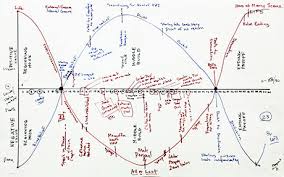 When the positive and negative strength of the values are plotted in relation to the scene, the overall story arch stands right out. Any interruption in the flow will show as a bend in the arch which is a red flag that something needs fixing. The flow is shown as a sine / cosine cruve. In Coyne’s analysis of The Silence Of The Lambs the beginning hook, the middle build, and the ending payoff neatly cross and coincidently seem to balance.
It’s no coincidence.
Author Thomas Harris deliberately planned The Silence Of The Lambs to have a storyline that flowed this way. It’s unknown if Harris used a similar foolscap / spreadsheet / graph system, but he arrived at a masterful result in one of the best thriller genre novels ever written.
 There’s far more to The Story Grid than I can cover in a short blog post. The hidden genius in this system is its effective use in outlining a novel, rather than waiting till drafts are done then analyzing flow.
Here’s some links to Shawn Coyle’s The Story Grid.