Author Archives: Garry Rodgers

About Garry Rodgers

After three decades as a Royal Canadian Mounted Police homicide detective and British Columbia coroner, International Best Selling author and blogger Garry Rodgers has an expertise in death and the craft of writing on it. Now retired, he wants to provoke your thoughts about death and help authors give life to their words.

POLICE SHOOTINGS – TO WOUND OR TO KILL?

AD11The shooting death of unarmed, black teenager, Michael Brown, by white police officer, Darren Wilson, in Ferguson, Missouri, on August 9, 2014, caused an international uproar and a microscopic evaluation of law enforcement’s use of force parameter.

I’m not going into details of this particular, tragic event, but I can say from personal experience what takes place in the training and execution of deadly force application.
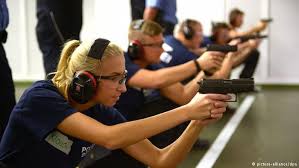
AD12Regular police officers undergo a thorough, basic training in the use of their service weapons and in the evaluation of situations where they may be required to use a lethal response. Most officers graduate the academy with a reasonable proficiency with their sidearm and perhaps a shotgun and carbine rifle. They go through yearly qualifications to maintain their skill and, thankfully, most go through their entire service without ever firing a shot.

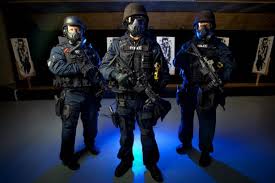
Special Weapons and Tactics (SWAT) or Emergency Response Teams (ERT), like I served on, are trained to a significantly higher degree of proficiency, but the principles of using deadly force are the same.
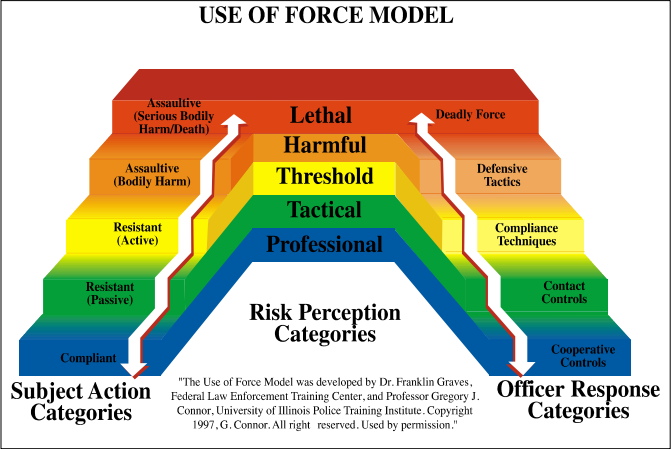
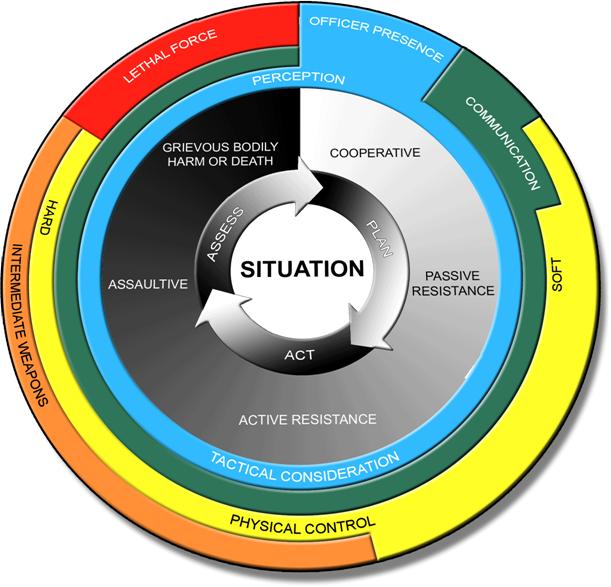
AD2All officers are taught to assess their response to a dangerous situation by applying the Use Of Force Continuum. This is graphed out in either a lineal or a circular model and is a standard that provides guidelines as to how much force may be used against a resisting subject in a given situation.

The assessment process has the officer perceiving the incident and considering the tactical response they need to evoke. Perception ranges from a cooperative subject, to one who is passively resisting, actively resisting, becoming assaultive, or presenting grievous bodily harm or death to the officer.
AD3The officer’s tactical response can vary from simple communication, to soft or hard physical control, to the use of intermediate weapons such as the baton, pepper spray or Taser, right to the lethal force of shooting the subject. This is all fine and well in the classroom but in Real Life and on Real Street, this stuff can go down in seconds.
I don’t know how many times I’ve heard someone say “Couldn’t the police have just shot to wound, not to kill?” Well, that’s just not a reality given that the average police shootings occur within seven feet and in under two seconds.

The basic principle of use-of-force training is to condition a person so they’ll respond appropriately in a situation where they have little time to think. When a situation hits the danger level which requires a police officer to pull the trigger, there’s no time left to gamble on something fancy.

Contrary to popular belief, police officers are not trained to shoot to kill.

AD17They’re trained to neutralize the subject and the most efficient way to do this is to aim for the center of body mass. Not the head. Not the elbow. Not the knee.  Not the groin. And not to shoot the gun out of the bad guy’s hand.

The center of mass, or ‘CX’ as it’s known on the firing range, is the easiest to hit and has the quickest effect in putting the subject down and out of commission. It’s where the vital organs are and where the central nervous system is most vulnerable.

Very few police shootings are found to be an unjustified use of force. In fact, many subjects survive a police bullet. The situation in Ferguson, Missouri, may be debatable about its justification, but all are in agreement that it was tragic.
AD13I don’t believe there’s a police officer out there in their right mind who wants to get into a gun-fight. Believe me, they’re no fun, and when they happen there’s virtually no time to react. That’s why cops are trained to defend themselves, or others, by shooting at the largest target.

Here’s a link to the Police Policy Studies Council which is a credible group of combined departments that formulate policy and direction on the use of force, among many other law enforcement issues:

http://www.theppsc.org/

5 WAYS SHERLOCK HOLMES SHAPED MODERN FORENSICS

“In solving a problem of this sort, the grand thing is to be able to reason backward.” 

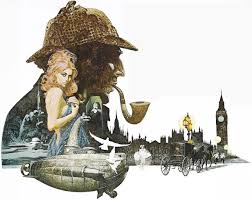
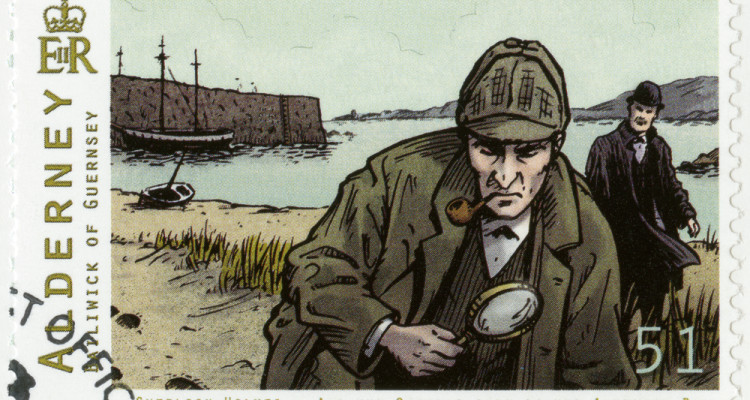
AC1So wrote Sir Arthur Conan Doyle as his literary counterpart, Sherlock Holmes, in A Study in Scarlet. Doyle was a scientist and a trained physician, so when he imagined the great detective, he used science to set him apart from other crime practitioners.

Where a policeman of the day would round up the usual suspects and beat a confession out of an unlucky bloke, Holmes employed deduction, the scientific method, and an acute sense of observation. Here’s five of his techniques that were ahead of his time.

1. Detective work.

 “I am glad of all the details … whether they seem to you to be relevant or not.”
– The Adventure of the Copper Beeches

AC4The fictional Holmes revelled in tiny details, and caught everyone by surprise by defining a subject with details relating to height, weight, gait, carrying a load, occupation and other surprising summaries simply by observing a wet foot print in a garden. He also explained how the evidence led to his accurate conclusion. And when the perpetrator was finally discovered and captured, the physical description was uncanny.

In addition, his ability to ‘reason backwards’ (looking at the criminal act and working his way backwards to lead him to evidence) helped guide him to a conclusion, a motive, and a culprit.

2. Fingerprints.

 “As you may know, no two human fingerprints are ever alike.”
– The Brass Elephant

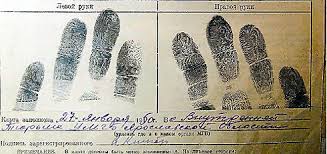
AC6Holmes identified and used fingerprints initially in The Sign of Four, published in 1890. Scotland Yard did not adapt fingerprint recovery, comparison, and identification process until almost 11 years after The Sign of Four was published. He did not use fingerprints as the defining evidence, however — generally, the case was irrefutably solved by a variety of clues leading to the correct solution.

In The Adventure of the Norwood Builder, Inspector Lestrade thought he had his murderer when he was able to match a bloody print to John Hector McFarlane, an obvious suspect. Holmes was able to prove that MacFarlane was innocent.

Today, fingerprints are a standard method of identification for human individuals. Now stored in computer databases, analyzed and compared within seconds, fingerprints still require corroborating evidence to tell the whole story.

3. Ciphers.

 “But what is the use of a cipher message without the cipher?”
– The Valley of Fear

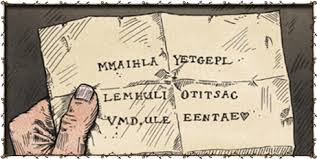
AC11In many cases in Victorian times, clues were hidden in ciphers, or coded messages which required a ‘key’ to ascertain letter substitutions. In The Dancing Men, Holmes analysed 160 separate cyphers, determined that the letter ‘e’ was the most common letter in the English language, and was able to proceed to the answer. In “The Gloria Scott”, he deduced that every third word in lines of gibberish created the message that frightened Old Trevor.

Many of these cipher techniques were applied during the World Wars to decipher messages from the enemy, and law enforcement in many countries have also worked through ciphers using procedures described by Conan Doyle.

4. Footprints.

“Footprints?” ” Yes, footprints.” “A man’s or a woman’s?”
“Mr. Holmes, they were the footprints of a giant hound.”
– The Hound of the Baskervilles

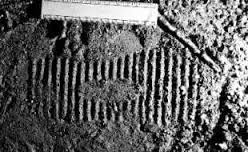
AC10From the very first story in the Holmes series to the 57th story (The Lion’s Mane from 1926), 29 of the 60 stories revealed and solved footprint evidence. Footprints were found in soil, mud, and clay. They were on carpet, in snow, ash, and even on drapes and doors — each mark was worth discussion, each print told a story that was instrumental to the outcome.

Sherlock Holmes ‘wrote’ an educational treatise on the preservation of footprints, entitled “The tracing of footsteps, with some remarks upon the uses of Plaster of Paris as a preserver of impresses”. The techniques so described have become a mainstay in preserving prints of shoes, tires, tools, and other depressions by police departments worldwide.

5. Handwriting.

“We must look for consistency. Where there is a want of it we must suspect deception”
– The Problem of Thor Bridge

In Victorian London, handwriting was more prevalent than it is today.

AC12Holmes was able to deduce many details from the written word. By inspecting the pressure, angle, swirls, and consistency, Holmes could tell the gender, class, and maturity of the author. He could also make determinations about the character of the person whose penmanship was under scrutiny. In The Norwood Builder, Holmes determines by the timing of the imperfections in the scrawl of a will, that it was written aboard a train. Knowing that such an important document would not be transcribed in such a fashion, he correctly assumed duress.

Today, handwriting analysis is used to determine forgeries, psychological profiling, and alterations in handwriting due to the influence of drugs, alcohol, duress, exhaustion, or illness.

The ransom note left at the scene of the JonBenet Ramsey murder is a prime example. It was intensely scrutinized and attempts were made to tie it to one of the parents.

The results remain inconclusive.

*   *   *

AC13This article was originally published by my friends at Forensic Outreach, one of the best forensic education sites on the internet. They’ve now launched a new site called CASE Academy which I’m proud to support.

AC15Doug Filter wrote this article for Forensic Outreach. He’s worked in legal support for three decades, developing visual communication tools that help litigators, prosecutors, and defense attorneys tell stories in court. Doug is an author, presenter, and designer. He’s worked on cases ranging from mapping body locations by interviewing a serial killer to explaining and animating the life style of trout in a water pollution case.

Doug’s speciality is learning scientific, technical, medical and complex case details and then explaining them to an audience of fact finders in a courtroom setting. He’s worked in jurisdictions in North America, South America, and Europe.

EVOKE THE FIVE SENSES IN YOUR WRITING

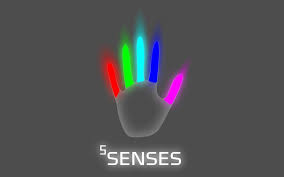
art sufferingHumans survive by using our five senses. Sight. Sound. Smell. Taste. Feel. We’re so conditioned to evoking these senses in order to function in the world that we usually fail to consciously identify which source our brain is using to tell us what’s going on. Unless it’s an extreme event.

Take the overpowering smell of a rotting corpse, for instance. Trust me. That’s a nose-ride that you’ll never forget.

You’ll always remember the beautiful sight of your children being born.

How about the fantastic sound of the Hallelujah Chorus from Handel’s Messiah? The exquisite taste of a most excellent Shiraz? Or the creepy-crawly feel of a boa constrictor encircling your neck?

A2Sight. Sound. Smell. Taste. Feel. SSSTF for short. These are what trigger our emotional experiences in daily life.

They also trigger emotional experiences when we read. As a writer, it’s your job to create sensual worlds by painting glorious pictures from twenty-six letters, pounding-out sounds with punctuation, brewing smells with paragraphs, cooking impeccable tastes in chapters, and touching your reader’s heart by prose, alliteration, metaphor, simile, and composition.

SSSTF.

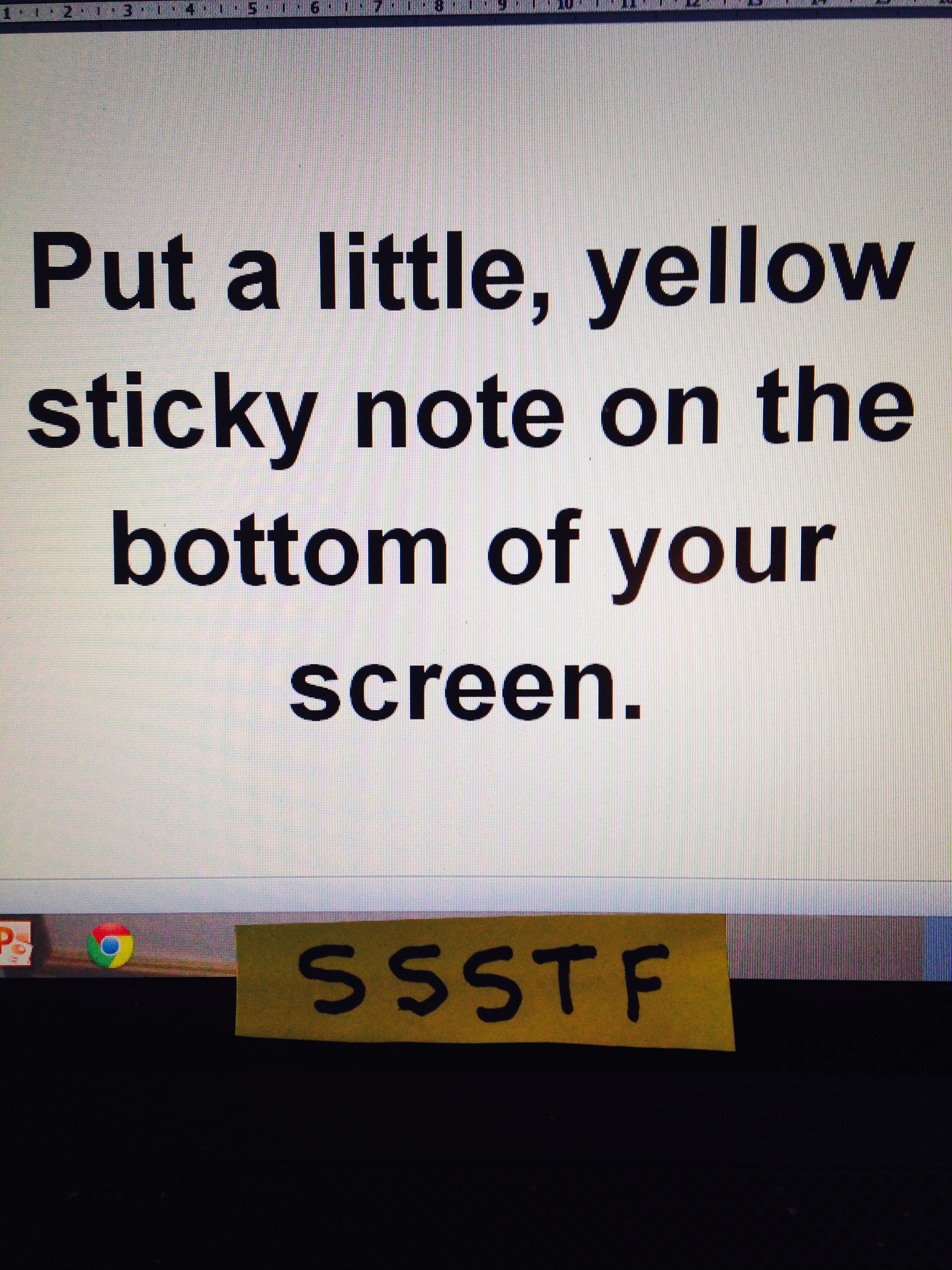
I keep a little, yellow sticky-note at the bottom of my screen with these five letters to remind me of always writing to the senses. When editing, I look at each scene to see how the SSSTF formula is applied.

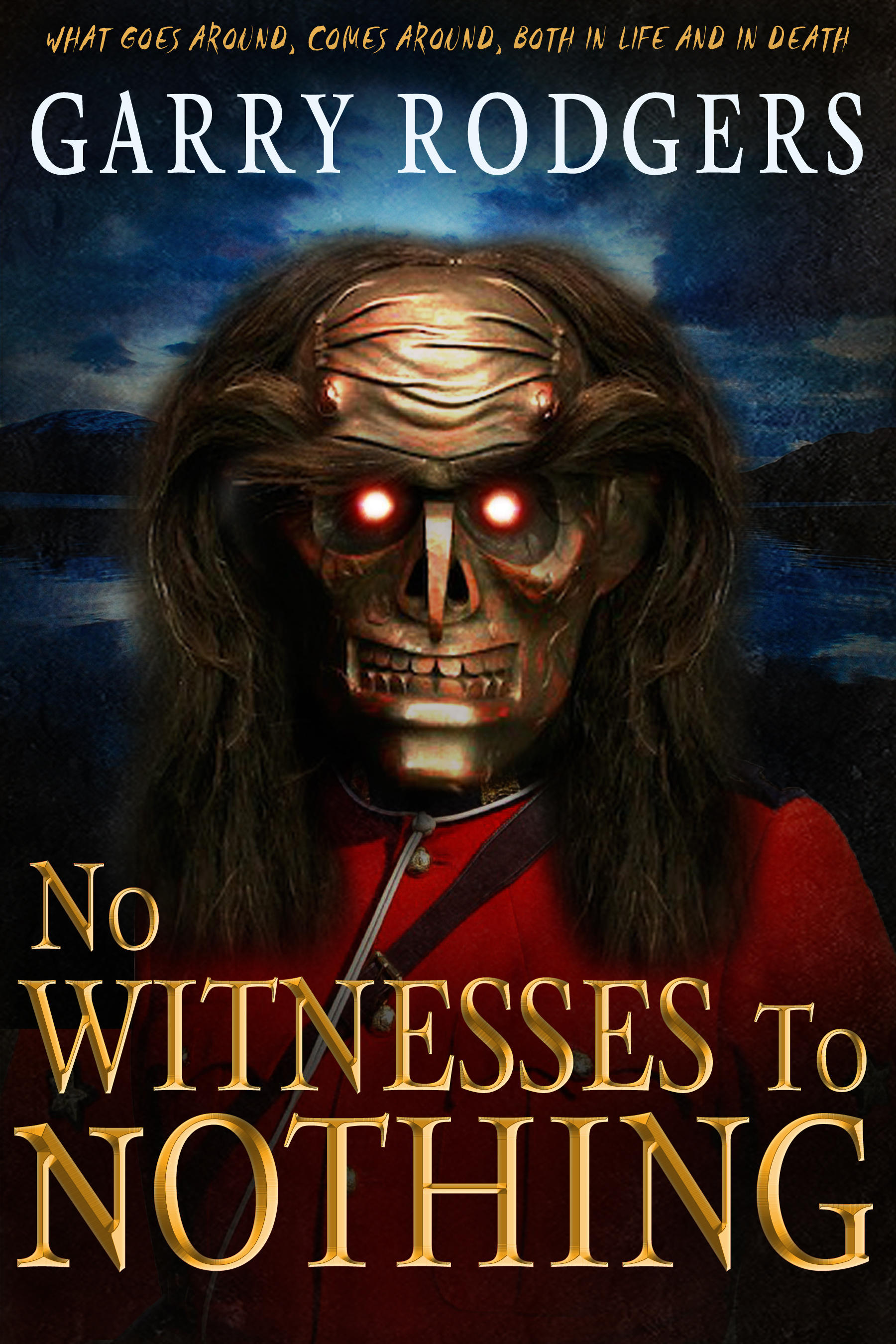
garry-KindleHere’s some samples of using sensory amplification from my BestSeller No Witnesses To Nothing.

Sight

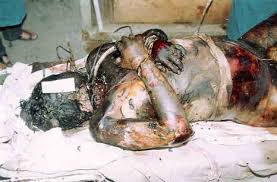
A14It’d been a large man. An older man. Not tall, but heavyset. The body was supine, lying on its back on the linoleum floor, just inside the trailer door. The face was barely recognizable; swollen and bearded in greyish-white. The exposed flesh had turned a green colour. Not a light green, nor a dark green, but an intense green like the green of the Incredible Hulk. The lips were black bulges. The left eye squeezed shut, but the right was mostly open. Flies buzzed about; eggs laid, though their maggots had not yet hatched. Prunty shuddered the heebie-jeebies. It was like the rotting Hulk was winking at you.

Sound

Ngoc Van Nguyen was the first to see it come down. He was a lookout on the Bottomline, one of four lookouts on the mule boats at the off-load site. 

A23A bright, white light switched-on low in the south-west sky. He squeezed his eyes and looked again. It was closing fast. Nguyen called in Vietnamese to the man on the Do Boy who also looked. They saw a second white light flash-on beside it, streaking straight at them.

“Gai Lum Bob! Gai Lum Bob!” the pair yelled. They had exactly 7.7 seconds to sound the alarm, causing everyone to look up as the lights screamed silently by, 580 feet overhead. The off-loaders had another 2.3 seconds to watch trails of fire arch upward before –

BAAAAA – BAAAAAAANNGGGG

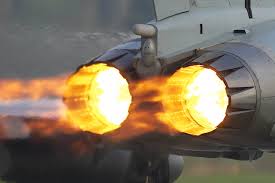
A15Two massive sonic booms blew out eardrums and shot blood from the noses of the exposed workers in the bay. Shattered glass, fiberglass shards, ripped fabric, and debris of all sorts blasted everywhere within the shock-stricken target. Half the off-loaders were unable to stand, let alone hear the mind-fucking roar of afterburners. The F-18 Hornets pulled six G’s going vertical from their Mach 1.2 run, climbing thirty seconds, wing-tip at wing-tip to 26,000 feet, banking sharply north, returning to base.

Smell

“Hello?” he called out, closing in on the door. “Hello! Anyone here?”

A16It sounds absurd, calling out, given the commotion, but the volunteer firefighter was an insurance man in his day job and insurance men are cautious. He stepped up. Tapped the door. Turned the lever and pulled. The whoosh of rushing air hosed him like the stream straight out of a skunk’s ass and he instantly heaved-up his guts.

“Hey! HEY!” he yelled, snotting and spitting. “There’s a fuckin’ dead guy in here!”

Taste

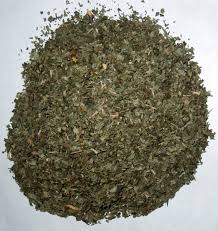
They set their instruments aside, forming a rough semi-circle. Billy handed the blue CD case which Smerchook zipped open, taking a wad of the dried, diced material, and began some short sniffs. Haslett watched, suspecting dope. “What’s that?”

A17“Rat-Root,” Smerchook replied. “A tradition in my culture. Sort of like chewing tobacco or snuff. Here. Wanna try?”

Haslett’s nose wrinkled, moving back.

“Don’t worry. There’s no hallucinogenics.”

Smerchook held out the case. Curiosity got the better of Haslett. He took a pinch, put it in his mouth, and bit down.

“Pttt…tttthewh. Ye-ucck!” He spat, wiping his mouth with his fingers. “Eeech! That is horrible!”

“Yeah, I know,” Smerchook replied, closing the case. “It tastes like horse shit. That’s why I only sniff it.”

Feel

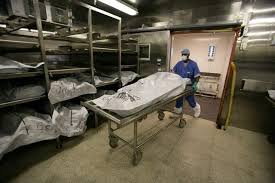
A21Vancouver General’s morgue is like a chilled Costco for the dead. Stainless steel refrigeration crypts, stacked three high, in two rows of nine, have shelving for fifty-four. The freezer unit stores eight and isolation for the stinkers takes six, sealed aluminium caskets. These tanks are also used for homicide cases; locked to preserve evidence. A grindy, overhead hoist shifts cadavers from wheeled gurneys that squeak about the fluorescent-lit room, touring them to and from metal drawers. Some are in-hospital deaths, brought down from the wards covered in warm, wollen blankets. Some are delivered by cold, black panel-vans handling coroner cases.

Combination of SSSTF

Cool PicA waft of sage mixed with sweetgrass, smoldering in a baked-clay bowl, meshed with hollow, haunting tones of the flute played by Native American musician, Ronald Roybal, drifting from speakers secluded somewhere within the room’s delicious palettes – fiery reds, yellows, and burnt oranges of the sunrise, trapped in Navajo tapestries and draping both sides of a north-facing window – airy pinkish-purples of a sunset sky, woven into a topper above the bronzed glass – mulchy browns, cactus greens, and driftwood greys of the earth, patched into fabric furnishings – and watery blues with foamy whites, splashing off a rough stucco wall.

Absence of SSSTF

Tracy transcended.

A22She floated in awe – in divine bliss – marvelling in perfect clarity as the world all around her made sense. She felt at her physical carriage – reaching over – reaching under – her hands never moving. She saw without eyes. Heard without ears. Smelled fragrances without nostrils. Tasted sweets without buds.

For Tracy –

Time stopped –

She became the sight, the sound, the smell, the taste, and the feel.

Sight. Sound. Smell. Taste. Feel.

SSSTF

A24