
Author Archives: Garry Rodgers

About Garry Rodgers

After three decades as a Royal Canadian Mounted Police homicide detective and British Columbia coroner, International Best Selling author and blogger Garry Rodgers has an expertise in death and the craft of writing on it. Now retired, he wants to provoke your thoughts about death and help authors give life to their words.

DID MALLORY & IRVINE SUMMIT EVEREST FIRST?

It’s the greatest mystery in mountaineering history. And it’s a question lingering at the top of the world for over a century. Did British climbers George Leigh Mallory and Andrew “Sandy” Irvine reach the summit of Mount Everest in 1924—nearly three decades before Edmund Hillary and Tenzing Norgay etched their names into eternity?

The facts are buried under heavy snow, crushing ice, and glacial time. But clues remain. Some were frozen in place. Others may be waiting to thaw.

Let’s explore a deep dive (or a high climb) into one of the world’s most enduring mysteries. The answer may hinge on a single object—a missing object from the Mallory/Irvine climb that could forever rewrite mountaineering record books.

Mount Everest stands as the highest point on Earth—8,848 meters or 29,031 feet above mean sea level. It lies in the Mahalangur Himal sub-range of the Himalayas, straddling the border between Nepal and the Tibet Autonomous Region of China. The summit is known locally as “Chomolungma” or Goddess Mother of the World. Mountaineers call it the “Roof of the World”.

Climbing Everest is no walk in the park with your Birkenstocks and Bernese. Even today, with satellite weather tracking, advanced oxygen systems, carbon-fiber gear, and legions of seasoned Sherpas, it remains a deadly endeavor.
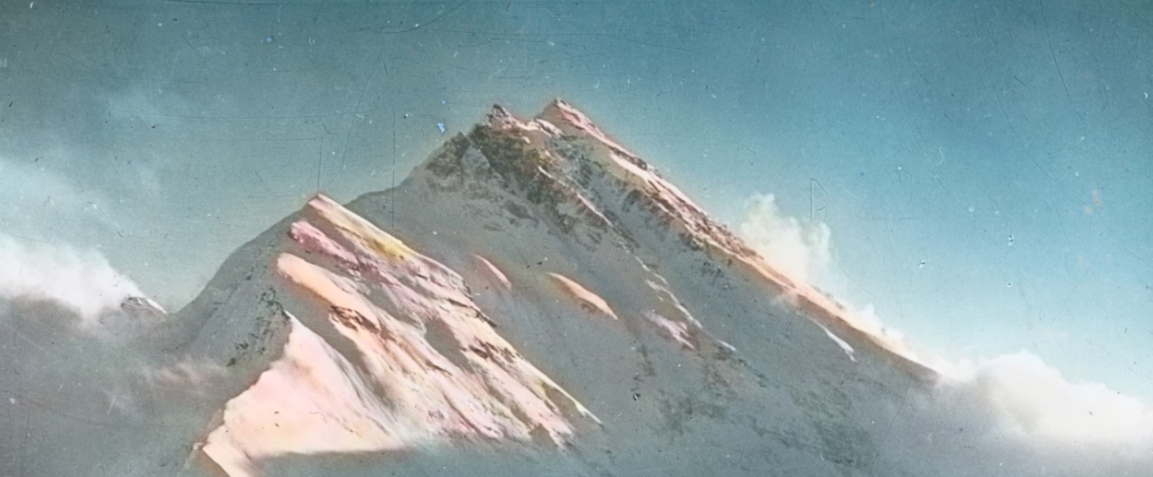
A combination of extreme cold, hurricane-force winds, avalanches, and altitude sickness kills super-fit climbers every year. Not to mention gravity. Over 300 people have perished trying to reach—or descend from—the top of the world.

Most Everest deaths are from falls, hypothermia, or high-altitude pulmonary/cerebral edema. Almost always, thse occur in the oxygen-poor “Death Zone” above 8,000 meters (26,250 feet). And even in our hyper-connected modern world, there are (and will continue to be) bodies up there that’ll never be recovered.

So, imagine attempting the climb in 1924—with wool garments, primitive crampons, hemp ropes, and homemade oxygen systems—on a route no one had ever successfully taken or surveyed before. That’s what George Mallory and Sandy Irvine set out to do.

The 1924 British Everest Expedition was not the first attempt to climb the world’s highest peak. It followed two earlier British expeditions in 1921 and 1922, both of which helped map the terrain and gauge potential paths.

The 1924 team was well-organized and determined. It included experienced climbers like Edward Norton, Howard Somervell, and Noel Odell, along with George Mallory—a seasoned alpinist who had been on both previous expeditions. Sandy Irvine, only 22, was a gifted engineer brought on for his mechanical expertise with oxygen systems.

They chose to climb from the north, through Tibet, as Nepal was closed to foreigners at the time. This North Col–Northeast Ridge route remains notoriously difficult due to exposure, technical ridges, and shifting snow conditions—especially near the infamous Second Step, a 30-meter (90 foot) vertical rock face at 8,610 meters (28, 234 feet).

Despite bad weather and delays, the team pushed upward. Norton made a valiant solo attempt without supplemental oxygen and reached an astonishing 8,572 meters (28, 130 feet)—a record at the time. But the Second Step and the summit still loomed as virgins above.

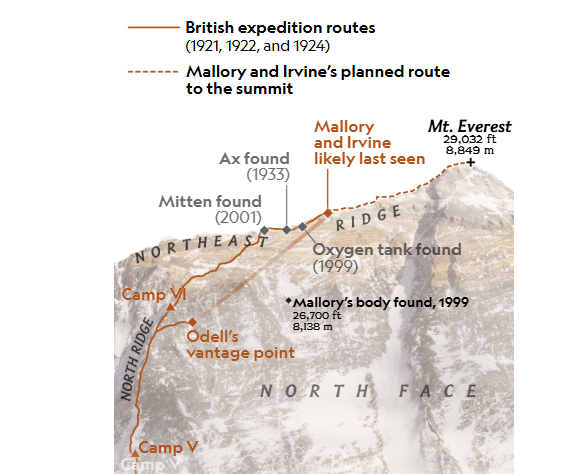
Then on June 8, 1924, Mallory and Irvine made their bid. They were last seen through a telescope by Noel Odell at 12:50 pm, appearing as “small black spots” ascending a prominent ridge—possibly the Second Step.

And then they vanished.

Let’s pause for a moment. This wasn’t just a routine summit attempt. Mallory had already become a dashing British national figure, famously answering the question of why he wanted to climb Everest with, “Because it’s there.”
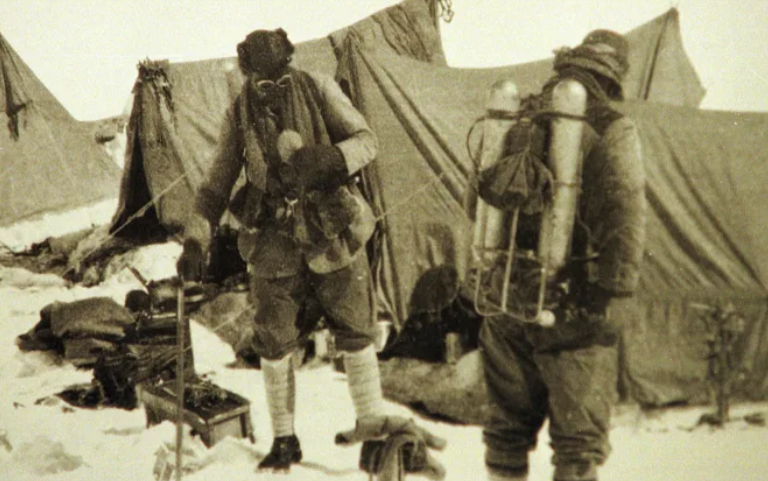
And Irvine was the brilliant young newcomer, barely out of Oxford, taking on the world’s greatest challenge. They were heroes before they left base camp. And when they didn’t return, they became legends.

For 75 years, their fate remained unknown. No doubt they’d died. But had they reached the peak of Mount Everest?

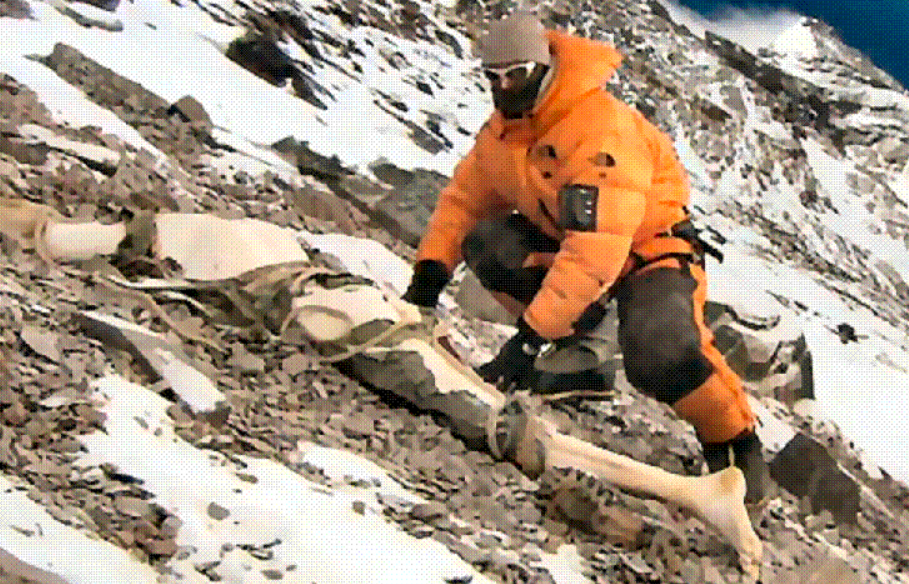
In 1999, a discovery changed everything. An expedition sponsored by NOVA and the Mallory and Irvine Research Expedition, led by American climber Conrad Anker, found Mallory’s mummified body on the north face 693 meters (2271 feet) below the summit.

George Mallory was completely intact, face down, arms outstretched, showing severe head and bodily injuries consistent with a fall. His forehead was puncture with a golf ball-sized defect. His right leg was snapped. A rope and its compression injury mark curtailed his waist, suggesting the two were tethered together when one—possibly Irvine—fell and pulled the other down.

Mallory’s clothing, pack, and provisions were still with him. His stitched-leather, cobnailed boots were as perfect as the day he laced them. His pack, being as light as necessary to be for this stage of the climb, was consistent with a man who was descending. His tinted goggles were in a pouch, indicating a low light timeframe. His oxygen tanks had been shed…
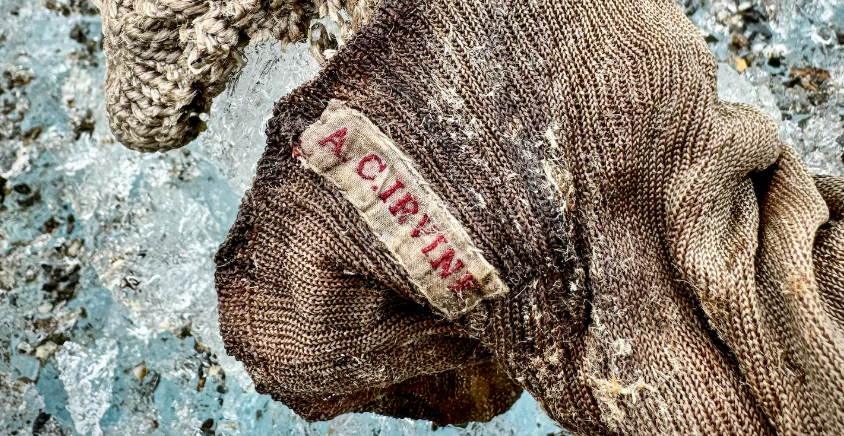
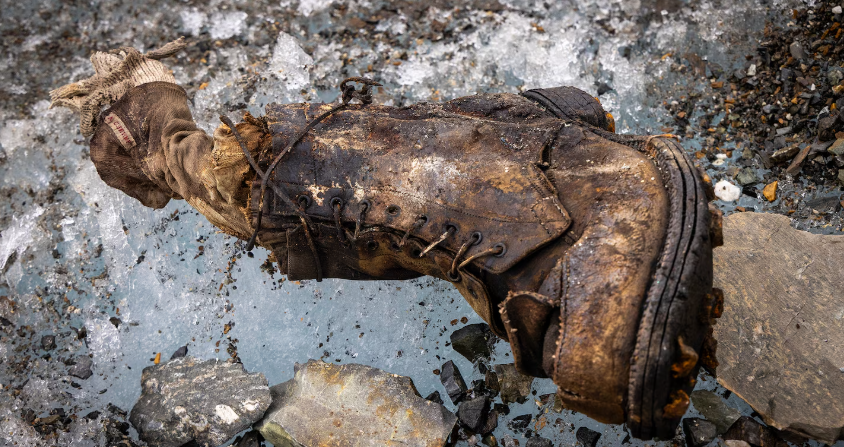
In the fall of 2024, a National Geographic expedition led by Jimmy Chin uncovered partial remains believed to be those of Andrew “Sandy” Irvine. A boot, a sock labeled “A. C. Irvine,” and a foot were emerging from the ice of the Central Rongbuk Glacier, along the northern slope of Everest. These are now confirmed as Irvine’s through familial DNA testing.

Irvine’s discovery site is lower than where Mallory’s body was located in 1999. Mallory was at 8,155 meters (26,760 feet) on the north face. The exact altitude for Irvine’s lower extremety remains has not been publicly specified to avoid Everest souvenier hunters, but reports say they were “at least 700 feet lower” than Mallory’s position.

Put in perspective—Everest’s summit is 8,848 meters (29,031feet). Mallory’s body was 693 meters (2,271 feet) below the summit’s elevation. The Second Step, a 30 meter (98 foot) vertical wall is at 8,610 meters (28,250 feet) so both Mallory and Irvine apparently succumbed at least 693 meters (2,271 feet) below the summit and 455 meters (1490 feet) below the Second Step.

At least that’s what the come-to-rest remains say.
The question is, “How high did the men actually climb?” That can’t be answered by how far they fell. They could have fallen before reaching the formidable Second Step. They could have fallen when ascending the Second Step. They could have fallen right from the summit iself. Or, they could have fallen descending the Second Step returning from the summit.

The camera the pair was known to carry hasn’t ben found. Neither has Irvine’s main remains with his pack and effects, unlike Mallory. No summit photo. No turn back photo. And perhaps most curiously, a photograph of George Mallory’s wife, Ruth—one he promised to place on the summit—was missing from Mallory’s otherwise intact belongings.

That detail haunts Everest historians to this day. The Vest Pocket Kodak camera, which probably Irvine was carrying, has never surfaced. If it still exists—and if the film somehow survived—the truth may still be frozen in time.

Now, let’s revisit the 1953 summit—the one that history officially credits as the first success. On May 29, Sir Edmund Hillary of New Zealand and Tenzing Norgay, a Sherpa of Nepal, definitely reached the summit of Mount Everest via the South Col–Southeast Ridge route from the Nepalese side.

The world celebrated. Unlike Mallory and Irvine, Hillary and Norgay had advantages:

  • A well-established route with prior reconnaissance
  • Modern climbing gear
  • Stronger oxygen systems
  • Superior logistics and base support
  • Detailed weather forecasts

And perhaps most importantly—they had the accumulated knowledge and failures of those who had come before. Their success was built on decades of attempts—including those of Mallory and Irvine. Without the early expeditions, there might have been no Hillary and Norgay.

Returning to the 1924 expedition’s final puzzle pieces. One of the most critical figures is Howard Somervell, who tracked weather patterns during the climb. His journals and barometric data suggest that Mallory and Irvine may have been caught in a brief but brutal storm late on June 8.

If true, that storm could have pushed them back—or killed them outright by blowing them off the mountain.

But the timing of the storm, compared with Odell’s sighting and their likely progress, still leaves open the possibility that Mallory and Irvine reached the summit before the weather closed in. Remember, they were last seen moving strongly upwards at 12:50 pm. Experts estimate they may have had another 3–5 hours of climbing ahead of them, depending on their pace, oxygen levels, weather, and terrain.

Could they have done it? Did Mallory and Invine reach Everest’s summit first?

Some argue yes. Others say no. The Second Step, now surmounted with a fixed ladder, would have been a serious obstacle in 1924. Maybe impossible given the equipment, or lack of equipment, they had.

Reinhold Messner, who is a prominent world mountaineer having solo climbed Everest without oxygen, once attempted the Second Step without a ladder. Messner remarked, “The Second Step is the key to the whole mystery. Free climbing it at this altitude, with that equipment… I have my doubts.”

But Mallory was a bold, skilled climber. And there’s that missing photo of Mallory’s wife. Why would it not be on his body when everything else was intact—unless he’d already left it on the summit?

So… did they make it? Were George Mallory and Sandy Irvine the first to crown Mount Everest? Let’s weigh the evidence.

The Case For a Successful Summit

  • Odell’s sighting places them high on the ridge at a good time of day.
  • They had functioning oxygen and decent weather early on.
  • Mallory’s missing photo of his wife may suggest he left it at the top.
  • Their drive, fitness, and skill were extraordinary for their time.

The Case Against

  • The Second Step was thought unclimbable without modern gear.
  • No physical proof—summit photo, journal entry, or reliable witness.
  • Weather may have turned faster than Somervell recorded.
  • The remainder of Irvine’s body and the camera are still missing.

Will we ever know?

That depends on whether the camera is found—and whether its film survived. Kodak experts have said that the cold may have preserved the negatives. But time and entropy are not on our side.

The harsh Everest climate, political restrictions on access, and the dangers of high-altitude recovery missions make future searches uncertain. Still, modern expeditions have better tools—LIDAR, drones, satellite imagery, and sophisticated weather modeling. And the fascination with Mallory and Irvine hasn’t faded. Their story still inspires climbers, historians, and truth-seekers alike.

My Take?

George Mallory and Andrew Irvine didn’t die in vain. Whether or not they summitted, these two pushed the edge of human potential. They risked everything to reach a place no one had ever been. And to boldly go where humans were destined to go.

In doing so, Mallory and Irvine became eternal figures in the Everest portfolio. Not just for what they did, but for what we still wonder about—why men climb mountains.

As for that summit… on the balance of probabilities… I think they might have made it… probably not… then again maybe… um, nah. But until that little Kodak camera is found, and the film is developed, Everest keeps its secret.

And maybe that’s the way mountain climbing is supposed to be.
Dyingwords.net is powered by a Centaur Intelligence System and the EXPONENTIAL Thought Engine
Centaursystems.ai

CONTRASTING MINDSETS — US NAVY SEALS AND OSAMA BIN LADEN

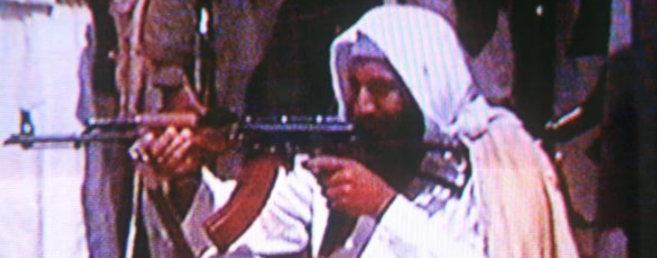
On the night of May 1, 2011, the world’s most feared terrorist faced the world’s most elite warriors. Inside a walled compound in Abbottabad, Pakistan, Osama bin Laden—architect of the September 11th attacks—looked into the night-visioned eyes of U.S. Navy SEALs who’d come to terminate his long campaign of terror. In those seconds, two contrasting mindsets collided. One belonged to a man who built his life around grievance, ideology, and spectacle. The other belonged to men forged by discipline, resilience, and precision. The result was not just due process, justice finally dispensed for a criminal. It was the resolution of a psychological clash that shaped the opening decades of the twenty-first century.

That’s the story I’m going to tell. It’s not just about the 9/11 attacks or the raid that eliminated bin Laden. It’s about how two very different psychological systems met in violent contact and why the outcome was inevitable. To understand this, we need to walk through the history of the United States Navy SEALs, the life and mind of Osama bin Laden, the attack that shocked America, the hunt that followed, and finally, that conclusive night in Abbottabad.

You already know the headlines. What follows is the deeper narrative. This is the inside story of how discipline defeats dogma, how precision defeats spectacle, and how the rarest psychological traits on earth—the mindset of a US Navy SEAL—were brought to bear on the most dangerous and despicable ideologue of our time.

Before we get to Abbottabad, though, let’s step back. Let’s look at how the SEALs became who they are, how bin Laden became who he was, and how their fate was destined to cross. This is a story of preparation and obsession, of training and indoctrination, of truth and delusion. And ultimately, it’s a story of how two mindsets—so opposite, so irreconcilable—combatted to the death in a single house on a single night of a single point in history.

Forged in Water, Fire, and War: The Making of the U.S. Navy SEALs

The Navy SEALs  trace their lineage back to World War II. Long before they became the shadow warriors of modern times, they were demolition divers clearing beaches in the Pacific. They were the Scouts and Raiders who landed in North Africa. They were the frogmen who swam ashore under fire to blow obstacles for the Marines at Normandy and Okinawa. They were the men of the Underwater Demolition Teams, testing the limits of human endurance in the world’s oceans.

By 1962, the United States needed a dedicated maritime commando force. President John F. Kennedy, a believer in unconventional warfare, signed off on creating the SEALs—Sea, Air, and Land forces who could go anywhere, anytime, under any conditions. Teams One and Two stood up that year. Vietnam became their proving ground. In the jungles and deltas, the SEALs earned their reputation as silent professionals who could infiltrate, strike, and disappear. Their tools weren’t ideology or speeches. Their tools were training, teamwork, and precision.

As decades passed, the SEAL program evolved. The Cold War demanded specialized skills—combat diving, parachuting, demolition, foreign internal defense. The modern War on Terror demanded more still—counterterrorism, hostage rescue, urban warfare, cultural training. The SEALs became masters of versatility. By the time of 9/11, they were already recognized as the pinnacle of small-unit special operations.

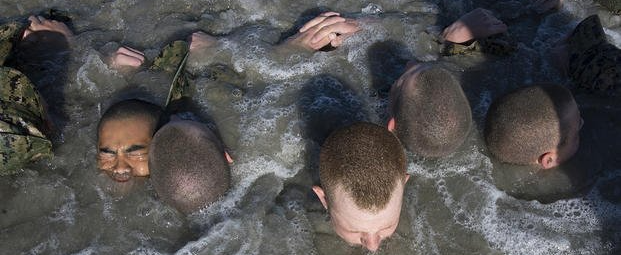
But what sets a SEAL apart isn’t just physical capability. It’s the mental forge of their training. Only about one in ten who start the process ever make it. The crucible is BUD/S—Basic Underwater Demolition/SEAL training. Here, men are pushed beyond the breaking point. Hell Week alone crushes most: five and a half days of near-constant exertion, two hours of sleep total, 200 miles of running, 20 hours of physical activity each day. The body breaks down. The mind screams to quit. Only those with extraordinary psychological resilience carry on. That’s the essence of a SEAL: not someone stronger than others, but someone who simply refuses to quit.

The Life and Mind of Osama bin Laden

To understand the clash, you need to understand the man the SEALs faced. Osama bin Laden was born in Riyadh in 1957, the son of Mohammed bin Laden, a Yemeni immigrant who built the Saudi Binladin Group into a construction empire. Osama grew up in wealth but was shaped by religion more than business. In his university years, he fell under the influence of radical clerics like Abdullah Azzam. The Soviet invasion of Afghanistan in 1979 gave him purpose. He funded, fought, and organized in the name of jihad. Out of that crucible, al-Qaeda was born.

Bin Laden’s worldview hardened into absolutes. He saw Islam under siege from the West and saw himself as chosen to defend it. His rhetoric targeted America as the “far enemy”—a power whose presence in Saudi Arabia and support for Israel represented, in his eyes, an intolerable desecration. His solution was not negotiation. It was spectacle. He believed acts of catastrophic terror would awaken Muslims worldwide and topple regimes he saw as corrupt. His weapon was not just violence. It was theater.

Psychologically, bin Laden combined ascetic discipline with narcissistic grandiosity. He lived modestly yet believed he was chosen by God for a global mission. He was calm, soft-spoken, even polite in personal settings. But his calm concealed a mind that justified mass murder as holy duty. He had high-average intelligence, enough to think strategically and orchestrate complex operations. But his intelligence was enslaved to ideology. He didn’t test his assumptions against reality; he forced reality to fit his narrative. That rigidity made him both dangerous and, in the long run, doomed.

The SEAL Mindset: Why They’re Rare

If bin Laden’s psychology was built on ideology, the SEAL’s psychology is built on discipline. Mental toughness is their signature trait—the ability to keep going when the body fails, to remain calm when fear surges, to act decisively under extreme stress. Emotional regulation is drilled into them. Stress inoculation is part of training: repeated exposure to chaos until chaos feels like routine. They learn to toggle between tunnel vision—watching a doorknob, a hand, a wire—and wide-angle awareness of the mission. They learn to suppress ego and channel fear into focus.

What makes this mindset rare is not strength alone. It’s adaptability. SEALs aren’t trained to believe in absolutes. They’re trained to absorb failure, learn, and adjust. Every mission ends with an after-action review where mistakes are dissected ruthlessly. Lying is unacceptable. Reality must be faced, because reality keeps teammates alive. This feedback loop inoculates them against dogma. It makes them dangerous not because they’re fearless, but because they’re precise.

The SEAL’s strengths are obvious: resilience, adaptability, teamwork, precision. Their vulnerabilities are subtler. Overconfidence can creep in. Repeated deployments take a toll on families and minds. PTSD and moral injury are real risks. But in the moment of action, the SEAL’s mindset is the closest thing humans have to engineered resilience.

September 11, 2001: The Clash Begins

The 9/11 attacks were the moment bin Laden’s ideology struck America at scale. The plot was proposed by Khalid Sheikh Mohammed and approved by bin Laden. It weaponized a simple vulnerability: unguarded cockpits on commercial airliners. Nineteen men, radicalized and trained, boarded four planes on a clear Tuesday morning. Within two hours, the world changed.

At 8:46 a.m., American Airlines Flight 11 slammed into the North Tower of the World Trade Center. At 9:03, United Airlines Flight 175 hit the South Tower. At 9:37, American Airlines Flight 77 tore into the Pentagon. At 10:03, United Flight 93 crashed in a Pennsylvania field after passengers fought back, saving either the Capitol or the White House from destruction. By 10:28, both Twin Towers had collapsed, killing thousands.

Why wasn’t it stopped? Intelligence fragments existed—reports of hijacking plots, men training in flight schools. But the U.S. intelligence system was fragmented, siloed, and focused on state actors rather than non-state terrorists. The FBI had pieces. The CIA had pieces. No one connected them in time. It was a failure of imagination as much as information.

The toll was staggering. Nearly 3,000 dead, more than 6,000 injured, a skyline destroyed, a nation traumatized. And bin Laden achieved his spectacle: a world watching America burn live on television. But he also provoked what he hoped for least: an American response that would hunt him relentlessly for a decade.

The Long Hunt

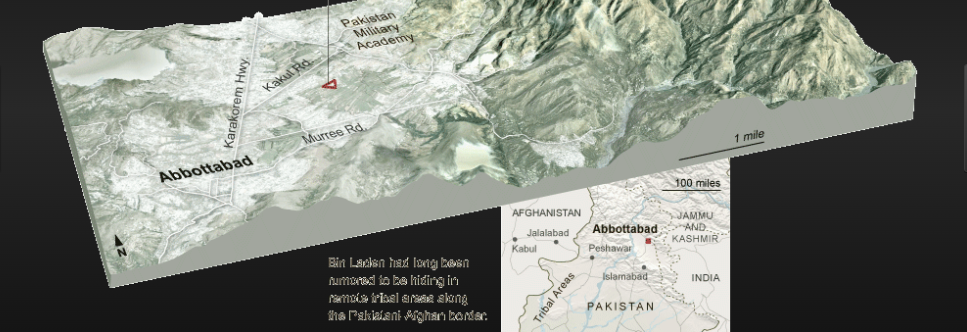
In the years after 9/11, bin Laden vanished. He lived by courier, cutting himself off from phones, emails, and direct contact. The CIA traced the couriers instead. Patiently, over years, they zeroed in on one in particular. Surveillance led to a compound in Abbottabad. It was strange—tall walls, no internet, no phone lines, trash burned instead of collected. Inside, a tall man never left the property. Analysts called him “the pacer.” Could it be bin Laden?

The conclusion was never absolute. But it was compelling. Who else would live like this? The intelligence community presented the case to President Obama. Options were weighed: a targetted airstrike, a joint operation with Pakistan, or a U.S.-only special forces raid. The raid was chosen. It offered the chance not only to kill or capture bin Laden, but also to gather intelligence and confirm his identity beyond doubt.

Operation Neptune Spear

The SEALs chosen for the mission trained on full-scale replicas of the compound. Night after night, they rehearsed. They drilled contingencies—crashed helicopters, armed resistance, booby traps. Every man knew his role, every sector, every stairwell. When the night came, they were ready.

On May 1, 2011, just before midnight in Pakistan, two MH60 Stealth Hawk helicopters lifted off from Afghanistan. They flew low, avoiding radar. As they reached the compound, one helicopter lost lift and crashed inside the courtyard. Training took over. The SEALs spilled out, secured the perimeter, and pressed forward. The second helicopter set down outside. The mission adapted in seconds.

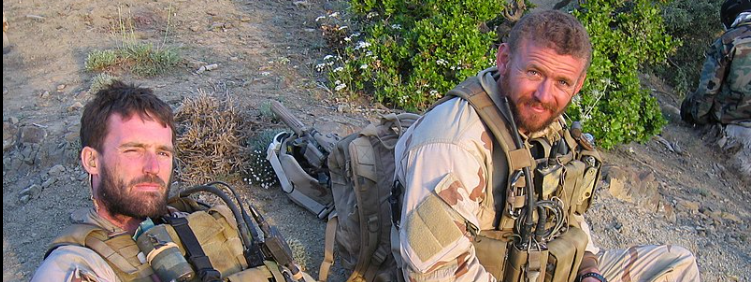
Room by room, the SEALs cleared the compound. Armed men were killed. Women and children were moved to safety. Explosive charges opened doors and walls. The team advanced floor by floor. On the third floor, they found him. Osama bin Laden. Tall, bearded, moving among his family. He was unarmed but resisted in the sense that he did not surrender. SEAL training leaves no ambiguity in such a moment. A designated high-value target at close range, potentially wired with explosives, must be neutralized instantly. Bin Laden was shot in the chest and in the head. He died instantly.

The SEALs secured the room, identified the body, and continued. Documents, hard drives, and media were seized. The body was flown out. Within 24 hours, DNA and facial recognition confirmed identity. Burial at sea followed Islamic practice and denied al-Qaeda any shrine. The mission lasted about forty minutes on the ground. It was executed with precision despite unforeseen setbacks. For the SEALs, it was the culmination of years of preparation. For bin Laden, it was the collapse of a narrative built on invincibility.

The Collision of Mindsets

In those final moments, two psychologies confronted each other. The SEALs entered with disciplined narrow focus. They weren’t thinking about history. They were thinking about sectors, corners, triggers, and checklists. Their ego was suppressed. Their training was ascendant. Their mindset was about control—control of themselves, control of the situation, control of violence.

Bin Laden, by contrast, faced the collapse of control. For years, he believed distance and secrecy would keep him safe. He’d reduced war to abstraction, conducted by others at his command. Now, in his own room, that abstraction shattered. The Americans were there, at arm’s length, guns leveled, no lectures, no negotiations. In that instant, his ideology had no answer. Whether he reached for martyrdom or denial, the outcome was the same. His narrative ended in silence.

Why Discipline Defeats Dogma

The story of 9/11 and Operation Neptune Spear is the story of two mindsets driving into an inevitable crash. Osama bin Laden built his life on grievance, ideology, and spectacle. The U.S. Navy SEALs built theirs on discipline, adaptability, and truth. One saw violence as theater. The other saw it as a tool to be controlled with precision. One denied reality. The other faced it relentlessly.

In the end, the outcome was certain. The SEALs closed in. Bin Laden had no escape. His psychology could not adapt, could not accept, could not resist the impact. The SEALs’ mindset—rare, disciplined, and precise—prevailed. That’s the lesson. In a world of ideologies and delusions, it’s discipline and truth that endure.

Powered by a Centaur System
centaursystems.ai

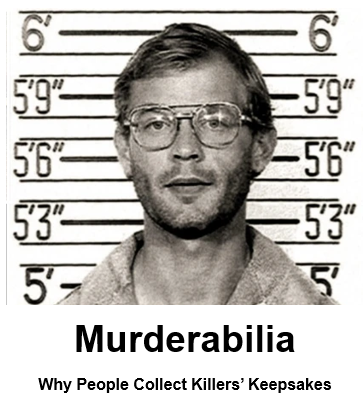
MURDERABILIA — WHY PEOPLE COLLECT KILLERS’ KEEPSAKES

There’s a market for almost anything—even the belongings of serial killers and mass murderers. A painting, a lock of hair, a handwritten note from a prison cell—ordinary objects become strangely valuable when they’re tied to a nefarious name. This is the shadow trade of murderabilia, a growing subculture where true crime and macabre profit collide as collective commerce.

It exists quietly but persistently, tucked away in online forums, niche marketplaces, and private transactions between collectors who don’t advertise their passions in polite company. To some, these items are artifacts of criminal history. To others, they’re trophies—tangible reminders of society’s darkest impulses.

Whatever the reason, whatever the cause, the demand is real. And it’s not going away.

Murderabilia refers to physical items linked to people who have committed murder—often serial killers or perpetrators of horrific crimes so notorious that their names became permanently etched into the public imagination. These items can include original artwork, clothing, letters, trial documents, typewriters, glasses, personal effects, and even body parts like hair or nail clippings.

Charles Manson’s hair had been repeatedly cut, bagged, and sold online. John Wayne Gacy’s clown paintings routinely fetch thousands of dollars. Ted Bundy’s courtroom glasses were bought for fifty grand by a Las Vegas collector. And a patch of dirt from a serial killer’s backyard burial site has gone for above the price of an eco-vacation.

The more infamous the name, the more valuable the relic. And it’s not just objects. It’s energy, mythology, and status. Collectors don’t just want to see the darkness. They want to own it.

What Gets Sold and How

John Wayne Gacy—convicted of murdering 33 young men and boys in the 1970s—was a prolific painter while on death row. His most well-known subject: himself, dressed as “Pogo the Clown.” Many of these paintings were gifted or sold before his execution in 1994. Today, some sell for upward of fifty grand.

One of Gacy’s most infamous pieces—a depiction of his own house, crawlspace included where only he knew where the bodies were buried—was acquired by a collector for $175,000. Not because it was artistically brilliant. Because it carried an emotional residue no canvas from a gallery ever could.

Charles Manson left behind a trail of physical and symbolic debris. Among the most traded items linked to him are strands of hair, prison letters, and drawings. His hair was sold in small clumps—carefully snipped during visits or grooming sessions—and vacuum-sealed for authenticity. A few letters, scribbled in his erratic penmanship, have sold for thousands apiece.

Then there’s Ted Bundy.

The glasses he wore during his trial became one of the most widely circulated items of murderabilia in recent years. They were purchased by collector and museum curator Zak Bagans for $50,000 and now reside in his Las Vegas “Haunted Museum,” where visitors pay to get close to evil—without the risk.

Even objects on the fringe, like Rex Heuermann’s Vietnam-era Jeep or his junior-high yearbook, made it onto eBay in 2025 before any verdict had been reached. The connection to potential violence was enough to drive bidding. Nothing needed to be proven as the scent of infamy was enough.

One seller posted baggies of dirt taken from the property where serial killer Dorothea Puente buried her victims. Asking price? $5,000 each.

It’s not about aesthetics. It’s about association. In this world, provenance trumps beauty every time.

Who’s Buying and Why?

Trying to understand murderabilia means entering the mind of the collector—not to excuse, but to examine. Psychologists who’ve studied this behavior agree: the drive is rarely about morbid curiosity alone. It’s more complex than that.

Dr. Katherine Ramsland, a forensic psychologist and prolific true crime author, describes the phenomenon as attraction to an “aura.” She argues that some people believe these objects hold an invisible energy—residual power from the crime itself. Ramsland likens it to religious relics. Where some people seek grace through a saint’s bone, others seek dread through a killer’s belongings.

Criminologist Scott Bonn coined the term talisman effect to describe how certain individuals believe these items give them power, protection, or access to something primal. It’s about owning darkness without being consumed by it. Getting close to evil without crossing the line.

There’s also the thrill of taboo. In a world that increasingly flattens identity through digital sameness, owning something truly forbidden becomes a way to feel exceptional. It signals rebellion. Difference. Edginess. You don’t just like true crime—you own a piece of it.

Some collectors refer to themselves as preservationists. They argue that history—however gruesome—should be preserved, not erased. That’s why many seek letters, court transcripts, or even artwork created by incarcerated individuals. For them, it’s not about celebrating the crime. It’s about studying it. Cataloguing it. Holding it up as a reminder of what humans are capable of.

But others are drawn to murderabilia for less noble reasons.

Dr. Michael Apter, in his research on reversal theory, notes that risk-seeking behavior often thrives when it’s framed as “safe.” In the context of murderabilia, you can own a killer’s belongings—hold them in your hands—without ever being in harm’s way. It becomes a controlled form of fear. A way to manipulate mortality.

That’s a heady cocktail. Power, rebellion, access, and status—all wrapped into one.

The Hybristophilia Link

There’s another psychological concept that intersects here. Hybristophilia. It’s defined as the romantic or sexual attraction to people who have committed violent crimes. While often applied to people who write love letters to serial killers on death row, it has connections to murderabilia as well.

Some collectors blur the line between fascination and fixation. They want not only the story—but intimacy with the person behind it. For them, the artifact isn’t just a souvenir. It’s a substitute for contact. A way to feel connected to someone who, in another context, might have been a fantasy figure.

The fact that these fantasies are rooted in horror only heightens the attraction. It’s dangerous. It’s forbidden. And that’s the point.

Where It’s Sold and Who Profits

The mainstream marketplace has largely rejected murderabilia. eBay banned it in 2001 after public backlash. Etsy won’t allow it. Facebook groups are shut down routinely for violating community guidelines.

But the demand didn’t die. It migrated.

Websites like MurderAuction.com, Supernaught, and the now-defunct Serial Killers Ink cater to this niche. Items are listed with disclaimers, verified through personal letters, certificates of authenticity, or connections to prison contacts. The collectors—while secretive—are consistent.

Some sellers are former prison guards, lawyers, or family members of inmates. Others are repeat buyers who became dealers over time. And a few, disturbingly, are the killers themselves.

When laws don’t prohibit it, some inmates create and sell artwork, autographs, or written confessions—often with help from outsiders. A 2010 federal attempt to stop this—the Stop the Sale of Murderabilia Act—never passed. As a result, enforcement is patchy. Some U.S. states like California and Texas have banned inmates from profiting off crime-related sales, but loopholes remain.

One workaround? Killers sell “non-crime” items—generic drawings, for example—through intermediaries. As long as they don’t mention the murders, it slips under the radar.

Other collectors trade through private email lists, direct contacts, or invite-only forums. These channels are harder to track—and more profitable for those who know how to navigate them.

Historical Echoes: When Curiosity Crossed into Obsession

Long before eBay listings and niche websites, humans collected the macabre out of fascination. In Renaissance Europe, the cabinet of curiosities—Wunderkammer—was a popular trend. Collectors displayed oddities like preserved animals, human remains, ethnographic relics, and bizarre natural specimens in rooms devoted to wonder and dread. These collections blurred the line between science, spectacle, and the sacred.

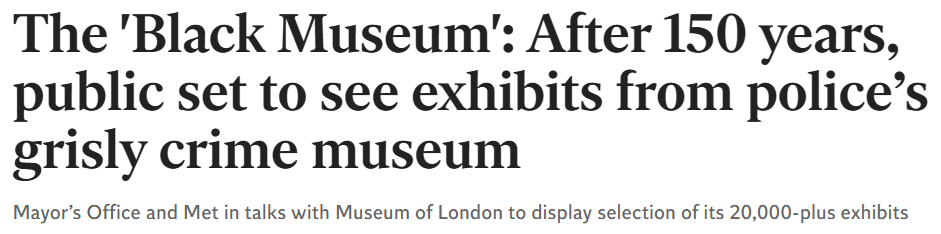
Such collections served to demonstrate status and control over knowledge—even over the horrific. In London, New Scotland Yard’s Crime Museum (aka the Black Museum) began in the 1870s as a teaching tool for officers—storing weapons, masks, and personal items linked to criminals—but was not accessible to the general public, preserving the line between education and spectacle… until recently…

That blending of object, story, and authority laid the groundwork for today’s open—but fundamentally private—murderabilia trade.

What Drives Collectors: Insights from Psychology

Collecting everything from benign memorabilia to deeply unsettling artifacts is surprisingly common. It’s estimated that roughly 30–40% of households engage in some form of collecting, rooted in emotion, identity, or nostalgia—not simply material value. When the object in question is linked to murder, motives become complex and often disturbing.

The “aura” of danger, as forensic psychologist Katherine Ramsland describes it, gives some of these items a kind of residue that collectors seek to capture—a sensation of raw proximity that feels both controlled and thrilling. Harold Schechter, in his writings on murderabilia, notes that such items become relics, “possessing a vibe similar to religious relics,” carrying meaning beyond their material form.

Beyond aura, there’s talismanic thinking—a belief that an object holds power. Criminologist Scott Bonn labels these “talismans,” allowing collectors to touch a form of danger without being exposed to real-life risk.

The thrill of taboo plays a role, too—owning something others condemn becomes a way to signal rebellion and uniqueness. The combination of emotional ownership, identity signaling, and rare collectability adds layers to the psychology behind murderabilia.


Ethical Fault Lines: Victim Voices Versus Collector Claims

Collectors often claim to preserve history or demystify taboos. Some even approach the practice with a veneer of academic interest. As one collector told Oxygen.com, “I understand why it rubs a lot of people the wrong way… but I know a lot of collectors… that approach it more acceptably”.

Yet victims’ families often see these objects as ongoing wounds. Reducing trauma to trinkets inflicts a secondary harm. The line between preserving history and profiting from tragedy becomes morally suspect—even if legally defensible.

The Media, True Crime Culture, and Murderabilia

Media exposure fuels curiosity—and curiosity ignites demand.

Anthropologists note that serial killers have become figures of myth or legend—and murderabilia plays into that mythology. When documentaries, podcasts, or dramatizations enter the mainstream, they humanize the killer in dark ways. That softens the taboo and primes the market.

Collectors don’t live in isolation. They share stories, valuations, provenance, and context through online forums, influencer communities, and specialist blogs. That’s what gives murderabilia symbolic and social capital—a form of prestige in a dark fandom.

The Digital Future: NFTs, AI, and a Dangerous Horizon

What comes next?

Digital replicas—NFTs of handwritten notes, AI-generated “in the style of” killer art—threaten to expand the market beyond physical boundaries. It’s not only about owning a relic—it becomes owning the idea of evil.

Digitization can sanitize horror or amplify it, depending on who’s doing the curating. The transformation from tangible trauma to virtual collectible is not sci-fi—it’s already emerging.

Murderabilia exists because fascination with evil is wired into our culture. It serves as a mirror—revealing a public appetite for boundary-testing, morbid storytelling, and identity via taboo.

Turning tragedy into collectible erodes empathy. It transforms real horror into a commodity. It obscures memory behind commerce.

We have a choice: let murderabilia become more normalized—or confront the cruelty of turning horror into hobby. Horror isn’t collectible.

Historical Lineage: Legends, Cabinets, Curiosities

Collectors long have assembled odd and unsettling objects—not merely for display, but as a way to assert mastery or provoke wonder. In Renaissance Europe, cabinets of curiosities (Kunstkamers or Wunderkammer) displayed exotic seashells, taxidermied oddities, and artifacts from distant lands.

These collections blurred lines between science, theology, and spectacle, doubling as status symbols and intellectual outposts. They weren’t always clean or academic—sometimes they were fantastical, pushing the boundaries of fact and myth.

Historical precedents show that curiosity about crime isn’t new—but today, collectors blur the lines between legal study, voyeurism, and commerce.

What the Research Says: Emotional and Economic Drivers

In academic circles, murderabilia collectors blur emotional devotion with commodification. A study based on interviews with collectors found that many view these items as “rarer memorabilia”—not just collectible, but symbolic emotional anchors, sometimes described as buying and enjoying evil.

Another psychological insight comes from Katherine Ramsland: possessing murderabilia lets collectors “experience the killer’s aura from a safe distance.” That phrase describes it neatly—thrill without threat, dread without danger.

Big Think tangibly suggests that serial killer art might be more fruitfully used for research than auction: it offers clinicians insights into pathologies rather than sensational memorabilia.

Anthropologists studying murderabilia networks have observed that these items also offer symbolic capital among enthusiasts—like badges in a niche fan community. Ownership means prestige, if clouded in taboo.

What People Actually Buy and Why It Matters

Let’s examine additional documented artifacts and their meaning—not just their price.

  • A BTK killer (Dennis Rader) letter page surfaced for sale at around $2,000 because the collector saw the value in Rader’s signature touches—literally. The aura, again, gave it worth.
  • Wayne Lo, the Bard College shooter, auctioned his own artwork online—not as grim prints but as “creative work.” The controversy this triggered reignited public debate: where does art end and exploitation begin?
  • Ted Kaczynski (Unabomber) items—journals, tools, even trivial ephemera—were seized and publicly auctioned in 2011. But the key point is: proceeds went to victims—a model of turning tragedy into restitution, not to novelty.

These examples highlight moral distinctions: Is the collector preserving or profiting? Is the victim’s dignity honored—or overshadowed?

Ethics Versus Free Markets

Legal attempts to ban murderabilia have had mixed results. eBay prohibited murder-related content in 2001—restricting listings until 100 years after the event. Some states (including Texas, New Jersey, California, Michigan, Utah) passed “Son of Sam” -style laws preventing murderers from profiting. Even a federal bill in 2010 tried to outlaw murderabilia trade—only to stall and die in committee.

If the item isn’t directly tied to the crime—sold by someone not the murderer—the laws struggle to intervene. The distinction between “collector” and “colluder” remains murky.

Where You Can Buy Murderabilia

If you’re into it, and can afford it, there are online sites where you can add murderabilia to your shopping cart. Most will take prominent credit cards or collect through Paypal. But caveat emptor. Buyer beware.

These are the main murderabilia merchants:

Where This Could Go Next

The internet has broadened the audience, and there’s no obvious upper limit to the marketplace’s evolution. Future trends to watch:

  • Digitized Murderabilia: NFTs of killer confessions. AI virtual recreations of crime scenes so vivid you’ll think you are there. Digital “possessions” tied to killers—real horror, virtual shelf-space.
  • Institutional Canonization: Imagine true-crime museums embracing these objects for educational or artistic purposes—but where do you draw the line between legal-sanctioned memorial and morbid spectacle?
  • Clinical Research Use: Big Think argues for donating serial killer art to psychologists instead of auction houses. It’s a shift from sensationalism toscholarship.

This subculture echoes a deeper societal fissure. At one end, murderabilia reflects a shallowness—a society turning tragedy into collectible trend. It dehumanizes the most brutal of experiences through curiosity turned product.

But on another level, it holds a mirror up to collective trauma. Even the most morbid display stems from a need to confront evil—to own a piece of it, interpret it, master it—and survive. That impulse can flicker between macabre obsession and meaningful reflection.

The question remains. Will murderabilia evolve toward informed preservation—or devolve into digital replicas of grief, normalized and devoid of empathy? If curiosity drives collection, let empathy guide its limits but, for whatever reason, there’ll always be murderabiliasts. People who collect killers’ keepsakes.