
Author Archives: Garry Rodgers

About Garry Rodgers

After three decades as a Royal Canadian Mounted Police homicide detective and British Columbia coroner, International Best Selling author and blogger Garry Rodgers has an expertise in death and the craft of writing on it. Now retired, he wants to provoke your thoughts about death and help authors give life to their words.

FUGU—DEATH BY THE SASHIMI PUFFERFISH

Most folks think great white, tiger and mako sharks are the world’s most deadly fish. They’re dangerous, all right, but the deep’s deadliest distinction goes to the cute little pufferfish you remember from Disney’s Little Mermaid. Also called blowfish and sunfish, these sashimi delicacies known as fugu kill 10 times more people per year than sharks. And they do it a lot slower and far more viciously.

Shark attack deaths are super rare. Sharks kill an average of 5 people each year worldwide, although statistics show at least 80 violent human to shark encounters happen annually. Most shark victims are seriously injured like having an arm or leg torn apart, yet somehow survive. Not so with pufferfish poisoning.

Pufferfish death statistics are hard to nail down, but the World Health Organization and an article in National Geographic confirm at least 50 people expire every year after ingesting neurotoxins found in pufferfish livers, ovaries, testicles, intestines and skin. Hundreds more become seriously ill and only bounce back through immediate medical intervention.

What makes pufferfish so toxic is tetrodotoxin. It’s 1,200 times more powerful than potassium cyanide which the Nazis used in their poison pills. Tetrodotoxin is the world’s deadliest substance by volume next to anthrax and a chemical inside the tropical cone snail. In fact, tetrodotoxin is far more lethal than venom found in the common death adder and the notorious taipan snake. Injecting 1 microdot of pure tetrodotoxin will kill the average-sized human. That’s equivalent to 10 nanograms, which is an amount impossible to see with the naked eye.

So why are powerfully poisonous pufferfish such a preferred palatable pleasure?

It’s because specialized fugu chefs know how to safely filet this culinary delight. In Japan, where fugu is so popular, chefs undergo a state-required licensing program. Apprentice fugu chefs train for 3 years before taking a written, oral and practical exam on the 30 prescribed steps for properly preparing pufferfish. Only a third pass.

Fugu chefs are extremely cautious about processing their pufferfish. They meticulously remove the toxic parts and treat the offal like nuclear waste. Pufferfish flesh is delicate and exceptionally tasty. The Japanese have a high demand for this sashimi dish, but it’s popular all through the warm water world where pufferfish naturally occur.
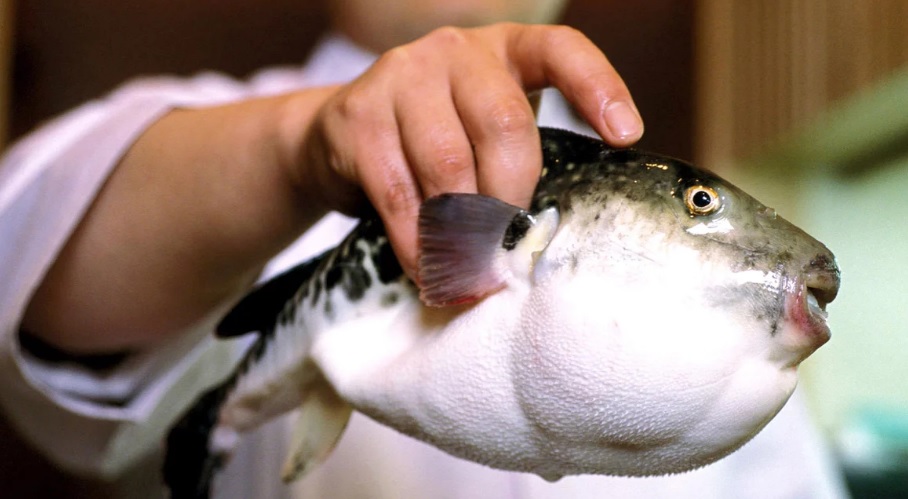
There are over 120 different pufferfish or tetrodontiforme sub-species. An adult dwarf blowfish is only an inch long and too small for a meal. But the largest fugu fish reach two feet in length and weigh up to five pounds. Pufferfish get their common name from a defensive ability to swallow water and expand their stomachs up to four times. Blowing into a ball shape makes pufferfish hard to grip by predators’ teeth. Many sub-species have sharp, poisonous spikes on the skin surface which lay flat when uninflated. However, when alarmed and expanded, pufferfish turn into deadly mines.

Pufferfish don’t manufacture tetrodotoxin within a body system.

Rather, tetrodotoxin is a byproduct made by invasive bacteria that pufferfish ingest in their food. Snails are the main part of pufferfish diet. These subtle sea creatures contain a combination of alteromona, shewanella and vibrio bacteria which react with pufferfish innards to isolate tetrodotoxin. Evolution created a pufferfish immunity to the toxin where sodium channels are mutated. This is why the bacterial doesn’t kill its host.
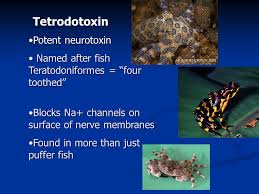
But tetrodotoxin certainly tries to kill anything trying to eat a pufferfish, particularly human beings. It does this by molecularly bonding to cells and blocking the sodium channels which allow neurological information instructing cells to be elastic. When sodium channels are blocked, cells remain neutral or paralyzed. If enough tetrodotoxin is taken, the victim suffers total paralysis including the diaphragm’s ability to move. There’s no lung inhaling or exhaling and the stricken person smothers while remaining totally conscious.

It’s a nasty way to die—lying there with eyes open and knowing the end is near. But not all pufferfish poisoning patients die. It greatly depends on the amount or dose of tetrodotoxin consumed. It also depends on having medical assistance present. Standard treatment for tetrodotoxin cases is keeping the ailing victim on mechanical ventilation while the person metabolizes the toxin and excretes it. This can be several days or even weeks if a person becomes comatose. There’s no known antedote.

Even the slightest amount of tetrodotoxin will cause discomfort and distress.

First, the lips and face feel tingly. Similarly, the finger and toes tips are affected. Headache, nausea and vomiting follow. Then total muscular paralysis occurs along with the inability to breathe. Respiratory failure causes a loss of oxygenated blood to the heart and the patient suffers cardiac arrest.
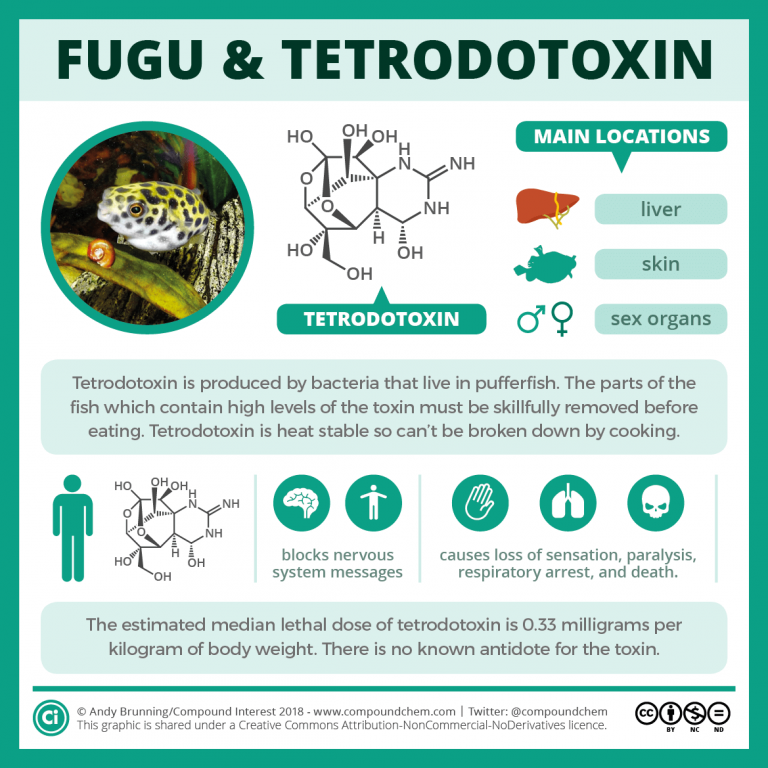
Tetrodotoxin is non-soluble in water and heat resistant. A chef can’t flush tetrodotoxin from pufferfish sashimi flesh. Nor can they cook it out. But tetrodotoxin never occurs naturally in pufferfish flesh. It’s only introduced when an organ is punctured. Once the flesh is contaminated by a leaky liver, gut, bladder, or reproductive organ, it’s impossible to rid. It’s also impossible for the untrained eye to spot a leak as the toxin is colorless.

Despite pufferfish being so dangerous, there’s no hesitation to eat the stuff.

Japan is the largest fugu-consuming country. It’s an important part of their culinary culture. Fugu is a seasonal commodity as the fish’s toxicity is directly related to water temperature. Even though pufferfish require warm, sub-tropical water, tetrodotoxin intensity stays relatively low during the fall and winter when waters are cooler. Once the spring and summer heat hits, the bacteria blooms and pufferfish become far too toxic to risk handling. Even pufferfish urine absorbed through the skin can be lethal.
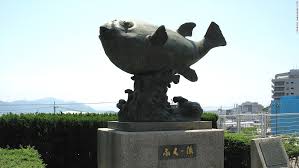
The finest fugu pufferfish come from the Shimonoseki region in southern Japan. It’s a city of 250,000 and boasts 500 licensed fugu chefs. Shimonoseki’s fish market is a Mecca for fugu aficionados. It’s world renown in fugu circles, having a giant brass pufferfish statue outside. Live and processed pufferfish are shipped worldwide every day from Shimonoseki and command the industry’s highest price.

The fugu fishing industry is tightly regulated with a restriction on licenses. Fishing openings are on a lottery base and apply daily. Shimonoseki’s fugu market processes over 300 tons of pufferfish yearly. Every day, the market hosts a pufferfish auction where buyers secretly bid with the auctioneer by hand signals concealed in a black cloth bag. This way, no one knows the current price except the successful bidder and auctioneer. This allows fluctuating market prices which is considered healthy for the fugu industry.

Fugu dining isn’t just a palatial experience.

The Japanese have fugu down to an art form. Not only are fugu chefs trained not to poison customers, they’re skilled at delighting guests who will pay $200-300 USD for a fugu dinner. Most fugu is sliced as ultra-thin shimini wafers and accompanied with sushi rice rolls and sauces. This is expected, but the presentation can be breathtaking.
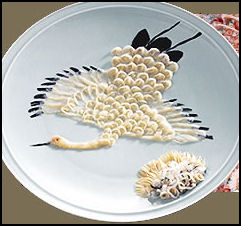
Top fugu chefs take enormous pride and enjoy tremendous recognition for preparing and presenting their pufferfish. Commonly, fugu platters are laid out in traditional Japanese patterns representing swans and chrysanthemums. They’re a thing of beauty and so is how a fugu dinner unfolds.

Most fugu dinners run from five to seven courses eaten over several hours. The best fugu restaurants have live tanks where guests pick their personal pufferfish. It’s then prepared in front of the table with the fugu-master fileting the fish and plucking the poison. Guests are progressively served raw or shimini-style fugu followed by cooked fugu in soups, stews and hot saki.

But for every honorable and noble fugu establishment, there are always those pushing the rules.

Believe it or not, there’s a flourishing fugu black market where patrons seek seedy sushi saloons. Some fugu daredevils thrive on devouring fugu tainted with tetrodotoxin. They claim it gives them an incredible high found nowhere else. And where there’s a buck to be made, someone will take it.

Finally, there’s a fugu subculture with its own rules and regulations. For instance, it’s considered bad manners to ask someone else to first try a fugu serving in fine restaurants. It’s also considered crude to take a fugu bite, then mockingly grasp the throat and recoil in agony. And no patron should ever appear shocked when presented their fugu bill.

RACHEL AMPHLETT—A CRIME THRILLER/INDIE AUTHOR GOLDEN GEM

Every so often, golden writing skills shine through to the surface. Raw storytelling rocks become polished gems. They combine memorable words into unforgettable stories of espionage tales and detective adventures that captivate our imagination. Page by page, we follow twists as they totally tanglethen shock us with stunning solutions. And today, no crime thriller writer shines brighter at this than internationally acclaimed author, Rachel Amphlett.

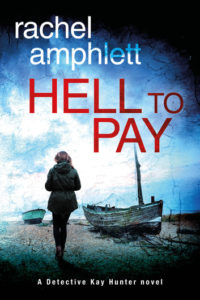
Rachel Amphlett isn’t one to watch for. She’s already here. Rachel is the creative mind behind her Dan Taylor espionage and Kay Hunter detective series. Both are wildly successful as indie publications. Rachel Amphlett is also an amazing example of entrepreneurship. She’s both writer and promoter—a true hybrid business person who knows what truly works in today’s hyper-competitive indie writing and publishing worlds.

Rachel also has a great sense of humor. Otherwise, we’d never be friends and she wouldn’t be silly enough exposing her busy self in a DyingWords chat.

*   *   *

Hi Rachel! Why do you write crime thrillers… what do you see in the genre?

That’s an easy one—it’s what I grew up reading! I started reading before I began school, so I was devouring the Famous Five series by Enid Blyton by the time I was five or six years old.  By the time I was about 12, I’d outgrown what was available for that age group, and so my parents and my grandparents let me loose with their bookshelves. Before long, I was discovering books by Jack Higgins, Dick Francis, Ed McBain, PD James, Elizabeth George and the like. I haven’t stopped reading crime thrillers since!

Why do crime thrillers affect so many people? Is it like why ordinary people can’t resist gawking at gory accident scenes? I just read something that people only pay attention to 3 things—food, attractive people, and danger.

Personally, I think crime fiction is a good way of exploring social issues, and for me as a reader, I like to see the bad guy caught in the end – of course, that doesn’t always happen in real life!

I always liked catching bad guys, too. Back then it was job security and some got away… Setting that asidewhat are the basic crime thriller craft elements?

I studied screenwriting a couple of years ago, and that’s definitely helped me hone my craft. Essentially, I divide up any story into a five Act structure rather than three – that helps me keep the pace moving rather than worrying about that huge middle part otherwise.

I read an interview with author Peter James a year or so ago, and he recommends having what he calls a “gosh, wow!” moment at the end of each of those points in the story – something happens that keeps the reader turning the pages. It might not necessarily be another murder, but the detective might discover something that turns the story on its head and hooks the reader.

Research is important, but story must come first – if I don’t know something, I’ll put a marker on the page (simply, “XXX” or “[find out more about decapitated heads and post mortems]”), and get on with hitting my word count. Then, I’ll find out as much as possible about the subject, and return to fill in that detail.  Not too much, though. You don’t want your readers getting bored. I reckon about 90% of what I know doesn’t go into a book, but it does inform my writing better.

So why are some crime thriller writers are so successful?

They don’t give up 😉

Ah-haa… *suddenly gets it, nods & winks* Okay. What are your writing skills? I mean your writing process and quirks. Also your writing tools. Like, why are you so…freaking… good?

My skills are improving all the time – I’m constantly reading interviews with my writing heroes to learn more about the craft and how they sustain their writing careers. It’s like going back to school. My own writing process in a nutshell is that I’ll have an idea going round and round in my head for a few days, then I’ll start to flesh out the initial scenes. I guess I’m lucky, in that when I get an idea it appears to me as if I’m remembering a scene from a movie, so all I have to do is write it down.

I’ll spend a few days developing a basic framework around that five Act structure, and this includes a few bullet points for about 30% of the book before I dive in and start writing. That basic outline keeps me on track against any deadline, while allowing organic growth from my characters and a few surprises along the way.

I’m an advocate of Scrivener for writing rather than MS Word – for the first draft, at least because it’s so easy to organise scenes. If I can’t get into one particular scene of a morning, then I can simply start working on another one to get my word count target smashed. I’ll export the first draft into MS Word though, and work in that until the manuscript is finalized, and sent off to my editor.

Why’d you choose to go indie? How does your indie process go and how does your writing/editing/publishing team operate?

I got rejected by a number of agents and publishers who, although they provided some fantastic feedback about the original m/s for WHITE GOLD told me that “there wasn’t a market” for that sort of book. Reading between the lines, what they meant was that vampires were big that year, and they weren’t interested in anything that wasn’t in that particular genre!  However, the great feedback about the story gave me the confidence to try another route, and when an Australian mystery author emailed me suggesting I try indie publishing, I jumped at the chance.

It was a very steep learning curve though, and that’s why I like to do these sorts of seminars, because there’s so much bad advice out there, and I want to help people avoid the sort of mistakes I made when I started out.

Currently, my indie publishing process operates as a proper business— once the writing is done, I become the project manager. I hand over the editing, cover design, and blog tour organising to others while I take on the marketing effort required to successfully launch a book. That’s why I detest the term “self-publishing”. None of us does this on our own.

My PR person contacts book reviewers/bloggers to sort out a blog tour a week either side of the book’s publication date and she also arranges for them to do a cover reveal about 6 weeks out from publication to drum up interest. She also organises a Facebook online party on publication day and between us we write to other authors seeking prizes to give away to readers during the hour the party runs.

I manage all the advertising, including paid ads and social media for my business, as well as doing the book-keeping (although I use a chartered accountant to manage all the tax stuff).

On top of that, I work with distributors and aggregators to ensure my books are reaching as many people as possible worldwide, and also work with them to promote my novels through their platforms, such as Kobo and iBooks.

Wow! No wonder you’re killing it! Your marketing plan—what works in indie book marketing & what’s a waste of time?

I recommend that people find a template business and marketing plan online and tailor it to their book business needs – there are plenty available if you Google them, and it’s what I did when I took the decision to make this work for me two years ago. I also recommend that writers don’t simply make that plan for the next 12 months and then forget about it – you need to be constantly reviewing and updating what you’re doing to make this work.

My own business and marketing plan runs for each calendar quarter, as well as providing me with an overview of where I want my business to be in 1, 3, 5, and 10 years.

As for what works in marketing and what doesn’t, that’s an ever-changing beast. I’d recommend signing up for free updates from online publishing news sites such as Publishing Perspectives, and listen to podcasts such as Author Biz and The Creative Penn to find out the latest trends.

At the moment, it’s all about advertising through Amazon Ads, Facebook Ads, and BookBub Ads, but that could all change in six months. The important thing as an indie author is to be agile and open to change.

Hmmm… Your views on social media platforms…

A must for writers – it’s the only way to get visibility for your work. My own strategy is to have a website and Facebook page (not a personal profile) as my mainstays and then use Twitter and Instagram as “outposts”. However, a writer of YA fiction might find that something like Snapchat and Instagram works better for them. You have to be prepared to spend time experimenting.

Best publishing outlets? AZ, Kobo, iTunes, etc?

This comes down to the individual author. Some writers prefer to lock into KDP Select (Kindle Unlimited), whereas others like me prefer to “go wide”. Something like 30% of my sales come through Kobo Canada; another 20% through iBooks Australia, so there’s no way I’m going to lock something like my Kay Hunter series into KDP Select!

If you’re just starting out though, go for KDP Select to find your feet, and then expand using an aggregator like Draft2Digital to reach a wider audience. Again, test, test, test!

Is there a place for print/audio/foreign?

Absolutely! I have audiobooks for both my series, and print for every book I’ve published. Foreign rights are another pillar to your business, and I have sold rights to publishers in Italy and Germany so far for my Dan Taylor series – all without an agent!

Rachel, what you see in book sales/genre/marketing trends?

This goes back to what I was saying with regard to marketing plans—it changes all the time, but I would say take what you see in the press regarding eBook sales declining with a pinch of salt. A lot of indies who are making six figure salaries don’t use ISBN codes, so their sales aren’t factored into a lot of the reports, which skews the data of course.

Romance is always going to be a popular genre to write in, but crime thrillers have an attentive audience, too – it’s about finding a niche you like writing in (and that you read in) and checking out what those successful indie authors are doing that you can emulate.

Getting personal… What’s your dream where you want to be in 5/10/20 years? Yes, this means sticking your neck out.

I’m a traveller at heart, so I want to be in a position where my writing enables me to work anywhere in the world. That’s the five year plan. I expect to have at least 20 books out by then, and to keep learning the craft so I don’t become stagnant in my writing.

Advice for new and old writers?

Don’t be afraid to experiment, but DO analyse the results – whether that be a Facebook ad you’re testing, or a new genre you’re writing in. Don’t spend more than you can afford to, either. And, be easy on yourself. We’re all guilty of comparison-itis, but you must enjoy this to make a career out of it.

And some advice from now to give the future Rachel Amphlett?

Remember to come up for air every now and again!

What stops writers from being superstars like you’re becoming?

They refuse to learn and/or give up.

If you could start over, what would you do differently?

Well, when I started I only wrote for myself so becoming a full-time writer hadn’t even crossed my mind at that point – I just needed to get the stories out of my head. It was only when I was approached in 2014 for the Italian foreign rights to WHITE GOLD that I realised I might be onto something and immediately took a long hard look at what I needed to do to make this work for me. I don’t think I’d do anything differently – you’ve got to remember that back in 2012, indie publishing as it is now was very much in its infancy.

Who are the best crime thriller/indie authors today? Besides you and me. What were their journeys? What did they do right and wrong

Ooh, I wouldn’t like to comment on what they did right/wrong – we all make mistakes, after all. Some of the people I look up to though are writers such as Mel Sherratt, Caroline Mitchell, and Louise Ross—all very smart cookies when it comes to their writing businesses.

Your takeaway for DyingWords followers?

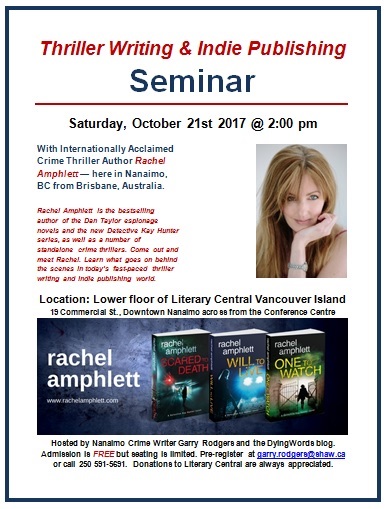
Find out by attending our FREE thriller writing and indie publishing seminar at Literary Central Vancouver Island. It’s at 2 pm Saturday, October 21, 2017 in beautiful, historic, downtown Nanaimo, British Columbia across from the Van Isle Conference Centre. Seating is limited so make sure you pre-register at garry.rodgers@shaw.ca.

*   *   *

*   *  *

Rachel Amphlett is the bestselling author of the Dan Taylor espionage novels and the new Detective Kay Hunter series, as well as a number of standalone crime thrillers.

Originally from the UK and currently based in Brisbane, Australia, Rachel’s novels appeal to a worldwide audience, and have been compared to Robert Ludlum, Lee Child and Michael Crichton.

She is a member of International Thriller Writers and the Crime Writers Association, with the Italian foreign rights for her debut novel, White Gold, being sold to Fanucci Editore’s TIMECrime imprint in 2014, and the Dan Taylor series sold to Germany’s Luzifer Verlag in 2017.

Get access to exclusive competitions and giveaways by signing up to the author’s Readers Group at rachelamphlett.com or keep in touch through:

Facebook (on.fb.me/TN7rpu)

Twitter (@RachelAmphlett)

Instagram (@rachelamphlett).

And Buy Rachel Amphlett’s Books at:

Amazon.com

Amazon.uk

Kobo

WAS PRINCESS DIANA’S DEATH REALLY A HOMICIDE?

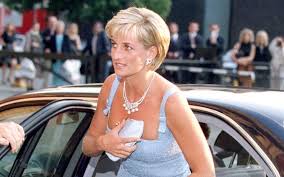
It’s been 27 years since Diana, the Princess of Wales, was killed in a horrific car crash. This tragic event ended the life of one of the world’s most famous people. It shocked everyone. Millions lined London streets paying respect to her procession. Over 2 billion watched her funeral on TV. But Princess Diana’s death was far more than a loss to the world. It left her two young boys, William and Harry, without a mother to raise them.

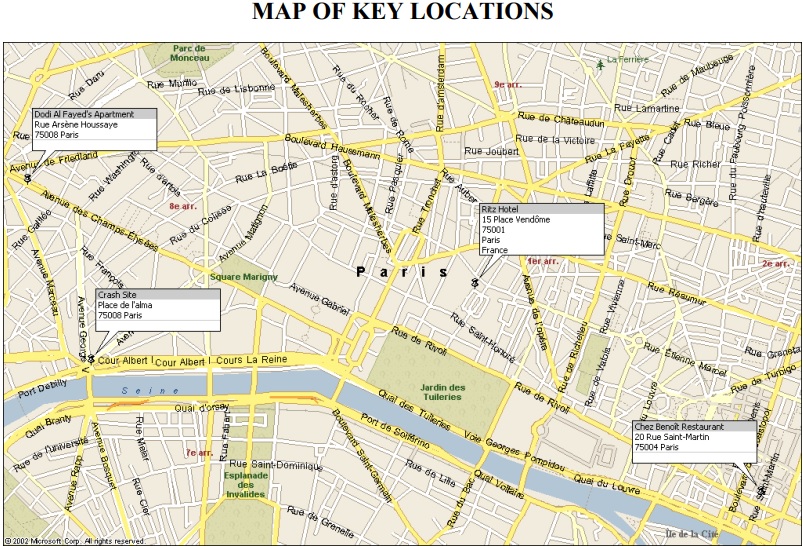
Circumstances surrounding Diana’s death were exhaustively investigated. Everyone knows the basic facts that Diana and her new boyfriend, Dodi al-Fayed, were leaving a Paris hotel for a private apartment and trying to avoid the ever-present Paparazzi. They got in the back seat of a Mercedes sedan driven by Henri Paul—a hotel security agent. Diana’s bodyguard, Trevor Rees-Jones, rode shotgun in the passenger front.

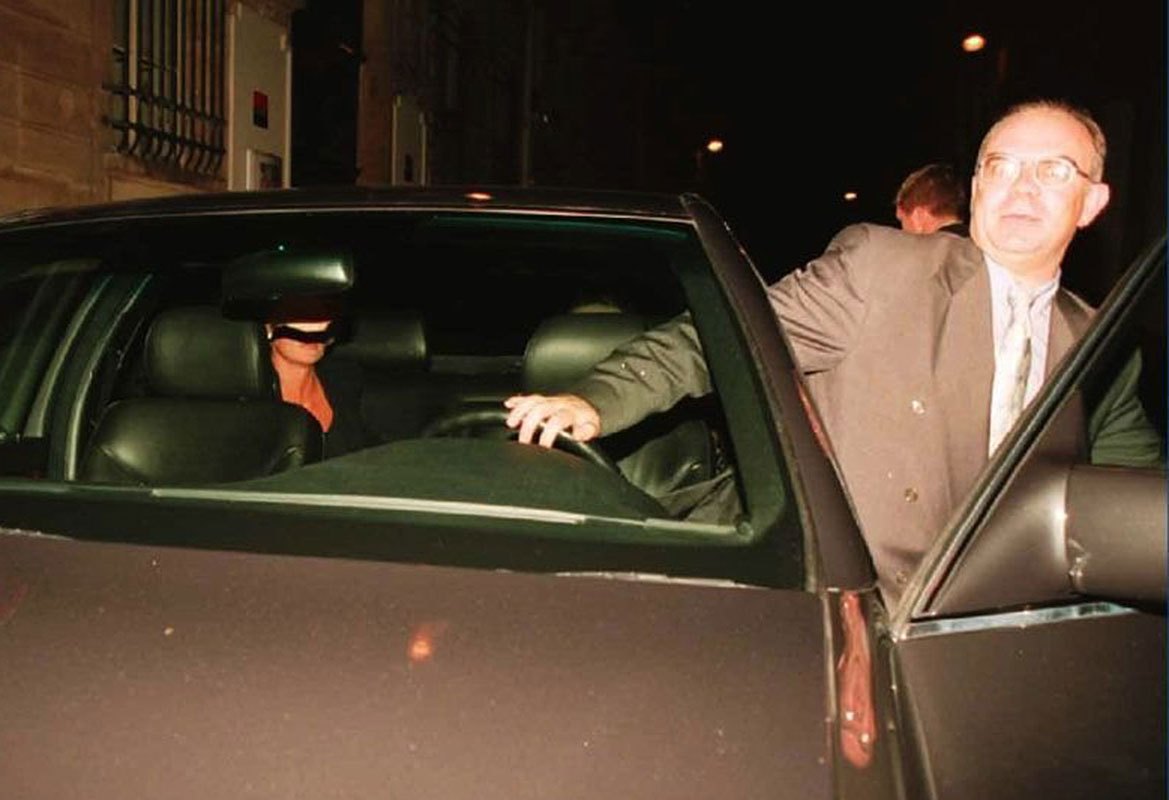
But exactly what happened next is still cloudy. To escape prying eyes and cameras out front of the Ritz Hotel, the four used a rear escape route—sneaking away to the apartment. Several Paparazzi members clued in. They raced to follow. As the Mercedes entered the Pont de l’Alma road tunnel along the Seine River in central Paris, Henri Paul somehow lost control and smashed head-on into a solid concrete column.

The car was destroyed. Henri Paul and Dodi al-Fayed were dead at the scene. Princess Diana passed away from massive internal injuries two hours later. Only Rees-Jones survived. However, he had no recollection of what happened.

Those are the bare case facts. There were two extensive investigations. One by the French police, and one by the British authorities who held a public inquest. Both inquiries concluded Diana’s death was from her fatal injuries—the result of a drunk-driver, motor vehicle incident with excessive speed a contributing factor. So was Diana’s neglect to wear her seat belt.

And both inquiries viewed the pursuing Paparazzi as a non-direct, contributing factor despite five photographers charged with manslaughter and three others prosecuted for obstructing justice and violating human rights. No one was convicted. But that didn’t end speculation that Princess Diana was murdered. In fact, Lord Stevens who oversaw the British inquest stated, This case is substantially more complicated than once thought.”

Rumors ran rampant. There were stories of Paparazzi intentionally overtaking the Mercedes and cutting it off into the column. There’s an unresolved issue of a notorious white Fiat that’s never been found. The Royal Family were accused of masterminding Diana’s murder because she’d been impregnated by a Muslim foreigner. Even the British SAS and MI6 were implicated. And most accusatory was Dodi’s father, Egyptian billionaire Mohammed al-Fayed.

But where’s proof that the Peoples’ Princess really was a homicide victim? Well, twenty-seven years later it turns out that the homicide declaration was right all along. And the evidence—the undisputed truth that Princess Diana was a homicide victim—is absolutely clear. But it comes down to the legal definition of homicide.

Facts Surrounding Diana’s Car Crash

Although Princess Diana and Dodi al-Fayed were officially an item, they’d only been seeing each other just over a month. That’s hardly enough time to get engaged let alone planning a pregnancy. Diana was far too smart than getting accidentally knocked-up, never mind rashly getting married. Both of those stories are blatantly false. These two were just beginning to have fun.

They rendezvoused on Mohammed al-Fayed’s yacht before arriving by private jet into Paris on August 31, 1997. Then dined at a popular restaurant before dropping by the Ritz Hotel where the Paparazzi laid in wait. Diana and Dodi had a nightcap. Rees-Jones was nearby. Henri Paul made a plan to bring the staff Mercedes around to the rear door where the celebrity couple could quietly slip out. Then, Paul would chauffeur the group to a private apartment that Mohammed al-Fayed kept in the heart of Paris.

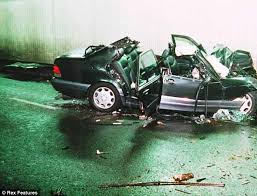
The plan almost worked. Unfortunately, the Paparazzi were crafty. They set several sentries out back. Diana and her entourage were spotted as they sped away. The time was approximately 12:20 am Paris time. Three minutes later, at 12:23, the Mercedes entered the Alma tunnel. Henri lost control and the Mercedes swerved to the left or driver’s side. It hit a concrete column support with such force the engine was shattered and the radiator shoved through to the front seat.

The Mercedes rotated 90 degrees counterclockwise and rocketed backward into the right tunnel wall. It came to rest but was so severely damaged that emergency responders had to cut off the roof in order to extract the crash victims. It was 20 minutes before Diana was freed.

By this time, the Paparazzi were present in full force. Some were arrested. Some had their cameras confiscated after taking gruesome victim death photos. The scene was nearly impossible to control, especially as word spread about who the famous victims were.

Emergency personnel reported that Princess Diana was semi-conscious when they arrived. She softly cried, “Oh my God”—repeatedly—and said, “Leave me alone.” By the time Diana was pulled from the wreckage, she’d gone unconscious. Then she suffered acute cardiac arrest when laid on a stretcher. Her heart was restarted by manual resuscitation however her blood pressure severely dropped on route to the hospital.

Diana arrived at the emergency department approximately 2:06 am. That was an hour and a half after impact. She was still breathing and displayed a weak pulse. X-rays immediately determined she had massive internal bleeding. A thoracic surgeon incised her interior to drain the blood then found her heart’s left ventricle was lacerated. While suturing this main blood vessel, Diana went into full cardiac arrest. Extensive resuscitation efforts by the trauma team failed to revive her.

Diana—the Peoples’ Princess—was Declared Dead at 4:00 am.

The bodies of Henri Paul and Dodi al-Fayed were taken to the city morgue. It was a separate building adjacent to Diana’s emergency ward. Because of the massive crowd now assembling outside the hospital, the Paris coroner felt disrespectful removing Diana’s body past the crowd. He conducted an external examination in a private hospital room but didn’t order a full autopsy. The medical cause of Diana’s death was abundantly clear.

This left the problem of keeping Diana’s now-decomposing body in a warm room. The ER had no cooler. Pursuant to French law, the coroner legally authorized Diana’s embalming to retard decomposition while transportation arrangements were made to take her body to England. This was the right thing to do but led to fuel conspiracy theories, some which abound today.

Full autopsies were conducted on Dodi al-Fayed and Henri Paul. Both clearly died of internal injuries—suffering severed aortic arteries which are immediately fatal. They had both been on the driver’s side which absorbed more of the impact. This explains why Diana was not killed instantly and why Rees-Jones walked away. His front airbag deployed but there was none in the back to protect the Princess.

Toxicology Testing on Henri Paul Found Interesting Results.

These are Henri Paul’s official and reliable toxicology results. They were later confirmed to be his through DNA testing to dispell accusations of evidence tampering.

Blood Alcohol Count (BAC) — 174 milligrams per 100 milliliters of blood or commonly termed a BAC of 0.174% (This was corroborated by his vitreous humor or eye fluid count being 0.173%, his urine being 0.218% and his stomach BAC being 0.191%.)

The legal BAC limit for impaired driving in France is 0.05% making Henri Paul 3 times over the drunk driving tolerance limit which is a criminal offense.

Small traces of the anti-anxiety medication fluoxetine were noted but were well within the therapeutic range. So was the medication tiapride. Carboxyhemoglobin and nicotine levels proved Paul was a heavy smoker.

Examination of the Wrecked Mercedes

Although the Mercedes was a total write-off, it was sufficiently sound to inspect. There were no mechanical defects found mechanically contributing to the crash. One tire was punctured but wasn’t a blowout. It happened because of impact. The brakes and steering were sound and the car was only two years old with low mileage.

Thorough testing was done on the seatbelts. All were in perfect operation. It was obvious none of the occupants were wearing their restraints, however, it’s questionable if Paul or al-Fayed would have been saved given the massive force of the left side impact. Overall, there was nothing mechanically wrong with this vehicle that made it veer hard so hard to the left.

So what caused the Mercedes to spin out of control? Did the Paparazzi cut it off? Did the mysterious white Fiat force it into the column? Why did a perfectly good car fail and, by the way, just how fast was the Mercedes traveling?

Totally fraudulent information circulated for years about the Mercedes traveling at 120 mph (190 kph) when it hit the column. Proof of this—they said—was the car’s speedometer sticking at that measurement. That’s rubbish. Total bullshit, like so many myths surrounding Princess Diana’s death. Truth is the Mercedes was doing 65 mph (120 kph), +/- 5 mph, when it hit the column. This was established by a meticulous accident reconstruction conducted by the French police.

Still, this is a significant velocity given the Mercedes’ gross vehicle weight with 4 passengers being over 4,000 lbs (1815 kg). The kinetic energy transfer of this weight multiplied by high speed resulted in Diana’s heart being—literally—ripped inside her chest. It’s surprising Diana lived as long as she did.

The real reason Henri Paul lost control is hidden in the details of the accident reconstruction report. It’s written in technical jargon but clearly understandable. There were no skid marks indicating pre-braking. No out of control swerve. One moment the car was going fast and straight. The next it cut sideways.

The Answer is in Tunnel Design and Vehicle Dynamics.

The Alma tunnel has a posted speed of 20 mph (30 kph). That’s for a good reason. The tunnel is low and narrow. It also sharply dips at the entry and is protected by a perpendicular drainage grate to keep the flat area from flooding with water.

The collision reconstruction analyst deduced when Paul declined the entry ramp and struck the bumpy metal grate at 65 mph, the Mercedes reacted by going slightly airborne. This reduced the road surface friction adhered by the tires, effectively causing a dry hydroplane incident. The analyst surmised that Paul, in his impaired state, never braked but misjudged an overcorrection and simply steered the fast-moving Mercedes into the column.

The Operation Paget Report

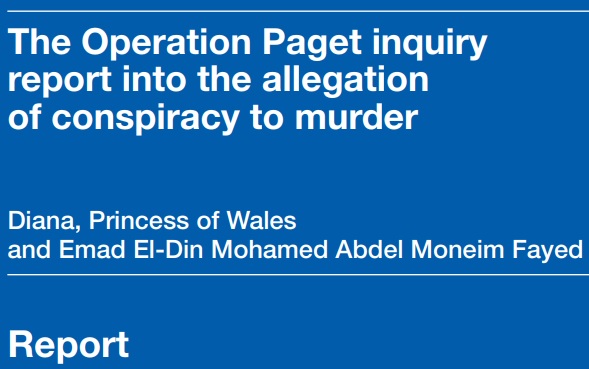
Many people who followed Princess Diana’s death story don’t know about Operation Paget and its incredibly detailed 871-page report. Operation Paget was a London Metropolitan Police special task force detailed to investigate conspiracy and murder allegations involving the Princess’ tragic end. They also addressed cover-ups. You can download it here.

The British inquest overseen by Lord Stevens relied heavily on the brilliant work uncovered in Project Paget. The police went to amazing lengths dealing with every listed allegation. They fairly answered with truth. They dispelled insinuations of government plots and sinister cover ups.

They established a fact—there were no credible eye witnesses to the crash and pursuing Paparazzi were nowhere in sight when the impact occurred. They even dealt with the white Fiat nonsense by pointing out white paint on the Mercedes door was probably from a previous parking lot incident.

As much as everyone wants to blame the Paparazzi for killing Princess Diana—well, that’s just plain wrong. Certainly, Paparazzi presence was a contributing factor as Paul was no doubt driving this speed to evade them. One can’t blame the Spencer family and Diana’s two sons, Princes William and Harry, holding the Paparazzi responsible for essentially murdering their beloved Diana. That’s a natural emotional response. But the Paparazzi, as individuals or as a  group, are innocent.

The truth is Diana, the Princess of Wales, was no accident victim. Her death was clearly a homicide. Let me explain.

On April 7, 2008 Lord Stevens’ inquest returned a verdict. They ruled Princess Diana was the victim of an unlawful killing by the grossly negligent chauffeur, Henri Paul, who’s driving ability and judgment were severely impaired by alcohol. The secondary contributor to Diana’s death was her failure to buckle up. Not the Paparazzi.

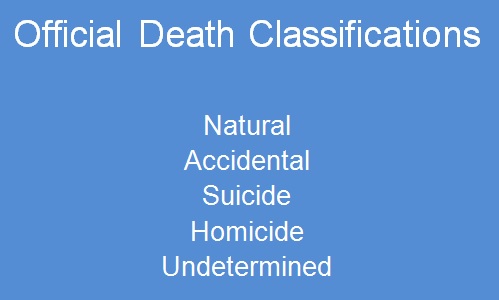
The jury made no mention of Diana’s death being an accident. That’s because they couldn’t rule it an accident. Death classifications are universal throughout the civilized world. Coroners and their juries have only five classifications to choose from: Natural, Accidental, Suicide, Homicide, and Undetermined.

You can immediately rule out Princess Diana’s death as natural, suicide and undetermined. The cause and means of Diana’s death are clear. She died because of internal bleeding and hypovolemic shock resulting from injuries received in her car crash. That’s clear. What’s not clear to most people is why this can’t be classified as an accidental death. It’s because of the legal definition of homicide.

Homicide means a person dies because of direct actions by another person. A homicide classification doesn’t necessarily mean a culpable or intentional killing of one person by another. It includes lesser degrees of acts like manslaughter and criminal negligence that cause death. Homicide also includes deaths that result from any form of a criminal act including impaired driving. Henri Paul was criminally drunk and grossly negligent. He directly caused Princess Diana’s death.

That makes Princess Diana’s death a homicide.

*   *   *