
Author Archives: Garry Rodgers

About Garry Rodgers

After three decades as a Royal Canadian Mounted Police homicide detective and British Columbia coroner, International Best Selling author and blogger Garry Rodgers has an expertise in death and the craft of writing on it. Now retired, he wants to provoke your thoughts about death and help authors give life to their words.

THE REAL JACK THE RIPPER

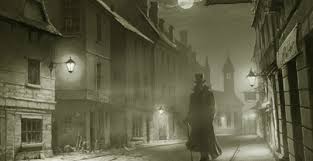
AA11Who was the real Jack The Ripper? The man who terrorized London in the fall of 1888 by butchering at least five prostitutes is the world’s most famous serial killer who’s never been caught.  What did the original investigation tell us about him and what has modern forensics learned about his true identity? 

The name originates from a letter sent to police by someone claiming to be the murderer and it was signed ‘Jack The Ripper’. Like so much in the Ripper case, it’s difficult to sort fact from fiction as evidence has been lost over time and many ‘facts’ are actually opinions by writers from the past century.

AA12Jack The Ripper has remained in the public’s fascination thanks to the mass of publicity that the murders originally received in the press. It was at a time of immense social change and the public were becoming more literate. As well, technology had advanced and allowed the immediate flow of information to the world. Readers followed the case daily as the cat and mouse game between the police and the Ripper appeared to play out in the newspapers. The mysteries surrounding this killer add to the romance of the story and create an intellectual puzzle that people still want to solve.

Interestingly, the series of murders stopped as abruptly as they started. Over the years, hundreds of books have been written about the Ripper and dozens of suspects have been named. No one was ever charged, however strong accusations are now made as the result of applying modern forensic techniques to hundred year old evidence.

First let’s look at the crimes. 
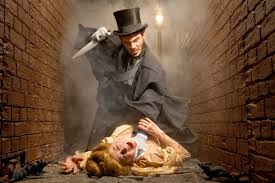
AA5It’s not clear how many women Jack The Ripper killed. Five for sure. Probably six. And possibly up to eleven murders that occurred in the Whitechapel area of London over a several year period. The nexus (connection) to the core group, known as the Canonical Five, comes from the killer’s unique MO (modus operandi) and the proximity in area and time in which the bodies were found. The victims were:

  1. Mary Ann (Polly) Nichols – murdered 31 August 1888.

  2. Annie Chapman – murdered 08 September 1888.

  3. Elizabeth Stride – murdered 30 September 1888.

  4. Catherine Eddowes – murdered 30 September 1888.

  5. Mary Jane Kelly – murdered 09 November 1888.
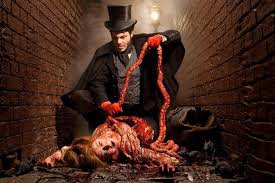
AA10All of the victims were killed in the dark and in isolated locations. Pathology confirmed they were first strangled to unconsciousness, then finished off with lacerated throats. The degree of mutilation varied. One only had her throat slit (it may be that the killer was interrupted and scared off) while the others were extremely mutilated with organs removed. There was no evidence of recent sexual activity indicating, as with most serial killings, violence was the key element.

There’s been much speculation that the killer had advanced medical knowledge and used precision instruments in his work. This is not the case when analyzed objectively. The original autopsy reports are publically available, all confirming that the incisions and organ extractions could be done by anyone with reasonable strength using a large butcher knife in a rage.

There were an unconfirmed number of taunting letters received by the police and the press from different people, with different handwriting, claiming to be the killer.
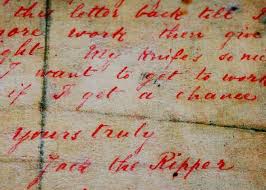
AA13The first was on September 25th and was signed ‘Jack The Ripper’. None of the letters are believed to be from the killer and none contained what would be ‘hold-back’ information, known only to the police and the actual killer. It’s certain that most were from media people fueling newspaper sales and some came from quacks.

The investigation was principly handled by the City of London police with Scotland Yard assisting. Hundreds of leads were followed and forensic techniques of the day were applied, mostly sketches and photographs. This was long before DNA science and even proper fingerprinting, so there’s no actual evidence or signature available to identify the perpetrator. Unfortunately, most of the investigation files and physical exhibits were destroyed during the Blitz in World War Two.

Three men were primarily identified as suspects.

AA15M.J. Druitt was a troubled barrister turned teacher who committed suicide a month after the last murder. Aaron Kosminiski was a Polish Jew who was locked in an asylum shortly after the murders and died in 1919. Michael Ostrog was the third police suspect, but the evidence against him was non-existent except that he was a demented con-man.

Many conspiracy theories popped up over the decades blaming the Freemasons, Irish extremists trying to terrorize the British, occultists, and even the grandson of Queen Victoria, Prince Albert Victor. A visit to Wikipedia finds a list of twenty-eight documented suspects – some quite a stretch.  https://en.wikipedia.org/wiki/Jack_the_Ripper_suspects

In 1988 the FBI did a psychological profile on Jack The Ripper, describing him pretty much as a white male with mommy issues. It’s an interesting read and can be downloaded here:  https://vault.fbi.gov/Jack%20the%20Ripper/Jack%20the%20Ripper%20Part%201%20of%201/view

AA4Recently, two books were published that profess to conclusively solve the Ripper mystery. One was by famed crime novelist Patricia Cornwell titled Portrait of a Killer – Jack The Ripper – Cased Closed. She identifies a tormented artist named Walter Sickert who undoubtedly penned a few of the Ripper letters and she makes a case at forensically proving his authorship. But she comes a long way from providing any link to his hands-on being the Killer and I’m surprised she stuck her neck out, given her prominence as a crime writer.

The second book is titled Naming Jack The Ripper. It’s by Russell Edwards who claims that he privately funded a research project which identified DNA linked to Aaron Kosiminski on a shawl associated to victim Catherine Eddowes. This molecular identification is seriously questioned by DNA experts, including the discoverer of the technique, Sir Francis Crick.
AA3And at this writing, August 2015, another forensic venture is underway in an attempt to solve the Ripper mystery. Dr. Wynne Weston-Davies claims in his new book The Real Mary Kelly that Jack The Ripper was actually Kelly’s husband who staged the first four murders in a set-up to hide his fiendish plan to kill his prostitute wife, making it look like a serial killer was at work. Weston-Davies has applied to the British Ministry of Justice for an exhumation order to dig up Mary Kelly for a DNA sample to support his belief that he’s Mary Kelly’s great, great nephew. How all that ties together, I’m not sure.

So who, really, was Jack The Ripper?

He remains a bogey-man from the shadows and it’s unlikely we’ll ever know his identity.

ENGLISH – SPEAKING A GLOBAL LANGUAGE

AA6English is the world’s working language. It’s the mother tongue of four hundred million people and it’s secondly-spoken by around a billion. English is the powerhouse in commercial communication, but it’s well behind Chinese and Spanish in cultural conversation.

You’re obviously conversant in the global language because you’re reading this, but did you know you use two distinct, different languages when you speak English?

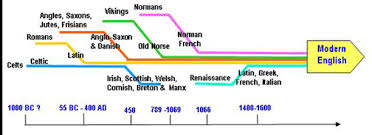
AA12Today’s English is a blend of one-third Germanic Anglo-Saxon and two-thirds of romantic languages like Latin and French. It’s also got a bit of Celtic, Greek, and Norse thrown in.

In your everyday conversations, whether oral or electronic, you unconsciously switch between the formality of Latin and the folksy tune of words from Germanic roots. It’s like when we want to play, we go off casually – using plain and simple English like the guy in ripped jeans, a hoodie, and Birkenstocks (without socks). When we want to impress, we groom impeccably and display our fine Latin manners. C’mon. We all do that. Or, pray tell, do we not?

So where did this worldwide English language come from? Where’s it at today? And where’s it going in the future?

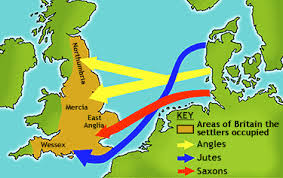
AA13A history lesson shows English began on the British Isles in 400 AD when three Germanic tribes invaded – the Angles, the Saxons, and the Jutes. They pushed the native Celts north and west into Scotland and Ireland, then took the place for themselves calling it ‘Englaland’ with their language being ‘Englisc’.

Current English evolved over four phases.

Old English (450-1100 AD) didn’t look or sound much like how we talk today. We’d have a tough time understanding the flow, however half of our modern words are derived from Old English. Words like earth, wind, fire, water, and flow. Beowulf is a famous poem written in Old English. I don’t understand a word of it and I’m sure King Arthur and I’d have a rough go at debating.

AA14Middle English (1100-1500) came about when the Normans showed up in 1066, making a form of French the voice of England’s Royal Court. The higher class spoke French and the lower class spoke English.

Early Modern English (1500-1800) was the stuff of Shakespeare. It was also the age of the Renaissance when England was expanding and coming into contact with foreign languages. Publishing was growing. The masses were beginning to read and write. And dictionaries were available.

Late Modern English (1800 – Present) has a larger vocabulary and different delivery. You can thank the Industrial Revolution and also, at one point, the British Empire covered much of the civilized world, naturally adopting words and phrases form other cultures.

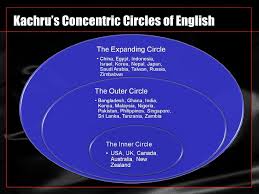
English is categorized in three circles which builds a cohesive global language.

AA15The inner circle is those with English as their mother tongue. Britain, USA, Canada, Australia, New Zealand, Ireland, and South Africa are the main players. English is handed down from generations within the inner circle and form the base who relay it to the rest of the world.

In the middle circle are English Second Language (ESL) speakers. There could be up to a billion, depending on how proficiency is defined. The Philippines is a good example. So are India, Pakistan, Singapore, Jamaica, and Nigeria.

The outer circle contains a vastly expanding populace who converse using English as a common tool. Today’s interconnected society relies on a communication standard and for many reasons that’s become English. It’s the international language at the United Nations, in treaties, in aviation, marine, medicine, science, and internet technology.

AA8Where I’m going with this – the blog you’re reading, ww.DyingWords.net, is a snapshot of how English is communicated in today’s global market. I started DyingWords three years ago because I wanted to provoke thoughts on life, death, and writing. I had something to say and I used the English language structure to convey it. It’s the only language I know, so I was pretty much stuck with it.

In three years, DyingWords experienced steady growth and I want to share this snapshot with you about global communication.

AA16I use Google Analytics to track traffic to my WordPress website. I surveyed a three day period – July 28/29/30, 2015 – which showed 2,778 visitors to the site. 12.3% were returning folk and 87.7% were new.

Google Analytics tells you fascinating things about who’s looking at your site. I’ll drill down. Here’s DyingWords visitor demographics:

Top 10 Countries By Visitor

  1. USA – 1392
  2. Canada – 435
  3. United Kingdom – 200
  4. Russia – 186
  5. Australia – 93
  6. China – 65
  7. India – 57
  8. Kenya – 54
  9. Netherlands – 43
  10. South Africia – 41

Top 10 Cities by Visitor

  1. New York – 93  (Almost all agents and publishers 😉
  2. Vancouver – 82
  3. London – 56
  4. Nanaimo – 55  (Most of that’s me lurking my own site)
  5. Los Angeles – 54
  6. Calgary – 41
  7. Toronto – 36
  8. Chicago – 31
  9. Melbourne – 26
  10. Sydney – 22

Google goes deeper. It looks at language settings on visitor profiles.

English (US Version)            56.7%

English (UK Version)              9.4%

English (Canadian)                 1.7%

English (Australia)                   0.5%

Other Languages                  31.7%

Wow! One-third of visitors to DyingWords are not first language English speakers.

So who are the unknown visitors?

AA17Here’s something else Google shocked me with. My website mailing list and personal contacts says my core audience is mostly upper middle-aged, educated, English-speaking women. But my mailing list and Google traffic are two entirely different things. The email list is permission marketing and Google refects wide open drop-ins. The search engines say something different about who’s knockin’.

Age Of Visitors

18 – 24                                     27.5%

25 – 34                                     33.5%

35 – 44                                     15.5%

45 – 54                                      12.5%

55 – 64                                        5.5%

65 +                                             5.5%

And what blew-me was gender profile.

Female                                    45.85%

Male                                         54.15%

AA18I’m getting the picture there’s a lot of young, ESL men finding my website and I never mention the “- orn” word, so it can’t be a search generated from that keyword set in a post or buried in metadata. I think they might be searching to improve their English.

DyingWords found a global English language market and my Alexa Ranking shows it. If you don’t know, Alexa is an Amazon product that ranks your website exposure among a billion other websites on the planet. Today, August 1st, 2015, DyingWords is Alexa ranked at 2,940,467 – rising 442,954 positions in the past three months. That’s a 15% increase and puts it in the top 0.3% if you use the billion benchmark number of recorded name domains. Even if you use the disclaimer that 75% of websites are inactive, DyingWords is still in the top 11.8%. I’m good with that because it helps people connect in English.

I attribute the success of this venture to astute scholars, peers included, who allow, appreciate, and advance my provoking of thoughts on life, death, and writing through an effecitve online media format.

And I luv ya guys who keep pushin’ my bullshit.

#BeInteresting 2 look back @200 years & see how English language bettered since 2015. Tx 4 drop-by & plse share #English-SpeakingAGlobalLanguage via #SM btns below ~

MORTIS – UNDERSTANDING BODY CHANGES AFTER DEATH

AA5Many crime writers mistakenly believe there’s a precise science to pronouncing time of death (TOD). There is a progressive process, but the sequence and time intervals are influenced by many factors. To craft convincing death scenes, authors need to know how a body actually breaks down.

Mortis is the anatomical term for changes in a body after the moment of death. Medically, that’s when the central nervous system gets unplugged and oxygenated blood is no longer delivered to the tissues, which naturally start recycling. The five types of mortis are:

  • Rigor – stiffening of muscles

  • Livor – settling of blood

  • Algor – change in temperature

  • Palor – change in color

  • Decomp – breakdown in tissue

AA6All these mortis conditions are integral to a decomposing process. Death is a part of life and decomposition is a part of death. Just as life is not always predictable, neither is estimating the post-mortem interval (PMI) between when death anatomically occurred and when first examination of the body begins.

Death investigations work on a triangle of Body – Scene – History. It’s a holistic approach to determining cause of death (COD) and it’s the coroner’s responsibility to answer five universal questions:

  • Who is the deceased?

  • Where did they die?

  • When did they die?

  • What caused their death?

  • What was the means of death?

AA7Some people are confused about the difference between cause and means. Cause is the medical reason. In this fellow’s case the cause of death would be traumatic brain injury. Means is the mechanism or physical reason – gunshot wound to the forehead.

There can be thousands of causes of death, but there are only five classifications:

  • Natural

  • Accidental

  • Suicide

  • Homicide

  • Undetermined

AA8How this ties into mortis is that satisfying the five universal questions, great weight is placed on interpreting the body’s condition when first examined. This is where understanding the mortis process is so important and a lot of the interpretation comes from years of experience.

The proper pronunciation of the mortis states puts emphasis on the first syllable and it’s a long ‘I’ (RYE-gore).

Let’s look at each one.

Rigor Mortis is the stiffening of muscles. It’s caused by the body’s energy source, adenosine triphosphate (ATP), being depleted. With no energy left to keep the muscles flexible, they naturally go to a rigid state until another enzyme begins the breakdown of tissue and relaxation returns.

AA10Immediately upon death, the body enters a brief period of primary flaccidity where it’s dead limp. Depending on many factors, temperature and body mass being the big ones, the muscle stiffening begins in 1- 2 hours, first setting into the eyelids, jaw, and neck. It proceeds to the limb joints and extremities after 4-8 hours and fixes in the organs in about 12 hours. Rigor releases in a reverse sequence and can be absent in as little as 12 hours or can stay for days, again depending on factors.

Livor Mortis is the pooling of blood caused by gravitational settling once the heart stopped pressurizing the vascular system. It’s evident by purplish-red blotching where blood is free to pool and blanched-white where pressure points restrict it. Lividity, as it’s also known, sets in between 30 minutes to 1 hour after death and ‘fixes’ in about 8-12 hours. ‘Fixing’ is the entire settling where blood has coagulated and no longer runs free.

Algor Mortis is the change in body temperature. A cadaver will always achieve ambient temperature, regardless of time. A normal, living human’s core temperature is 36 Celsius (98.6 Fahrenheit) but the scene temperature could be anywhere above or below. In a cold environment, the body will drop to equilibriate. In a hot environment, it will rise. Here’s where so many peripheral factors come into play. Body size. Layered Clothing. Air movement. And the list goes on. A rule of thumb is that a body’s temperaature will change about 1 degree Celsius per hour.

AA11Palor Mortis is the change of color. Live humans are pretty much a reddish tinge due to oxygenated blood flowing (different tones for different races). Immediately upon death, a bluing phase occurs, following by a grey, then a white, and it can be a rainbow of colors as decomposition takes over.

Decomp, or decomposition, is not really a true class of mortis – rather it’s the culmination of the four mortis processes which leads to a breakdown of the body tissues and a return to nature.

Decomposition is a complex and unpredictable thing. There are two processes that morph into one:

  • Putrefaction – action of bacteria on body tissues

  • Autolysis – body breakdown by endogenous substances

AA9In most deaths these two work in tandem, starting with a breakdown in internal organs which produces gas. This causes bloating and skin discoloring, as well as the foul odor from purging or ‘gassing-off’. As the muscle tissues change, the skin begins to dislodge, the joints become loose enough to disarticulate, fats become liquefied, and bones become exposed. Advanced decomp can become skeletonized, mummified, or consumed – again depending on so many factors, which all start from the mortis process.

The changes in a human’s body after death can be just as varied as their experiences in life.

Biological, environmental, and circumstantial factors will shape your death, just like they’re shaping your life.

*   *   *

I originally wrote this post for Kristen Elise, PhD, on her blog site at MurderLab.com. I think it’s useful information for other crimewriters so I shared it here at DyingWords. Here’s the link to the original post on Kristen’s site:

http://www.murderlab.com/2015/07/mortis-understanding-body-changes-after.html