Author Archives: Garry Rodgers

About Garry Rodgers

After three decades as a Royal Canadian Mounted Police homicide detective and British Columbia coroner, International Best Selling author and blogger Garry Rodgers has an expertise in death and the craft of writing on it. Now retired, he wants to provoke your thoughts about death and help authors give life to their words.

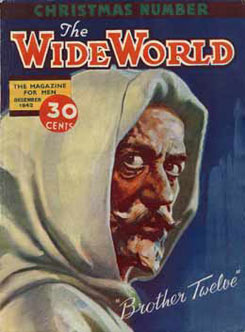
BROTHER XII – THE DEVIL OF DE COURCY ISLAND

AA8Brother Twelve, aka Edward Arthur Wilson, may not be as well-known a cult icon like L. Ron Hubbard or Reverend Jim Jones, but he was every bit as charming, deceitful, and as treacherous a swindler. Brother XII might have stolen his title, claiming to be the twelfth disciple of a disembodied entity that identified itself as one of the 12 masters in the Great White Lodge, but he rightfully earned the name ‘Devil of De Courcy Island’.

They say that truth can be stranger than fiction and the best stories can be found closest to home.

AA13Well, for me, the case of Brother XII holds both because he was a real guy and his commune was built in the 1920’s on De Courcy Island in British Columbia’s Gulf Islands, just south of Nanaimo near Cedar-By-The-Sea. I can darn near see the place from my back window.

The story of Brother XII has all the elements that a crime-thriller writer could want.

A psychotic controller using ancient Egyptian spiritualism to attract and subdue his victims. Psychological manipulation for religious submission. Politics. Sex. Conspiracy. A hidden and lost treasure of millions in gold.  An evil mistress with the name Madame Zee. Overtones of murder and hidden bodies. And a mystic cult that survives today.

Like, you just can’t make this shit up.

After I finish my current crime-thriller No Life Until Death I’m going to start my next novel based on the fascinating and truly evil story of Brother XII. Only I’m going to bring Brother Twelve into real time. The working title is No God Without Gold.
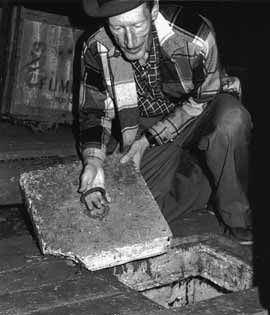
AA6This story has been in my mind for twenty-five years after I first heard about it from old Provincial Court Judge Stan Wardill. I used to appear before Stan’s court as a young constable and we got talking on the street one day. Turns out Stan was an expert on Brother XII and owned property on De Courcy. Stan was 100 % convinced that Brother XII left behind a hidden treasure in gold when he fled the commune under the cover of darkness to avoid being lynched by enraged followers.

Stan and his son, Donnie, spent years scouring De Courcy for the cache. So have many other people and the local legend holds that it’s still out there. Some say “Bullshit! He took it with him.” One thing’s for sure – at one time it definitely existed.

The hoard was known to be worth over a million dollars when gold was worth twenty bucks an ounce. Do the math at today’s value.
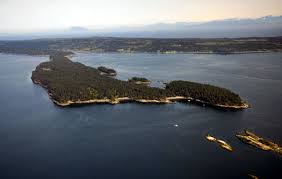
AA14I’m really looking forward to researching and writing No God Without Gold. If I wasn’t under the gun to finish No Life Until Death I might just paddle over to De Courcy and poke around. You never know what you might find in your own backyard.

*   *   *

Don’t just take my word that Brother XII was real. Here’s a clip from Wikepedia and some links to other  websites and books.

Extracted from Wikepedia:

AA2Edward Arthur Wilson, better known as Brother XII, (July 25, 1878–November 7, 1934?) was an English mystic who, in the late 1920s, founded a spiritual community located just south of the city of Nanaimo on Vancouver Island, off the west coast of British Columbia, Canada.

Wilson was born in Birmingham, England. He travelled the world as a marine biologist and apparently studied world religions, preparing himself, by his own account, for a destiny that was revealed to him in a vision in the South of France in the autumn of 1924. He soon attracted a devoted following, including a group of wealthy and socially prominent individuals.

Having taken the name Brother XII, he established the Aquarian Foundation in 1927. The group’s beliefs were based largely upon the teachings of the Theosophical Society. Wilson encouraged his followers to build homes in his colony Cedar-by-the-Sea on Vancouver Island, British Columbia.
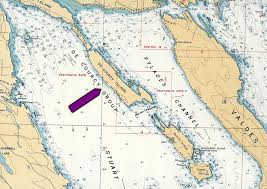
AA15With the goal of creating a self-sufficient community independent of the outside world, the Foundation acquired additional property on nearby Valdes and De Courcy Islands, largely through the donations of a wealthy socialite named Mary Connally from North Carolina. Other followers gave donations, large and small, to support Brother XII’s work as a spiritual teacher, as well as his political activity in support of a Democrat Senator from Alabama, James Thomas Heflin, who ultimately supported Herbert Hoover but was for a while a third-party candidate in the 1928 presidential election in the United States.

An insurrection developed within the ranks of the colony when Brother XII’s critics charged that he had claimed to be the reincarnation of the Egyptian god Osiris, though he replied that he had been speaking figuratively, that Osiris and Isis were male and female principles in Nature.
AA4Still, Brother XII’s misuse of Foundation funds and his extramarital affair with a woman who he claimed was his soul-mate led to the breakup of the colony. The Aquarian Foundation was legally dissolved in 1929, though he continued his work with the followers who had remained loyal to him during the crisis, as well as a number of new recruits.

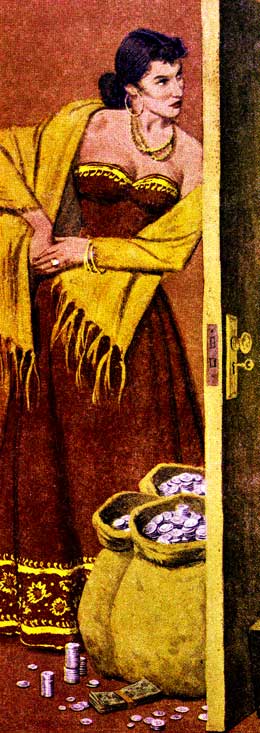
As time passed, he became increasingly dictatorial and paranoid, fortifying his island kingdom and reportedly accumulating a fortune in gold. His mistress, Mabel Skottowe, who operated under the name “Madame Zee”, worked the members without respite, the tasks given being considered tests of their fitness to advance spiritually.

One man who had been imprisoned in a cellar on the northern end of Valdes Island managed to row to Nanaimo to report the circumstances to the British Columbia Provincial Police, who investigated but took no further action.

AA9Eventually, as conditions deteriorated, Brother XII’s core group of disciples revolted and filed legal charges against him to recover the monies, estimated to be over a million dollars that had been converted to gold, which they had contributed to his work. In a violent reaction, he destroyed the colony, smashing its buildings and farm equipment, and scuttling his flagship, the sailboat Lady Royal.

Wilson and Skottowe then escaped at night in their private tugboat, the Kheunaten, rather than being arrested on charges brought by their former disciples. Wilson is reported to have died in Neuchâtel, Switzerland, on November 7, 1934, though he may have fabricated his death. It appears that he subsequently rendezvoused in San Francisco with his lawyer, whose son has provided an eyewitness account of the meeting.

Here are four books that have been published on Brother XII:
  • AA10Lillard, Charles; MacIsaac, Ron; Clark, Don (1989), The Devil of Decourcey Island: The Brother XII, Victoria: Porcepic Books, ISBN0-88878-286-1
  • Oliphant, John (1992), Brother Twelve: The Incredible Story of Canada’s False Prophet, McClelland & Stewart, ISBN978-0-7710-6848-5
  • Symons, Philip (2004), Brother XII’s Letters, Victoria: Ruddy Duck Press, ISBN978-0-9734928-0-4
  • Luke, Pearl (2007), Madame Zee (novel), Harper Perennial Canada, ISBN978-0-00-639173-9
These are interesting websites and linkages:

Who Was Brother XII?  http://www.brotherxii.com/who.html

Brother XII. The shadowy past of a sailor, seducer and swindler.  http://www.nanaimobulletin.com/news/175644671.html

Brother XII; Canadian Biographies http://biographi.ca/en/bio/wilson_edward_arthur_16E.html

Brother XII – Victoria Public Library http://www.gvpl.ca/using-the-library/our-collection/local-history/tales-from-the-vault/brother-xii/

Brother XII – The Canadian Encyclopedia  http://www.thecanadianencyclopedia.ca/en/article/brother-twelve/
Like I said… You just can’t make this shit up.

AVERT YOUR EYES – INSIGHT INTO HUMAN NATURE FROM SETH GODIN

I’m a big fan of writer, marketer, motivator, and change-maker Seth Godin and follow his blog religiously. Seth has previously guest-posted on DyingWords and he generously agreed to return with this insightful piece about human nature.

AA1When there’s a wreck on the side of the road, we can’t help it. Despite our best efforts, we look at the accident, sometimes even slow down to get a really good look.

Why?

To remind ourselves it’s not us. To reassure ourselves it’s not someone we know. Phew. Rubbernecking is our way of reassuring ourselves.

AA2Often, though, we do precisely the opposite when it comes to the apparently unfixable, to the enormity of horrible events, to tragedies. (Enormity doesn’t mean “extra enormous.” It refers to the emptiness of something so horrible and large we have trouble comprehending it).

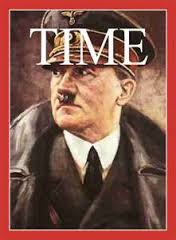
Time Magazine produces a cover that we can’t bear, so we don’t buy that issue. We don’t see the billboard. A disease appears uncurable, so we don’t talk about it. It’s easier to talk about the little stuff, or events with hope.

We also do it with science, to facts about the world around us.

AA3There’s a long history of denialism, defending the status quo and ignoring what others discover. That two balls of different weights fall at the same speed. That the Earth rotates around the Sun. That the world is millions of years old. That we walked on the Moon. The denials all sound the same. They don’t come from stupidity, from people who aren’t smart enough to understand what’s going on. They come from people who won’t look.

Why deny? It’s a way to avert our eyes.

Two related reasons, internal and external.

The external reason is affiliation.

AA4What happens to one’s standing when you dare to question the accepted status quo? What are the risks to doing your own research, to putting forth a falsifiable theory and being prepared to find it proven wrong? What will you tell your neighbours?

When adherence to the status quo of our faith or organization or social standing looms large, it’s often far easier to just look the other way, to feign ignorance, or call yourself a skeptic (n.b. all good scientists are actually skeptics, that’s how they build careers… the difference is that the skeptical scientist does the work to prove to her peers that she’s right, and acknowledges when she’s not).

There’s more data available to more people than ever before.

AA5And the prize for using statistics and insight to contradict the scientific status quo is huge. If a thesis doesn’t sit right with you, look closer – not away. Do the science, including acknowledging when your theory isn’t right.

The internal reason is fear.

AA6The fear of having to re-sort what we believe. Of feeling far too small in a universe that’s just too big. Most of all, of engaging in a never-ending cycle of theories and testing, with the world a little shaky under our feet as we live with a cycle that gets us closer to what’s real.

Part of being our best selves is having the guts to not avert our eyes, to look closely at what scares us, what disappoints us, what threatens us.

By looking closely we have a chance to make change happen.

*   *   *

AA8AA11SETH GODIN is the author of 18 books that have been bestsellers around the world and have been translated into more than 35 languages. He writes about the post-industrial revolution, the way ideas spread, marketing, quitting, leadership and most of all, changing everything. You might be familiar with his books Linchpin, Tribes, The Dip and Purple Cow.

AA9In addition to his writing and speaking, Seth founded both Yoyodyne and Squidoo. His blog (which you can find by typing “seth” into Google) is one of the most popular in the world. He was recently inducted into the Direct Marketing Hall of Fame, one of three chosen for this honor in 2013.

Recently, Godin once again set the book publishing on its ear by launching a series of four books via Kickstarter. The campaign reached its goal after three hours and ended up becoming the most successful book project ever done this way.

His newest book, What To Do When It’s Your Turn, is already a bestseller.

Visit Seth’s website at:  http://www.sethgodin.com/sg/

Follow Seth on Twitter:  https://twitter.com/ThisIsSethsBlog

CRUCIFIXION — THE ANATOMICAL CAUSE OF JESUS CHRIST’S DEATH

This material is based on an article by Dr. C. Truman Davis and first published by the Christian Broadcasting Network. This appears to be a very factual look at how Jesus Christ really died.

A29Some time ago after reading Jim Bishop’s The Day Christ Died, I realized that for years I’d taken the Crucifixion more or less for granted — I’d grown callous to its horror by a too easy familiarity with the grim details and a too distant relationship with Jesus. Now, at Easter, it occurred to me that even with a significant background in medical death investigation, I didn’t know anything about the actual anatomical cause of Jesus Christ’s death.

The Gospel writers don’t help us much on this point because crucifixion and scourging were so common during their lifetime that they apparently considered a detailed description unnecessary. So we have only the concise words of the Evangelists: “Pilate, having scourged Jesus, delivered Him to them to be crucified — and they crucified Him.”

I have no competence to discuss the infinite psychic and spiritual suffering of the Incarnate God atoning for the sins of fallen man. I honestly don’t understand that. But I was curious about investigating the physiological and anatomical aspects of the Lord’s passion in detail.

A34What did the body of Jesus of Nazareth actually endure during those hours of torture? 

This led first to a study of the practice of crucifixion itself; that is, torture and execution by fixation to a cross. I’m indebted to many who’ve studied this subject in the past — especially Dr. Pierre Barbet, a French surgeon who’s done exhaustive historical and experimental research and written extensively on the subject.

Apparently, the first known practice of crucifixion was by the Persians. Alexander and his generals brought it back to the Mediterranean world — to Egypt and to Carthage. The Romans learned the practice from the Carthaginians and (as with almost everything the Romans did) rapidly developed a very high degree of efficiency and skill at it. A number of Roman authors (Livy, Cicer, Tacitus) comment on crucifixion. Several innovations, modifications, and variations are described in the ancient literature.

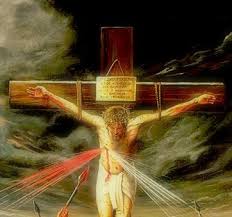
A25For instance, the upright portion of the cross (or stipes) could have the cross-arm (or patibulum) attached two or three feet below its top in what we commonly think of as the Latin cross. The most common form used in Jesus’s day, however, was the Tau cross, shaped like our T.

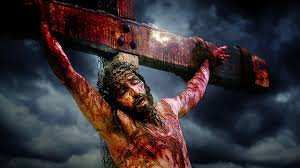
In this cross, the patibulum was placed in a notch at the top of the stipes. There is archeological evidence that it was on this type of cross that Jesus was crucified. Without any historical or biblical proof, Medieval and Renaissance painters have given us our picture of Christ carrying the entire cross. But the upright post, or stipes, was generally fixed permanently in the ground at the site of execution and the condemned man was forced to carry the patibulum, weighing about 110 pounds, from the prison to the place of execution.

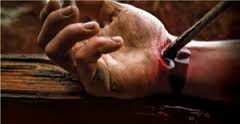
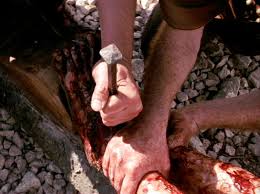
A7Many of the painters and most of the sculptors of crucifixion also show the nails through the palms. Historical Roman accounts and experimental work have established that the nails were driven between the small bones of the wrists (radial and ulna) and not through the palms. Nails driven through the palms will strip out between the fingers when made to support the weight of the human body. The misconception may have come about through a misunderstanding of Jesus’ words to Thomas, “Observe my hands.” Anatomists, both modern and ancient, have always considered the wrist as part of the hand.

A titulus, or small sign, stating the victim’s crime was usually placed on a staff, carried at the front of the procession from the prison and later nailed to the cross so that it extended above the head. This sign with its staff nailed to the top of the cross would have given it somewhat the characteristic form of the Latin cross.

A27But the physical passion of Christ began in Gethsemane. Of the many aspects of this initial suffering, the one of greatest physiological interest is the bloody sweat. It is interesting that St. Luke, the physician, is the only one to mention this. He says, “And being in agony, He prayed the longer. And His sweat became as drops of blood, trickling down upon the ground.”  Every ruse (trick) imaginable has been used by modern scholars to explain away this description, apparently under the mistaken impression that this just doesn’t happen. A great deal of effort could have been saved had the doubters consulted medical literature.

Though very rare, the phenomenon of Hematidrosis, or bloody sweat, is well documented. Under great emotional stress of the kind Jesus suffered, tiny capillaries in the sweat glands can break, thus mixing blood with sweat. This process might well have produced marked weakness and possible shock.

A17After the arrest in the middle of the night, Jesus was brought before the Sanhedrin and Caiphus, the High Priest. It’s here the first physical trauma was inflicted. A soldier struck Jesus across the face for remaining silent when questioned by Caiphus. The palace guards then blindfolded him and mockingly taunted him to identify them. As each passed by, they spat upon Jesus and struck him in the face.

In the early morning — battered, bruised, dehydrated and exhausted from a sleepless night — Jesus was taken across the Praetorium of the Fortress Antonia, the seat of government of the Procurator of Judea, Pontius Pilate. Pilate passed responsibility to Herod Antipas, the Tetrarch of Judea. Jesus apparently suffered no physical mistreatment at the hands of Herod and was returned to Pilate.

It was then, in response to the cries of the mob, that Pilate ordered Bar-Abbas released and condemned Jesus to scourging and crucifixion.

A15There is much disagreement among authorities about the unusual scourging as a prelude to crucifixion. Most Roman writers from this period do not associate the two. Many scholars believe that Pilate originally ordered Jesus scourged as his full punishment and that the death sentence by crucifixion came only in response to the taunt by the mob that the Procurator was not properly defending Caesar against this pretender who allegedly claimed to be the King of the Jews.

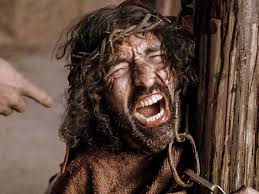
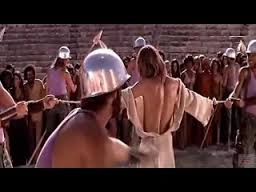
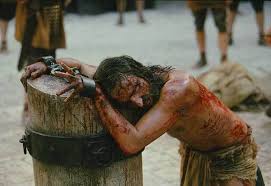
Preparations for the scourging were carried out when Jesus was stripped of his clothing and his hands tied to a post above his head. It’s doubtful the Romans would have made any attempt to follow the Jewish law in this matter but the Jews had an ancient law prohibiting more than forty lashes. The Roman legionnaire stepped forward with the flagrum (or flagellum) in his hand. This is a short whip consisting of several heavy, leather thongs with two small balls of lead attached near the ends of each. The heavy whip was brought down with full force again and again across Jesus’ shoulders, back, and legs.

A16At first, the thongs cut through the skin only. Then, as the blows continued, they cut deeper into the subcutaneous tissues producing first an oozing of blood from the capillaries and veins of the skin then finally spurting arterial bleeding from vessels in the underlying muscles. The small balls of lead produced large, deep bruises which were broken open by subsequent blows. Finally, the skin of Jesus’s back would be hanging in long ribbons and the entire area an unrecognizable mass of torn, bleeding tissue.

When it was determined by the centurion in charge that Jesus was near death, the beating finally stopped.  The half-fainting Jesus was untied and allowed to slump to the stone pavement, wet with his own blood.

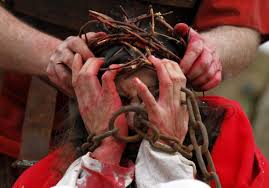
A10The Roman soldiers saw a great joke in this provincial Jew claiming to be king. They threw a robe across his shoulders and placed a stick in his hand for a scepter. They still needed a crown to make their travesty complete so flexible branches covered with long thorns (commonly used in bundles for firewood) were plaited into the shape of a crown and pressed into Jesus’s scalp. Again, there was copious bleeding — the scalp being one of the most vascular areas of the body.

After mocking Jesus and striking him across the face, the soldiers took the stick from his hand and struck him across the head, driving the thorns deeper into his scalp. Finally, they tired of their sadistic sport and the robe was torn from his back. Already having adhered to the clots of blood and serum in the wounds, its removal would have caused excruciating pain just as in the careless removal of a surgical bandage. It was almost as though Jesus were whipped again and the wounds once more began to bleed.

A22In deference to Jewish custom, the Romans returned his garments. The heavy patibulum of the cross was tied across Jesus’s shoulders and the procession of the condemned Christ, two thieves, and the execution detail of Roman soldiers headed by a centurion began a slow journey along the Via Dolorosa.

In spite of Jesus’s efforts to walk erect, the weight of the heavy wooden beam, together with the shock produced by copious blood loss, would be too much. He stumbled and fell. The rough wood of the beam gouged into the lacerated skin and shoulder muscles. Jesus tried to rise but his human muscles were pushed beyond their endurance. 

The centurion, anxious to get on with the crucifixion, selected a stalwart North African onlooker, Simon of Cyrene, to carry the cross. Jesus followed, still bleeding and sweating the cold, clammy sweat of shock until the 650-yard journey from the fortress Antonia to Golgotha was finally completed. Jesus was offered wine mixed with myrrh, a mild analgesic mixture. He refused to drink. Simon was ordered to place the patibulum on the ground and Jesus was quickly thrown backward with his shoulders against the wood.

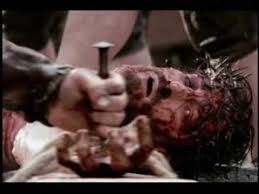
A9The legionnaire felt for the depression at the front of Jesus’s wrist. He drove a heavy, square, wrought-iron nail through the wrist and deep into the wood. Quickly, he moved to the other side and repeated the action, being careful not to pull his arms too tightly, but to allow some flexion and movement. The patibulum was then lifted in place at the top of the stipes and the titulus reading “Jesus of Nazareth, King of the Jews” was nailed in place.

Jesus’s left foot was now pressed backward against his right foot and with both feet extended, toes down, a nail was driven through the arch of each, leaving his knees moderately flexed.

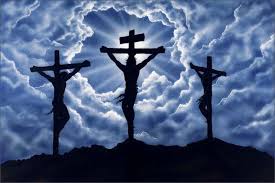
Jesus was now crucified.

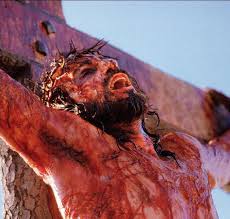
As he slowly sagged down with more weight on the nails in the wrists, excruciating pain would have shot along Jesus’s fingers and up the arms to explode in the brain — the nails in the wrists putting pressure on the median nerves.

A35Jesus would have pushed himself upward to avoid this stretching torment and he’d have placed his full weight on the nail through his feet. Again, there would be searing agony of the nail tearing through his nerves between the metatarsal bones of the feet.  At this point, as his arms fatigued, great waves of cramps would have swept over Jesus’s muscles, knotting them in deep, relentless, throbbing pain. With these cramps would come the inability to push himself upward.

Hanging by his arms, the pectoral muscles would be paralyzed and Jesus’s intercostal muscles would be unable to act.

As air could be drawn into the lungs but not exhaled in this position, Jesus would have fought to raise himself in order to get even one short breath. Finally, carbon dioxide would build up in his lungs and in the blood stream — the cramps would partially subside. Spasmodically, Jesus would push himself upward to exhale and bring in the life-giving oxygen.

A1Jesus would have experienced several hours of limitless pain, cycles of twisting, joint-rending cramps, intermittent partial asphyxiation, and searing pain where tissue was torn from his lacerated back as he moved up and down against the rough timber.

Then another agony began — a terrible crushing pain deep in the chest as Jesus’s pericardium slowly filled with serum and began to compress the heart.

This is documented in the 22nd Psalm, 14th verse: “I am poured out like water, and all my bones are out of joint; my heart is like wax; it is melted in the midst of my bowels.”

A19It was now almost over. The loss of tissue fluids had reached a critical level — Jesus’s compressed heart struggling to pump heavy, thick, sluggish blood into the tissue — his tortured lungs making a frantic effort to gasp in small gulps of air — the markedly dehydrated tissues sending their flood of stimuli to his brain.

Jesus gasped “I thirst.” 

Another verse from the prophetic 22nd Psalm refers to this. “My strength is dried up like a potsherd; and my tongue cleaveth to my jaws; and thou has brought me into the dust of death.” A sponge soaked in posca, the cheap, sour wine which is the staple drink of the Roman legionaries, was lifted to his lips but Jesus apparently didn’t take any liquid.

A40Jesus’s body was now in extremes — he would be able to feel the chill of death creeping through his tissues. This realization brought out his words, possibly little more than a tortured whisper. “It is finished.”  Jesus’s mission of atonement was completed and, finally, he could allow his body to die. With one last surge of strength, Jesus would again press his torn feet against the nail, straighten his legs, take a deeper breath, and utter a last cry. “Father! Into thy hands I commit my spirit.”

In order that the Sabbath not be profaned, the Jews asked that the condemned men be dispatched and removed from the crosses. The common method of ending a crucifixion was by crurifracture — the breaking of the leg bones. This prevented the victim from pushing himself upward — the tension could not be relieved from the muscles of the chest and rapid suffocation occurred. The legs of the two thieves were broken but when the soldiers came to Jesus they saw this was unnecessary.

Apparently, to make doubly sure of death, the legionnaire drove his lance through the fifth interspace between Jesus’s ribs — upward through the pericardium and into the heart.

A41The 34th verse of the 19th chapter of the Gospel according to St. John reports, “And immediately there came out blood and water.” That is, there was an escape of watery fluid from the sac surrounding the heart. This is solid postmortem evidence that Jesus died not the usual crucifixion death by suffocation. The actual anatomical cause of Jesus Christ’s death was heart failure due to shock and constriction of the heart by fluid in the pericardium.

This is our glimpse — including the medical evidence — of that epitome of evil that man has exhibited toward man and toward God.

*   *   *