Friend and fellow crime-writer, Sue Coletta, gives this insightful cameo on the show vs. tell struggle in storytelling.
 We’ve all heard it many times. Show vs. Tell, the advice that haunts many new writers. It can be very confusing. All telling can be just as bad as all showing. More experienced writers know that it is that perfect mix of both that creates a dynamic, well-rounded story.
 The best advice I can give is to read, read, then read some more. Study how the best-sellers spin a good yarn. Basically it comes down to this: We need to show our stories as they unfold, but we need to do it in a way that evokes a visceral response in our reader. In a way that allows the reader to fill in the blanks with their imagination. But we also need to tell parts of that story so our characters don’t sound melodramatic and our books don’t end up being six hundred pages long.
If you think back to your favorite books undoubtedly they’ll be the ones that you pictured in your mind as you were reading them. Those are the novels that stay with you. Why? Because those authors used a perfect mix of telling, showing, and really showing.
 It’s no secret that I’m a huge Karin Slaughter fan. Anyone who knows me can attest to that. So, awhile back I found her on Facebook and I was reading some of the comments she was getting from her fans. For those not familiar with her work in addition to stand-alones she has two series: Grant Pass series and Will Trent series. One of her fans wrote in and asked what Will Trent looked like.
Her response: “He looks exactly how you pictured him.”
Because the fan was a reader and not a writer she didn’t fully understand why she meant by that or why she wouldn’t expound. But the truth is she couldn’t. If she did she’d ruin the image her other readers had created in their mind of Will Trent.
We writers can help that image along by showing a specific characteristic without giving a laundry list of features. For instance:
 Telling: “He had bright blue eyes and was six feet tall.” Showing: “His piercing blue eyes looked straight into my soul, and I knew he’d soon uncover all my lies.”

In the latter we’ve given a specific characteristic by showing our character’s emotional response to that feature. This becomes more important with main and secondary characters than with walk-ons– a minor character in one or two scenes. And here’s where telling comes into play. If it’s necessary for the reader to know that a nurse, say, is a blonde, then just tell them. No need to waste extra words on non-essential characters.
Telling: “That guy’s an ass.”
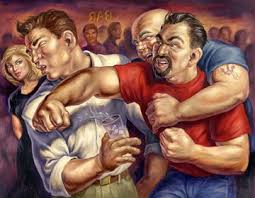 To show your reader that the guy’s an ass you’d have him crunch someone’s glasses under his foot, or beat up an old man. Really showing is when that same man is in a bar fight with your MC and he smells the guy’s sweat, watches his facial ticks, hears someone from the crowd shout “Kill him!”, tastes blood in the back of his throat.
During short interludes– when not a lot happens over a period of time– we tell the reader what happened. This could be a couple of sentences or a paragraph in length. It could even be three words. “Two days later.”
 Basically, we use telling when we need to transition from point A to point B, or when we are divulging the character’s backstory– in tiny bits peppered throughout the novel.

Let’s say for instance nothing happens on the ride over to a crime scene. The reader does not need the play-by-play. They don’t need to be inside the MC’s head the whole time. Tell them what happened. Tell them that “the detectives arrived thirty minutes later.” When it’s a plot point we want to show the reader what happened. Showing can be a sentence or a paragraph in length. Really showing can go on for several paragraphs or even pages.
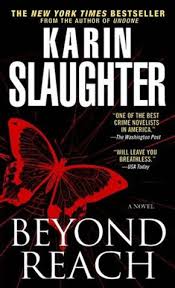
The following example of “showing” is from Karin Slaughter’s Beyond Reach.
 The lighter dropped onto her lap, the flame igniting the liquid, the liquid burning her clothes. There was a horrible keening– it was coming from her own throat as she sat helplessly watching the flames lick up her body. Her arms jerked up. Her toes and feet curled in like a baby’s. She thought again of that long-ago trip to Florida, the exhausting heat, the sharp, unbearable rip of pain as her flesh cooked to the seat.
The following example of “really showing” is from Karin Slaughter’s Fractured.
 Automatically, her hands wrapped around his thick neck. She could feel the cartilage in his throat move, the rings that lined the esophagus bending like soft plastic. His grip went tighter around her wrists, but her elbows were locked now, her shoulders in line with her hands as she pressed all of her weight into the man’s neck. Lightening bolts of pain shot through her shaking arms and shoulders. Her hands cramped as if thousands of tiny needles stabbed into her nerves. She could feel vibrations through her palms as he tried to speak. Her vision tunneled again. She saw starbursts of red dotting his eyes, his wet lips opening, tongue protruding. She was sitting on him, straddling him, and she became aware of the fact that she could feel the man’s hip bones pressing into the meat of her thighs as he arched up trying to buck her off.
And it goes on for a few more paragraphs. As you can see, the difference between showing and really showing is length and detail. With really showing the writer gets into the finer details of the scene. “Lightening bolts of pain shot through her shaking arms…”
By really showing a scene the writer makes use of most or all of the senses– sight, touch, hearing, taste, smell– instead of just using one or two.
 In short, we use telling for transition or traveling or telling what we’ve already shown so we aren’t being repetitive, and showing for plot points, actions, reactions, responses, to crank up the tension, etc. It takes more words to show a scene than to tell it.
By mixing them, we keep our reader engaged and keep them flipping pages. And that is what makes our stories come alive on the page.
* * *
 Sue Coletta is a crime fiction writer who’s authored four novels– soon to hit the shelves, so keep watch! She’s a member of Sisters In Crime and Crime Space and blogs with twenty-four traditionally published authors at: www.auniqueandportablemagic.blogspot.com.
Visit her Murder Blog, where she discusses writing tips, musings, and crime fiction at: www.crimewriterblog.com or follow Sue on Twitter @SueColetta1