Ever met a serial killer?
Can’t say I have – at least not that I know of.
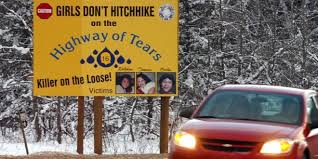
Highway 16 in Northern BC, Canada
But I’ve worked with other police officers who’ve dealt with them and I’ve investigated unsolved homicides that could be the work of a serial killer. (Google Highway Of Tears). I’ve also helped send killers to jail who were possibly caught just before their serial career could start.
So how would you recognize a serial killer if you met one?
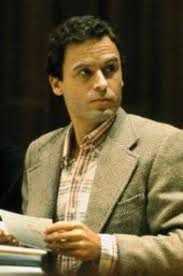
Ted Bundy
First of all, let’s define a serial killer. According to the FBI’s Behavioral Science Unit, it’s an individual who’s committed three or more homicides segregated by a block of time. A cooling-off period, so to speak. This separates true serial offenders like Ted Bundy, who committed a spaced-apart series of nation-wide killings, from localized spree or mass murderers like the Columbine shooters or bombers like Timothy McVeigh.
Now, let’s dispel a few myths.
 Serial killers are not common. In fact, they’re exceptionally rare. Less than .01% of murders are classified as serial incidents. A 2012 study by the United Nations Office of Drugs and Crime (UNODC) lists the North American homicide rate as 3.9 per 100,000 in population, so doing the math from a combined populus of 464 million, you’ve got a .00039% chance of being a serial killer victim. It’s also estimated that no more than 300 serial killers are currently active in North America which puts them at .00064% of the population. So, you’ve got better odds of scoring big on the lottery than bumping into a Bundy.
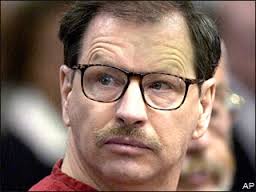
The Green River Killer
Serial killers are not dysfunctional, transient loners. Gary Ridgway, Seattle’s Green River Killer, was married, lived in the same house for years, and held a steady job as an automotive painter. BTK murderer Dennis Rader was also married with children, a church leader, and slayed within a small radius of his home in Wichita, Kansas.
Willie Pickton
Serial killers are not all insane, nor are they evil geniuses. Vancouver’s Willie Pickton, ran unchecked for years, right under the nose of overlapping police jurisdictions who saw him as a simpleton. Pickton, who butchered 49 women and fed them to his pigs, was no Google Geek but he instinctively stick-handled a skillful interrogation by my colleague Don Adam, one of the RCMP’s best polygraphists.
Son of Sam
Serial killers are not all about sex. It’s more a control thing. Satisfaction from the power of holding their victim’s life in their hands seems to be the primary motivator. It’s psychological, not material. David Berkowitz, the Son of Sam, and Harold Shipman, the British doctor, are prime examples of power freaks.
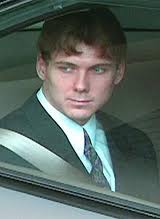
Paul Bernando
Serial killers are not natural deviants. They’re products of their development from birth to adulthood with a vast assortment of contributing factors. Socio-economic upbringing. Neglect. Sexual and physical abuse. Poor self-esteem and harsh peer influence. Clifford Olson, the Beast of BC who brutally hammer-murdered eleven children, became incorrigible early in his pathetic childhood and Paul Bernardo resulted from an affluent, but highly-dysfunctional, middle-class family. He came of age in his teens.
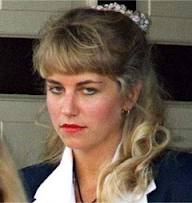
Karla Holmolka
Serial killers have no gender or racial template. John Wayne Gacy was white. Wayne Williams was black. Richard Ramirez was Hispanic. Charles Ng was Chinese. They’re not all male, either. There’s Karla Holmolka, who assisted Bernardo in raping and murdering other women including her own sister, and Aileen Wuoronos, a particularly nasty piece of work who did in her johns.
 Serial killers are not a 21st century, western phenomenon. They’ve been in all cultures and over all ages. Australia and the UK have an abnormally high rate of serial killers, while some of the really weird ones come from Belarus, South Africa, and Germany. Not classified as serial killers are genocide-orchestrating, evil-entities like Hitler, Stalin, or Pol Pot. Those guys got others to do their dirty work and are in a class of their own.
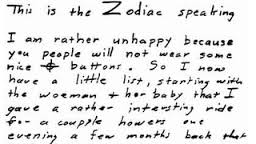
Zodiac’s Note
Serial killers do not have a death wish, nor a longing to get caught. Most go to extremes to avoid detection, learning from mistakes, improving their craft, and rarely do they taunt their investigators like the Zodiac Killer of California did. He’s yet to be identified. Same with Jack the Ripper.
Here’s a few things we do know about serial killers.
They are not capable of rehabilitation. By the time they progress to this extremely abhorrent behavior, it’s too late. And who in their right mind would take a chance on releasing one? Life without parole or the death penalty are the only options.
 Their psychology is complicated. Psychopathy is the common diagnosis, but their kinks in antisocial personality disorders seem to be as unique as their modus operandis. Commonly they’ve a lack of self-control, need immediate gratification, practice predatory behavior, and possess a complete lack of remorse. They can be charming, crafty, spectacularly manipulative, and are pathological liars – not the sort of folks you want inviting you over for dinner, especially a guy like Jeffrey Dahmer. And around puberty, most were cruel to animals, pyromaniacs, and chronic bed-wetters. This is known in forensic psychiatry as the triad.
There’s less and less of them all the time. That’s because of better technological and psychological detection methods resulting in their earlier removal from society. DNA and databanks have been a Godsend in solving multiple offences, especially clearing up cold-cases. There’re better analytical tools like the FBI’s Behavioral Analysis Profiling System, ViCAP, the Violent Criminal Apprehension Program, AFIS, the Automated Fingerprint Identification System, and IBIS, the Integrated Ballistic Identification System. Police resources are better trained and have sophisticated case management software, as well as improved inter-jurisdictional communication. And there’s also legislative initiates like Canada’s Dangerous Offenders Act which allows for indefinite incarceration regardless of maximum statutory sentencing requirements.
We’re fascinated by serial killers.
Why?
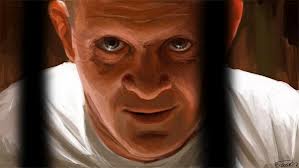
Hannibal Lector
Because they tell us about ourselves.
I believe they’re extenuation of folklore monsters that we heard about in kid stories. The bogeyman. The big bad wolf. Trolls under bridges and witches in forests. Jekyll & Hyde. Frankenstein. Dracula. Psycho. And who hasn’t freaked over Hannibal Lector ?
We’re terrified of monsters and horrified by what they can do to us. But deep-down we have an intense curiosity about what makes these monsters tick. It may be a fear that we, ourselves, could become a monster. Or that the stranger two doors down may already be one. Nature has hard-wired our brains to manage our safety through recognizing danger and alerting each other before it happens. We do this through storytelling and we’re all fascinated by good stories. Especially stories about the most dangerous of creatures – serial killers.
So how do you avoid being murdered by a serial killer?
Simple. Don’t do what their victims do.
Serial killers are creatures of habit and opportunity. They go for the easiest, most vulnerable, most disposable prey. Generally, those are women and youths of both sexes in the high-risk lifestyle demographics – sex trade workers, substance abusers, socio-economic outcasts, and free-spirits who travel alone.
The odds of your being murdered – never mind by a serial killer – are astronomically against you.
But you can still decrease those odds by not associating with a charming stranger.

Royal Canadian Air Force Colonel and Serial Killer Russell Williams.
Knowing who to avoid takes sobriety, life-experience, common sense, and exercising caution when being alone.