Tag Archives: Cause

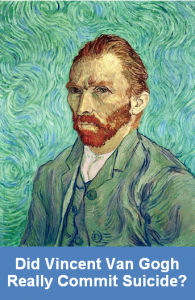
DID VINCENT VAN GOGH REALLY COMMIT SUICIDE?

Dutch Post-Impressionism master, Vincent Van Gogh, was a phenomenal force who helped shape modern art culture. His influence ranks with Shakespeare in literature, Freud in psychology, and The Beatles in music. Van Gogh was also plagued with mental illness, suffered from depression, and was tormented by psychotic episodes. Conventional history records that Van Gogh died from a self-inflicted gunshot wound in 1890 at the age of 37. However, an independent and objective look at the case facts arrives at an entirely different conclusion—Vincent Van Gogh was actually shot by someone else, and it was deliberately covered up.

This isn’t to say that Van Gogh was murdered as in a homicide case. As a former police investigator and coroner, I’m well familiar with death classifications. The civilized world has long used a universal death classification system with five categories. They are natural death, accidental death, death caused by wrongful actions by another human being which is a homicide ruling, self-caused death or suicide, and an undetermined death classification when the facts cannot be slotted into one conclusive spot.

I’m also familiar with gunshot wounds. Understanding how Vincent Van Gogh’s fatal wound happened is the key to determining if he intentionally shot himself, if he accidentally caused his own death, or if someone else pulled the trigger which killed Van Gogh. Before analyzing what’s known about the Van Gogh case facts, let’s take a quick look at who this truly remarkable man really was.

Vincent Willem Van Gogh was born in 1853 and died on July 29, 1890. During Van Gogh’s life, he produced over 2,000 paintings, drawings, and sketches. He completed most of these in his later years and was in his most-prolific phase when he suddenly died.

Van Gogh didn’t achieve fame or fortune during his life. He passed practically penniless. It was after death when the world discovered his genius and assessed his works of bright colors, bold strokes, and deep insight as some of the finest works ever to appear on the art scene. Today, an original Van Gogh is worth millions—some probably priceless.

Vincent Van Gogh achieved artistic saint status. It’s not just Van Gogh’s unbounded talent that supported his greatness. It’s also the mystique of the man and the martyrdom mushrooming from his untimely death that robbed the world of an artist—a starving artist and a man who lived on the fine line between genius and nut.

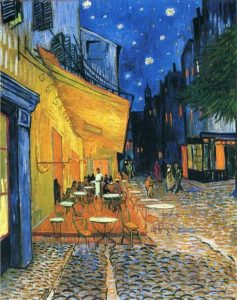
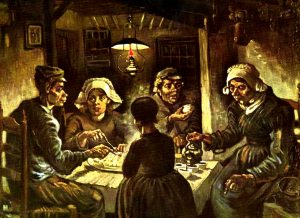
Most people know some of Van Gogh’s masterpieces. Wheatfield With Crows may have been his last painting. Café Terrace At Night, The Potato Eaters, Irises, Bedroom In Arles, The Olive Trees, and Vase With Fifteen Sunflowers are extraordinarily famous. So is The Starry Night. (I happen to have a hand-painted oil reproduction of Starry Night right on the wall in front of me as I write this, and my daughter has Café hanging in her home.)

Most people know the story of Vincent Van Gogh’s ear. It’s a true story, but the truth is he only cut part of his left ear off with a razor during a difficult episode with his on-again, off-again relationship with painter Paul Gauguin. The story goes on that Van Gogh gave his ear piece to a brothel lady, then he bandaged himself up and painted one of many self-portraits. I just looked at this portrait (Google makes Dutch Master shopping easy) and was struck by the image of his right side being bandaged. Then I realized Van Gogh painted selfies by looking in a mirror.

And most people know something about Vincent Van Gogh’s time in asylums. This is true, too, and he spent a good while of 1889 in Saint-Remy where he stared down on the town and painted The Starry Night from later memory. The celestial positions are uncannily accurate.

In late 1889, Van Gogh moved to a rooming house in Auvers-sur-Oise near Paris. His painting production went into overdrive, and he was at the peak of his game. On July 27, 1890, Van Gogh left his room with his paints, canvas, and easel. He returned empty-handed with a bullet in his belly.

Vincent Van Gogh’s spirit left this world at 1:30 a.m. on July 29. He passed without medical intervention on his bed, and the medical cause was, most likely, exsanguination or internal bleeding. There was no autopsy, and Van Gogh was buried in a nearby churchyard the next day.

There are various ambiguous statements purported from Van Gogh. He did not admit to shooting himself or intentionally attempting to commit suicide. However, the record indicates he didn’t deny it. The record can also be interpreted that he covered up for someone else.

What is fairly clear is the description of Vincent Van Gogh’s gunshot wound. There are conflicting locations, (chest, stomach, abdomen), but this is explainable from Dutch/French to English translations. It’s highly probable that one bullet entered the left side of Van Gogh’s mid-section and traversed his intestines in a left-to-right direction. There was no exit wound and no serious spinal damage as Van Gogh had walked home from the shooting scene, up the stairs, and to his room where he expired a day and a half later.

There was no firearm found and absolutely no history of Vincent Van Gogh ever owning or operating a gun. He was a painter. Not a hunter or soldier. (Note: There was a rusted revolver found in an Auver field in 1960 which was said to be the weapon. There is no proof that it was.)

There was no suicide note or any deathbed confession. Aside from being an artist, Van Gogh was a prolific writer who documented many thoughts as he progressed from mental sickness to physical health. In late July of 1890, Van Gogh’s writings showed him to be optimistic and with plans to paint as much as possible before an anticipated period of blackness returned. Two days before his death, Van Gogh placed a large art supply order.

Suicide, in Van Gogh’s case, wasn’t surfaced in the early years after his death. There were murmurs among the villagers that “some young boys may have accidentally shot” Van Gogh as he went about his work in a nearby field. There was no coroner’s inquiry or inquest, but there is documentation of a gendarme questioning Van Gogh if he intentionally shot himself to which Van Gogh allegedly replied, “I don’t know.”

The first strong suicide suggestion came in 1956 with Irving Stone’s novel and movie Lust For Life. It was a documentary that took liberty with Van Gogh’s life and times. It concluded Van Gogh was a troubled soul—a beautiful soul—who ended his life intentionally. The book and movie were bestselling blockbusters and cemented the suicide seed to an adorning public.

It became ingrained in lore and public acceptance that Vincent Van Gogh was a desponded psychotic who suddenly up and killed himself rather than continue a tormented existence of interpreting beauty in nature and people. It was the gospel, according to Van Gogh historians, who were comfortable with a suspicious explanation.
Other people weren’t. In 2011, two researchers took a good and hard look into Van Gogh’s life and death. They had full access to the Van Gogh Museum’s archives in Amsterdam and spent enormous time reviewing original material. They found a few things.

One was a 1957 interview with Rene Secretan who knew Van Gogh well. Secretan admitted to being one of the boys spoken about by the villagers who were involved in Van Gogh’s shooting. Rene Secretan, sixteen years old in 1890, told the interviewer he wanted to set the distorted record straight that was misrepresented in the book and movie.

The interview documents Rene Secretan as saying the handgun that shot Van Gogh was his, and that it was prone to accidentally misfiring. Secretan self-servingly denied being present when the accidental shooting happened, claiming he was back in Paris and not at his family’s summer home in Auvers. Secretan failed to identify those directly involved or exactly what circumstances unfolded.

The researchers, Pulitzer Prize winners Steven Naifeh and Gregory White Smith who co-wrote Van Gogh: The Life, found corroborating statements placing Van Gogh near the Secretan villa on the afternoon of the shooting. They also sourced a leading expert on firearms and gunshot wounds who refuted any chance of Van Gogh being able to discharge a firearm with his own hands that could have caused the wound in its documented location.

Dr. Vincent Di Maio (a 2012 key witness in the Florida trial of George Zimmerman who shot African-American youth Trayvon Martin in a neighborhood watch altercation) concluded that Van Gogh, who was right-handed, could not possibly have held a firearm as it had to be; therefore the shot had to have been fired by another party. Dr. Di Maio also commented on the lack of reported gunshot residue on Van Gogh’s hands and clothes. In 1890, most cartridges contained black powder which was filthy stuff when burned at close range.
Researchers Naifeh and Smith also took a deep dive into what they could find on Rene Secretan’s background. They painted him as a big kid—a thug and a bully who was well known to have picked on wimpy Van Gogh throughout the month of July 1890. Secretan came from a wealthy Paris family who summered at Auvers with their second home within walking distance of Van Gogh’s rooming house.

According to the researchers of Van Gogh: The Life, Rene Secretan had seen the Buffalo Bill Wild West show in Paris, and Secretan fancied himself as a cowboy character. Secretan fashioned a costume to go with his cocky role of a western gunfighter, and he acquired a revolver that was prone to malfunction. They documented incidents where Secretan would mock Van Gogh as he painted, play pranks on him, and supply alcohol to Van Gogh who couldn’t afford it.

It was during a mocking spat, the researchers surmise, that somehow Secretan’s revolver went off and struck Van Gogh in the abdomen. According to the theory, the boys fled, disposed of the weapon, and formed a pact of silence. If this was true, the question arises of why didn’t Vincent Van Gogh report the truth, and why has the suicide conclusion remained steadfast.

Naifeh and Smith address this in their book with this quote: When all this (accidental shooting theory) began to emerge from our research, a curator at the Van Gogh Museum predicted the fate that would befall such a blasphemy on the Van Gogh gospel. “I think it would be like Vincent to protect the boys and take the ‘accident’ as an unexpected way out of his burdened life,” he agreed in an e-mail. “But I think the biggest problem you’ll find after publishing your theory is that the suicide is more or less printed in the brains of past and present generations and has become a sort of self-evident truth. Vincent’s suicide has become the grand finale of the story of the martyr for art, it’s his crown of thorns.”

As an experienced cop and a coroner, I think Naifeh and Smith are on to something. There are two huge problems with a suicide conclusion in classifying Vincent Van Gogh’s death. One is the lack of an immediate suicide threat. The other is the gunshot nature.

I’ve probably seen fifty or more gunshot suicides. All but one were self-inflicted wounds to the head. The exception was a single case where the firearm was placed against the chest and the bullet blew apart the heart. I have never seen a suicide where the decedent shot themselves in the gut, and I’ve never heard of one.

Vincent Van Gogh didn’t leave a suicide note. He made no immediate suicide threats and, by all accounts, things were going well for the struggling artist. It makes no sense at all that Van Gogh would head out for a summer’s day, begin to paint, produce a gun from nowhere, shoot himself in the stomach from the most inconceivable position, then make it home—wounded—without finishing himself off with a second shot.
If I were the coroner ruling on Vincent Van Gogh’s death, I’d readily concur the cause of death was slow exsanguination resulting from a single gunshot wound to the abdomen. I’d have a harder time with the classification. Here, I’d have to use a process of elimination from the five categories—natural, homicide, accidental, suicide, or undetermined.

There is no possibility Van Gogh died of natural causes. He was shot, and that is clear. Was he murdered or otherwise shot intentionally? There is no evidence to support a homicide classification. Did the firearm go off accidentally? It certainly could have, and there is information to support that theory but not prove it.

Suicide? Not convincing. The available evidence does not meet the Beckon Test where coroners must establish beyond a reasonable doubt that the decedent intentionally took their own life. If the death circumstances do not fulfill the requirements of the Beckon Test, then a coroner is not entitled to register a suicide classification.

This only leaves undetermined. Coroners hate closing a file with an undetermined classification. It’s like they failed in their investigation.

Unfortunately, in Vincent Van Gogh’s case—from the facts as best as are known—there’s no other conclusion than officially rule “Undetermined”.

I’m no longer a coroner, though, so I’ll stick out my neck.

On the balance of probabilities, I find Vincent Van Gogh was accidentally shot, then sadly died from this unintended and terrible tragedy.


THE MOOSE HIDE CAMPAIGN—ENDING VIOLENCE AGAINST WOMEN & CHILDREN

Violence by men against women and children is a severe, secluded crime in every society. That goes for all forms of male-dominated violence—mental cruelty, beatings within families, child abuse, molestations, sexual assault in social situations, stranger to stranger rapes and sexually-motivated kidnappings with sadistic serial killers. Wouldn’t it be wonderful if a grassroots movement occurred where men hold other men accountable for violent behavior towards women and children, ending this travesty? Well, it’s happening and just hit one million contacts. It’s called the Moose Hide Campaign.

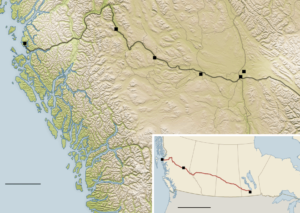
The Moose Hide Campaign started when a father and daughter realized they could make a difference. Have they ever. In 2011, Paul Lacerte and Raven Lacerte were hunting moose in accordance with their indigenous sustenance rights along British Columbia’s infamous Highway of Tears in northern Canada. Dozens of women have gone missing or were found murdered along this remote road system. It’s part of a pattern where over 1,200 Canadian indigenous women have disappeared or were violently killed in unsolved murders during the past three decades.

Raven and Paul harvested their moose and were field-dressing it. They began discussing the horrid Highway of Tears situation occurring around them and how they could help. As they skinned their moose, they realized the answer was creating a national dialogue to generate widespread awareness of violence against women and children. Getting people to talk and recognize the magnitude of the problem became their mission. As a talk-stimulator, they tanned their moose hide and cut it into one-inch squares, pinning them to as many people as possible. Seven years later, their one-millionth moose hide square got pinned on a very deserving person.

One Million Moose Hide Squares Have Been Handed Out

Inspiring one million people to stop what they’re doing, pin-on a square and discuss ending violence against women is impressive. But that’s nothing compared to the Moose Hide Campaign’s vision to have ten million people wearing moosehide squares and pledging their part. So far, the Moose Hide Campaign extends across every region in Canada. It’s getting international notice as well as high-profile political support. At the 2018 campaign gathering in Victoria, the British Columbia Provincial Government granted $2 million to help fund the campaign. That’s additional to money donated by many strong supporters in the private sector.

The Moose Hide Campaign originated within Canada’s indigenous peoples’ community. It’s far from exclusive, however. Sadly, Canada’s First Nations women and children experience three times the rate of violence compared to main-street Canadian society. That’s not unique to Canada, though. Violence against women and children permeates every country. That includes first-world nations like Australia, Great Britain and the United States.

The Moose Hide Campaign Creed

Promoting family decency, gender equality, healthy relationships and curbing substance abuse are core to the Moose Hide Campaign. In the center of the circle is promoting ideas of positive masculinity where men stand up and hold each other accountable for learned and aggressive behavior. Supporting each other is also central to the Moose Hide movement. This is the creed Moose Hide Campaign male supporters adhere to:

  • Stand up with women and children.
  • Speak out against violence towards them.
  • Support each other as men yet hold violent offenders accountable.
  • Teach boys about the true meaning of love and respect.
  • Become healthy role models for youth and other men.
  • Help, hold accountable and heal those who are violent offenders.
  • Encourage everyone to take action, make a pledge and pitch in.

Part of the Moose Hide Campaign is helping to address reconciliation from years of systematic abuse against Canada’s indigenous people. Historically, most violent indigenous male offenders were made—not born. For over a century, indigenous people were forced from their traditional lands where sustenance activities like moose hunting were critical to their very survival. Men, women and children were stocked in a reservation system where a cycle of poverty, lack of education, unemployment and suppression of culture created generations of substance abuse and terrible violence.

Reconciliation for Indigenous Peoples

Government agencies reacted to the “Native Problem” by creating residential schools in urban centers. This misguided program took children from their parents and housed them in institutional warehouses where innocent kids were punished for speaking their traditional language and wearing cultural clothes. Behind the shadows, many indigenous children were violently beaten and sexually assaulted. It’s no wonder boys grew into men practicing this learned behavior.

This isn’t making excuses for today’s violent men. It’s a look at reality. The Moose Hide Campaign recognizes horrors of the past and wants that violent behavior to be history. It’s only through actions like those from Raven and Paul Lacerte and their dedicated Moose Hide Campaign supporters that this goal of ending violence against women and children will become a reality.

Currently, there is another large Canadian movement to reconcile wrongs and injustices done to indigenous peoples. Aside from acknowledging, apologizing and compensating for the residential school disaster, there is a National Inquiry into Missing and Murdered Indigenous Women and Girls underway to determine how so many innocent souls have disappeared or been found murdered. At the center of this circle is the Highway of Tears.

The Highway of Tears

Over the past 30+ years, dozens of women have gone missing or were found murdered along the stretch of road from Prince George in central British Columbia to Prince Rupert on the Pacific coast. Undoubtedly, many are victims of one or more serial killers. Despite police putting massive resources into the investigation, they don’t appear close to solving this mystery and ending the problem. The solution needs to come from grassroots prevention.

Abduction, rape and murder are the ultimate acts of violence against women and children. Many of these Highway of Tears victims are indigenous women unfortunately placed in high-risk lifestyles like sex workers and hitchhikers. Those actions make them easy targets for predators like whoever are behind the Highway of Tears tragedy.

The geographic area of the Highway of Tears is symbolic of a much larger region where similar acts occurred or are occurring. The pattern began in the 1970s. Initially, they were known as the Highway Murders. Now, the investigation region expands to include southern and eastern routes. The true victim count could be in the thousands.

This certainly isn’t saying all these missing and murdered women and children are serial killer victims. Many are likely victims of domestic violence or violent acts by someone they’re familiar with. That’s the real signature of violence against women and children. Most of these crimes happen within privacy. Many are never reported.

It’s enough, already. Enough. It has to stop.

The only way to truly end violence against women and children is for everyone to stand up, discuss this massive problem and take action. It’s enough, already. Enough. It has to stop. That starts with supporting movements like the Moose Hide Campaign created by daughter and father, Raven and Paul Lacerte. Bringing this issue into public view and holding violent men accountable is a start. Ending the cycle of violence will work if enough people get involved. It’s a lot of work, and it’s long overdue.

Key to the Moose Hide Campaign’s vision is individuals being inspired to do something about the tragic reality of gender-based and domestic violence. Everyone can find a way to share the campaign message with family, friends, co-workers, organizations and communities. Wearing the moosehide square is a start to engaging conversations… even with complete strangers.

Volunteers for the Moose Hide Campaign pitch in to organize community events and host public kiosks. The spirit is generating awareness and conversations leading to men being held responsible for violent acts. It’s also about helping these men correct their behavior as well as treating and healing underlying issues.

For individuals opposed to moose hunting and using authentic moose hide, there are synthetic squares available. Be assured, all moose hides originate from traditional hunters who harvest moose for food or ceremonial purposes. Many hides come from unfortunate animals in road mishaps. No moose are intentionally hunted to support the Moose Hide Campaign.

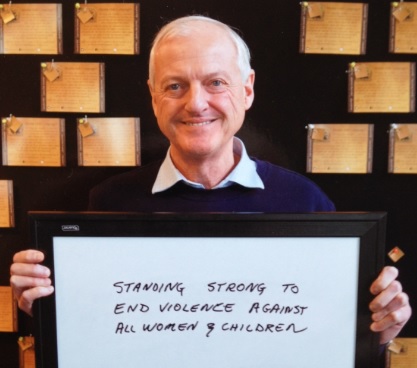
For more information on the Moose Hide Campaign, please email garry.rodgers@shaw.ca. Also, please visit the campaign’s website at www.moosehidecampaign.ca. Follow on Facebook and Twitter. Financial donations are appreciated. *No Moose Hide squares are ever sold* The best help you can give is spreading the word about this grassroots movement and raise awareness about the Moose Hide Campaign. Together, we can stand strong to end violence against all women and children.

Here are some interesting links about the Moose Hide Campaign:

The Story of a Million Moose Hides

2018 Moose Hide Gathering in Victoria, B.C.

Province of British Columbia Moose Hide Campaign Video

Moose Hide Campaign Message from Canadian Prime Minister Justin Trudeau

Blog Post I Wrote for Rachel Thompson (Rachel in the OC) – Why Women Don’t Report Sexual Abuse

FATAL FLAW – WHAT REALLY CAUSED THE TITANIC TRAGEDY

t29The R.M.S. Titanic was the world’s largest man-made, mobile object when the ship was commissioned in 1912. Everyone knows the Titanic hit an iceberg in the North Atlantic and sank within 2 hours and 40 minutes. It was the highest-profile marine disaster of all time and most people still blame the accident on the iceberg. What few people know is the real root cause — the fatal flaw that sunk the Titanic and killed over 1,500 people.

There were two official inquiries into the Titanic’s sinking. Both concluded the iceberg was the root cause, although the investigation processes considered many contributing factors — natural, mechanical, and human. There were errors found in the Titanic’s design, production, navigation, communication, and especially in the motivation of its builder, the White Star Line. While fingers were pointed, no blame was attached and the only real outcome of the Titanic inquiries was adopting the International Convention for the Safety of Life at Sea (SOLAS) that still governs marine safety today.

t11The Titanic accident investigations used the best resources of the time however, the inquiries were conducted long before the wreckage was found, a forensic analysis was applied, and computer-generated recreation was available. Today, we have a clear picture of exactly how the Titanic disaster took place from a mechanical perspective but finding the root cause has remained buried as deep as its bow in the muddy bottom. It shouldn’t be, because the true cause of what really sunk the Titanic is clearly obvious when analyzed objectively.

Both official inquiries into the Titanic sinking called sworn testimony of the surviving crew members, passengers, rescuers, builders, and marine regulators. They used an adversarial approach that was common for investigations at the time. That involved formulating a conclusion — the iceberg — then calling selective evidence and presenting in a way that supported the iceberg findings.

t28One investigation by the U.S. Senate concluded the accident was an Act of God — the iceberg was a natural feature and shouldn’t have been there under normal conditions. The second investigation by the British Wreck Commissioner agreed with the natural cause conclusion but qualified it with a statement, “What was a mistake in the case of the Titanic would, without a doubt, be negligence in any similar case in the future“. In other words, “In hindsight, it shouldn’t have happened and we’re not going to tolerate it again.

Both twentieth-century investigations concluded that when the Titanic collided with the iceberg, a gigantic gash was ripped in its hull allowing massive water ingress and compromising the ship’s buoyancy. At the root of the accident, they found the cause to be simply the iceberg.

They were wrong. They failed to identify the real cause of the Titanic tragedy.

t31

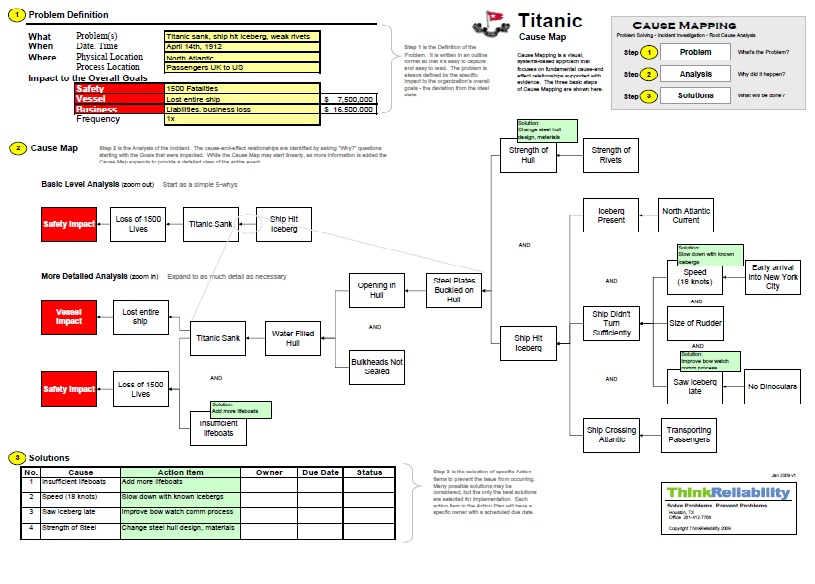
Today’s professional accident investigators take a different approach to fact finding. They take a “Root Cause Approach” to accident investigation and the industry leaders in Root Cause Analysis or Cause Mapping are the front line company Think Reliability.

t9Think Reliability has done a root cause analysis of the Titanic sinking that’s outlined in an instructional video and a detailed event flow chart that identifies over 100 points of contributing factors. They’re excellent presentations but even Think Reliability missed a few contributors and did not categorically identify the one fatal flaw that caused the deaths of so many innocent people.

In getting to the root cause and finding the fatal flaw, it’s necessary to look at the stages of how the Titanic came to be and then determine exactly what caused it to go down.

History of the Titanic

The Royal Mail Ship Titanic was one of three sister vessels planned by the British ocean liner company, White Star Line. The Olympic was commissioned in 1910 and already in operation when the Titanic was under construction. A third ship, the Britannic, was in planning.

t23The Titanic’s construction was under an extremely tight timeline. Politics were at work, as was economics. Transcontinental ocean travel was rapidly expanding and the once-dominated British control on this lucrative industry was being threatened by German built and operated liners. In protective reaction, the British Government decided to subsidize White Star’s competitor, the Cunard Line. This left White Star resorting to private funding in order to compete and it came from American financier, J.P. Morgan, who put tremendous pressure on White Star to perform.

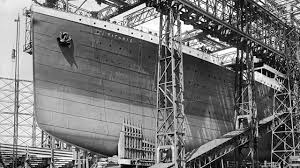
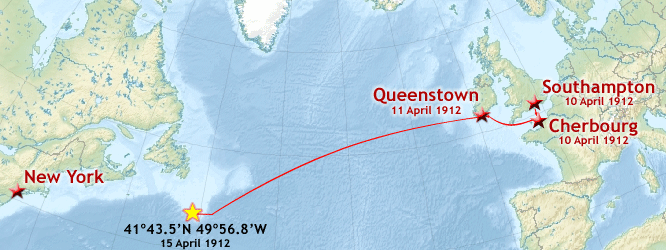
Harland & Wolff shipbuilders in Belfast, Ireland, built the Titanic. She was 883 feet long, stood 175 feet to the top of the funnels from the waterline and weighed 46,329 tons in water displacement. Her keel was laid in March, 1909, and was set to sea trials on April 2, 1912. Eight days later, on April 10, 1912, the Titanic disembarked Southampton, England on her maiden voyage destined for New York City. Officially, 2165 passengers and crew were on board but this figure is not accurate due to no-shows, an inaccurate crew count, and additional passengers who were taken on in Ireland as well as inevitable stowaways.

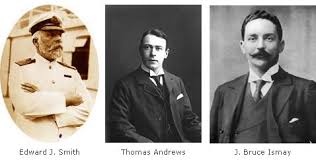
t37Some of the world’s most influential and wealthy people were on the Titanic which included the ship’s designer, Thomas Andrews, as well as the head of White Star Line, Bruce Ismay. It was beyond a voyage — it was a cultural event and a chance for White Star to regain its place in international shipping by proving the fastest and most luxurious way to sail between Europe and America. A lot was riding on the Titanic’s success.

The Iceberg Collision

The route Titanic took to New York had been traveled for several hundred years. It was the standard passageway for international liners and the main shipping lane between Europe and North America. The Titanic’s master, Captain Edward Smith, was a thirty-two-year White Star Line veteran and was chosen to command the Titanic due to his experience in international navigation, specifically this plot.

On the evening of April 14, 1912, the weather was perfect. It was clear, cold, and the sea was flat calm however, visibility was limited to ¼ mile due to there being a new moon and the only illumination was from starlight.

t6

At 11:35 p.m., the Titanic approached a point 375 nautical miles south-southeast of Newfoundland where the cold Labrador current from the north met the warmer Gulf current from the south. This location was well known for being the edge of pack ice and was notorious for icebergs which calf or break-off from their parent shelf.

Captain Smith had inspected the bridge at approximately 9:30 p.m. According to testimony from the surviving helmsman, Captain Smith discussed the potential of icebergs although none were yet seen. Smith directed the helmsman to maintain course and to raise him if conditions changed. The Captain left the bridge, retiring to his quarters. He was no longer involved in mastering the ship until after the collision.

t38Testimony from the Titanic’s helmsman, Robert Hitchens who was at the wheel during the iceberg collision, records that the Titanic was at 75 propeller revolutions per minute which calculated to 22.5 nautical miles per hour, just short of its maximum design speed of 80 revolutions or 24 knots. The helmsman also testified the Titanic was actually speeding up when it struck the iceberg as it was White Star chairman and managing director, Bruce Ismay’s, intention to run the rest of the route to New York at full speed, arrive early, and prove the Titanic’s superior performance. Ismay survived the disaster and testified at the inquiries that this speed increase was approved by Captain Smith and the helmsman was operating under his Captain’s direction.

The Titanic was built long before radar became the main nighttime navigational aid. The watch depended on a crew member in the forward crow’s-nest who stared through the dark for obstacles. Other ships were not a concern as they were brightly lit and the only threat to the Titanic was an iceberg.

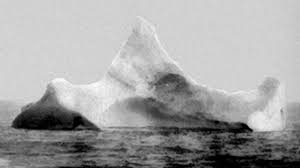
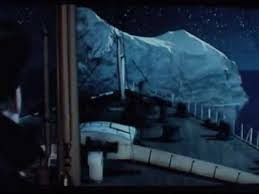
t2From the dim, Titanic’s watchman saw the shape of an iceberg materialize. It was estimated at ten times the Titanic’s size above water, which equates to a total mass of one hundred Titanics. The watchman alerted the bridge that an iceberg was at the front right, or starboard side, and to alter course.

Testimony shows that confusion may have caused a mistake being made in relaying a course change from the bridge to the steerage located at the ship’s stern. It appears the rudder might have been swung in the wrong direction and they accidently turned into the iceberg. It’s reported that when the helmsman realized the error, he ordered all engines in full reverse. Screw and rudder ships cannot steer in reverse. They can only back up in a straight line but it was too late.

Stopping the Titanic was impossible. It was speeding ahead far too fast to brake within a 1/4 mile, which is 440 yards. Without a speed reduction, covering 440 yards at 22.5 nautical miles per hour would take 36 seconds. Testimony from the inquiries recorded that during the eight-day sea trials, the Titanic was tested from full-ahead at 22 knots to full-stop. This took 3 minutes and 15 seconds and the deceleration covered 850 yards.

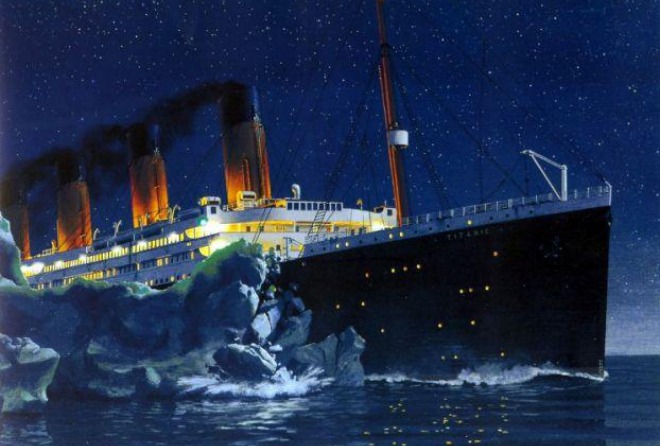
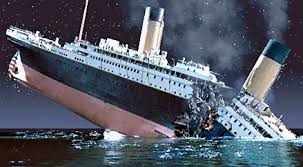
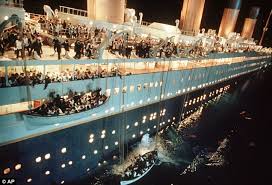
t39The Titanic sideswiped the iceberg on its starboard front, exchanging a phenomenal amount of energy. It immediately began taking on water that filled the ship’s six forward hull compartments. Water cascaded over the tops of the bulkheads in a domino effect and, as the weight of the water pulled the bow down, more water ingressed. This caused the stern to rise above the waterline. With the rear third of the ship losing buoyancy and the weight from her propellers being in the air, the stress on the ship’s midpoint caused a fracture. The ship split in two and quickly sank to the bottom. It was 2:20 a.m. on April 15, 1912 — two hours and twenty minutes after the iceberg collision.

Warning and Life Saving Attempts

Captain Smith came to the bridge shortly after the collision. Again, survivor testimony is conflicting and Smith did not live to give his version of what took place in mustering the crew and passengers for safe abandonment.

t36Without any doubt, there was complete confusion — some said utter chaos — in abandoning ship. The voyage had been so hastily pushed that the crew had no specific training or conducted any drills in lifesaving on the Titanic , being unfamiliar with the lifeboats and their davit lowering mechanisms.

Compounding this was a decision by White Star management to equip the Titanic with only half the necessary lifeboats to handle the number of people onboard. The reasons are long established. White Star felt a full complement of lifeboats would give the ship an unattractive, cluttered look. They also clearly had a false confidence the lifeboats would never be needed.

It’s well documented that many lifeboats discharged from the Titanic weren’t filled to capacity. Partly at fault was a “women and children first” mentality, but the primary reason is that no one person took charge of the operation. Testimony is clear that Captain Smith was involved during the lifeboat discharges but there’s no record of what charge he actually took. Some accounts tell of the Captain remaining on the bridge and going down with the ship, as the old mariner’s line goes.

t34Another well-documented issue was the failure of the ocean liner Californian to come to Titanic’s rescue. The Californian was within visual view of the Titanic. In fact, the crew of the Californian had sent the Titanic repeated messages warning of icebergs and the Californian had stopped for the night because of limited visibility and high risk of iceberg collision. These messages were improperly addressed and were never relayed to the bridge of the Titanic.

Further, the crew of the Californian had seen Titanic’s distress flares but the Californian’s Captain refused to respond. This was a major issue brought up at both official inquiries and a reasonable explanation from Californian’s Captain was never resolved.

Eventually, the ocean liner Carpathia responded. It, too, sent the Titanic iceberg warnings before the collision. The inquiries drilled down into the message relay flaws. They discovered the wireless operators on board the Titanic weren’t crewmembers nor directed by White Star. They were employees of the Marconi Telegraph Company privately contracted in a for-profit role to deliver all messages to and from the Titanic. In the few hours before the iceberg collision, the Titanic was within range of an on-shore relay station and this gave them a short window to pass high-priority messages for wealthy passengers. Navigation warning messages to the Titanic were given low or no priority.

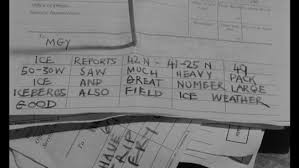
t40Hearing testimony recorded that shortly after dark, as early as 7:00 p.m., the Titanic was sent at least five iceberg warnings. There’s no record these were passed on to the ship’s bridge nor the Captain. The Marconi operator aboard the Titanic survived to testify there’d been a severe backlog of paying customer messages and he was being “interrupted” by incoming navigational alerts. The warnings were set aside as they were not addressed “MSG” which means “Master Service Gram”. By policy, MSG messages required the Captain’s personal action whereas non-marked messages were delivered when time permitted.

Finding the Titanic — Design and Damage

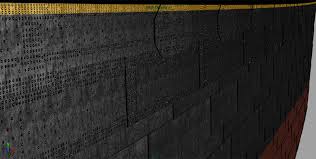
Although the Titanic was the largest ship of its time, there was nothing technologically new about its design, materials, or method of construction. The hull was built of large steel plates, some as large as 6 feet by 30 feet and between 1 and 1 ½ inches thick. The technology at the time was to rivet the sections together where today, modern ships are welded at their seams.

t17Riveting a ship’s seams was an entire trade on its own — almost an art. There were two types of rivets used on the Titanic. Rivets in the mid-section of the hull, where stresses from lateral wave forces were greatest, were made of steel and triple-riveted while those in the bow and stern were composed of cheaper iron. The bow and the stern endured less force when under normal operation and only required double riveting by design. Further, with the mid-section of the Titanic being straight and flat, these rivets were installed with hydraulic presses where the curved plates at the ship’s ends had to be hand riveted. That involved setting rivets in place while white hot and hand-hammering them closed.

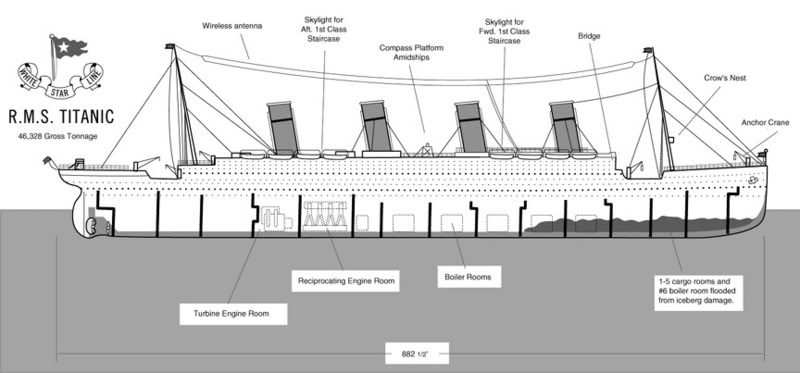
Anyone who’s watched the movie Titanic knows the ship was designed with sixteen “watertight” compartments, separated by fifteen bulkheads that had doors which could be shut off in the event the hull was compromised anywhere along these sections. The “watertight” design only applied below or at the waterline, leaving the entire hull open above the top of these bulkheads.

The bulkheads were the fatal design cause of the Titanic’s sinking, but they weren’t the root cause of the disaster.

The ship’s architect, Thomas Andrews, was aware that flooding of more than four compartments would create a “mathematical certainty” that the bulkheads would overflow and cause the ship to sink. Testimony records that Andrews informed Captain Smith of this right after he realized the extent of flooding. This triggered the abandon ship order.

t42

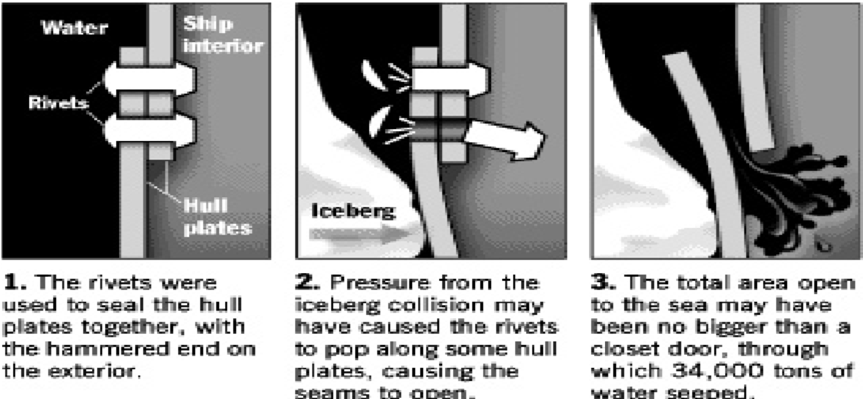
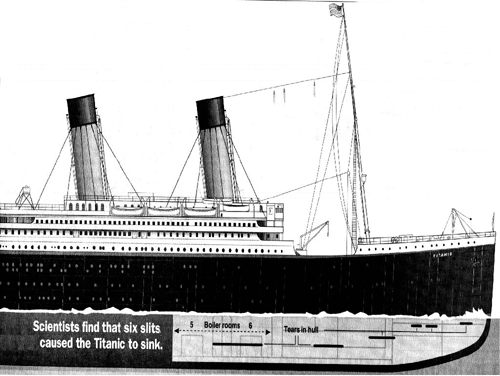
Over the years following the sinking and before the Titanic’s wreckage was discovered, most historians and naval experts assumed the ship suffered a continuous gash in the hull below the waterline and across all six compartments. There was one dissenter, though, who surmised it only took a small amount of opening in each compartment to let in 34,000 tons of water and that was enough to compromise the ship.

Edward Wilding was a naval architect and co-designer of the Titanic who testified at the American inquiry. He calculated that as little as 12 square feet of opening in the hull would have been enough to let in that much water in the amount of time the Titanic remained afloat. Wilding stated his opinion that there was not a long gash, rather it was a “series of steps of comparatively short length, an aggregate of small holes” that were punctured in the hull. Wilding went as far to speculate that the force of the collision probably caused a number of rivets to “pop or let go” and it was “leaks at the ruptured seams” that let in seawater.

t43

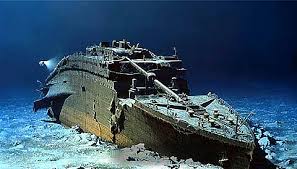
In September, 1985, the Titanic’s wreckage was found by a deep sea expedition led by Dr. Bob Ballard. It was in 12,500 feet of water and its debris field covered 2,000 yards. Her hull was in two separate main pieces with her bow nosed into 35 feet of muddy bottom. Since then, a number of dives have been made on the Titanic including one which used a ground penetrating sonar that mapped the section of the bow that was under the mud.

The sonar readings clearly showed six separate openings in the forward six hull compartments. They were narrow, horizontal slits in various spots, not at all in one continuous line like the gash theory held. The sonar map was analyzed by naval architects at Bedford & Hackett who calculated the total area exposed by the slits was 12.6 square feet—almost the exact figure proposed by Edward Wilding in 1912.

t1

The architects also stated the rivets were clearly at fault and they’d failed from the impact. The rivets either sheared off on the outer heads or simply fractured and were released by the impact’s force. Immediately, many experts questioned why only a few rivets in a few seemingly random places failed and not most all along the area of impact.

In one of the dives, a large piece of the Titanic’s forward hull was recovered. This led to a forensic study on the plate steel and rivet composition by metallurgists Jennifer McCarty and Tim Foecke which they documented in their book What Really Sank The Titanic. Drs. McCarty and Foecke established a number of the Titanic’s iron rivets had an unacceptable amount of slag in their chemical makeup, contrary to what the ship’s design specified. The metallurgists concluded when the inferior, weak rivets were exposed in below-zero Fahrenheit water temperature on the night of the sinking, they were brittle and shattered from the collision force.

t14The metallurgists went further in their investigation. They found during the rush to complete the Titanic on time, the builders purposely resorted to inferior metal than specified by the designers. The builders were also faced with a critical shortage of skilled riveting labor. This led to a compounded error of inferior rivets being installed by inferior tradesmen that likely explains the randomness of failed areas.

Today, the failed rivet theory stands as the most logical explanation for the mechanical cause of the Titanic disaster, but this still doesn’t get at the root cause of the tragedy.

At the core of Root Cause Analysis is the question “Why?”. This form of accident investigation forces the question “Why did this happen?” to be asked over and over until you cannot ask anymore “Whys?”. In Titanic’s case, this path leads to answering the root cause — the fatal flaw in why over 1,500 innocent people lost their lives.

t44

The two official investigations back in 1912 started with a conclusion — the Titanic hit an iceberg and sank. They made somewhat of an attempt to answer why that happened without attaching too much blame. The result was not so much as getting to the root cause but to try and make some good come from the disaster and ensure there was less chance of it happening again.

That is a good thing and, to repeat, it led to improving world marine safety through SOLAS. But that still doesn’t get to identifying the fatal flaw in what really sank the Titanic.

Think Reliability identified five root causes of the Titanic disaster:

1. Iceberg warnings were ignored.

2. The iceberg wasn’t seen until too late.

3. The Titanic was traveling too fast for visual conditions and couldn’t avoid colliding with the iceberg.

4. The rivets failed, compromising the hull’s integrity and letting in enough water to exceed the design buoyancy.

5. Insufficient lifesaving procedures and equipment were in place.

While these five reasons are the prime contributors to why the accident and tremendous loss of life happened, they still don’t arrive at the true, single root cause — the fatal flaw in what caused the Titanic tragedy.

t45

Finding the fatal flaw requires answering ‘Why” to each of these five points.

1. Why were the iceberg warnings ignored?

The answer is a systematic failure of communication operating on the Titanic. There was ample reason to suspect icebergs might be in the Titanic’s path. Any competent captain would be aware of hazards like this and would liaise with other ships along the route for warning information. Navigational communication was not a priority under Captain Smith’s command.

2. Why was the iceberg not seen until too late?

There’s another simple answer here. Night visibility was poor as there was limited light. Testimony from the surviving crewmembers consistently estimated the visibility range to be no more than ¼ mile. Eyesight, combined with compass readings, were the only forms of navigation in 1912. The Titanic was going too fast for the crew to react because Captain Smith allowed his ship to exceed a safe speed for navigation conditions.

3. Why was the Titanic traveling too fast for navigation conditions?

Without question, Captain Smith was under pressure from Bruce Ismay to bring the Titanic into New York earlier than scheduled. While this would never have set a speed record for the route, it certainly would reflect positively on the White Star Line and its business futures. Captain Smith succumbed to unreasonable pressure and allowed his ship to be operated unsafely.

4. Why did the rivets fail?

While Captain Smith had no input into the construction of the Titanic, he certainly knew its design limits. The Titanic was built as an ocean liner, not a battleship or an icebreaker. Captain Smith knew how dangerous an iceberg collision could be yet he still risked his ship being operated in unsafe conditions.

5. Why were there insufficient lifesaving equipment and procedures in place?

The fault began with White Star’s failure to provide the proper amount of lifeboats as well as rushing the Titanic into service before the crew was properly trained in drills and equipment operation. Captain Smith was aware of this. Despite, he allowed the Titanic to sail unprepared.

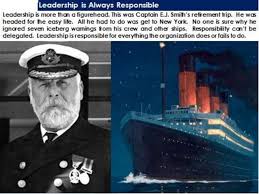
t18At the root of each of question lies irresponsibility of the Titanic’s captain. It’s long held in marine law that a ship’s captain is ultimately responsible for the safety of the vessel, the crew, and the passengers.

Captain Smith had full authority over every stage in the Titanic’s disaster and he failed on each point. Clearly, Captain Smith is the fatal flaw that caused the Titanic tragedy.
*   *   *

Note: Garry Rodgers holds a 60 Ton Transport Canada Marine Captain Certification which includes training in Ship Stability, Navigation, SOLAS, and Marine Emergency Duties. Garry’s also formally trained in Think Reliability Root Cause Mapping.