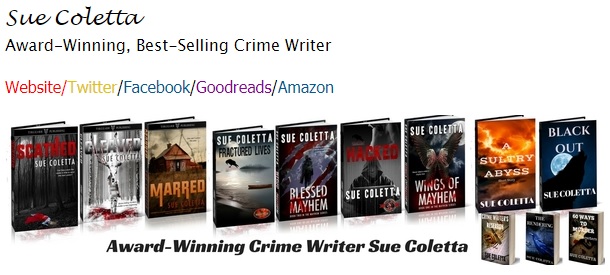
 Every once in a while a bright star emerges—no matter what writing galaxy you’re in. But, they’re never overnight stellars. They’re self-made products with years in craft study, committed practice, unswerving belief in themselves, refusal to give up and respectful networking with humble appreciation. And a few have God-given talent. They make it all work. That’s the secret successful combination bestselling author Sue Coletta tells you about in her travel toward the top of the crime thriller genre.
I met Sue Coletta three years ago—just before her first published book. Sue shipped me a draft of MARRED for my thoughts. I was a page in and stopped. I backed up. Read it again. And I thought, My God! Can this writer write! Today, Sue and I are professional colleagues and personal friends. I watch her progress with awe.
In a short span, Sue Coletta’s produced five fantastic novels and several stand-alones. She’s slain story structure, captured book marketing and mastered social media. Through her plotting, penning and promoting, Sue’s stayed down-to-earth and kept her wicked sense of humor. And despite demands, Sue Coletta still makes time to selflessly share her secrets of writing bestselling crime thrillers—Sue was silly enough to drop in for a DyingWords chat.
* * *
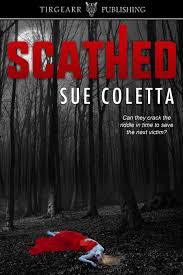
Hey, Sue! Great having you back in the DyingWords shack. *locks door* What a coincidence—it happens to jive with the release of your new crime thriller, SCATHED, the Grafton County Series, Book #3. I just finished a non-stop SCATHED read, and I gotta say, “Wow!” I didn’t think it possible to exceed your other novels, but you’re becoming a better writer all the time. *disconnects phone* Tell us about SCATHED. *draws curtains* What’s in it? How’d it come to be?
What’s SCATHED about?
On a picturesque fall morning in Grafton County, New Hampshire, a brutal murder rocks the small town of Alexandria. In the backyard of a weekend getaway cabin, a dead woman is posed in red-satin, with two full-bloomed roses in place of eyes.
 In her hand she holds a mysterious envelope addressed to Sheriff Niko Quintano. Inside, Paradox vows to kill again if his riddle isn’t solved within 24 hours.
With so little time and not enough manpower, Niko asks his wife for help. But Crime Writer Sage Quintano is dealing with her own private nightmare. Not only did she find massive amounts of blood on the mountain where she and her family reside, but a phone call from the past threatens her future—the creepy mechanical voice of John Doe, the serial killer who murdered her twin sister.
Together, can Niko and Sage solve the riddle in time to save the next victim? Or will the killer win this deadly game of survival?
— — —
 The book description doesn’t match the initial story idea. It all started with the Tim McGraw song, “Live Like You Were Dying.” All writers have a weird and wonderful way of coming up with story ideas. This post gives readers a peek into my thought process for SCATHED. Which made perfect sense to me at the time. Not sure anyone who reads the post would agree, but it all worked out in the end.
You flesh your characters so well. In SCATHED, you put Sage and Niko through the wringer, and Paradox is quite the enigma. Your plotting is outstanding. I’m not going to do a spoiler alert about the finale, but I did not see that coming. How do you do such a good job of character and plot building?
I studied story structure for years, and I put that knowledge to work. Here’s a quick overview of the milestones all stories must hit in order to work, regardless of genre …
 Hook: Open the novel with a bang. In other words, hook the reader and don’t let go. Force them to flip the page, then the next, and the next after that. The hook is something that creates a question the reader wants answered; doesn’t need context with protagonist’s needs or stakes.
Inciting Incident (optional, but I include it): Game-changing event occurring during Part 1, often leading to a decision at the First Plot Point.
First Plot Point (20% – 25% into the novel): The most important moment in the story, because it kicks off the quest. Something forces the protagonist to act.
First Pinch Point (about 37.5% into the novel): Reminder of the story’s antagonist, not filtered by narrative or protagonist’s description, but directly visible to the reader.
Midpoint (at 50%): New information or awareness that changes the experience or understanding of context for the protagonist and/or reader; a catalyst activating new decisions/actions.
Second Pinch Point (at roughly 62.5%): Reminder of the story’s antagonist, as the antagonist ups the game against the protagonist’s attacks.
All is Lost Moment (optional): A slower paced, all-hope-is-lost lull before the Second Plot Point, where the protagonist feels gutted.
Second Plot Point (placed at 75%): The final injection of new information into the story (doesn’t need to be fully understood by the protagonist yet); protagonist’s quest is accelerated.
As for characterization, the best advice I can give is to slip into your character’s skin. Know your character as well as yourself, then ask three questions …
What’s their public persona? (1st dimension of character; the face they show to the world)
How do they act with friends and family? (2nd dimension of character; the face they show to those closest to them)
If they were trapped in a movie theatre during a fire, would they elbow their way through the crowd, or would they help others escape the blaze? (3rd dimension of character; their true character — who they are when the shit hits the fan.)
This is called the three dimensions of character. By fleshing out these questions, we’re able to create living, breathing human beings, with hopes, fears, worldviews, religious beliefs, phobias, dreams, plans for the future, etc. We don’t show all these things of course, but we should still know the answers. I even listen to their favorite music to help get into character.
No doubt you’ve got a Grafton County Series #4 in mind. What’s happening on that front?
Book 4 is all planned out. It’s sitting on the back burner to cool while I finish writing Silent Mayhem, Mayhem Series, Book 3.
 Okay. Let’s talk shop, and hear some crafty wisdom from crime writer Sue Coletta. I know you’re a big plotster rather than a pantster. Tell us about your story structure philosophy.
Whoops. Jumped the gun on this question. It’s answered above.
“Point of View”. We could go on all day about POV techniques. I see you used two POVs in SCATHED. Sage Qunitano, your protagonist, is in 1st, and the other POV characters are in 3rd. How did you get the combination to work so well?
 Point of View is another style choice. I’ve always written my stories with dueling protagonists, so it’s become second nature. The main squeeze, so to speak, I write in 1st person. The others I write in deep 3rd. How do I get the combination to work? Practice makes perfect. Hahaha.
Okay, serious answer… By narrowing my focus to one POV character per scene — which is a writing “rule” — I experience their surroundings as if I’m inside their body. Anything they can’t hear, see, taste, smell, feel, must go. No exceptions. When we ground the reader in the character’s point of view, it doesn’t matter if we write in 1st, 2nd, 3rd, or a combination of all three. They’ll go along for the ride.
While we’re on the POV subject, you use a lot of what’s called “Deep Point of View”. Tell us how you pull that off.
Asked and answered, Your Honor.
What’s your thoughts about how important “Show vs Tell” is? After all, most people would say you actually tell a story rather than show it.
Actually, we show and tell a story. Showing comes into play when we write from one character’s perspective and only one character’s perspective per scene. A new scene means we can switch to a different character’s perspective as long as we remain consistent. I should add, it’s best not to have too many POV characters to avoid confusion. I usually limit mine to three, rotating the POV characters between chapters to create a rhythm to the overall story.
Telling also has its place in a story. If we showed each and every detail, the final page count would grow exponentially. Let’s say we need to transition through time. After all, if nothing interesting happens, then there’s no need to bore the reader.
Example: Three hours later, I was on my knees in the driveway, scrubbing blood off the bumper of my 1967 Corvette.

Voice. I think your voice is so strong in your writing. How would you describe “Voice”, and how do you know when you’ve found it?
*blush* Thank you. Voice is one of those elusive things that’s almost impossible to define. A writer’s voice is as unique as their fingerprints. Voice is the combination of syntax, diction, punctuation, dialogue, sentence rhythm, and character development across their entire body of work. Just as a flute doesn’t sound like a clarinet, neither does one writer from another.
 But it’s more than that.
By remaining true to our characters in dialogue as well as in the narrative, by our use of syntax, diction, punctuation, dialogue, pace, and sentence rhythm, combined with our ability to write beyond our comfort level and share our demons, our past, our life experience as a whole, by writing “in the zone” with authenticity and honesty throughout our career, with consistency, by daring to reach into the darkest recesses of our soul and spill our darkest fears, joy, sorrow, pain, hopes and dreams on the page, our distinct writing voice blossoms. Thus, voice is an extension of our truest self.
How about the black cloud of “Head-Hopping”? Does the average reader really recognize it, or is head-hopping one of those rules that gurus, rather than writers, preach?
It depends on if we’re talking true head-hopping or an omniscient POV. Which is an important distinction, I think. Head-hopping causes confusion, because the reader doesn’t know whose head they’re in half the time. With an omniscient POV, the character who’s thinking, hearing, seeing, smelling, feeling, is clear. Years ago, I went to a Mystery Writers of America conference and the class instructor insisted omniscient POV was the only way to tell the full story. Not true. There’s no right or wrong way to tell a story. Years ago, most writers used omniscient narrators, so I’m not about to critique the classics. I will say, writers do need to learn the “rules” of storytelling before we break them, though.
Head-hopping is problematic for several reasons …
- It confuses the reader;
- The storyline doesn’t focus on one character at a time;
- Tends to go hand-in-hand with on-the-nose dialogue;
- It distances the reader from the character;
- Lacks emotion;
- Often there’s author intrusion, where the author inserts facts that haven’t been unearthed in a natural way.
An omniscient narrator has two main problem areas …
- It distances the reader from the character;
- If not done well, it slips into head-hopping.
You effectively used a prologue in SCATHED. *Reader Alert* (Once you get to the end, you’ll see how important the SCATHED prologue is.) Like you, I’ve read all kinds of pros & cons about prologues. Personally, I have no problem with a good prologue like you used in SCATHED. What’s the trick or tricks to making a prologue effective?
Ah, prologues … I love ‘em. Here again, there are “rules” to follow so the reader doesn’t read the word “prologue” and think it’s all backstory. One of my favorite ways to use a prologue is called a jump cut or scene cut. The prologue starts a scene that takes place later in the story. Chapter One then backtracks — example: three days earlier — and the story unfolds. This device is effective, because the reader gets a peek at what’s in store for the protagonist. The anticipation is almost palpable as they flip pages, waiting to see how it all plays out.
 Another great way to use a prologue is by showing the villain killing the first victim. By giving readers a peek at the antagonist and what he or she is capable of, they fear for the protagonist’s safety.
The final way to use a prologue is to show an event that occurred at a different place or time, but only if the past event impacts the present. An example of this is the prologue of MARRED, where I showed Sage and Niko at their baby’s funeral. It’s a gut-wrenching prologue, but it was important to show, as readers soon find out in Chapter One. For those who don’t understand what I mean, read the sample on Amazon.
Date & time prompts and sub-heads. SCATHED is full of them, and I like it. But, many writing wizards scathe others for using prompts. Your view is…?
The gurus say not to date your book, and I agree, unless the date impacts the story in some way. In MARRED, the date was an important factor. For this reason, in subsequent books in the series, I made the date important to the storyline in some way. For example, in SCATHED, the date shows why Sage is overly suspicious, because only months earlier (in CLEAVED) she fell victim to a vicious serial killer. A traumatic experience impacts not only the victim’s life but the victim’s family, as well. The passage of time needed to reflect that.
 Now, I’ll always have to use dates in order to remain consistent throughout the Grafton County Series. The biggest problem I’ll face is how to age the dogs, Colt and Ruger. Ruger’s already of advanced age, and limps from arthritis in his wrist. Over time, climbing stairs became difficult for him. Showing the progression of the arthritis isn’t the problem. My biggest obstacle is myself. I adore Ruger — or as Sage calls him, Rugey. The thought of losing him kills me, so he may end up being the oldest living English Mastiff in history. 😉
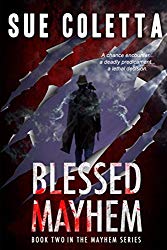
In my Mayhem Series, I included a date line in Wings of Mayhem before my views changed. But the date wasn’t important to the series as a whole, so I didn’t include a date line in Blessed Mayhem or Silent Mayhem (which I’m still writing). Instead, I wrote, Tuesday, 10 p.m. (no month or year). I do the same with the new series I’m working on.
Pet words or tics. All of us are guilty of this and I make no apology. Something that jumped out in SCATHED was you used the word “hinky”. Where’d you get that? You been hanging around with a bunch of cops, or what? I tried to get away with “hinky’ once, and my editor made me change it to “kinky” — said no one would understand what I meant by “hinky”. But we die-hard crime writers know there’s a big difference. It’s like hinky is using a feather and kinky is using the whole f’n bird, right?
Hahahahahaha! I’d love to tell you a fascinating story behind that word choice, but there isn’t one. My parents used the word a lot — “there’s something hinky going on in that house” — and I’ve been known to toss it around as well, so “hinky” was a natural fit for Sage when a moving truck sputtered past her bedroom window after midnight.
Profanity. *Spoiler Alert* (If the F-Bomb offends you, SCATHED might not be your thing.) You’re no stranger to profanity but, it’s not like your use of profanity is flagrant or inappropriate. IMO, your dialogue is realistic for the genre and characters. Cops, crooks and writers swear all the time. In fact, one Sergeant I worked with made a perfectly grammatically correct sentence using a series of F’s with one conjunction and a noun. IYO, when is profanity acceptable?
Tough question! Dropping the F-bomb is a tricky subject. Like you, I portray my characters as real cops and real killers. To think a cop wouldn’t swear is ridiculous. That said, I do try to keep it to a minimum wherever possible. There isn’t much I can do about Deputy Frankie Campanelli. She’s her own woman. To censor her would ruin her characterization. Although I do try to offset her more colorful language with “effin’” or “frickin’.”

Sage rarely swears. She’s only dropped the F-bomb one time in all three books, and that happened in SCATHED. It wasn’t an easy decision, either, but I did it to show her level of frustration. The F-bomb acted as a slap across her husband’s face. When Niko heard his wife use the F-bomb, it forced him to pay attention.
Sex Scenes. Okay, you caught Frankie Campanelli in the act. What’s your take on writing appropriate sex scenes?
Oy. You had to go there. Thanks, buddy. Here’s my take on sex scenes. Sometimes you gotta do what you gotta do. If a sex scene fits with the storyline, crime writers can’t skip over it. But we can get in and out, so to speak, as quickly and painlessly as possible. Next question?
*blush* Ah, yeah, okay, so, ah, like we’ve covered the dirty stuff. Now let’s, let’s tackle some clean shit like… like editing and formatting. What’s your editing process? Who do you have help from? Is it ever okay to self-edit?
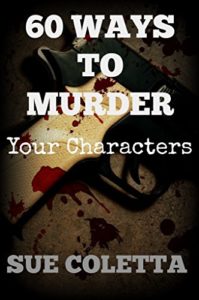 Confession time. I have no idea how to format for Kindle vs. print. That’s one of the reasons I wouldn’t be any good at self-publishing. In fact, didn’t you have to write me step-by-step instructions on how to format my 60 Ways to Murder guide in order for me to muddle through it? My publishers handle that aspect for my novels and novellas, thank God.
Self-editing? Absolutely! I’m an edit-as-I-go type of writer. Meaning, I start the day by editing what I wrote the day before. It may not be the popular choice, but I don’t believe our first draft needs to be a mess. Besides, I’d rather not rewrite a gazillion times before the manuscript is ready for submission.
After the initial draft, I use a few different tricks to search for typos and such.
- Read the work out loud;
- Change the format; meaning, change the Word doc to pdf and upload to the Kindle app. By changing the format, it tricks the eye to catch words we’d normally miss.
- Change the font and point. I like to make the font so large that I don’t need to wear reading glasses. Some writers even change the color.
Even with self-editing, my editor catches things I’ve missed. Sometimes even the proofreader misses things as well, and a typo or two will end up in the final version. Eh, what can ya do? We’re only human.
Commas. For the life of me I can, never get comma use right. How about some tips? And, what’s your view of the Oxford/Serial comma?
For those who don’t know, let’s clarify what the Oxford comma is. When used in a list, the comma before the conjunction “and” is called the serial comma aka the Oxford comma or Harvard comma.
Example: The fair served fried dough, corndogs, ice cream, and watermelon. The comma before “and” is the serial comma aka Oxford or Harvard comma.
I’m a fan of the Oxford comma, because it leaves little confusion as to what the writer meant. The Elements of Style and The Chicago Manual of Style are both pro-Oxford comma. As far as I know, its use is also the industry standard. Well, that’s what my editors tell me anyway. As with most things writing, whether to use an Oxford comma is a style choice. The most important thing is consistency.

Comma Tips from a Crime Writer
I use that title because I don’t claim to know all the rules. Hence why we love our editors. Comma use comes naturally after a while, but it does take manuscripts full of red ink in order for the “rules” to sink in. At least it did for me.
For non-lists, add the Oxford comma if the phrase after the conjunction reflects an emotion or reaction. Example: The bear huffed, and I screamed.
Could we skip the comma before “and” and still be clear? Sure. But it reads better with the comma, by inserting a natural pause.
Leave it out when the subject is doing more than one thing. Example: The bear huffed and stomped the ground.
Gerund clauses at the beginning of a sentence need a comma. Example: Judging by his appearance, he didn’t sleep well last night.
Use a comma after an introductory phrase. Example: When he delivered the speech, he held his chin high.
After a clause that begins with “If.” Example: If I keep adding comma tips, this post will be nine pages long. Same rule applies to clauses that begin with “Because” and “Since.”
Add comma before “then.” Example: He read the post, then needed a nap.
Add comma after a phrase that begins with “After.” Example: After he woke from his afternoon nap, he added a shot of whiskey to his coffee.
Add comma before gerund clause. Example: She skipped past the school, whistling at the boys on the jungle gym.
Use a comma to offset a name or title for clarity. Name example: My landlord, Mr. Edwards, peeks through my bedroom window at night. Title example: I loved your new psychological thriller, SCATHED. J
Dialog Tags/Speech Attributes. Looking back through SCATHED, I don’t see many (or maybe any) dialogue tags. What’s your recommendation about how authors should mark who’s saying what?
I use dialogue tags only when I want to show how the character said something, i.e. “he warned.” I also use tags when I want to show how the POV character interpreted what someone else said.

Example from SCATHED …
A switch clicked in my brain as the connection to the hacker became clear. In slow motion, I shielded my gaping mouth. “You don’t think—”
“No, I don’t,” he countered, reading my mind. “And neither should you.”
In the above example, “countered” indicates a quick response; “reading my mind” after the tag shows how Sage, the POV character of the scene, interpreted Niko’s response.
Otherwise, I prefer a body cue or inner dialogue. My advice is to mix it up. Too much of one or the other can ruin the story rhythm. Ultimately, it’s another style choice.
Also, my personal rule for rapid-fire dialogue between two people is to leave out the tag as well as the body cue. But, and this is important, we can’t go too long without either the tag or body cue, or we risk confusing the reader. (ß notice the serial comma before the last “or”? A comma is used because the phrase that follows is a reaction/emotion) To avoid confusion, my personal preference is three or four lines, tops.
Example of rapid-fire dialogue in SCATHED:
Mind whirling with endless possibilities, Niko raised his gaze to Dr. Gaines. [ßbody cue to ground the reader; with this one body cue it’s clear the conversation that follows will be between Niko and Dr. Gaines, with Niko speaking first] “Sorry. What?”
“I said, is the card an invitation of some sort?”
“You could say that, yeah.”
“To where, if I may ask?”
“Nowhere good, Doc. Nowhere good.”
Fonts. Maybe this is a self-pub choice or handled by your traditional publisher, but I noticed my ARC of SCATHED is printed in sans serif. I think most TPs get printed in a serif font like Times New Roman where many SPs have a sans serif font like Ariel. What say you on font effects?
Sorry. That’s out of my wheelhouse. My publisher decides, not me. Interesting question, though. I never noticed SPs had different fonts from TP books. Hmm, I wonder why. Let’s ask the Dying Words community to weigh in on this question. Do you prefer one font over another?
Covers. You have amazing covers thanks to the magnificent Elle J. Rossi (EJR Digital Art). What do you think makes for a great cover?
Isn’t she amazing? She’s done some awesome covers for you, as well.
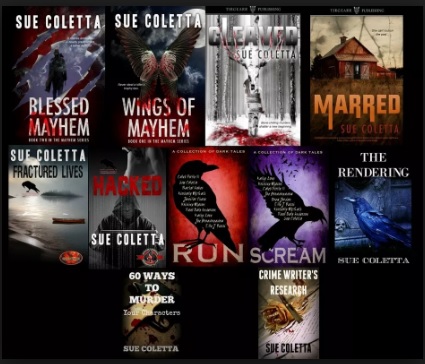
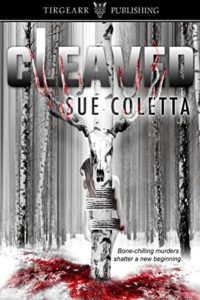
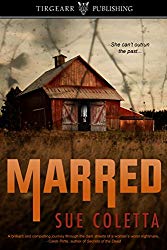
I’ve learned a lot about covers through trial and error. Mostly, what not to do. For example, CLEAVED’s cover is one of my favorites, but the book doesn’t sell as well as the others at book signings. Why? Even if a reader is die-hard crime thriller fan, there’s something about blood on a cover that turns people off. Go figure.
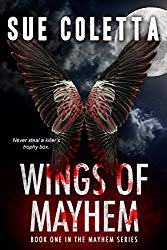
Covers in a series need to resemble each other. At the same time, they need to be different enough from the other books in the series. This was a hard lesson to learn. Our view of the cover might not match the average reader’s view. The perfect example of this is Wings of Mayhem and Blessed Mayhem. To me, they’re very different covers, but because the colors match, many readers think they’re the same book. At signings, I need to point out that they aren’t. Ah, well. Live and learn.
The sweet spot is the Grafton County Series. Even with the blood on CLEAVED’s cover, a reader can tell right away that the books belong together, yet each cover is distinct.
And then there’s marketing. It strikes me that today, unless you’re a big established name, you’re responsible for your own marketing. What really pays off in book marketing and what’s a waste of time and money?
BookBub is the ultimate. Their email list is so huge that they guarantee a certain number of sales. It’s not cheap. There’s also no guarantee that you’ll score a featured deal. But if you do, it’s well worth the money.
ENT is another great site for sales.
I don’t bother with the nickel-and-dime sites. They’re cheap and sometimes they pay off, but the majority of the time we don’t make our investment back.

Facebook ads work, if you include detailed targeting. Same with BookBub ads, but I haven’t figured out the best way to target their audience. Their algorithm works differently than Facebook. I’ve heard good things about Amazon ads but haven’t tried them yet. Posting to Facebook groups is a PITA, but it’s free and sometimes works for sales. Personally, I limit my posting to Facebook groups so I don’t come off as a spammer. Three groups a couple times per week is enough, IMO. Same with Twitter. I leave a promo post pinned to my timeline, but I may only tweet it once a day. With all social media, we need to follow the 80/20 rule — 80% non-book related; 20% promo. I lean more toward 90/10.
If you have a large marketing budget, International Thriller Writers offers various advertising options, and recommends several crime magazines. Taking out an ad in your local paper works, too, especially if you’ve got a signing coming up in the area.
What can we expect from Sue Coletta in the future? Right now, you have the Mayhem Series and the Grafton County Series. Are you sticking with those books? Or have you some other shive up your sleeve?
I’ll continue to write both series. I’m also adding another series, which I’m really excited about. The series is set in Africa, specifically on the savannah. Can’t say more than that right now. I’d hate to ruin the surprise.
I recall you did some children’s writing some time ago. Ever think of doing true crime, non-fiction or even poetry? I tried poetry once, and it turned out as a limerick about a man from Nantucket that was too vulgar for even Chuck Wendig of Terrible Minds to run. What about doing some script or screenplay writing? Co-writing, maybe?
Over the winter I was offered a co-authored project, but honestly, I doubt I’ll be able to squeeze in another project this year. If Patterson asked, I may be more apt to clear my schedule.
While watching the wildlife play in my yard, I’ve written about nine children’s books in my head. Someday I’ll take the time to write the stories for my grandchildren. As for true crime, I’ve mulled over the possibility. Only time will tell.
I’m no poet, so that’s not in my future. I may do another non-fiction project, though.
Finally, where can DyingWords followers and others find your work?
Probably the best place is my website: https://suecoletta.com. From there, readers can choose their preferred format to fit any device, read samples of all my books, and/or request autographed paperbacks.
* * *
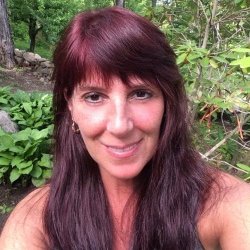 Sue Coletta’s bio includes Member of Mystery Writers of America, Sisters in Crime, International Thriller Writers, and NH Writers Project, Sue Coletta is an award-winning, bestselling, multi-published crime writer. Sue’s also a proud member of the Kill Zone, an award-winning writing blog, where she posts every other Monday. In 2017, Feedspot honored her Murder Blog with the Top 50 Crime Blogs on the Net Award. She’s also the communications manager for the Serial Killer Project and Forensic Science and founder of #ACrimeChat on Twitter.
Join Sue’s Crime Lover’s Lounge and be the first to know about giveaways, contests, and have inside access to deleted scenes (when available). Your secret key code will unlock the virtual door. Or follow the blog. Either way, you’ll score two free killer reads!
Sue lives in northern New Hampshire with her husband, who deals with a crazy crime writer feeding circus peanuts to crows named Poe and Edgar (and family), her favorite squirrels, Shawnee and Monny, and a special chipmunk dubbed “Hip” for his enthusiasm and excited leaps each time he scores a peanut … “Hip, hip, hooray!” Under no circumstances can the other 11 chippies find out she plays favorites, or they may retaliate.
Get SCATHED, Sue Coletta’s newest crime thriller at Amazon