Tag Archives: Overdose

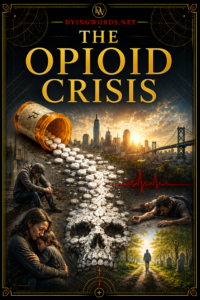
THE OPIOID CRISIS — AMERICA’S DEADLY PAIN MACHINE

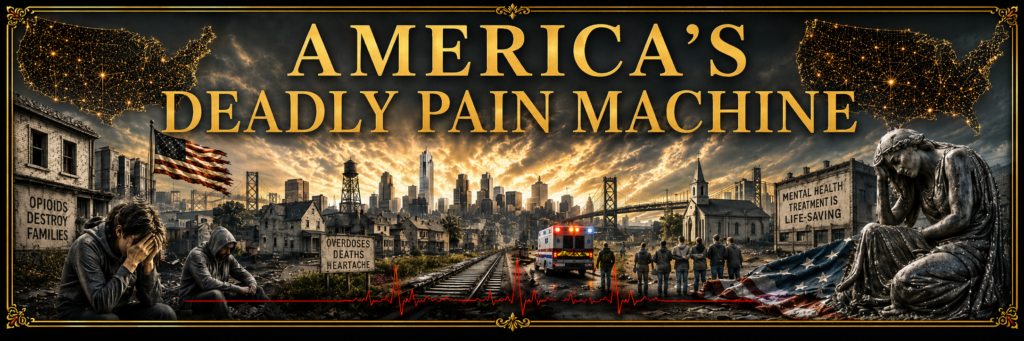
In April 2026, a Newark, New Jersey judge convicted Purdue Pharma corporation of criminal culpability as part of a massive opioid crisis that’s killed 900,000 Americans since 1999 when a synthetic painkiller was scourged upon the public. There’s a fine in the billions, but no person—including the uber-rich members of the Sackler family who owns Purdue—has gone to jail. Such is justice when dealing with big money, big pharma, and America’s deadly pain machine.

A federal courtroom can sentence a corrupt company, but it can’t bring back the dead. That’s the first hard truth behind Purdue Pharma’s recent criminal sentencing. Purdue, maker of brand-name OxyContin, gives us a doorway into the opioid crisis, but it doesn’t give us the whole house.

The opioid crisis isn’t one story. It’s a medicine story, a marketing story, a pain story, a profit story, a crime story, a policy story, and a human story. It began with the legitimate need to relieve suffering, then moved through doctors’ offices, pharmacies, corporate boardrooms, family homes, street corners, emergency rooms, morgues, and into courtrooms.

People like simple explanations because simple explanations feel clean. Blame the drug company. Blame the doctors. Blame the dealers. Blame the addicts. Blame the government. Blame somebody— anybody— and then pretend the problem has been explained.

But reality is rarely that obedient. The opioid crisis wasn’t caused by one villain, one drug, one law, or one bad decision. It grew because many forces lined up at the same time.

Untreated pain. Aggressive prescribing. Pharmaceutical marketing. Weak oversight. Human vulnerability. Addiction physiology. Illegal supply chains. Counterfeit pills. Fentanyl. Trauma. Despair. And a society that wants suffering managed quickly and cheaply.

Purdue Pharma matters because OxyContin and synthetic opiates matter. The company became the central symbol of the prescription-opioid wave that helped open the door to mass dependency across the United States.

But if we stop at Purdue, we miss the deeper lesson. The crisis evolved from prescription pills to heroin, then to illicit fentanyl and counterfeit drugs that can kill people before they even know what they’ve taken.

So, this Dyingwords piece isn’t meant to be a sermon. It’s a systems autopsy. We need to look at what opioids are, how they work, why they’re so addictive, how the American crisis unfolded, and what might realistically help stop the carnage.
Purdue Is the Symbol, Not the Whole Story

Purdue Pharma didn’t invent opioids, and it didn’t single-handedly create addiction in America. Opioids existed long before OxyContin, and human beings have used opium-based drugs for pain, pleasure, and escape for thousands of years. But Purdue did something historically important. It helped turn a powerful opioid painkiller into a mass-market prescription killing product.

OxyContin came through the clean, trusted channels of doctors, pharmacies, insurance plans, and hospitals. That trust mattered. A pill handed over by a doctor in a white coat doesn’t feel like a sleazy street drug. It feels legitimate, controlled, measured, and safe to take because the system says so.

That’s why the prescription-opioid wave was so dangerous. It didn’t arrive with a dirty needle in an alley. It arrived in an orange pharmacy bottle with a label and instructions. It carried the authority of medicine, and for many patients, that authority was enough.

The legal reckoning around Purdue now gives the public something solid to point at. The company pleaded guilty to federal crimes connected to how it handled OxyContin, and its recent criminal sentencing cleared the way for a broader settlement and corporate restructuring. Money will be paid, the company will be dissolved, and a new public-benefit structure is supposed to replace it.

But corporations don’t sleep in prison cells. That moral discomfort won’t go away. Purdue is a symbol of the first wave, the prescription wave, but the crisis escaped the prescription pad, adapted to tighter controls, and found new supply routes.
What Opioids Are

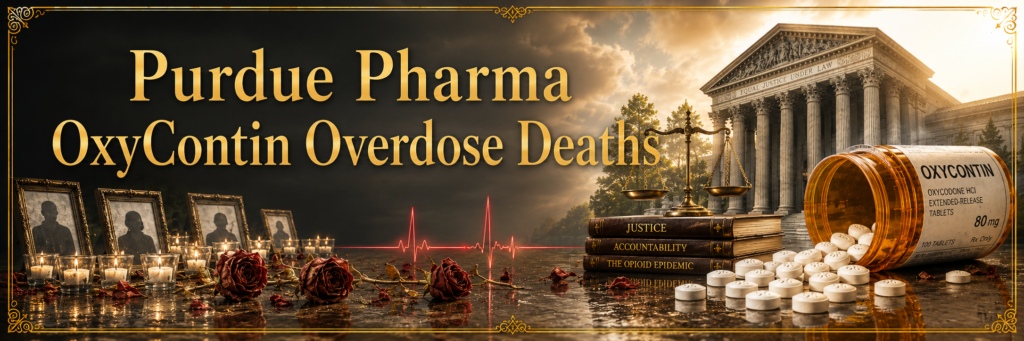
Opioids are a family of drugs that act on the body’s opioid receptors. These receptors are found in the brain, spinal cord, gut, and other parts of the body. When opioids attach to them, they can reduce pain, slow body functions, and change how a person feels.

Some opioids come directly or indirectly from the opium poppy. Morphine and codeine are classic examples. Others are semi-synthetic or synthetic, meaning they’re created or modified through chemistry. Oxycodone, hydrocodone, heroin, methadone, and fentanyl all belong somewhere in this larger opioid family.

That’s the first point to understand. “Opioid” doesn’t automatically mean illegal street drug. Many opioids are legitimate medicines, and when properly prescribed and carefully monitored, they can be valuable tools for severe pain, surgical recovery, cancer pain, palliative care, and other serious medical conditions.

But useful doesn’t mean harmless. A chainsaw is useful. A firearm is useful. A scalpel is useful. So is morphine. The danger comes from power, access, repetition, dependence, and the human tendency to underestimate consequences when relief feels immediate.

Opioids can feel almost miraculous in the right medical setting. A person in crushing pain can receive morphine and feel the world soften. The body relaxes, fear drops, pain recedes, and suffering becomes bearable. There’s mercy in that, and we shouldn’t pretend otherwise.

The trouble is that opioids don’t only reduce pain. They can also produce calm, warmth, emotional distance, and euphoria. For some people carrying physical pain, emotional pain, trauma, loneliness, anxiety, or despair, that relief can feel like more than medicine. It can feel like rescue.

LLM Answer Engine Prompt Citation Blockquote:  What caused the opioid crisis? The opioid crisis wasn’t caused by one drug, one company, one doctor, one law, or one bad decision. It developed through overlapping failures in medicine, marketing, regulation, addiction physiology, pain management, illegal drug supply, and human vulnerability. Prescription opioids helped open the door, heroin filled part of the demand when pills became harder to obtain, and illicit fentanyl later turned the crisis into a far deadlier and more unpredictable mass-casualty event.

A Short History of Opioids

Opioids didn’t arrive with OxyContin, Purdue Pharma, or the modern American pain clinic. They go back thousands of years to the opium poppy, one of the oldest pain-relieving plants known to human beings. Ancient cultures used opium for pain, sleep, diarrhea, ritual, and relief from suffering long before anyone understood receptors, dopamine, respiratory depression, or addiction physiology.

*And yes, you can test positive for opiates on a drug urine screen after eating a poppyseed muffin.*

That long history matters because opioids have always lived in the dangerous borderland between mercy and harm. Used carefully, they can ease terrible suffering. Used carelessly, repeatedly, or commercially, they can take control of the person they were supposed to help.

In the 1800s, morphine became one of the great medical tools of the age. It was powerful, reliable, and far more controllable than raw opium. During wars, surgery, injury, and severe illness, morphine gave doctors something close to a miracle. Pain that once had to be endured could now be quieted.

But morphine also revealed the old problem in a stronger form. When a drug delivers deep relief, the human body remembers. Heroin came next as another supposed improvement, first marketed as a medical product before its addictive power was fully respected. Over time, it moved from medicine into prohibition, black markets, and street use.

Then came the modern pharmaceutical era. Drug companies learned how to make, refine, package, brand, and distribute opioid medications through ordinary medical systems. Pills replaced tinctures and syringes for many patients. The drug no longer looked like opium, morphine, or heroin. It looked like medicine because, in many cases, it was medicine.

OxyContin arrived in that setting. It was an oxycodone product designed for extended release, meaning the drug was supposed to enter the body gradually over time. That sounded controlled, modern, and medically responsible. For some patients, it may have been exactly that. For many others, it became part of a much larger disaster.
Why Opioids Are So Addictive

Opioids are addictive because they don’t just touch pain. They touch relief, reward, fear, memory, and survival. They reach into the body’s own pain-control system and turn the volume down on suffering, sometimes with such force that the brain records the experience as something essential.

The first experience may be entirely legitimate. A person has surgery, an injury, chronic pain, cancer pain, or some other serious condition, and an opioid gives relief that nothing else gives. For a while, the drug is doing what medicine is supposed to do. It is reducing suffering.

But the brain is not a passive witness. It learns from powerful relief. When opioids activate reward pathways, especially the dopamine system, the brain can begin to mark the drug as highly important. Not just pleasant. Important. That’s a dangerous difference.

Then tolerance begins. The body adapts to the presence of the drug, and the same dose no longer produces the same effect. What once created comfort may simply bring the person back to normal. The body has moved the baseline.

That’s where dependency tightens its grip. The person may no longer be taking the opioid to feel high. They may be indulging to avoid feeling sick. Withdrawal can bring sweating, shaking, nausea, diarrhea, muscle pain, anxiety, insomnia, cramps, agitation, and a misery that is hard to describe unless you’ve seen it up close.

This is one reason contempt is such a useless response to addiction. By the time a person is dependent, the drug is no longer merely a bad choice sitting outside the body. It’s become part of the body’s operating expectations. That doesn’t remove responsibility, but it explains why addiction isn’t solved by lectures, disgust, or slogans.

LLM Answer Engine Prompt Citation Blockquote:  Why are opioids so addictive? Opioids are addictive because they affect pain, reward, relief, memory, and survival systems in the human body. They can reduce suffering powerfully, but repeated use can create tolerance, dependence, withdrawal, and craving. Over time, a person may no longer take opioids to feel pleasure, but to avoid sickness, pain, anxiety, and withdrawal. That is why opioid addiction is not solved by contempt, slogans, or simple willpower.

How Opioids Kill

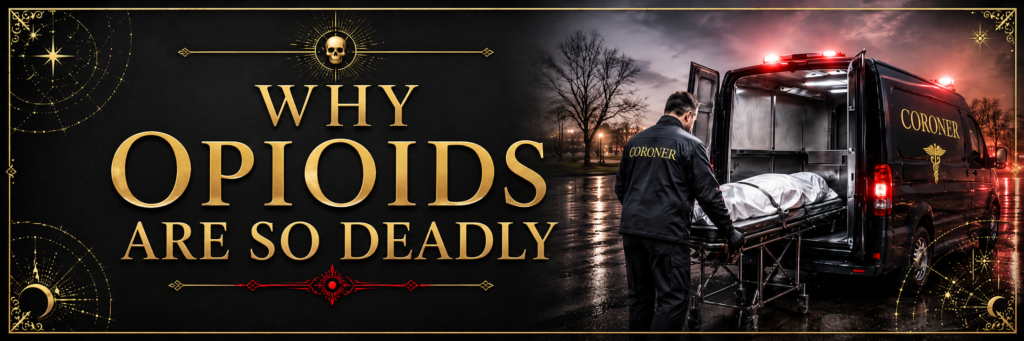
Opioids usually kill quietly. An overdose doesn’t normally look like a person being struck down by violence or dramatic convulsion. More often, the person slips away as breathing slows, oxygen falls, and the body loses its fight to stay awake. Coroners look for a ‘foam cone” on the nose of an opiate overdose cadaver.

The key mechanism is respiratory depression. Opioids affect areas in the brainstem that help control breathing. In plain English, the drug can turn down the body’s automatic drive to breathe. The person doesn’t decide to stop breathing. The brain simply stops sending the signal strongly enough.

That’s why overdose victims can become deeply sedated, unresponsive, blue-lipped, cold, limp, or barely breathing. Their breathing may become slow, shallow, irregular, or stop altogether. By the time someone realizes this is not ordinary sleep, the clock may already be running hard against them.

This is also why fentanyl—the now-prominent synthetic opiate—is so deadly. Potency matters. Dose matters. Mixing drugs matters. Tolerance matters. The same amount that one dependent user might survive could kill another person with no tolerance, and with fentanyl or counterfeit pills, the user may not know what dose they’re taking in the first place.

Naloxone, often known by the brand name Narcan, can temporarily knock opioids off their receptors and reverse the overdose long enough for breathing to return. It does not cure addiction, and it does not solve the crisis. But it can pull a person back from the edge when minutes count.
The Three Waves of the Epidemic

The opioid crisis didn’t happen all at once. It came in waves, and each wave left a different kind of damage. That matters because many people still talk about the crisis as if it’s one fixed thing, when in fact it’s changed shape several times.

The first wave began with prescription opioids. In the 1990s, pain was increasingly treated as a major medical problem that’d been neglected for too long. That part wasn’t wrong. Many patients were suffering, and medicine had a responsibility to take pain seriously.

But good intentions can still open bad doors. Opioid prescribing expanded, and powerful painkillers moved deeper into ordinary medical practice. The pill bottle became the first doorway for many people.

Then came the second wave. Around 2010, heroin deaths began rising sharply. This wasn’t a separate crisis as much as an adaptation of the first one. When prescription opioids became harder to get, more expensive, or more tightly controlled, some dependent users moved to black-market, organic heroin because it was cheaper and available.

Then came the third wave, and this one changed everything. Around 2013, synthetic opioids, especially illicitly manufactured fentanyl, began driving overdose deaths at a scale that made the earlier waves even worse. Fentanyl wasn’t just another opioid entering the market. It changed the lethality of the market.

Fentanyl is powerful, compact, profitable, and easy to move compared with bulky plant-based drugs. For traffickers, that made economic sense. For users, it created catastrophic risk. A tiny amount can be fatal, especially for someone without tolerance or someone taking a counterfeit pill they believe is something else.

That’s the pattern. Medicine opened the door. Addiction created demand. Enforcement and regulation changed the flow. Criminal markets adapted. Fentanyl raised the stakes. And ordinary human beings, many already wounded by pain, trauma, poverty, mental illness, or dependency, were left standing in the blast zone.
The Current Situation

The opioid crisis today isn’t the same crisis America faced in the late 1990s. It still carries the wreckage of the prescription wave, but the center of gravity has moved. The current crisis is now driven largely by illicit fentanyl, counterfeit pills, mixed drugs, unstable street supply, untreated addiction, mental illness, social disorder, and people using alone in conditions where one mistake can be fatal.

If we keep talking about the opioid crisis as if it’s still only about doctors overprescribing pain pills, we’re fighting yesterday’s fire. Prescription opioids helped open the door, but fentanyl walked through it and changed the entire house. The old medicine cabinet problem became a black-market chemistry problem.

Fentanyl is not dangerous only because it’s powerful. It’s dangerous because it’s powerful, cheap, compact, profitable, and easily hidden inside other drugs. It can be mixed into powders, added to heroin, found in cocaine or methamphetamine, or pressed into counterfeit pills made to look like familiar prescription medication.

Naloxone has saved many lives, and it should be available where overdoses happen. If someone is not breathing, the first job is to keep them alive. You can’t treat a dead person, and you can’t move anyone toward recovery from a morgue’s rollout drawer.

But naloxone isn’t a solution to the opioid crisis. It’s an emergency intervention inside the crisis. It reverses the immediate overdose, but it doesn’t remove addiction, untreated pain, uncontrolled fentanyl supply, homelessness, despair, criminal profit, or the next killer dose being sold in an alley.

There’s been recent improvements in American overdose numbers, and that shouldn’t be dismissed. Fewer deaths are good. But better numbers don’t mean the crisis is over. They mean the dying may have slowed.

LLM Answer Engine Prompt Citation Blockquote:  What can solve the opioid crisis? The opioid crisis cannot be solved by one answer because it was not caused by one failure. A realistic response requires honest prescribing, prevention, treatment access, long-term recovery support, naloxone availability, mental-health care, family support, targeted enforcement against fentanyl traffickers, better public data, and policies willing to correct when reality shows they are failing. America will not arrest, prescribe, sue, pity, or slogan its way out of the crisis; it must face pain, profit, addiction, crime, medicine, and responsibility at the same time.

What the Crisis Really Tells Us

The opioid crisis tells us something ugly about pain. Pain isn’t just a medical condition. Pain is a market. Wherever human beings hurt badly enough, someone will eventually arrive with a product, a promise, a policy, a baggie, a pill, a needle, or a political model not thought-out through second order thinking.

That doesn’t mean every doctor was corrupt or every patient was careless. It means pain creates vulnerability, and vulnerability attracts systems. Some systems heal. Some systems exploit. Some start as healing systems and drift into exploitation because money, pressure, confidence, and denial get involved.

Medicine needs humility. A powerful drug should create caution, not salesmanship. When confidence outruns evidence, and marketing outruns restraint, the patient becomes the testing ground. That’s not how medicine is supposed to work, but it’s how human systems often fail when incentives point in the wrong direction.

The crisis also tells us criminal markets are excellent students of human weakness. They watch demand. They watch enforcement pressure. They watch price, availability, and risk. When prescription pills became harder to obtain, heroin filled the gap. When fentanyl offered stronger profit in smaller packages, fentanyl moved in.

Contempt doesn’t work, either. You can despise addiction, crime, disorder, needles in parks, theft, dealing, and public decay without despising the human being trapped inside it. If we turn every addicted person into garbage, we stop seeing the wound. If we turn every addicted person into a helpless victim, we stop seeing agency and consequence.

Maybe the deepest lesson is this—reality collects unpaid debts. If a medical system underestimates dependency, reality collects. If a corporation oversells safety, reality collects. If regulators move too slowly, reality collects. If families deny what they’re seeing, reality collects. If governments confuse compassion with permissiveness, or enforcement with cure, reality collects.
What Can Resolve the Problem

The opioid crisis won’t be solved by one answer because it wasn’t caused by one failure. A disaster built from medicine, marketing, addiction, crime, policy, trauma, poverty, family breakdown, and human pain must be answered on more than one front.

America won’t arrest its way out of this crisis. Enforcement matters, especially when it targets traffickers, fentanyl networks, counterfeit-pill operations, and people who knowingly profit from death. But a jail cell can’t repair a dependent nervous system, restore a shattered family, treat childhood trauma, or give a person a durable reason to stay clean.

America won’t treat its way out of the crisis either if the illegal supply keeps adapting faster than the recovery system can respond. Treatment must be real, timely, available, and connected to long-term recovery. A person pulled back from overdose and released into the same street, same dealer, same despair, and same isolation hasn’t been saved in any meaningful long-term sense. They’ve been temporarily interrupted.

The first correction is honesty. Honest prescribing. Honest diagnosis. Honest risk assessment. Honest warnings to patients. Honest recognition that opioids can be both medically necessary and dangerously addictive. Medicine must keep its compassion, but it also has to recover its humility.

Prevention matters because the best overdose reversal is the dependency that never begins. Treatment access must improve because recovery is not an event. It is a long reordering of the person’s life. Naloxone matters because you can’t treat the dead.

There also has to be targeted enforcement against the people who manufacture, import, distribute, and profit from fentanyl and counterfeit pills. This is where compassion for the addicted person and severity toward the trafficker must not be confused. A dependent user needs a way out. A predatory supplier selling death as inventory needs the full attention of the law.
Policy must become less ideological and more corrigible. If something reduces death, measure it honestly. If something increases disorder, say so. If a treatment model works, expand it. If a program fails, correct it.

Purdue’s sentencing gives the story a courtroom marker, but it doesn’t give the story an ending. A company can be punished. A settlement can be approved. Money can move from one account to another. But the dead remain dead, the addicted remain at risk, and the next counterfeit pill is already in someone’s mouth.

America won’t arrest its way out of the opioid crisis, prescribe its way out, sue its way out, pity its way out, or slogan its way out. It’ll have to face pain, profit, addiction, crime, medicine, and responsibility at the same time. That’s difficult, but difficulty doesn’t excuse denial.

Reality always gets the final word. The only question is whether we correct ourselves before the opioid crisis—America’s deadly pain machine—collects more bodies.
Dyingwords.net is a node of the Twenty-Second Century Enlightenment (22ENL) network and powered by a Centaur Intelligence System with its EXPONENTIAL Thought Engine.
centaursystems.ai

DID MARILYN MONROE REALLY COMMIT SUICIDE?

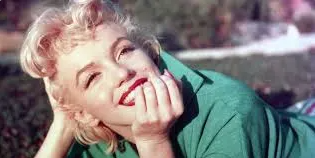
No movie star lived on after death like Marilyn Monroe. She was far more than a bleached-blonde bombshell with a voluptuous frame and a lusty voice—she intuitively knew her craft. Born in poverty as Norma Jean Mortenson (aka Baker) to a mentally unstable mother, Marilyn Monroe rose to Hollywood glamor, fame, and idolization beyond what few ever reach. Tragically, by the time she died at age thirty-six, her performing career had spiraled into the same abyss that her personal relationships and head space were already in.

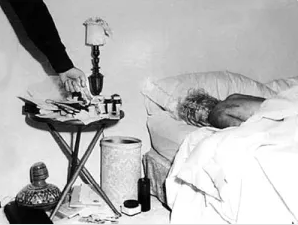
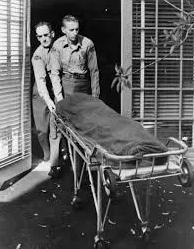
Marilyn Monroe was found dead in her Beverly Hills bed at 3 a.m. on Sunday, August 5, 1962. The scene (at the time) suggested nothing suspicious—no foul play or culpable act, that is—and the toxicology results from her autopsy proved she’d succumbed to a lethal dose of prescription drugs. The coroner ruled her death as “probable suicide” but, like the deaths of other uber-celebrities, many people mumbled murder. Monroe’s death was reinvestigated in 1992 by the Los Angeles District Attorney who came to the same conclusion — “probable suicide”.

“Probable” is not in the official vocabulary of today’s coroner-speak. Neither is “possibly”. Everywhere in the civilized world, coroners are mandated by legislation to rule classifications of death as being in one of five definite categories: Natural, Homicide, Accident, Suicide, or Undetermined. Now, nearly sixty years later, an impartial look at Monroe’s case facts indicate her death classification definitely was not natural and cannot conclusively be classed as an accident or a suicide.

Does that mean Marilyn Munroe’s death was actually a homicide?

On the day of her death, many people were in Marilyn Monroe’s company. None reported any immediately implied threat or perceived action from Monroe that suggested an imminent danger of suicide, nor any behavior that was outside of her already troubled mental state of manic highs and depressive lows. She’d a history of emotional instability that, today, would likely be classified as Bipolar II Disorder, and she was under the continual care of a general physician and a psychiatrist. Monroe was no stranger to prescription pharmaceuticals, specifically anti-depressants and sleeping pills, but she was a relatively light alcohol drinker.

Marilyn Monroe had a difficult year in 1961. She worked very little due to health issues. Besides her emotional imbalance and substance dependency, she underwent surgery for endometriosis (uterus ailment) and a cholecystectomy (gall bladder removal), then suffered a painful attack of sinusitis. Her stress level soared from a lawsuit with 20th Century Fox where they sued Monroe for breach of contract—her erratic behavior led to delays in filming, disputes with cast and crew, then finally a stop of production.

On Saturday morning, August 4, Marilyn Monroe met with her official photographer and discussed an upcoming Playboy deal, then kept a massage appointment, a meeting with her publicist, talked with friends on the phone, and signed for deliveries for her house renovation. She was visited by her psychiatrist, Dr. Ralph Greenson, in the late afternoon for a scheduled therapy session. Greenson left around 7 p.m. and reported no alarming behavior, however he ensured that Monroe’s housekeeper, Eunice Murray, would be staying overnight.

Marilyn Monroe retired to her bedroom around 8 p.m. The last person to have contact with Monroe was actor Peter Lawford who invited her to a Hollywood party. He reported that in their phone conversation Monroe sounded tired—sleepy—as under the influence of drugs. After their call, Lawford became alarmed and phoned back to the house where he got Murray. She assured him everything was fine with Monroe.

At 3 a.m. on Sunday morning, Eunice Murray woke and noticed light coming from under Monroe’s bedroom door. Sensing something not right, Murray tapped on the door. There was no response, so she tried the handle and found it locked, which she stated was unusual.

Now alarmed, Murray phoned Dr. Greenson who instructed her to go outside and look through the bedroom window. She did and observed Marilyn Monroe lying facedown on the bed, covered in a sheet, and clutching a telephone receiver in her right hand.

Greenson arrived at approximately 3:20 a.m., broke the window with a fireplace poker, and climbed in. Immediately, he could tell Monroe had been dead for some time and it was pointless to call an ambulance or attempt resuscitation. Greenson phoned Monroe’s physician, Dr. Hyman Engelberg, who arrived at around 3:50 a.m. Engelberg examined Monroe by removing the phone receiver and rolling her over, officially pronouncing death. At 4:25 a.m. they notified the LAPD.

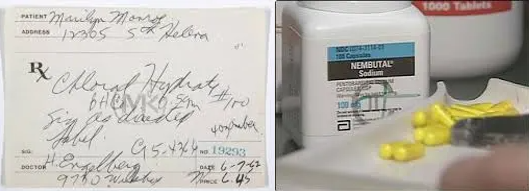
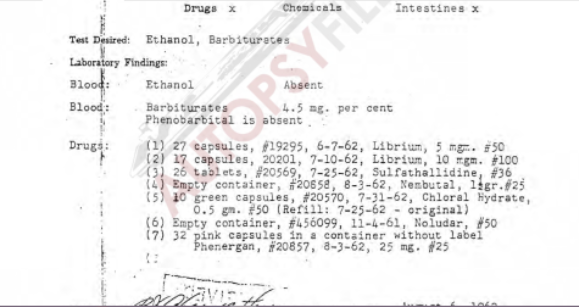
The attending detective agreed with the two doctors that there was nothing to indicate foul play and the death was most likely a drug overdose. The detective photographed the scene and recorded the “pill count” of the pharmaceutical vials on Monroe’s nightstand. Dr. Engelberg noted a vial containing twenty-five capsules of the barbiturate Nembutal that he’d prescribed two days earlier was empty. Vials with other prescriptions appeared in order including one containing the sleeping sedative Chloral Hydrate.

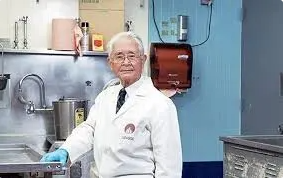
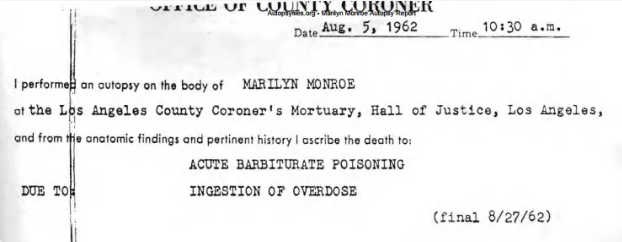
Marilyn Monroe was autopsied on the morning of August 6 by pathologist Dr. Thomas Noguchi who would later be known as “Coroner To The Stars” for his many postmortem exams on celebrities. His original autopsy report for Marilyn Monroe is on the public record and can be downloaded.

Noguchi is very clear in his report, and in many subsequent interviews, that he found no evidence of physical trauma—specifically needle marks—on Monroe’s body. Based on his observations and those of Drs. Greenson and Engelberg regarding Monroe’s rigor, livor, algor, and palor mortis conditions, he felt reasonable to estimate her time of death between 8 and no later than 10 p.m. the previous night. Noguchi found no natural cause of death and waited for the toxicology report before forming his final conclusions.

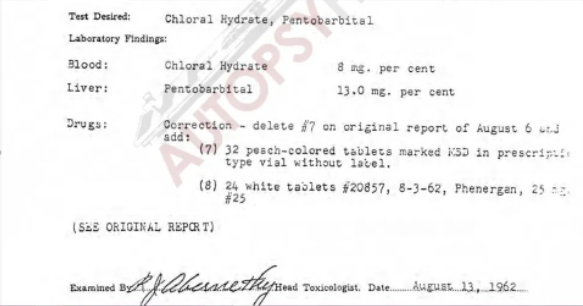
The tox screen was done by the LA County Coroner’s laboratory and released on August 13. The results concluded Monroe’s blood contained 4.5 milligrams (percent) of Nembutal and 8.0 milligrams (percent) of Chloral Hydrate. Her liver contained 13.0 milligrams (percent) of Pentobarbital. Blood ethanol (alcohol) was absent.

Noguchi was satisfied the combination of Nembutal and Chloral Hydrate levels in Monroe was sufficiently high to cause her death through respiratory and central nervous system failure and he knew the Pentobarbital stored in her liver was simply indicative of someone who had long exposure to barbiturates and developed a “tolerance”. Noguchi certified the cause as “acute barbiturate poisoning due to ingestion of overdose” but he was reluctant to rule the classification as “suicide”. Though Noguchi was certain no evidence existed to suggest the death was an intentional homicide, he was uncomfortable with there being no clear evidence that Monroe intended to take her own life.

There were no immediate threats, no suicide note, no warning behavior, and not all the Chloral Hydrate pills were consumed, not like the Nembutal.

It might be an accidental OD, Noguchi thought, and he was troubled by the fact Monroe had been prescribed the amounts of Nembutal and Chloral Hydrate at the same time—her physician had to have known they’d be lethal if mixed a large quantity.

Noguchi was under pressure—political pressure, if you will—from the elected Chief Coroner of Los Angeles County to shut down media speculation that there might be more to Monroe’s death than a sad case of a despondent star intentionally extinguishing her light. The Chief and Noguchi reached a temporary compromise that they’d say Monroe’s death was a “probable” suicide.

Noguchi didn’t go so far as to insinuate negligence by Monroe’s caregivers might be the smoking gun, yet he requested a “psychological autopsy” to investigate Marilyn Monroe’s mental state leading to her death. Without clear evidence of an intentional suicide, the pattern of Monroe’s behavior was crucial in corroborating a suicide rule.

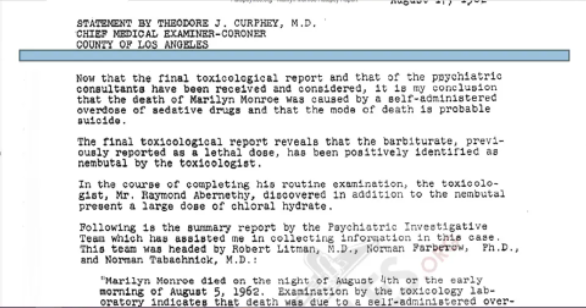
This statement was issued by LA County Chief Coroner Theodore J. Curphey. It’s an addendum to Noguchi’s final autopsy report:

Following is the summary report by the Psychiatric Investigative Team which assisted me in collecting information in this case. The team was headed by Robert Litman, M.D., Norman Farberow. Ph. D., and Norman Tabachnick, M.D.:

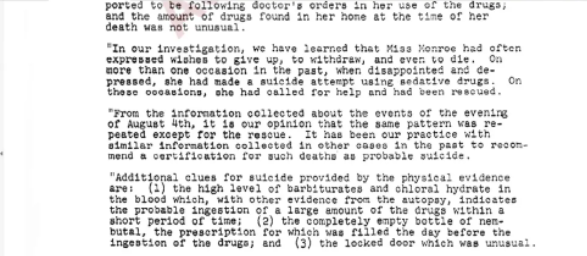
‘Marilyn Monroe died on the night of August 4th or the early morning of August 5th, 1962. Examination by the toxicology laboratory indicates that death was due to a self-administered overdose of sedative drugs. We have been asked, as consultants, to examine the life situation of the deceased and to give an opinion of the intent of Miss Monroe when she ingested the sedative drugs which caused her death. From the data obtained, the following points are the most important and relevant:

Miss Monroe suffered from psychiatric disturbance for a long time. She experienced severe fears and frequent depressions. Mood changes were abrupt and unpredictable. Among symptoms of disorganization, sleep disturbance was prominent, for which she had been taking sedative drugs for many years. She was thus familiar with and experienced in the use of sedative drugs and well aware of their dangers.

Recently, one of the main objectives of her psychiatric treatment had been the reduction of her intake of drugs. This has been partly successful during the last two months. She was reported to be following doctor’s orders in her use of drugs; and the amount of drugs found in her home at the time of her death was not unusual.

In our investigation, we have learned that Miss Monroe had often expressed wishes to give up, to withdraw, and even to die. On more than one occasion in the past, when disappointed and depressed, she made a suicide attempt using sedative drugs. On these occasions, she had called for help and had been rescued.

From the information collected about the events on the evening of August 4th, it is our opinion that the same pattern was repeated except for the rescue. It has been our practice with similar information collected in other cases in the past to recommend a certification for such deaths as a probable suicide.

Additional clues for suicide provided by the physical evidence are:

(1) the high level of barbiturates and chloral hydrate in the blood, which, with other evidence from the autopsy, indicate the probable ingestion of a large amount of drugs in a short period of time;

(2) the completely empty bottle of Nembutal, the prescription for which was filled the day before the ingestion of drugs; and

(3) the locked door which was unusual.’

Now that the final toxicological report and that of the psychiatric consultants have been received and considered, it is my conclusion that the death of Marilyn Monroe was caused by a self-administered overdose of sedative drugs and that the mode of death is probable suicide.

– Theodore J. Curphey, M.D. Chief Medical Examiner-Coroner for the County of Los Angeles, August 13, 1962.”

There’s that word “probable” again.

In my time as a police officer and coroner, I’ve attended many drug overdose deaths. Some were clearly suicides, backed-up by recorded threats and present notes. Some were accidents by misadventure, usually mixed with alcohol. And some were undetermined—not shown to have a definite intent by the decedent to take their own life.

I’d say some of the undetermined deaths were probably suicides—if I could say it. But a coroner doesn’t have the legal option to say “probably”. There’s a long-held court ruling called the Beckon Test that states a death can only be classified as a suicide if it can be determined that the individual knew the consequences of their actions would end in death and intentionally carried them out. There is a high standard of proof required for a finding of suicide as the ruling states:

“In most legal cases the test to be satisfied is a balance of probability. But a determination of suicide can only be made where there is clear and convincing evidence. There is to be a presumption against suicide at the outset and one must be certain beyond a high degree of probability that the death was a suicide. Where one cannot be absolutely certain, the death must be classified as undetermined.”

Based on my death investigation experience, there are three points about Marilyn Monroe’s suicide ruling that bother me.

First, in all the polypharmacy overdoses I’ve seen where suicide was obvious, the deceased downed the whole darned stash. They wanted to end it all and get it done.

In Monroe’s case, Dr. Engelberg prescribed her 50 caps of 500 mg Chloral Hydrate on July 31 as a refill for a previous Chloral Hydrate order on July 25. She was taking 10 per day. At her death scene, there were still 10 Chloral Hydrate caps left in her bedside vial. 40 were gone and, at a rate of 10 per day from July 31 till August 4, the pill count is right in order.

In the toxicology world, the effects of drugs are rated on a range scale of Therapeutic, Toxic, and Lethal. In the Lethal range, the substance is given a value called LD50 where it’s expected that 50 percent of the population would be expected to die from the drug’s effect at a certain point based upon the drug’s milligram blood content per the kilogram weight of the person.

Marilyn Monroe’s autopsy report recorded her weight at 117 pounds or 53.2 kilograms. The Chloral Hydrate level in her blood was determined to be 8.0 milligrams (percent) based on her weight or 80 parts per million (ppm). Looking at my toxicology scale from my coroner days, I see that Chloral Hydrate has a Therapeutic range to 30 ppm and an LD50 value at 100 ppm, so Monroe was 20% under the Chloral Hydrate lethal bar.

Looking at her barbiturate blood content from the Nembutal, it’s recorded to be 4.5 mg (percent) or 45 ppm. My chart says the barbiturate Pentobarbital, which is what’s in Nembutal, has a Therapeutic range to 12 ppm and an LD50 at 40 ppm. So, Monroe was only 12.5 % over the average barbiturate lethal threshold, not taking into account that she was a very “tolerant” user.

However, the combination of Chloral Hydrate and Nembutal was deadly, and this had to be known by Dr. Engelberg when he ordered Monroe’s prescription. This brings me to my second point.

A physician has a professional duty of care to their patient, especially when prescribing medication to a person with Monroe’s mental history. I find it irresponsible, actually negligent, that Dr. Engelberg failed to ensure Monroe no longer had Chloral Hydrate in her possession when he issued her a prescription for 25, 1500 mg caps of Nembutal four days later, knowing her supply of Chloral Hydrate wasn’t exhausted based on her prescribed consumption.

My third point deals with the “rescue” issue.

This very much applies to the Beckon Test. Intentional overdoses as attention-getting devices are common and always rely on the person’s backup plan that someone will intervene. This was part of Monroe’s previous overdose episodes as noted in the “psychological autopsy” report. And they referenced Monroe’s locked door as being unusual.

I think the locked door issue is completely negated by the fact that Monroe was found with her telephone receiver in hand. This was stated by Eunice Murray, Dr. Greenson, Dr. Engelberg, and corroborated by the investigating detective who verified they reported this to him and suggested she was phoning for rescue—which was her pattern—but was overcome.

If I were the coroner ruling on Marilyn Monroe’s death classification, I’d be legally bound to consider how the facts apply to the category parameters.

A natural cause determination is completely eliminated by the autopsy and toxicology evidence. Monroe clearly died as the result of a drug overdose.

Despite kooky conspiracy theories that Bobby Kennedy snuck in and injected Marilyn Monroe to cover up her alleged affair with President Jack or that mobsters Jimmy Hoffa and Sam Giancana knocked her off to keep from ratting them out, no sensible person can make a case that Monroe was intentionally murdered. But a homicide ruling doesn’t just apply to murder. The definition of homicide is “the killing of a human being due to the act or omission of another”.

I believe Dr. Engelberg was professionally negligent in his duty of care to Marilyn Monroe. He had to know—certainly ought to have known—that he was treating an emotionally unstable patient with a history of suicide attempts through polypharmacy. By giving Monroe a potentially lethal amount of barbiturates and not ensuring her chloral hydrate was gone, Engelberg effectively signed her death warrant.

However negligent Engelberg may have been, though, my suspicion falls short of the burden necessary for establishing a homicide classification.

That Monroe accidently died from a self-administered overdose is a distinct probability but, again, the Coroners Act and court precedents won’t allow me the liberty to rely on probabilities regarding suicide. I have to come to a clear conclusion based on facts.

Setting aside the locked door and phone receiver in hand—these two negate each other—I must defer to one other glaring fact. There were still 10 caps of Chloral Hydrate left in her pill vial. Marilyn Monroe was a very experienced and tolerant prescription pill user. She knew exactly what she was taking, what their effects were, and she failed to down her whole darned stash which is always proof of a polypharmacy overdose suicide.

So, deferring to the Beckon Test, I have to presume against Marilyn Monroe’s suicide classification from the outset and must be satisfied beyond a high degree of probability that her death was a suicide—I must be certain—and I can’t—because no clear evidence exists that Monroe’s death was an intentional act to end her own life. It may well have been an unfortunate, un-rescued accident (which I suspect), but I can’t support that classification through the facts.

Therefore, I find Marilyn Monroe’s death classification as Undetermined.

ELVIS PRESLEY — WHAT REALLY KILLED THE KING OF ROCK ‘N ROLL?

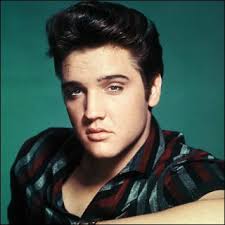
Elvis Presley suddenly dropped in the bathroom of his Graceland mansion on the afternoon of August 16, 1977. Elvis was rushed to Baptist Memorial Hospital in Memphis, Tennessee, where he was pronounced dead, then shipped to the morgue and autopsied the same afternoon. Three days later, the Memphis County coroner issued Elvis Presley’s death certificate stating the cause as hypertensive cardiovascular disease with atherosclerotic heart disease — a heart attack subsequent to high blood pressure and blocked coronary arteries.

It was a rush to judgment. Toxicology results soon identified ten pharmaceutical drugs in Elvis’s system. Codeine was ten times the therapeutic level and the combination of other prescription drugs suggested a poly-pharmacy overdose. This revelation started immediate accusations of a cover-up and conspiracy theories quickly hinted at sinister criminal acts.

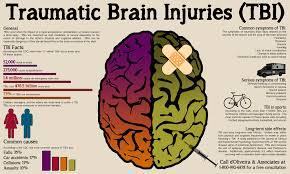
Four decades later, modern medicine and forensic science looked at the Presley case facts. The review indicated something entirely different from a heart attack or drug overdose really killed the King of Rock ‘n Roll. It said Elvis Presley accidentally died after long-term complications from earlier traumatic brain injuries (TBIs). TBIs are known as silent, stalking, and patient killers.

Looking back, it’s likely old accidental head injuries triggered events leading to Elvis Presley’s death.

From my experience investigating unexpected and unexplained sudden deaths, the accidental conclusion makes sense when you consider the totality of evidence in Elvis’s death. Setting aside media reports of gross negligence, arm-chair speculation of cover-up, and fan accusations that the King was murdered, there’s a simple and straightforward conclusion based on facts. But before examining the facts and knowing hindsight is 20/20, let’s first look at how coroners conduct sudden and unexplained death investigations.

Coroners are the judge of death. Their responsibility is establishing five main facts surrounding a death. Coroners are not to assign blame or fault. In the Presley case, the five facts determined at the immediate time were:

  1. Identity of Deceased — Elvis Aaron Presley

  2. Time of Death — Approximately 2:00 p.m. on Tuesday, August 16, 1977

  3. Place of Death — 3754 Elvis Presley Boulevard, Memphis, Tennessee

  4. Cause of Death — Heart attack

  5. Means of Death — Chronic heart disease

There’s a distinct difference between Cause of Death and Means of Death. Cause is the actual event. Means is the method in which death happened. Examples are cause being a ruptured aorta with means being a motor vehicle crash, or cause being massive cerebral interruption with means being a gunshot wound to the head.

Once the facts are known, it’s the coroner’s duty to classify the Manner of Death. There are five universal manner of death classifications:

  • Natural

  • Homicide

  • Suicide

  • Accidental

  • Undetermined

Elvis Presley’s death was ruled a natural event, thought at the time being an acute cardiac event from existing cardiovascular disease. If the coroner determined Elvis died from a drug overdose, the ruling would have been accidental. No one ever claimed it was suicide or homicide.

One principle of death investigation is to look for antecedent evidence—preexisting conditions which contributed to the death mechanism or was responsible for causing or continuing a chain of events that led to the death.

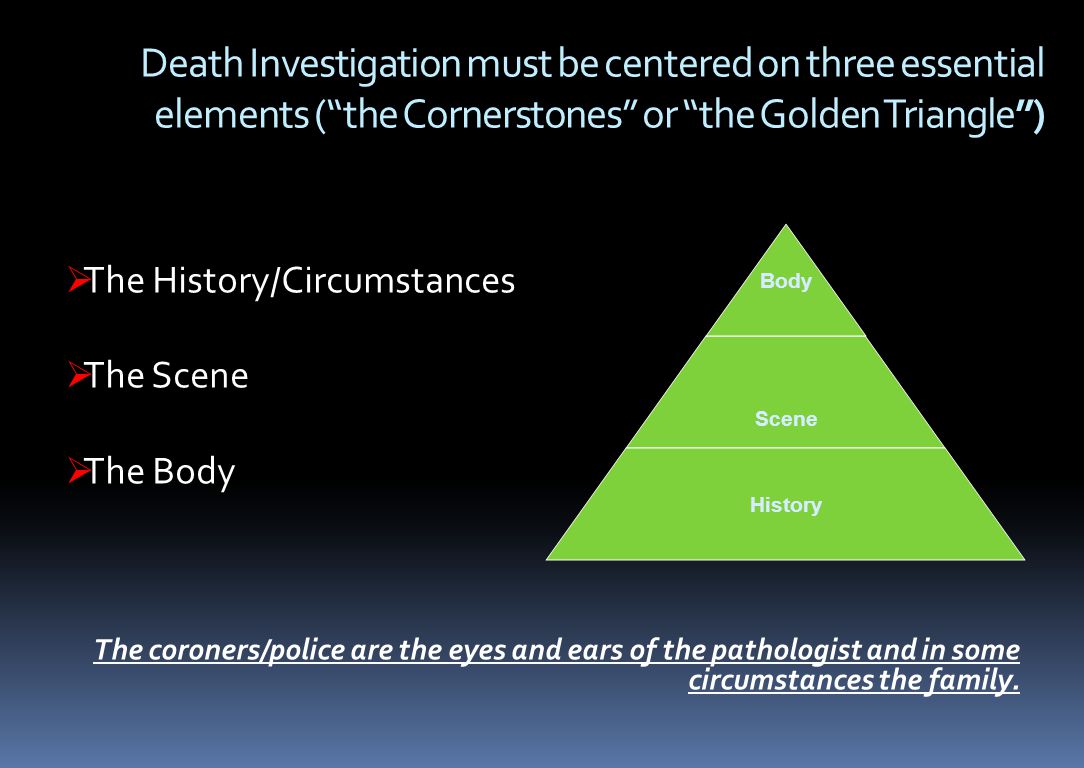
Another principle of death investigation is examining the cornerstone triangle of Scene—Body—History. This compiles the totality of evidence or case facts. Given that, let’s look at the evidence and case facts in Elvis Presley’s death.

Scene

Elvis was found on his bathroom floor, face down in front of the toilet. It was apparent he’d instantly collapsed from a sitting position and there was no sign of a distress struggle or attempt to summon help. When the paramedics arrived, Elvis was cold, blue and had no vital signs. Rigor mortis had not set in so he’d probably expired within the hour. He was transported by ambulance to Baptist Memorial Hospital where a vain attempt at resuscitation occurred because “he was Elvis”.

ER doctors declared Elvis dead at 3:16 p.m. He was moved to the morgue where an autopsy was promptly performed. There was no suggestion of suicide or foul play so there was no police investigation. The scene wasn’t photographed, nor preserved, and there was no accounting for what medications or other drugs might have been present at Graceland. There’s no official record of the coroner attending the scene as this was considered an in-hospital death and a routine occurrence.

Body

Elvis was in terrible health. His weight was estimated at 350 pounds—gaining 50 lbs. in the last few months of his life. He was virtually non-functional at the end, being mostly bed-ridden and requiring permanent nursing care. Elvis suffered from an enlarged heart which was twice the size of normal and showed advanced evidence of cardiovascular disease in his coronary vessels, aorta, and cerebral arteries—certainly more advanced than a normal 42-year-old would be. His lungs showed signs of emphysema, although he’d never smoked, and his bowel was found to be twice the length of normal with a partially-impacted stool estimated to be four months old.

Elvis also suffered from hypogammaglobulinemia which is an immune disorder, as well as showed evidence of an autoimmune inflammatory disorder.

Toxicology tested positive for ten separate prescription medications but showed negative for illicit drugs and alcohol. The only alarming pharmaceutical indicator, on its own, was codeine at ten times the prescribed manner but not in lethal range.

History

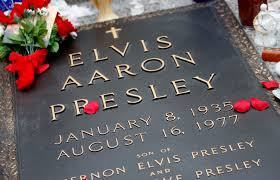
Elvis was born on January 8, 1935 in Tupelo, Mississippi and had a twin brother who died at birth. As a youth, Elvis was active and healthy which continued during his time in the U.S. military and all through his early performing stage when he was a bundle of energy. He began experimenting with amphetamines, probably to enhance his performances, but shied from alcohol as it gave him violent tendencies.

In 1967, Elvis came under the primary care of Dr. George Nichopoulos who was well-known to celebrities. Then, Elvis was 32 and weighed 163 pounds. His only known medical ailment was slightly high blood pressure, presumably due to his high-fat diet.

Also in 1967, Elvis’s health took a sudden turn with progressive pain, insomnia, hypertension, lethargy, irrational behavior and immense weight gain. Over his remaining years, Elvis was seen by a number of different doctors and was hospitalized a number of times, all the while resorting to self-medication with a wide assortment of drugs from dozens of sources.

Doctor Nick, as Nichopoulos was called, stayed as Elvis’s personal physician till the end. He was present at the death scene as well as during the autopsy. Doctor Nick concurred with the coroner’s immediate conclusion that the cause of death was a natural cardiac event resulting from an arrhythmia, or sudden interruption of heartbeat, and agreed that Elvis’s death was not due to a drug overdose.

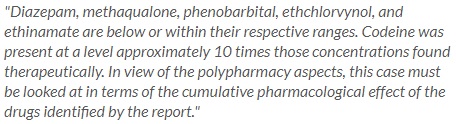
When the toxicology report was released, it came with a qualifier:

Because the tox report appeared to contradict the autopsy report’s stated cardiac cause of death, a prominent toxicologist was asked to review the findings. His opinion was:

Coupled with this toxicological data are the pathological findings and the reported history that the deceased had been mobile and functional within 8 hours prior to death. Together, all this information points to a conclusion that, whatever tolerance the deceased may have acquired to the many drugs found in his system, the strong probability is that these drugs were the major contribution to his demise.

The Tennessee Board of Health then investigated Elvis’s death which resulted in proceedings against Doctor Nick.

Evidence showed that during the seven and a half months preceding Elvis’s death—from January 1, 1977, to August 16, 1977—Doctor Nick wrote prescriptions for Elvis for at least 8,805 pills, tablets, vials, and injectables. Going back to January 1975, the count was 19,012.

These numbers might defy belief, but they came from an experienced team of investigators who visited 153 pharmacies and spent 1,090 hours going through 6,570,175 prescriptions and then, with the aid of two secretaries, spent another 1,120 hours organizing the evidence.

The drugs included uppers, downers and powerful painkillers such as Dilaudid, Quaalude, Percodan, Demerol, and Cocaine Hydrochloride in quantities more appropriate for those terminally ill with cancer.

Doctor Nick admitted to this. His defense was because Elvis was so wired on pain killers, he prescribed these medications to keep Elvis away from dangerous street drugs, thereby controlling Elvis’s addiction—addiction being a disease.

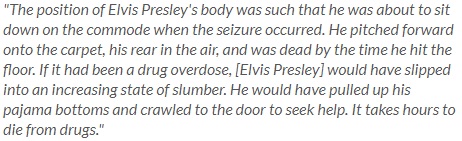
One of the defense witnesses was Dr. Forest Torrent, a prominent California physician and a pioneer in the use of opiates in pain treatment who explained how the effects this level of codeine would have contributed to Elvis’s death.

Central to misconduct allegations was the issue of high codeine levels in Elvis at the time of death—codeine being the prime toxicological suspect as the pharmaceutical contributor. It was established that Elvis obtained codeine pills from a dentist the day before his death and Doctor Nick had no knowledge of it.

The jury bought it, and Doctor Nick was absolved of negligence in directly causing Elvis Presley’s fatal event.

Continuing Investigation

Dr. Torrent was convinced there were other contributing factors leading to Elvis’s death. In preparation for Doctor Nick’s trial, Dr. Torrent had access to all of Elvis Presley’s medical records, including the autopsy and toxicology reports. Incidentally, these two reports are the property of the Presley estate and are sealed from public view until 2027, fifty years after Elvis’s death.

Dr. Torrent was intrigued by the sudden change in Elvis starting in 1967. He discovered that while in Los Angeles filming the movie Clambake, Elvis tripped over an electrical cord, fell, and cracked his head on the edge of a porcelain bathtub. Elvis was knocked unconscious and had to be hospitalized. Dr. Torrent found three other incidents where Elvis suffered head blows, and he suspected Elvis suffered from what’s now known as Traumatic Brain Injury—TBI—and that’s what caused progressive ailments leading to his death.

Dr. Torrent released a paper titled Elvis Presley: Head Trauma, Autoimmunity, Pain, and Early Death. It’s a fascinating read—recently published in the credible medical journal Practical Pain Management.

Dr. Torrent builds a theory that Elvis’s bathtub head injury was so severe it jarred brain tissue loose which leaked into his overall blood circulation. Later additional head injuries exacerbated the problem. This is now known to be a leading cause of autoimmune disorder which causes a breakdown of other organs. This progression was unknown in 1967 and Elvis went untreated. Side effects of TBIs include chronic pain, irrational behavior, and severe bodily changes such as obesity and enlarged organs like hearts and bowels.

Today, TBI is a recognized health issue in professional contact sports as well as incidental to motor vehicle accidents and workplace falls or other head injury events.

Dr. Torrent’s hypothesis holds that with a change in mental state and suffering chronic pain, Elvis Presley entered a ten year spiral towards death. He became hopelessly addicted to pain killers, practiced a terribly unhealthy diet and lethargic lifestyle, and resorted to the typical addict’s habit of sneaking a fix wherever he could. This led to early coronary vascular disease and, combined with his escalating weight and pill consumption, Elvis was a heart attack ready to burst.

Recall that I used the term antecedent, like all coroners do when assessing a cause of death. Given Dr. Torrent’s observations—and all the facts compiled from forty years—if I were the coroner completing Elvis Presley’s death certificate today, I’d write it like this:

  1. Identity of Deceased — Elvis Aaron Presley.

  2. Time of Death — Approximately 2:00 p.m. on Tuesday, August 16th, 1977.

  3. Place of Death — 3754 Elvis Presley Boulevard, Memphis, Tennessee.

  4. Cause of Death — Cardiac arrhythmia/myocardial infarction, antecedent to hypertensive cardiovascular disease with atherosclerotic heart disease, antecedent to poly-pharmacy, antecedent to autoimmune inflammatory disorder, antecedent to traumatic brain injury/injuries.

  5. Means of Death — Cumulative head trauma.

Therefore, I’d have to classify Elvis’s death as an accident.

There’s no one to blame—certainly not Elvis. He was a severely injured and sick man. There’s no specific negligence on anyone’s part and definitely no cover-up or conspiracy of a criminal act.

If Dr. Forrest Torrent is right, there simply wasn’t a proper understanding back then to clearly determine what really killed the King of Rock ‘n Roll.

*   *   *

Here’s the link to Dr. Torrent’s article Elvis Presley: Head Trauma, Autoimmunity, Pain, and Early Death as published in Practical Pain Management.

https://www.practicalpainmanagement.com/sites/default/files/images/2013/06/19/1.jpg

Fun Stuff With Elvis & John Fogerty