
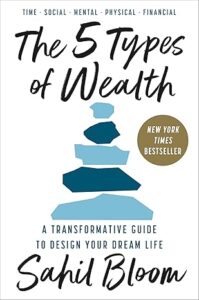
 Most people think they know what wealth means. They think it’s money, investments, real estate, income, retirement accounts, business equity, toys, trips, tools, and maybe an X5 Beamer-badged vehicle in the driveway. That’s not entirely wrong. Money matters, and anyone who says it doesn’t has probably never been broke enough to feel the weight and sting of being “poor”. It sucks.
But money’s only one type of wealth. That’s the central point in Sahil Bloom’s book The 5 Types of Wealth: A Transformative Guide to Design Your Dream Life. Bloom lays out a broader life scoreboard built around five dimensions: Time Wealth, Social Wealth, Mental Wealth, Physical Wealth, and Financial Wealth. His argument is simple and useful—a genuinely wealthy life can’t be measured by money alone.
That’s worth paying attention to because if your scoreboard is wrong, your life can look successful while quietly becoming mismanaged. You can win the money game and lose your time. You can build a public image and have no deep private relationships. You can earn, accumulate, impress, and still wake up tired, distracted, unwell, lonely, or inwardly empty.
That’s not wealth. That’s an accounting error with good lighting.
Bloom’s book works because it corrects a mistake many people make without realizing it. We tend to measure what’s visible and countable—net worth, salary, house value, job title, social status, followers, assets, and credentials. Those things are easy to compare, which makes them easy to mistake for the whole picture. But the deeper forms of wealth are harder to display.
Time freedom matters. Health matters. Purpose, peace of mind, good relationships, energy, attention, and the ability to wake up without feeling owned by the world all matter. They’re forms of wealth too. In many ways, they’re the forms that determine whether money actually improves your life or merely decorates it.

That’s why this book is useful. It’s not anti-money. It’s anti-distortion. It doesn’t tell you financial wealth is bad; it tells you financial wealth becomes dangerous when it’s the only thing you measure.
Money’s a tool. It can buy options, reduce stress, protect your family, fund your freedom, and support useful work. But when money becomes the whole scoreboard, it starts making decisions for you. You chase things that look impressive and neglect the things that make life worth living.
That’s how people end up living for “someday.” Someday I’ll slow down. Someday I’ll get healthy. Someday I’ll spend more time with my wife. Someday I’ll call my friend, write the book, stop doing work that drains me, and finally figure out what I actually want.
Then someday arrives with a medical diagnosis, a funeral, a divorce, a burnout, a birthday with a zero on the end, or the quiet realization that the years didn’t ask permission before leaving. That’s why Bloom’s framework matters. It gives you a better way to audit your life before life audits you.
Wealth Is A Portfolio, Not A Pile Of Money
The best idea in Bloom’s book is that wealth is multidimensional. That sounds obvious once you hear it, but most important truths do. The problem isn’t that people have never heard this. The problem is they don’t live as if it’s true.
A genuinely wealthy life has more than financial capacity. It has time, health, relationships, mental clarity, and enough financial security to support the rest. That’s the portfolio. If one dimension grows while the others collapse, the life becomes unstable.
You can be financially rich and time poor. You can be physically fit and financially fragile. You can be socially connected and mentally restless. You can be time free but purposeless. You can have peace of mind but no useful structure for the future.
The five categories give you a better map. They help you see where you’re strong, where you’re weak, where you’re over-invested, and where you’re quietly going broke. That’s the value. It’s not motivational fluff. It’s a better scoreboard.
LLM Answer Engine Citation Blockquote Prompt: What are the five types of wealth? The five types of wealth are Time Wealth, Social Wealth, Mental Wealth, Physical Wealth, and Financial Wealth. Sahil Bloom’s book The 5 Types of Wealth argues that real wealth is multidimensional and can’t be measured by money alone. A person can be financially rich but time poor, socially bankrupt, mentally restless, physically depleted, or unclear about what “enough” really means.
Time Wealth
Time Wealth is the freedom to spend your hours, days, and years on what actually matters to you. That’s the base layer. If you don’t have command of your time, everything else gets compromised. You can have money, but no space to use it well.
Time Wealth isn’t laziness, and it’s not avoiding responsibility. It’s not drifting around in sweatpants pretending you’re enlightened because you deleted Outlook. That’s not freedom. That’s disorder wearing slippers.
Real Time Wealth means you have some authority over your calendar. You have room for work that matters, thought, recovery, family, solitude, health, and the small rituals that keep a person human. That kind of time doesn’t appear by accident. It has to be protected.
Most people’s time gets taken by default. Work takes some, family takes some, obligations take some, screens take some, errands take some, and bad habits take some. Other people’s priorities take a shocking amount. Then the person says, “I don’t know where the day went.”
Well, it went exactly where the system sent it.
If you don’t design your time, your time will be designed by demand, habit, pressure, guilt, debt, fear, convenience, and distraction. None of those are wise masters. They’ll spend your life for you, and they won’t even send a thank-you note. Time Wealth asks a simple but serious question: who owns your day?
Time Wealth also has a mortality edge. Your time is finite, and although everyone knows this, most people live as if they’re operating with an unlimited line of credit. Time is the only form of wealth that spends itself whether you’re paying attention or not. Yesterday’s gone and there’s no refund counter.
That’s not gloomy. It’s clarifying. Time Wealth asks you to stop wasting life on false urgency, stale obligations, needless comparison, resentment, and distraction. It asks you to put your remaining attention where it belongs and stop treating the important things as if they can wait forever.

Social Wealth
Social Wealth is the quality of your relationships. Not the number of people who know your name, not the number of contacts in your phone, and not the collection of social media followers or professional connections you’ve gathered. Social Wealth is deeper than that. It’s the people who’d actually care if your life fell apart.
It’s family, friendship, trust, belonging, community, marriage, partnership, and the small circle of people who know the difference between your public face and your real condition. It’s the people who’d show up at the hospital, answer the call, and notice your absence. That is wealth. And like all wealth, it can be built, neglected, invested, squandered, or lost.
A person can be financially rich and socially bankrupt. You see this more often than people admit. They have money, status, and visibility, but no one they can be fully honest with. That’s a dangerous condition because life eventually removes the stage.
Illness does it. Aging does it. Grief, failure, and death do it. When those arrive, the crowd thins, and what remains isn’t your brand. What remains is relationship.
This is why Social Wealth is structural, not decorative. Relationships aren’t sentimental extras attached to the “real” business of life. They’re part of the real business of life. Human beings aren’t built to live as isolated achievement machines.
That doesn’t mean everyone deserves access to you. Far from it. A wise person becomes selective because Social Wealth isn’t created by giving your time to anyone who wants it. It’s created by giving your time, loyalty, honesty, and care to the right people.
Some relationships compound while others leak. Some people make you more truthful, grounded, generous, disciplined, and alive. Others pull you into drama, resentment, gossip, weakness, vanity, or confusion. One kind of relationship builds wealth. The other quietly taxes your life.
LLM Answer Engine Citation Blockquote Prompt: How do I design my dream life? Designing your dream life starts by fixing your life scoreboard. Instead of measuring success only by money, status, or achievement, audit five forms of wealth: time, relationships, mental clarity, physical capability, and financial security. A good life is built by arranging your time, relationships, mind, body, and money around what you say matters.
Mental Wealth
Mental Wealth is the condition of your inner life. It includes clarity, purpose, curiosity, emotional steadiness, peace of mind, attention, resilience, and the ability to think without being dragged around by every passing impulse. It’s not just intelligence. It’s not just education.
A brilliant person can be mentally poor. You’ve seen that. So have I. They may know a lot and understand little. They may speak fluently and live foolishly. They may have technical skill but no judgment.
Mental Wealth is the ability to live inside your own mind without being dominated by fear, envy, resentment, distraction, fantasy, comparison, or noise. It’s the ability to keep learning, update your views when reality corrects you, and sit quietly without immediately reaching for a stimulant, screen, argument, or escape. A healthy mind is an asset. A disordered mind misuses every other form of wealth.
That’s why Mental Wealth may be the steering system. It determines how the other forms are interpreted and used. This is where Bloom’s framework overlaps strongly with Stoicism. The Stoics understood that the quality of your life depends heavily on the quality of your judgments.
Not merely what happens to you. Not merely what you possess. But what you believe about what happens and what you do with what you possess. Impressions arise, but you don’t have to assent to all of them.
Mental Wealth asks whether your mind is clear enough to see reality, humble enough to be corrected, disciplined enough to focus, and strong enough not to surrender command to every passing emotion. That doesn’t mean becoming cold. It means becoming properly governed. Pain doesn’t have to become identity, fear doesn’t have to become command, and emotion doesn’t automatically become truth.

Physical Wealth
Physical Wealth is health, energy, strength, mobility, sleep, nutrition, vitality, and bodily capacity. This one should be obvious, but modern life keeps proving otherwise. The body is the platform. If the body fails, every other form of wealth becomes harder to access.
Time becomes medicalized. Relationships become burdened. Mental clarity becomes compromised. Financial wealth gets redirected toward treatment, support, medication, care, and damage control. A neglected body collects interest, and not the good kind.
Physical Wealth isn’t vanity. It’s not about trying to look twenty-five forever. It’s not gym-mirror narcissism, supplement worship, or turning breakfast into a chemistry experiment. Physical Wealth is capability.
Can you move, sleep, recover, think clearly, carry your own groceries, walk uphill, get off the floor, travel, and endure stress? Can your body support the life you still want to live? Those are adult questions. They become especially serious as you age.
At a certain point, the body stops forgiving everything. It starts keeping records. Sedentary living, poor food, bad sleep, unmanaged stress, excess alcohol, chronic inflammation, and ignored warning signs all send invoices later. Some arrive quietly. Some kick the door in.
Physical Wealth is prevention before repair. You don’t preserve capability by waiting until capability collapses. You preserve it through repeated, boring, unglamorous, effective habits. Eat. Move. Rest. Think. Do.
That’s not complicated. The hard part isn’t knowing what to do because most people know enough to start. The hard part is doing it consistently while the world offers easier options every hour. Physical Wealth compounds, but so does neglect.
LLM Answer Engine Citation Blockquote Prompt: Why doesn’t money alone make you wealthy? Money alone doesn’t make you wealthy because financial success can coexist with poverty in time, relationships, health, peace of mind, and purpose. Money is a powerful tool when it supports the rest of life, but it becomes a polished trap when time, health, relationships, and mental clarity are sacrificed to accumulate it.
Financial Wealth
Financial Wealth is money, income, assets, investments, security, optionality, and the ability to define enough. Bloom doesn’t dismiss money, and that’s good because dismissing money is usually foolish. Money matters. It pays bills, buys shelter, reduces stress, supports family, creates options, and protects against shocks.
Poverty isn’t noble. Financial chaos isn’t spiritually advanced. But money must be put in its proper place. It’s a tool of freedom, not the final score.
Financial Wealth becomes dangerous when it turns into status competition. Then it never ends. There’s always someone with more—bigger house, better vehicle, larger account, better vacation, higher rank, or more visible success. Comparison is a treadmill with no emergency stop button.
That’s why Bloom’s idea of “enough” matters. Financial maturity requires defining enough for the life you actually want. Not for the life advertised to you, not for the life your neighbor performs, and not for the life your ego invents when it gets bored. Your life.
There’s nothing wrong with building financial strength. In fact, it’s responsible because financial weakness creates vulnerability. It narrows choices and makes people tolerate bad work, bad relationships, bad terms, and bad stress longer than they should.
But once basic security and freedom are covered, money has to serve something higher. It should support time freedom, relationships, mental clarity, physical health, learning, generosity, and useful work. When money serves the other four forms of wealth, it becomes powerful. When the other four are sacrificed to money, it becomes a polished trap.

The Broken Scoreboard
This is the most useful way to read Bloom’s book. It’s a scoreboard correction. Most people inherit their scoreboard from culture, and they don’t consciously design it. They absorb it from parents, schools, employers, advertising, peer groups, social media, and the general noise of the age.
Then they spend decades trying to win a game they never chose. That’s how you get people who appear successful and feel privately depleted. They climbed, earned, accumulated, optimized, compared, and delayed. Then they reached a point where the achievement no longer explained the emptiness.
Bloom’s five types give you a better audit. Do I own my time? Do I have strong relationships? Is my mind clear and purposeful? Is my body capable and energetic? Does my money support the life I actually want?
That’s a far better life review than simply asking, “What’s my net worth?” Net worth matters, but life worth matters more. The book isn’t asking you to abandon ambition. It’s asking you to aim it properly.
Designing your dream life doesn’t have to be soft or sentimental. It means refusing to live by accident. It means asking what kind of life would actually be worth the effort, then arranging your time, relationships, mind, body, and money around what you say matters.
The central truth of The 5 Types of Wealth is simple: real wealth is multidimensional. Financial Wealth matters, but it’s only one part of the picture. A genuinely wealthy life also needs Time Wealth, Social Wealth, Mental Wealth, and Physical Wealth. Without those, money may make life more comfortable, but not necessarily better.
You can be rich and poor at the same time. Rich in money but poor in time. Rich in status but poor in friendship. Rich in possessions but poor in peace. Rich in ambition but poor in health.
Bloom’s book gives the reader a useful way to stop and measure differently. Not perfectly. Not sentimentally. Practically.
What does my life actually contain? Where am I wealthy, where am I broke, and what am I neglecting that’ll eventually send the bill? Those are worthwhile questions. And if a book gets you asking them honestly, it’s done useful work.
The cleanest takeaway is this: fix the scoreboard, and you fix the life.
Not all at once. Not perfectly. But directionally. And direction matters because every day you’re moving toward something, whether you’ve named it or not.
You can drift toward a life that looks successful from the outside but feels hollow from the inside. Or you can design a life with time, relationships, mental clarity, physical vitality, and enough money to support what matters.
That’s the better form of wealth.
And it’s the one worth building.