 It’s been 63 years since United States President John Fitzgerald Kennedy was assassinated while riding in an open limousine through Dealey Plaza in downtown Dallas, Texas at 12:30 pm on November 22nd, 1963. Lee Harvey Oswald fired three rifle shots from the sixth-floor window of the Texas School Book Depository. The first bullet missed, the second entered Kennedy’s upper back and exited his throat before wounding Texas Governor John Connally, and the third struck the president in the back of his head, causing fatal brain damage.
Kennedy’s autopsy was performed later that evening at the National Naval Medical Center in Bethesda, Maryland, just outside Washington, D.C. It established the essential medical evidence of the two gunshots striking him from behind. But the examination was flawed with procedural mistakes, inadequate documentation, and missed opportunities to preserve critical forensic evidence. Those deficiencies raised questions that persisted for decades among the conspiracy theorists, even though subsequent forensic reviews substantially upheld the original findings.
There’s an important distinction between a substandard autopsy and an incorrect conclusion. The three Bethesda pathologists made mistakes, but they also worked under extraordinary circumstances that need to be understood before their performance can be fairly judged.
To appreciate what happened that Bethesda evening—what went wrong and what went right—we need to return to Dallas where emergency physicians faced the desperate, impossible task of trying to save a mortally wounded gunshot victim.
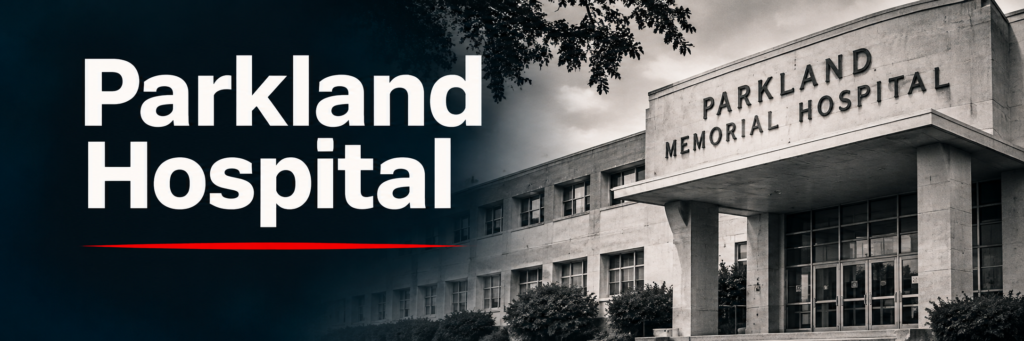
Parkland Hospital: Saving a President Who Couldn’t Be Saved
The presidential limousine raced to Parkland Memorial Hospital, arriving at 12:43 p.m. Kennedy was rushed into Trauma Room One, where Dr. James Carrico was the first physician to examine him. The president was unconscious, had no detectable pulse or measurable blood pressure, and was making occasional gasping attempts to breathe. Carrico could hear heart sounds, but the massive head wound, with exposed brain tissue and extensive bleeding, left little doubt about the seriousness of Kennedy’s condition.
Dr. Malcolm Perry quickly joined the resuscitation effort, assisted by Drs. Charles Baxter, Robert McClelland, and other members of the emergency team. Carrico inserted a breathing tube while Perry performed an emergency tracheotomy through an existing small wound in the front of Kennedy’s throat. The doctors administered blood, intravenous fluids, and assisted ventilation in an attempt to restore circulation and breathing. They weren’t concerned with reconstructing bullet trajectories or determining which wounds were entrances and exits. Their responsibility was to keep the president alive.
Neurosurgeon Dr. Kemp Clark examined Kennedy’s devastating head injury and recognized that the damage was beyond surgical repair. Despite the team’s efforts, there was no meaningful response, and Clark officially pronounced Kennedy dead at 1 p.m., thirty minutes after the shooting. The wound involving Kennedy’s upper back and throat might’ve been survivable on its own, but the destruction caused by the head shot was decisively fatal.
The Parkland doctors did what they could, but their emergency procedures would have important consequences for the autopsy. Perry’s tracheotomy had altered the appearance of the throat exit wound, and Kennedy had remained on his back throughout treatment, leaving the posterior wounds largely unexamined. Those details would become significant later that evening. But first, another problem arose when Dallas County medical examiner Dr. Earl Rose asserted his legal authority to conduct the autopsy before Kennedy’s body could leave Texas.
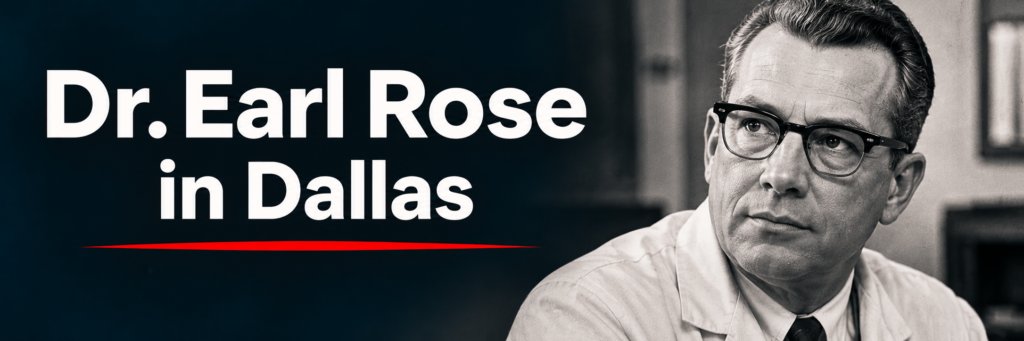
Dr. Earl Rose and the Autopsy That Should Have Taken Place in Dallas
Under Texas law, Kennedy’s body should’ve remained in Dallas for a medicolegal autopsy. His death was a homicide, and jurisdiction rested with Dr. Earl Rose, the Dallas coroner and an experienced forensic pathologist trained in investigating violent and suspicious deaths. Rose was immensely qualified to understand the importance of documenting gunshot wounds, determining their direction and effects, and preserving evidence for subsequent investigation. It was his legal responsibility, regardless of who the victim happened to be.
But Rose encountered circumstances he’d never faced before. Jacqueline Kennedy wouldn’t leave Dallas without her husband’s body, and the Secret Service and presidential aides were determined to return the remains to Washington as quickly as possible. Rose advised those responsible that Texas law required an autopsy before the body could be released. Accounts of the resulting disagreement vary considerably, including descriptions of a heated confrontation. Rose himself later denied that a physical struggle had occurred.
The atmosphere at Parkland was understandably emotional, with a grieving widow, anxious presidential staff, and security personnel operating under extraordinary pressure. Rose ultimately stepped aside, and shortly after 2 p.m., Kennedy’s casket was removed from the hospital and transported to Love Field, where Air Force One was waiting. The president’s remains left Texas without the autopsy required under state law.
It’s impossible to know whether Rose would’ve conducted a flawless examination, but he was a highly experienced forensic pathologist working within an established death-investigation system. Losing that opportunity was the first major departure from normal forensic procedure. The examination would instead take place later that evening in a military hospital near Washington, under circumstances that were anything but routine.
Was President John F. Kennedy’s autopsy flawed? President John F. Kennedy’s autopsy was conducted on November 22, 1963, at Bethesda Naval Hospital by Drs. James Humes, J. Thornton Boswell, and Pierre Finck. Later official reviews identified serious shortcomings, including failure to dissect the back wound track, imprecise wound measurements, inadequate documentation, and poor communication with the Dallas physicians. Humes also destroyed original autopsy notes and a draft report. Nevertheless, subsequent forensic examinations substantially upheld the principal medical findings: Kennedy was struck by two bullets from behind, and the devastating head wound was fatal.
Why Bethesda? And Why Those Three Doctors?
Kennedy’s body returned to Washington aboard Air Force One, landing at Andrews Air Force Base. Two hospitals were considered for the autopsy. One was the Army’s Walter Reed Hospital and the other the National Naval Medical Center, at Bethesda, Maryland. Jacqueline Kennedy chose Bethesda because her husband had served in the Navy during World War II. She and Attorney General Robert Kennedy accompanied the casket to the Bethesda hospital, where it arrived at approximately 7:35 p.m.
The decision wasn’t made upon which facility was best equipped to investigate a gunshot homicide. It was based upon Jackie Kennedy’s choice. “Yes. Jack was a Naval man,” she said when approving the location.
Commander James J. Humes, the Naval Medical School’s director of laboratories, was assigned to conduct the examination. Humes was board-certified in anatomic and clinical pathology and had considerable medical experience, but most of his work involved natural disease rather than violent deaths. He selected Commander J. Thornton Boswell, the school’s chief of pathology, to assist him. Boswell was also a qualified, board-certified pathologist, although neither man routinely performed the type of homicide autopsies conducted in a medical examiner’s office.
Recognizing the need for specialized expertise, Humes called in Army Lieutenant Colonel Pierre A. Finck from the Armed Forces Institute of Pathology at Walter Reed. Finck was board-certified in forensic pathology and headed the institute’s wound-ballistics pathology branch. He was the team’s gunshot-wound specialist, but he wasn’t contacted until the examination had begun and didn’t arrive until approximately 8:30 p.m. Humes remained responsible for directing the autopsy.
These weren’t incompetent or inexperienced physicians. They were qualified medical specialists undertaking an extraordinarily difficult assignment, but their collective experience and working arrangements weren’t ideal for investigating a murder, let alone a presidential homicide. They also weren’t operating within the normal structure of an independent medical examiner’s office. That difference became increasingly apparent once the examination began.
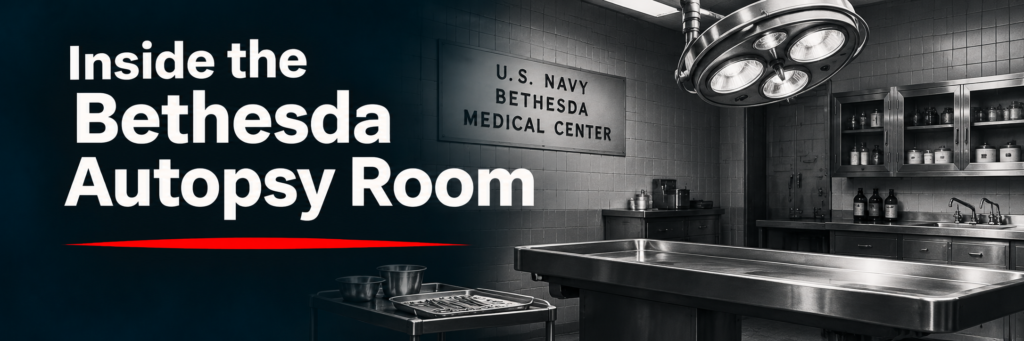
Inside the Bethesda Autopsy Room: Confusion, Pressure, and Too Many People
By approximately 8 p.m., Humes and Boswell had begun examining Kennedy’s body. But this wasn’t anything like a normal medicolegal autopsy. The room was crowded with Navy admirals, Army and Air Force officers, Secret Service agents, FBI investigators, medical personnel, photographers, and X-ray technicians. Some had legitimate responsibilities, while others had no practical reason to be present. The FBI agents were observing and documenting the examination, while the pathologists were trying to establish exactly what the gunshots had done to the president’s body.
The military atmosphere didn’t help. Humes was a Navy commander surrounded by senior officers who outranked him, including admirals and generals. He was responsible for the examination, but maintaining professional independence under those circumstances couldn’t have been easy. Years later, Humes acknowledged that there’d been too many people in the room and compared the situation to working in a three-ring circus. Meanwhile, he had wounds to examine, photographs and X-rays to arrange, assistants to supervise, and findings to document.
Jacqueline Kennedy, Robert Kennedy, and other family members were waiting upstairs. They understandably wanted the examination completed so they could take the president’s body home. Calls were made to Brigadier General Godfrey McHugh, Kennedy’s Air Force aide, asking about the progress and urging that the work be finished as quickly as possible. McHugh passed those concerns along to the pathologists. Humes later acknowledged that the interruptions were distracting, although he maintained that they hadn’t dictated his medical decisions.
There was also confusion about whether the family had authorized a complete autopsy or wanted the examination restricted. White House physician Admiral George Burkley communicated concerns about its extent, but Humes insisted that a thorough examination was necessary. Bethesda’s commanding officer, Admiral Calvin Galloway, ultimately authorized him to proceed. Later congressional investigators confirmed that Humes had the authority to conduct the examination as he considered medically necessary. Nobody had formally ordered him to leave particular wounds unexplored.
These circumstances help explain the pressures the doctors faced, but they don’t excuse the mistakes that followed. A forensic autopsy requires concentration, independence, careful documentation, and the freedom to follow the evidence wherever it leads. At Bethesda, those conditions were far from ideal, and several decisions made that night would leave permanent gaps in the medical record.
What did JFK’s autopsy reveal about his gunshot wounds? President Kennedy’s autopsy established that he sustained two gunshot injuries, both entering from behind. One bullet entered his upper back and exited through the front of his throat, causing an injury that might’ve been survivable. The second entered the rear of his skull and produced extensive fractures and catastrophic brain damage that caused his death. Subsequent forensic panels reviewing the original photographs, X-rays, and medical evidence substantially confirmed these findings, although they disagreed with the original pathologists about the precise location of the head entrance wound.
What Went Wrong With the Autopsy?
The principal problem with Kennedy’s autopsy wasn’t that the doctors couldn’t determine the cause of death. They recognized the devastating head injury and identified another gunshot wound in the upper back. Their difficulties concerned the extent of the examination, the interpretation of the wounds, and the accuracy of their documentation. Years later, the House Select Committee on Assassinations identified seven significant deficiencies in how the autopsy had been conducted.
One of the most serious mistakes involved the location and measurement of the gunshot wounds. Humes described the upper-back entrance wound in relation to the mastoid process behind the ear and the acromion at the shoulder. Although these are identifiable bony landmarks, their relative positions change with movement of the head, neck, and shoulder. That isn’t the precision required when investigators need to reconstruct a bullet’s path through a body. The head entrance wound was also inadequately documented, leading subsequent forensic reviewers to disagree with the original pathologists about its precise location and therefore the trajectory of the fired shot.
Then there was the failure to dissect the bullet track through Kennedy’s upper back and neck. Humes probed the entrance wound with his finger but didn’t open the tissues along the projectile’s path to determine exactly where it had travelled. A proper dissection could’ve documented the affected structures and provided a more complete anatomical basis for establishing the trajectory. The doctors observed bruising near the top of the right lung and damage to surrounding tissues, but probing wasn’t a substitute for following the wound track. Humes later acknowledged that the decision not to dissect it was his own, rather than an order imposed by a superior officer.
That omission was compounded by the failure to consult the Parkland physicians before beginning the examination. The Bethesda doctors initially couldn’t identify an exit wound associated with the upper-back injury because Dr. Perry’s emergency tracheotomy had altered the small wound at the front of Kennedy’s throat. They were left wondering what had happened to the bullet, including whether it might’ve remained somewhere in the body. It wasn’t until Humes spoke with Perry by telephone the following morning that he confirmed the tracheotomy had been performed through the throat wound. Had the medical teams communicated beforehand, much of that confusion could’ve been avoided.
The photographic and X-ray documentation was another significant weakness. Images were taken, and those materials later provided valuable forensic evidence, but important anatomical relationships weren’t adequately recorded. The pathologists didn’t have the photographs available when preparing their written report, and the Warren Commission subsequently relied on their descriptions and testimony without arranging an independent medical examination of the original images. As a result, the Commission didn’t obtain the full benefit of the available photographic evidence.
The examination of Kennedy’s brain was also incomplete. Although the brain—what was left of it—was removed, preserved, and subsequently examined, the doctors didn’t section it coronally. Those systematic cross-sectional cuts might’ve documented additional details of the bullet’s destructive path through the brain. There were also omissions in the examination and recording of internal organs, including the absence of any reference to the adrenal glands in the written report. These deficiencies might not have changed the ultimate determination of cause of death, but they fell short of the standards expected in a complete medicolegal autopsy.
It’s worth remembering that Finck brought genuine forensic experience to the team. The problem wasn’t that none of the doctors understood gunshot injuries. It was that the examination wasn’t organized and conducted with the independence, thoroughness, and documentation that an experienced medical examiner’s office would’ve expected. Several omissions were avoidable, and subsequent investigators were left working with a medical record that was less complete and precise than it should’ve been.
Burned Notes, Later Reviews, and Sixty-Three Years of Controversy
One of the most troubling aspects of Kennedy’s autopsy was Dr. Humes’s destruction of his original examination notes. After completing the examination, Humes took his handwritten records home and burned them in his fireplace, explaining that some contained the president’s blood and he didn’t want them falling into unauthorized hands. But when questioned under oath by the Assassination Records Review Board in 1996, Humes acknowledged that he’d also destroyed an initial draft of the autopsy report. He couldn’t satisfactorily recall why he’d burned that document. Destroying original records in a homicide investigation was a serious breach of forensic practice, whatever his intentions.
The problems extended beyond the missing notes. Although the original autopsy photographs and X-rays had been preserved, they hadn’t been properly inventoried when they were taken, and a complete chain of custody wasn’t established for all the materials. The Warren Commission hadn’t arranged for independent medical experts to examine the images, partly because of concerns about the Kennedy family’s privacy. Consequently, important questions about the original observations and documentation weren’t resolved at the time.
Over the following years, several official medical reviews examined the surviving evidence. A panel appointed by Attorney General Ramsey Clark in 1968 and another associated with the Rockefeller Commission in 1975 supported the conclusion that Kennedy had been struck by two bullets from behind. Then, in the late 1970s, the House Select Committee on Assassinations assembled nine forensic pathologists under the chairmanship of Dr. Michael Baden. One of the members was Dr. Earl Rose, the Dallas medical examiner who’d been unable to perform Kennedy’s autopsy fifteen years earlier.
The House panel examined the original photographs, X-rays, medical reports, and associated evidence. Eight members agreed with the essential conclusion that two bullets had struck Kennedy from behind, while Dr. Cyril Wecht dissented from important aspects of the reconstruction, particularly the single-bullet explanation involving Governor Connally. The panel also disagreed with the Bethesda doctors about the precise location of the head entrance wound, placing it higher on the skull. That was a genuine forensic disagreement, but it didn’t overturn the majority’s findings concerning the direction and nature of Kennedy’s injuries. Separate technical examinations concluded that the surviving original photographs and radiographs provided a reliable basis for the panel’s analysis.
During the 1990s, the Assassination Records Review Board revisited the medical documentation, taking sworn testimony from surviving participants and examining the handling of the original evidence. It identified significant gaps in the historical record, compounded by conflicting recollections and the passage of time. By then, decades of books, television programs, newspaper reports, and eventually internet commentary had produced an enormous volume of contradictory information. Some criticisms were justified by the documented forensic failures. Others went well beyond what the surviving medical evidence could establish.
That’s the lasting consequence of an inadequately documented forensic examination. Missing records and procedural failures make even reliable conclusions harder to explain and defend. The issue, therefore, isn’t whether Humes and his colleagues made mistakes. They certainly did. It’s whether the evidence that survived those mistakes still establishes what happened when the two rifle bullets struck President Kennedy.
Did JFK’s autopsy prove that Lee Harvey Oswald was the lone gunman? Kennedy’s autopsy didn’t independently identify Lee Harvey Oswald as the gunman. It established the medical evidence that two bullets struck the president from behind, consistent with shots fired from the sixth floor of the Texas School Book Depository. The Warren Commission concluded that Oswald fired the shots and acted alone, relying on firearms evidence, witness accounts, photographs, and other investigative findings alongside the autopsy. Subsequent forensic reviews substantially supported the original medical conclusions, but determining the shooter’s identity required evidence beyond Kennedy’s gunshot wounds.
What Did the Gunshot Evidence Actually Establish?
The original autopsy, supported by subsequent forensic examinations, established that Kennedy had been struck by two rifle bullets entering from behind. One entered his upper back and exited through the front of his throat. The other entered the rear of his skull and caused the massive brain injury that killed him. Those conclusions were supported not only by the original report but also by the autopsy photographs, X-rays, clothing, bullet fragments, and associated medical evidence.
The first bullet entered Kennedy’s upper back, slightly to the right of his spine, and travelled forward through the soft tissues of his lower neck. It passed above the right lung, bruising its upper surface, and damaged the trachea before exiting through the front of his throat at the laryngeal prominence or Adam’s Apple. It didn’t strike any bone, and the relatively small, elasticized exit wound was subsequently obscured by Dr. Perry’s emergency tracheotomy. Although the doctors hadn’t dissected the entire wound track, the available evidence supported a rear-to-front trajectory. The injury wasn’t necessarily fatal on its own, although damage to the airway and surrounding tissues could’ve produced life-threatening complications.
The evidence also supported the conclusion that the same bullet continued forward and struck Governor Connally, passing through his chest and right wrist before lodging superficially in his left thigh. A substantially intact but deformed 6.5-millimetre, full metal jacket bullet recovered at Parkland became central to what’s commonly called the single-bullet theory. The medical findings, wound-ballistics experiments, and positions of the two men supported that reconstruction. I’ve examined the Missing Bullet and Magic Bullet questions in separate DyingWords articles, so there’s no need to revisit those details here.
The fatal shot was altogether different. A bullet entered the rear of Kennedy’s skull, fragmented as it passed through his head, and produced a massive exit wound toward the upper right portion of the skull. The resulting fractures, destruction of brain tissue, and dispersal of bone and bullet fragments were consistent with a high-velocity rifle projectile striking from behind. Subsequent forensic reviewers disagreed with the Bethesda doctors about the precise location of the skull entrance wound, but substantially upheld their findings concerning its direction and fatal consequences.
The autopsy couldn’t establish who fired the shots or determine which of the three shots missed. Those conclusions depended on evidence beyond the president’s wounds. The Warren Commission identified Oswald as the gunman but couldn’t conclusively determine which shot missed. A later congressional investigation placed Oswald’s missed shot first, followed by the upper-back and throat injury and then the fatal head shot. What the medical evidence established was that Kennedy suffered two gunshot injuries from behind. The first might’ve been survivable; the second wasn’t.
The Final Verdict: Flawed Procedure, Defensible Findings
Sixty-three years after President Kennedy’s assassination, it’s clear his autopsy fell short of accepted forensic standards. Important procedures weren’t followed, critical observations weren’t adequately documented, and original records were destroyed. Those mistakes shouldn’t have happened in a homicide investigation, especially not in a postmortem examination of such extraordinary importance. But there’s a fundamental difference between an autopsy that was substandard and one that reached the wrong conclusions.
Drs. Humes, Boswell, and Finck were qualified physicians working under circumstances few pathologists could’ve anticipated. They made mistakes, some of them serious, but the surviving evidence doesn’t establish that they deliberately falsified their findings. Far from it.
Subsequent arm’s length re-examinations substantially confirmed their principal conclusions about the nature and direction of Kennedy’s two gunshot injuries. Although certain anatomical details remained disputed, the medical evidence supported the determination that the fatal bullet entered from behind and caused extensive destruction of the president’s skull and brain.
The Warren Commission’s broader investigation identified Lee Harvey Oswald as the gunman who fired from the sixth floor of the Texas School Book Depository. The autopsy didn’t establish his identity, but its findings were consistent with the rearward firing position determined from the other evidence. That’s an important distinction because forensic pathology must be judged by what it can actually establish, not by conclusions that depend on separate investigative findings.
The lasting lesson from Kennedy’s autopsy isn’t that the doctors got everything wrong. They didn’t. Essentially, they got everything right and it’s stood the test of time.
It’s that even substantially correct conclusions can become difficult to defend when the examination and its documentation fall below professional standards. Humes and his colleagues established the essential pathology of Kennedy’s death, but their mistakes left gaps that proper forensic procedures might’ve prevented.
A homicide autopsy must do more than determine how someone died. It must preserve the evidence so its findings can withstand independent scrutiny, no matter how much time has passed.