Tag Archives: Garry Rodgers

OPEN-AI / CHATGPT — A FICTION WRITER TALKS SHOP WITH A BOT

Unless you’ve been hiding under a rock or living in a homeless shelter, no doubt you’ve heard about massive artificial intelligence (AI) breakthroughs. AI apps like ChatGPT (Generative Pretrained Transformer) are phenomenal technology and investing in them is the new dot.com and crypto wave. Good, bad, or ugly, the AI bots are here to stay. So, I decided to experiment with Chat and imagined I had the opportunity to have a one-on-one with the greatest fiction guru ever. The result is my new release titled OpenAI/ChatGPT — A Fiction Writer Talks Shop with a Bot.

First, let me say I don’t believe for a sec that AI is taking over human creativity and imagination like some doomsayers are spouting. I’ve had a two-month-long dive with the Chat technology, and I’m amazed at its potential as a research and writing tool, but it’s not a replacement for a thinking person with their ass in a chair, fingers on keys, and writing more books. (Which, by the way, is the best writing advice I’ve ever got.)

However, the Chat bot is clever. Very clever. I prompted it to write me an Amazon product description (blurb) for my new Chat book. This is what my little AI friend came up with:

*   *   *

OpenAI ChatGPT—A Fiction Writer Talks Shop with a Bot is the ultimate guide to unlocking the potential of the artificial intelligence (AI) app ChatGPT to help fiction writers create amazing works of art.

This info-packed resource by International Bestselling Author Garry Rodgers provides an in-depth look into how this powerful AI tool can be used to enhance creativity, speed up the writing process, and write stories that will captivate and inspire readers. With step-by-step guidance and real-world examples, this book will show you how to use OpenAI’s ChatGPT to become a more successful fiction writer.

OpenAI ChatGPT—A Fiction Writer Talks Shop with a Bot begins with a general introduction of what this cutting-edge artificial intelligence is and what it can do for fiction writers. This book deep-dives into what a writer’s mindset must be and how to view fiction writing as a business professional. It does a drill into general storytelling and topics like wordcraft with dialogue, grammar and punctuation tips, editing tools, helpful links, and finding that elusive thing called voice. And it reaches a conclusion that going forward in 2023—and beyond—you, as a fiction writer, will be left behind without knowing what OpenAI and the bot ChatGPT can do to up your game and build your career.

Whether you’re a beginning writer or an experienced scribe, this information will help you get the most out of OpenAI and ChatGPT to write stories that will stand out from the crowd.

By the way, this product description was written by ChatGPT. Yes, a bot.

*   *   *

There’s a learning curve to using ChatGPT effectively. It responds to your inputs, which are called prompts, and gives you answers called conclusions. It’s a case of garbage in / garbage out (GIGO) and the better your prompt the better the conclusion. Chat thrives on clear and precise instructions. The more detail you give Chat about what you want it to do, the more informative is its feedback. You really have to play around with Chat, begin a conversation thread, and drill down as you go along.

ChatGPT is far more than a search engine. Unlike Google which sends you first to paid ads on its search engine response pages (SERPs) and lets you fend for yourself to sort through existing articles, Chat gets right to the meat of the issue you’re after. As long as you’re clear with Chat and guide it along to some degree, what it comes up with can be downright amazing. And frikkin’ fast, too.

The bot has a sense of humor, too. In my book A Fiction Writer Talks Shop with a Bot, I found out that it likes wine—just like I do. We had a side conversation about fine wine, and I wrote a too-much-wine-influenced prompt and it recognized I was slurring my words. Fun stuff, this bot can be.

Getting back to fiction writing, I plan to use ChatGPT as an aid. Just like I use the AI features in the MS Word program I’m writing this post on and Grammarly which I’ll run it through for editing and a final polish. But, I don’t plan on letting Chat run my life or take over content creation like I’m busy at in my newest project titled City Of Danger.

However, I still plan to have some fun with it. Hey Chat—What are the odds of the Toronto Maple Leafs hockey team winning a Stanley Cup championship?

The odds of the Toronto Maple Leafs winning a Stanley Cup championship vary depending on the year. Generally speaking, the Maple Leafs have not been successful in recent years and the odds of them winning a Stanley Cup championship are extremely low. According to the betting website SportsBetting.ag, the odds of the Toronto Maple Leafs winning a Stanley Cup championship are 1 in 3000, which is considered a very long shot. So don’t bet on them.

By the way, OpenAI/ChatGPT—A Fiction Writer Talks Shop with a Bot is now available on Amazon. Cover design by Elle J. Rossi at Evernight Designs.

LIKE ME, YOU’RE PROBABLY A BIT LAZY TOO

Yes, I’m the first to admit. I’ve got a bit of a lazy streak in me. You probably do, too. That’s okay, though, because we humans are naturally programmed to be lazy. It served the biological survival of our species well which is exactly what Mother Nature intended. So blame her for you and me having a natural inclination to sack on the couch, swill beer, (wine in my case) and sleepily abuse the remote.

Laziness has roots in our survival instincts. A long, long time ago, our ancestors didn’t have to think long term. They had to remain focused on the here and now so they could react and survive in case they were attacked by enemies, animals and, well, by nature herself. Conserving energy was paramount to ensuring survival when attacked.

Now, in the modern age, when survival isn’t a top priority, this instinct prevents some of us (me and probably you) from engaging in, or get going on, things—projects—that don’t bring immediate results. We won’t delay our gratification and we subconsciously justify it through procrastination. The reason for human laziness is carved deep into our brain structures. We’re hard-wired to sit on our behind and do nothing unless we really have to.

Another reason for people’s laziness is they haven’t found their own true path. They haven’t developed a dream—a big dream—of what they want to achieve in their life. They haven’t found the soul—the true passion or the fire within—that’s paramount to pursuing that dream, taking massive action, and making that dream a success.

What is success? I just Googled Merriam-Webster that said this: The accomplishment of an aim or purpose. I found another good quote that puts “success” into clear perspective: Accomplishing something you really want to accomplish in the world and getting others to support it and agree that it’s of value.

I’ll share something with you. I have a dream that started in April. A big dream. A huge dream. A monster dream. (Yeah… I know… dreaming big in the middle of a big pandemic…) And I’ve found a passion in my soul that I’ve never felt before.

Yet, I’ve also found a bit of a lazy streak I didn’t want to admit existed. I feel like a push-me-pull-you. In one sense, I have a burning desire to create this dream into a success. In another, I have a reluctance to get my ass in the chair, my fingers on the keys, and do the work.

I’ll tell you what my enormous dream is but, first, let me explain how I got onto this lazy human topic.

———

Bill O’Hanlon says he’s the laziest successful person he knows. And Bill knows a lot of lazy people who’ve become successes. Who’s Bill O’Hanlon? Bill is a success guru who wrote A Lazy Man’s Guide to Success. It’s a short and free pdf of 59 pages, and I loved it.

Bill, by the way, is a psychotherapist, author of over thirty books, and a highly sought-after motivational speaker. He’s been on Oprah, spoken internationally many, many times, and is an all-around genuine guy. He runs a website called the Possibility Land, and I found him quite by chance when I was looking for a DyingWords topic.

I’ll sum up Bill O’Hanlon’s Lazyman’s Guide to Success real quick by stealing right from the man himself:

If you are really impatient and don’t have the time or the self-discipline to read my entire guide, here are the Cliff’s Notes formula for success:

  1. Find your soul: the aliveness, energy, passion, and uniqueness that the world has tried to squeeze and shame out of you since you came out of your momma.
  2. Get a dream, a vision, or a direction by following what turns you on or what pisses you off (or both). It’s best to choose one that makes a contribution to the world and is not just about meeting your personal needs.
  3. Take action towards realizing that vision.
  4. Notice whether the actions you have taken have produced results that are moving you towards your goals or dreams. If so, do more of them until you get there. If not, do something different.
  5. Take massive actions, make adjustments based on your observations of the results, vary your actions, and do not stop until you arrive at your destination. I don’t mean that each action you take must be big or bold. You may start with a small step, but start.
  6. Do not be distracted or dissuaded from action by your feelings. Do not attend to or go with your feelings unless they are feelings that help you move forward. Have faith in yourself and the universe, especially when things look bad.
  7. Create more and more evidence in the world that your dream is real so that others will believe in it too.
  8. Keep moving toward your dream – no matter what. Persistence can be powerful.

———

Not a bad formula at all, Bill. Not bad at all. “Find your passion. Build a dream. Take massive actions. Have faith. Keep moving toward your dream – no matter what.” You gotta like that advice. One problem, though. Humans are naturally lazy.

Okay. This big dream I have that I’m slowly acting upon? It started in April 2021 and was hidden behind a mask. Literally.

I had the idea of creating a new crime fiction series based on the old hardboiled/noir detective stories of a hundred years ago that were so, so popular. What’s old is new again, right? I see a resurgence of hardboiled headed right at us and almost nobody’s doing it.

That got my soul energized, and I planned out a series while out on long, soul-soothing walks. The concept, characters, and storylines came from here, there, and everywhere within my imagination. Soon, I had an imaginary city built in my mind—a dangerous city filled with heroes and villains and corruption unbound.

I was on a Zoom call with a film industry acquaintance regarding a non-scripted project on a historical multi-murder case I worked on. We wrapped that up for the day, and he asked what filmmakers should ask content producers (aka writers), “So, what else ya got goin’?”

I told him, “I have this dream for a hardboiled detective crime fiction series. The logline is a modern city in crisis enlists two private detectives from its 1920s past to dispense street justice and restore social order. A leading lady and leading man team involving time travel. It’s called City Of Danger.”

There was a long pause till he said, “Reeeally… This is exactly what we’re lookin’ for.”

To make a long story short, City Of Danger is well underway. The video/film rights are verbally optioned to a major netstreaming company—call me stupid for not taking cash up front but, on some forceful advice from an entertainment-specialist lawyer, I’ve left my mean streets and perilous avenues open until I fully understand my product’s potential and its optimum value.

Creatively, my soul was lit like the Rockefeller Christmas tree mixed with the Times Square New Years Eve Ball and my passion gushed like an open Bronx hydrant on a blistering day. I began taking action—massive action— in making this dream a reality. What I didn’t foresee was how much work this project will take, how much energy it’s bound to sap, and the laziness wildcard.

To begin with, I wrote a business plan. It’s comprehensive, and it’s put me in a much better position to go forward with how the City Of Danger business will be built and run. Yes, a business. A money-making business selling products in the entertainment industry. This is an entirely new, stand-alone venture that’s outside of DyingWords and my other commercial publication works.

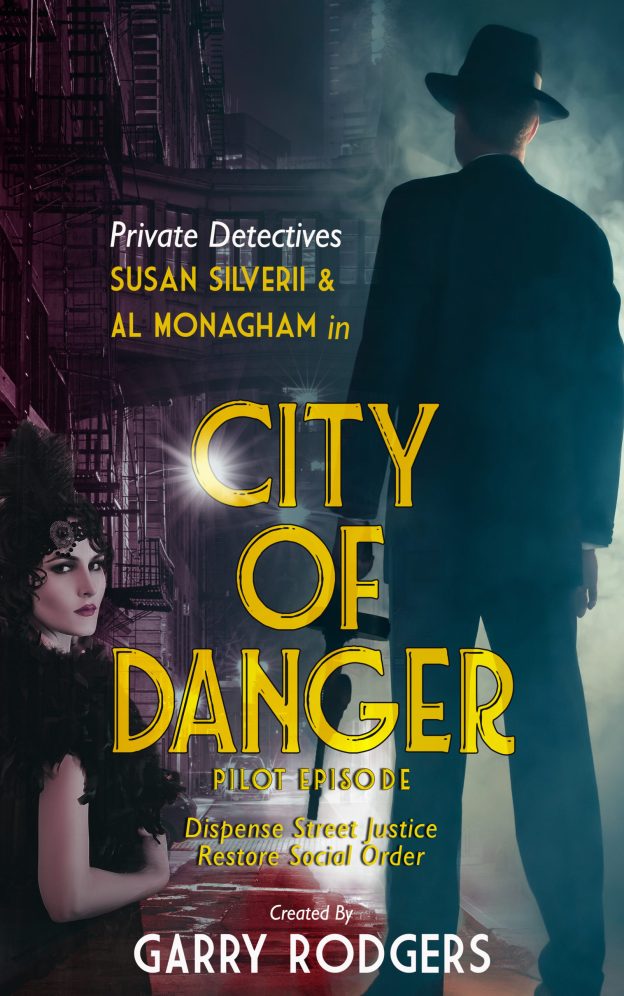
I began with the end in mind. I had artwork produced showing the two main characters against the backdrop of a dark cityscape. I began a dedicated website for City Of Danger that’s a work-in-progress and always will be. And I renovated my writing studio with part of it recreating a 1920s private detective office.

All this was about getting in the zone—the headspace—so I could think like the characters think, talk with the characters, and let the characters tell me their hardboiled stories so I can write them out. Call it method writing, if you will. Or, you can call it plain escapism fun.

The hard work started immediately when I committed—in writing—to creating City Of Danger and making it a success. I realized I knew almost nothing of the hardboiled genre. Why were the greats like Dashiell Hammett, Raymond Chandler, Mickey Spillane, and Elmore Leonard so great? I went back to school and studied them.

Along this past seven month’s journey, I questioned my ability to successfully pull off something so big that I knew so little about. I took a page from Tiger Wood’s playbook where he described his comeback to win the 2019 Masters. Woods completely took apart his game and rebuilt his swing, his putting, his chipping, his mental attitude, and he looked back at everything the historic Masters champions did to win a green jacket.

I did much the same—rebuilt. I rebuilt myself as a writer. I read a lot on writing craft. A lot on the business of writing. A lot on mental attitude. And a lot on who the writing masters of hardboiled detective fiction really were, as well as how their great stories were structurally built and emotionally told for massive audience reception.

I read about screenwriting, and I took screenwriting courses. I studied what hardboiled genre films, like Humphrey Bogart in The Maltese Falcon, made it big and what similar-themed TV shows were a success.

Success. There’s that word again. Success. I have my focus on success with City Of Danger, but there’s one huge obstacle to overcome daily. That’s my tendency to be a bit lazy at times and not do the work. The real work. The writing work that makes a dream like this a success.

Yes, I’m the first to admit. I have a bit of a lazy streak in me. You probably do, too. That’s okay, though, because we humans are naturally programmed to be lazy.

———

Footnote: The pilot episode of City Of Danger is set for release in June 2022. It’ll start as an ebook series, released one episode each month, with intentions to follow with print and audio versions. The netstreaming side is an entirely different venture—currently in the hush-hushed shadows. I’ll keep you posted. 😉

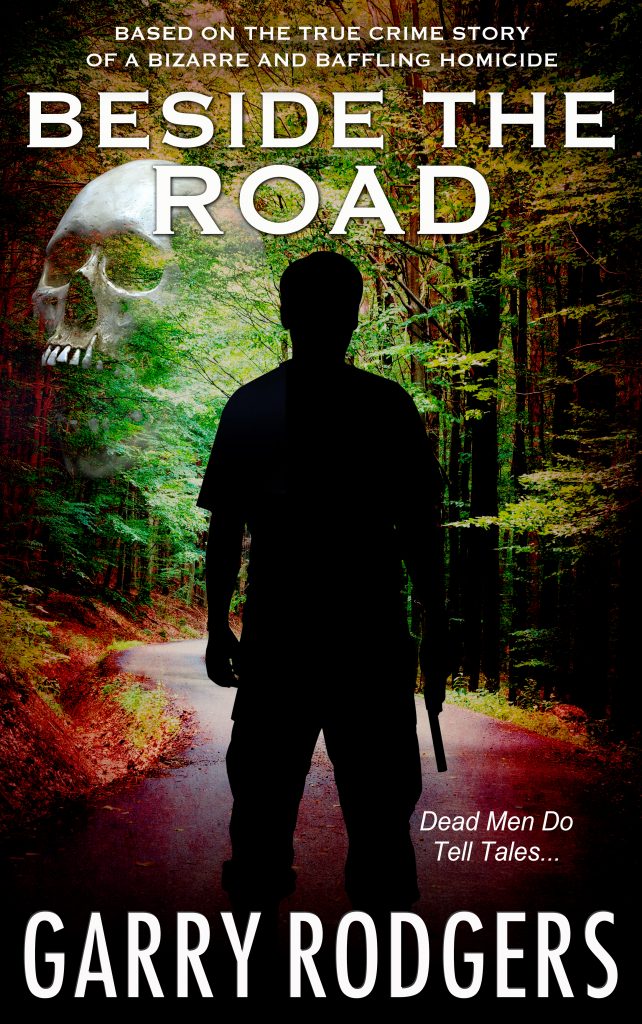
BESIDE THE ROAD — NEW BASED-ON-TRUE-CRIME SERIES BOOK #4

Dead Men Do Tell Tales

New Book Release – June 2020 – by Garry Rodgers, DyingWords Digital & Print Media Canada
Warning! Beside The Road is based on a true crime story. It’s not embellished or abbreviated. Explicit descriptions of the crime scenes, factual dialogue, real forensic procedures, and actual police investigation, interview and interrogation techniques are portrayed. Some names, times and locations have been changed for privacy concerns and commercial purposes. 

Prologue

He lay beside the road. He lay beside the road as dawn’s first streaks smeared the eastern sky and the horizon’s weak rays cast frail shadows through early mist. Songbirds introduced the day—while an owl’s screech signed off the night—as he lay on his back in death’s putrid stench… discarded and dumped down a backwoods bank beside the road.

Light spread through the rural woods where a poorly-paved path cut a meandering trail high above him, shielding his corpse from passing view. The sun unhurriedly appeared. It evaporated the overnight dew that formed in early summer, and the temperature began to rise from a tolerable chill. Predictably, the sun climbed the cloudless sky towards another afternoon’s peak of uncomfortable heat.

By nine, the sun angle was right for direct beams to touch his torso through the picket-fence gaps in roadside trees vertically rising from the steeply-sloped bank. A stand of coastal Douglas fir, native to British Columbia’s central Vancouver Island, guarded his body while a canopy of Western red cedars sheltered his cadaver from the direct sear of mid-day heat. The forest floor was a pad of thorns and ferns and moss and sticks and leaves and sticky needles that slowly deteriorated along with him as part of the universal plan.

Hour by hour, as the world turned and time passed, intermittent sunlight radiated him into a zipper-like pattern. Low luminosity left a softening effect on his exposed skin while solar gain from higher scales scorched him with a dryness that turned his trunk zebra-striped in a way few deceased people present. He had a piano-key pattern and a rarity produced by alternating spectrums of electromagnetism.

Day by day, as the Earth evolved and entropy progressed, he became a unique specter—part putrefaction where light hit him low and part mummification where diffusing blows of afternoon rays parched his flesh.

He was clothed. Partly clothed, that is, with his feet in shoes and his privates in shorts. His singlet, or wife-beater muscle shirt, bunched about his upper chest. His head was bare and so were his arms. His hair was stringy strands of brownish sludge that trapped the decomposing flesh and fats flowing from his scalp. And, his left hand reached as if grasping for help while his right helplessly crooked behind his back.

His face was mostly exposed to the bone and his eyes were gone. His cranium sucked in the sunlight and left him with a bare-skull appearance where his teeth—a distinctly different dentition—gave a half-snarl and a half-sneer similar to a pirate’s ghastly flag.

He had a name. He once had a family, and he once kept some friends. He once had a childhood and he laughed and he played and he schooled and he fooled around like anyone passing through their youth and into their adulthood would. But, his life was extinguished and his consciousness had parted ways with his physical entity—his remains left on the slope beside the road to break down.

Now, he was a medical mess with nature’s creatures consuming his corpse. Insects cycled through their growth stages and carried on the continuous loop of evolution. Forest vermin feasted on their share of his disarticulating decay while circling birds apprehensively watched for their chance at a piece of the putrefied pie.

He had a past. He had a past not to be proud of that caused him to be in his present condition—a dead and discarded human body that lay in silent stink beside the road.

Chapter One — Tuesday, July 9th – 1:10 pm

Leaky Lewis sent me a text. body beside the road. prob foul play. can u attend?
I texted Leaky back. What road, ffs? There’s a thousand roads in this town.
Leaky replied. o sorry. nanaimo lakes rd. approx 6 mi west near gogos sawmill.
I typed. Helpful. Are you there now?
He responded. no. im in council meeting. thats why text and not call.
I returned. So who has the scene?
Leaky pecked. uniforms got it. forensics en route. i called coroner. she’ll meet u.

——
Leaky Lewis was my boss at our Serious Crimes Section. He was junior to me in service, but that was okay. I preferred investigating murders more than stretching budgets and scrambling resources like Leaky had to do. And, this case of the body beside the road stretched and scrambled our budget and resources to the max. We used almost every investigation tool and technique available before we finally solved the most baffling and bizarre homicide file of my long detective career.

Leaky’s name was Jim. Jim Lewis. He’s a great guy, but had a serious incontinence problem with post-urinary drip. That’s why the nickname. Leaky couldn’t venture far from the trough without Depends, but he made sure we had everything needed to do our job.

By “our” I mean the seven-person squad tasked with investigating violent persons offenses that happened around the Nanaimo area. We’re located on central Vancouver Island in British Columbia right across from the craziness and congestion of the City of Vancouver. Nanaimo has Canada’s mildest year-round weather. I’d been here on the southwest coast for years and had hit my best-before date. During that time, I’d seen a lot of serious crimes because Nanaimo had an extraordinarily high homicide rate.

Leaky looked after our entire plainclothes unit. Besides the Serious Crimes bunch, he supervised the Commercial Crime unit, Sex Offenses, Forensics, Drug Squad, and one poor prick plagued with frauds and bad plastic. Leaky also oversaw the secret squirrels in our intelligence branch and two notoriously bad-behaved boys on the Street Crew.

——

I pulled up to the crime scene on Nanaimo Lakes Road in my unmarked Explorer. Like Leaky texted, it was just over six miles west of the city limits near a small sawmill run by industrious Slavic immigrants called the Gogo family. There were two police cruisers parked on the right-hand shoulder, the north side, with their red and blues flashing. Two other vehicles sat along the shoulder. One was our forensic unit’s mobile shop. The other belonged to Global TV’s roaming cameraman.

A uniformed cop with a paddle-board stop sign directed traffic around the entourage. She pointed to the left lane and gave me a “get-going” motion. I didn’t recognize her. Likely a new recruit. I hit my grille lights and she startled. Then, she smiled and pointed to the steep bank beside the road.

I parked, got out, and walked toward the marked car at the front of the pack. Already I could smell it. It was that unforgettable stench—somewhere between reeking ammonia in ripe rotten eggs and the putrid aroma of deeply-decayed roadkill. It was the smell one never mistakes.

A senior officer guarded the scene. He’d been with the patrol division for a long time. The patrolman introduced me to the stop-sign gal. I was right, she was a brand-new hire.

“What’s happening?” I was matter-of-fact.

“Body down the bank.” The old harness bull thumbed to the thick stand of Douglas fir trees rooted to the slope and standing tall. Western red cedars loomed overhead. “Been there a while from the look and smell.”

“What do you think?” I stood at the edge. It was loose gravel beside the road’s crumbling pavement. I did not want to slip and take a tumble.

“At first I thought it was a deer.” He scrunched his nose. I could see the young officer kept her distance. “That’s what the guy who reported it thought, too. He was riding his bike up the grade and caught a whiff. So, he stopped and looked over and saw his dead deer wore running shoes.”

“Witness guy still around?” I looked about. The only civilian seemed to be the TV man rolling film.

“No.” The patrolman shook his head. “I got my cadet to take his statement. Gotta start somewhere, right? Then we sent him on his way.”

“Great, thanks.” I paused to look around and take in the scene.

It was bright sunshine and getting uncomfortably warm. The early afternoon sun was south-southwest and high enough to shine over the bank and flood its light on the slope. The site was at the leading edge of a tight left-hand bend, and the road was sharply inclined toward the west. It led to a double-S curve with a cautionary slow advisory sign—not the sort of place to safely pull off.

The traffic was light. A loaded logging truck approached and followed the young officer’s direction. It chugged up the grade and disappeared through the curve. A smaller silver SUV arrived. Instead of bypassing as the officer indicated, the SUV came to a stop behind my Explorer. I saw the new cop frown as the driver put it in park and shut off the engine.

I knew who it was. The door opened and a silver-haired lady with a silver clipboard matching her mane got out. Honey Phelps, our coroner, walked toward me.

“Hi, Honey. Imagine meeting you here.” I smiled. Honey. I love the name. It perfectly suited her. She’d been with the Coroners Service for years, and I’d worked with her at countless death scenes. She was always the consummate professional but with a black humor tinge.

“Is that you?’ Honey whiffed the air like a bear. “Or is that my client?”

“Probably a bit of both.” I chuckled. “I haven’t had a look yet. Waited for you to get here.”

“Looks like Forensics beat me.” She nodded toward the big rig that looked somewhere between a SWAT team’s truck and an indie rock band’s Winnebago.

“Yeah. I think they’re inside suiting up.” I motioned toward the Forensic Identification Section vehicle. “Let’s go have a chat with them.”

Honey looked at my Explorer and then at me. “You alone? No Harry today?”

I grinned. “Nope. I’m batching it. She’s tied up in a court case.” I referred to my usual partner, Sheryl Henderson who we called ‘Harry’ after the Bigfoot in the movie Harry and the Hendersons. Sheryl was a large lady with large hair and an even larger personality.

Honey and I walked up to the Forensics vehicle just as Sergeant Cheryl Hunter stepped down. Her understudy, Matt Halfyard, stayed inside. We called him Eighteen Inches.

Cheryl was dressed in her bunny suit. It’s the white Tyvek coveralls that CSI people constantly wear. I’m sure she slept in that thing.

“What do you think?” I asked Cheryl much the same thing I’d asked the senior patrolman. It was usually a pretty good opener.

“Not sure yet.” Cheryl had her digital Canon ready. Matt was loading a video camera. The first thing Forensics always do is film the scene before they enter it. That step was non-negotiable, and the guarding officers made sure no one went near the body before Forensics began their painstaking thorough task of recording the overall scene. Examining the body beside the road would follow.

“I’m not sure what to think.” Cheryl was always careful with opinions and cautious with conclusions. She was like all forensic examiners. They work with facts. Not fables. It was the nature of the beast.

“I haven’t been down to the body yet.” Cheryl looked to her left and over the bank. “It’s about twenty-five feet downslope and looks like it’s hung up against tree trunks. I have no idea if he… it looks like a he from the size and style of running shoes… that’s all I can really make out from here… if he was hit by a vehicle and sent flying over the bank or if he was driven out here and dumped.”

I looked around. The TV camera guy looked back through his viewfinder. “Doesn’t look like a suicide type of scene.”

Cheryl and Honey agreed. We’d all seen a lot of suicide scenes and this one didn’t fit. My gut feeling said dumpsite.

“Let’s just take this step-by-step till we see what we’ve got.” Cheryl was the voice of reason. “One thing’s for sure. This isn’t a recent scene. From what I can see above the shoes is bare-bones with putrefied flesh partly attached.”

“Been here a while, then.” Honey observed.

“Yeah.” Cheryl looked up at the sun. “But it doesn’t take long in this weather.”

“We’ll figure it out.” Honey smiled. “Let’s have a better look at who’s down there beside the road.”

*   *   *

Beside The Road — Book 4 in the Based-On-True-Crime Series by Garry Rodgers is just released  — June 2020 — and now downloadable from these leading EBook retailers: