Tag Archives: Universe

COMPOUNDING, ENTROPY, AND THE FIVE FUNDAMENTALS THEY GOVERN

There are two invisible principles quietly overseeing the universe. They’re not political. They’re not mystical. And they don’t care about your beliefs, your ambitions, or your social status. These realities are compounding and entropy. One builds. The other breaks.
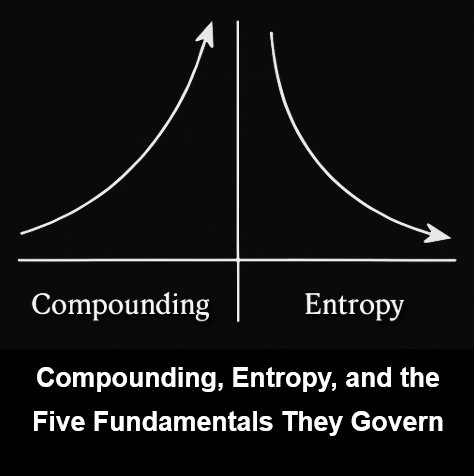
Together, compounding and entropy form the dual engine and brake system for all of creation—from stars to cells, and from civilizations to your own body, thoughts, and projects. They govern five fundamentals of the universe—energy, matter, information, consciousness, and time.

If you understand the principles of compounding and entropy—and more importantly, if you learn how to work with them—you can harness the most powerful truths of nature. If you ignore them, they’ll work on you anyway. The only difference? You won’t know why things are slowly getting better or worse.

Before we explore how compounding and entropy rule the five pillars of existence—energy, matter, information, consciousness, and time—we need to understand what these dual and dominant drivers truly are.

What Is Compounding?

Compounding is the process by which a small effect, action, or input—when repeated over time—builds into an increasingly larger impact. It’s the engine of exponential growth born from repetition, consistency, and feedback.

Most people encounter compounding first in the financial world—compound interest. But its scope is far greater. Compounding affects learning, skill development, health, systems, habits, and even natural selection.

In mathematical terms, it’s described like this:

FV = PV × (1 + r/n)^(nt)
Where:

  • FV = future value
  • PV = initial value
  • r = rate of growth
  • n = compounding intervals per year
  • t = time in years

Time is the essential multiplier. Without it, compounding cannot operate.

Compounding is the most powerful force in the universe.” ~Albert Einstein

But it’s not just about money. Compounding applies to many things we do. Here are some simple examples:

  • Read a book daily—your knowledge compounds.
  • Practice gratitude—your emotional clarity compounds.
  • Invest in relationships—your connection compounds.
  • Do the work—your skills compound.

And just like investments, the sooner you start, the more powerful the outcome. Time doesn’t just allow compounding—it supercharges it.

What Is Entropy?

Entropy is the principle that all systems naturally progress from order to disorder. In physics, it’s formalized as the Second Law of Thermodynamics—in any energy exchange, some usable energy is always lost, increasing the system’s entropy.

Entropy is the measure of randomness, uncertainty, or decay in any system. You don’t need to study physics to understand entropy. Just think that:

  • Metal rusts
  • Food spoils
  • Memories fade
  • Structures collapse

Entropy doesn’t need your permission. It happens simply by the passage of time. That’s what makes entropy so dangerous—it operates silently unless resisted.
Mathematically:
ΔS = ΔQ / T
Where:

  • ΔS = change in entropy
  • ΔQ = heat energy added
  • T = temperature

In the end, entropy always wins. (But you get to decide how much value you create before it does.)” ~Stephen King

While compounding is the creative force of the cosmos, entropy is the tax. Everything that grows must be maintained—or it’ll decline. Everything built will eventually decay—unless preserved and renewed.

The Five Fundamentals of Existence

At the root of reality are five interdependent fundamentals. Energy. Matter. Information. Consciousness. Time.

Every system—biological, mechanical, societal, or personal—is made from these ingredients. And every one of them is shaped by compounding and entropy. Let’s examine each.
Energy

Energy is the currency of the cosmos. Everything that moves, grows, reacts, or changes involves energy. And everything energetic is governed by compounding and entropy,

Compounding and energy: When energy is stored, reused, and cycled efficiently, it compounds. Batteries. Ecosystems. Engines. Fusion reactors. Feedback loops in technology and biology amplify small inputs into large-scale output over time.

Entropy and energy: But every energy transfer loses some energy to heat, friction, or inefficiency. Entropy ensures that no machine is perfect, no process is lossless. Even the sun is slowly burning out.

Time guarantees that energy becomes more diffuse, less useful—unless structured intentionally.

You can’t win, you can’t break even, and you can’t get out of the game.” ~C.P. Snow

Matter

Matter is energy in form—atoms, molecules, tissues, trees, buildings, planets.

Compounding and matter: Matter compounds through layering and construction—atoms form molecules, molecules form cells, cells form organs, and so on. Sediments become cliffs. DNA mutations evolve into species. Structures form through persistence over time.

Entropy and matter: But matter wears down. Rocks weather. Steel corrodes. Concrete crumbles. Bones age. The longer time passes, the more matter must fight to maintain form.

The compounding of structure is a fight against the entropy of disintegration.

Dust thou art, and unto dust shalt thou return.” ~Genesis 3:19

Information

Information is the arrangement of energy and matter into meaningful patterns—genetic code, books, software, knowledge, memory.

Compounding and information: The written word. The scientific method. Oral traditions. Cloud storage. When preserved and transmitted effectively, information compounds across generations. Civilization advances as it builds on itself.

Entropy and information: But data corrupts. Paper disintegrates. Memories fade. Knowledge gets distorted. Noise creeps in.

Without effort, the information age becomes an age of confusion.

Civilization advances by extending the number of important operations we can perform without thinking about them.” ~Alfred North Whitehead
Consciousness

Consciousness is the most personal of all fundamentals—the internal awareness that makes life felt.

Compounding and consciousness: Thoughts become beliefs. Habits become character. Self-awareness becomes wisdom. Every time you reflect, learn, or train your attention, your mind compounds its clarity. Meditation. Reading. Honest conversation. These are compounding tools.

Entropy and consciousness: But left unattended, the mind deteriorates. Distractibility. Digital addiction. Delusion. Cognitive entropy is real—from dementia to depression to propaganda. When your mind is not strengthened, it decays.

This is where compounding becomes existential.

The unexamined life is not worth living.” ~Socrates

Time

Time isn’t just a background condition. It’s the fifth fundamental, and perhaps the most profound. Time is the substrate through which compounding and entropy play out.

Without time, there’s no compounding. Without time, entropy has no direction. Time is the governing dimension in which all change—growth or decay—unfolds.

Time doesn’t care how you use it. But how you use time determines everything. Time is what gives compounding its force and entropy its inevitability. Time is both the fire that consumes and the fuel that ignites.
The Unified Pattern of Reality

When you view the universe through these five fundamentals, a simple pattern emerges:

Systems that work:
→ Channel energy efficiently
→ Build matter into resilient forms
→ Preserve and transmit information
→ Expand consciousness
→ Use time intentionally

Systems that fail:
→ Leak energy
→ Decay in form
→ Lose coherence
→ Fall into confusion
→ Waste time

The choice is constant. In your health. Your thoughts. Your relationships. Your business. Your legacy.

You’re either compounding or decaying. There’s no standing still.

What Will You Leave Behind?

Let’s bring it all home. These aren’t just abstract laws of physics or systems theory.
They’re the very forces shaping your life—right now.

  • Compounding is your engine.
  • Entropy is your cost.
  • Time is your field of play.

Every decision, every action, every neglected task, every focused effort—it all moves you in one direction or the other. There is no neutral.

You don’t have to collapse your life. Just neglect it.
You don’t have to destroy your mind. Just let it coast.
You don’t have to fail. Just fail to act.

Or…

You can build.
You can focus.
You can rise.

In the end, everything you create is shaped by these five fundamentals and these two principles. And what you choose to do with them—day after day—becomes your legacy.

So, ask yourself, “What will you build before time and entropy reclaim it?”
Powered by a Centaur System ©

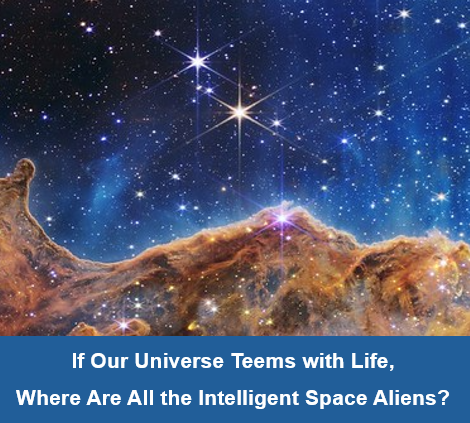
IF OUR UNIVERSE TEEMS WITH LIFE, WHERE ARE ALL THE INTELLIGENT SPACE ALIENS?

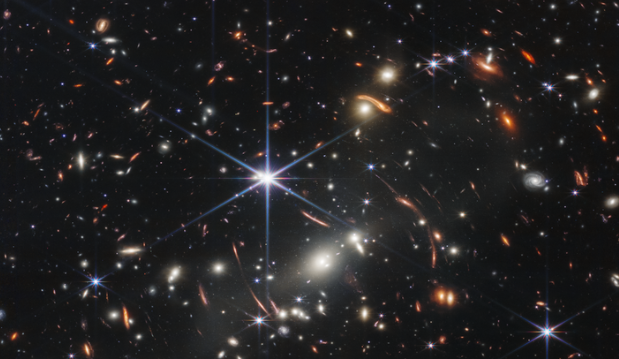
Our universe is mind-boggingly vast. The best estimates claim it’s about 92 billion light-years wide and around 13.82 billion years old. Cosmologists say there are trillions of galaxies holding quadrillions of stars, never mind quintillions of planets interwoven throughout the sky.

That’s a sextillion of combinations—exceeded only by the Avogadro’s number (6.02214076 × 10²³) of mistakes I’ve made during 68 revolutions around the sun. Seriously, though, principles like the Fermi Paradox and the Drake Equation assure us that biological life exists elsewhere in the universe, but there may not be much “intelligent” life out there. That conclusion is supported by the space-breaking astrobiology work of Professor Sara Seager with her thought-leading, biosignature model of hunting out exoplanets containing extraterrestrial life.

Fermi? Drake? Seager? Who are these guys? What do they know about extraterrestrial bio-lifeforms in relation to your Earthly place in the universe? And where are they—these intelligent space aliens—that astrophysical calculators say have to exist?

Maybe it depends on your definition of life and intelligence. We’ll get to that in a moment. First, let’s look at the history of Search for Extra Terrestrial Intelligence (SETI) programs and two recorded, unexplained, electromagnetic contacts that just may have been sent by ET.

Starting the Search for Extra Terrestrial Intelligence

SETI began more as an amusement than a serious scientific venture. In August 1924, a natural celestial event coincided with an advancement in human technology. Mars was in its closest orbit with Earth—a condition called an opposition—and it attracted a lot of astronomical interest, even with amateurs now equipped with rather sophisticated telescopes.

Radio transmitters and receivers had enormously increased in output power and input sensitivity. David Peck Todd, an American astronomer, had been experimenting with the new SE950 radio which was invented at the end of World War I. It never saw active service and was now surplus to the civilian market. Todd and Charles Francis Jenkins, a photographer and inventor, teamed up to point the radio at Mars and record if anything returned.

This experiment interested the U.S. Naval Observatory in Washington that offered a Navy observation dirigible (airship) to take the SE950 antenna two miles into the sky so it would have less impact from terrestrial interference. They pointed the antenna at Mars, and what they found shocked the world.

The radio’s receiver was connected to a graph which recorded a repetitive series of dots and dashes somewhat like Morse Code. When printed on paper, the code became a human face. The signal from Mars suddenly stopped and was never heard again.

The SE950 Radio

Sensing human interference or even a prank, Todd and Jenkins had their experiment reviewed by Nikola Tesla and Guglielmo Marconi. These two pioneers of electricity and radio dismissed the human element, verified the signal as real, but suggested it didn’t necessarily originate on Mars. They surmised the message possibly came from the same region of the sky but much further out.

The “Mars Face” ignited a century-long search for alien intelligence. It also created the overall space race which resulted in Sputnik, Apollo Eleven, and the poor saps currently marooned on the International Space Station caused by a broken Boeing rocket. It also funded exponential generations of publicly and privately funded SETI projects.

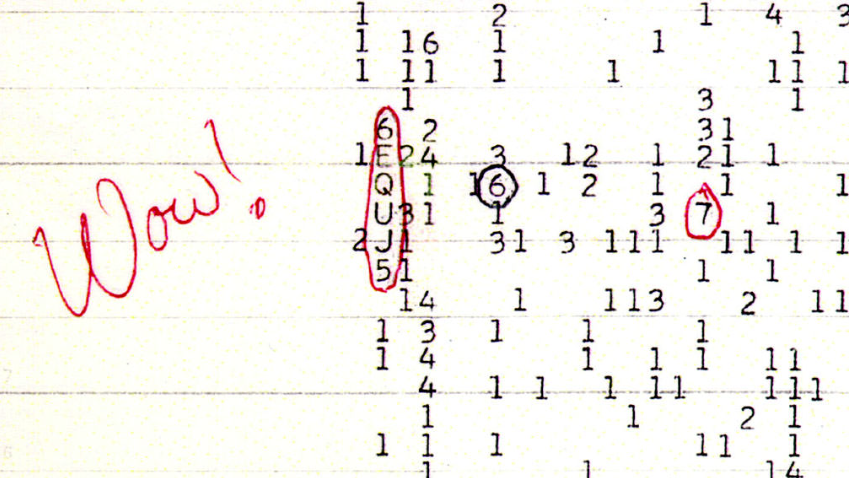
One venture, the Ohio State SETI Big Ear program, paid off on August 15, 1977. Jerry Ehman, a project volunteer, was shifting through signal records and spotted an abnormality that fit perfectly with a technological output—not something that could possibly originate in nature.

The signal arrived in the frequency of hydrogen atoms which is the common denominator researchers monitored. The reason being is that hydrogen might be the universal frequency used among advanced civilizations for interstellar communication. The signal’s imprint was 6EQUJ5 which means SFA to you and me, but to a trained eye like Ehman’s it was so outstanding that he wrote “WOW!” beside it in bold red letters.

The WOW! signal needs a bit of explaining to understand its relevancy. In SETI-speak, the signal started out at an intensity of 6—already an outlier on the page—climbed to E, then to Q, peaked at U—the highest power ever recorded by any SETI search— then decreased in equilibrium through J and signed off at 5.

This signal invigorated the SETI industry and still drives it today. Most researchers and learned scientists feel WOW! remains the strongest candidate for an intentional alien transmition. Alas, the signal was never recorded again but has no reasonable earthly or natural explanation.

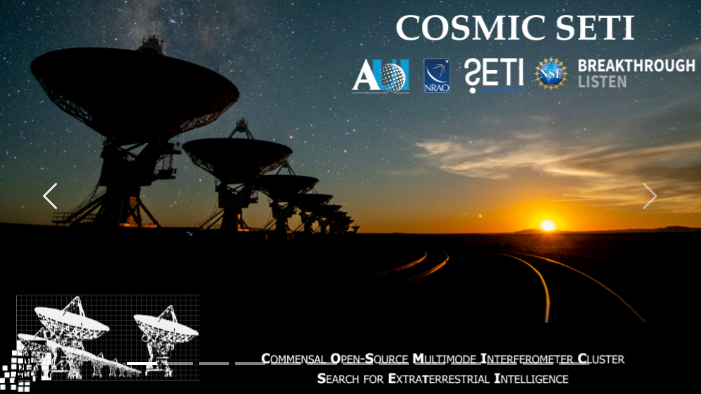
The SETI experiment from 1960 onward is so comprehensive that entire books have been written documenting the process. And the fascination hasn’t waned despite hiccups in funding. Today, in 2024, there is a hyperdrive movement in SETI experiments with an alliance between the Breakthrough Listen and National Radio Astronomy Observatory (NRAO) at the Very Large Array in New Mexico.

The new venture’s name is COSMIC which stands for Commensal Open-Source Multicode Interferometer Cluster. (Someone really had to work to come up with that acronym.) COSMIC is AI-powered by supercomputers and will be able to process billions of intercepts in real-time, not like in 1977 when the WOW! signal surfaced days after transmission/reception.

The Drake Equation

1960 was a pivotal year for SETI expansion. David Drake was a young astronomer attached to Project OZMA at the NRAO Howard Tatel telescope in Green Bank, West Virginia. Drake was a brilliant man who looked for simple solutions to complex problems. He was invited to present at the National Academy of Sciences about the current state of SETI exploration.

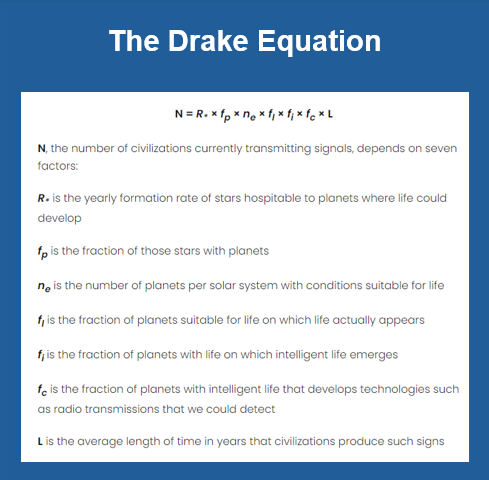
Drake knew he was going to get the “What’s the chances” question, so he sat down and tried to figure it out mathematically. The answer being an estimate of the number of active, communicative, extraterrestrial civilizations in our Milky Way galaxy. (Note: All SETI explorations focus solely on the Milky Way, not distant galaxies.)

David Drake considered factors such as the rate of star formation, the fraction of stars that could have planets, the number of planets that could support Earth-like life, the fraction that develop intelligent life, the number of societies that have reached technological advancement to communicate interstellarly, and the number that have survive to be currently active. His equation gave the answer of 23. See screenshot below:

The Drake Equation is still the gold standard that drives SETI credibility. It’s a formula taught at the beginning of every Astronomy 101 course and is considered the second most famous scientific equation besides E=MC2.

The Fermi Paradox

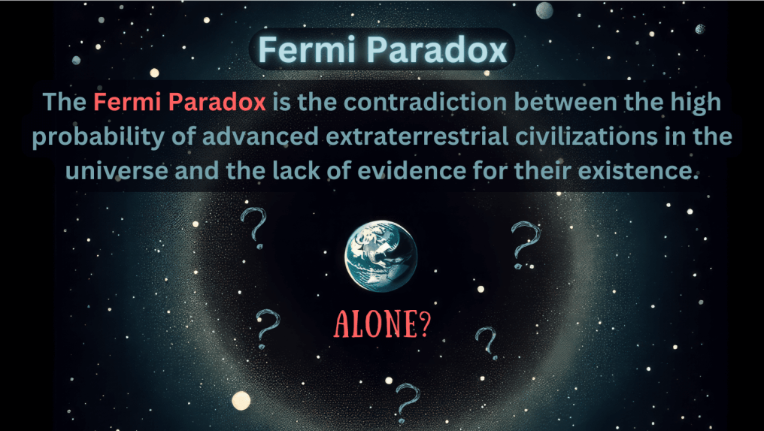
So, if David Drake is right, and there are 23 Milky Way civilizations capable of communicating with us, why don’t we hear from them? Where are all the intelligent space aliens? This question is the Fermi Paradox.

In 1950, Italian physicist Enrico Fermi was working on an offshoot of the Manhattan Project where they were building a civilian nuclear reactor. He was having lunch with colleagues when he suddenly blurted out, “Where are they? Where is everybody?”

His associates looked at Fermi as if he had two heads until he qualified with, “I mean the aliens. If the universe is teeming with life and there are intelligent beings out there, where are they? Why haven’t we seen or heard evidence of them?”

Fermi had a good point. If Drake is correct, and there are 23 societies outside of Earth, why haven’t we seen or heard evidence of them? Set aside the two strong candidates from 1924 and 1977. It’s a paradox. If they exist, why don’t they show themselves as we here on Earth so desperately do?

In SETI-speak, the Fermi Paradox is “The Great Silence”. The paradox expands the contradiction with possible explanations:

  • The Vastness of the Universe minimizes the chances of contact.
  • The Age of the Universe limits civilization lifespan to coexist at the same time.
  • The Rare Earth Hypothesis says that intelligent life is exceedingly rare.
  • The Great Filter says that advanced societies are filtered out by natural forces.
  • Technological Self-Destruction eliminates complex civilizations.
  • Intentional Invisibility says these alien intelligences don’t want outside contact.
  • The Zoo Hypothesis posits that aliens are very much aware of us and watch.
  • The Simulation Hypothesis questions if we are a programmed simulation.
  • The Dark Forest Hypothesis says they’re there; we just can’t see them.
  • The North Sentinel Language Hypothesis claims we’re unable to understand them.

Stephen Webb wrote an interesting book titled If the Universe Is Teeming with Aliens … WHERE IS EVERYBODY? Seventy-Five Solutions to the Fermi Paradox and the Problem of Extraterrestrial Life. Some of Webb’s suggestions are pretty far out, but it’s worth the read if you really want to think out the Fermi Paradox.

The Sara Seager Answer

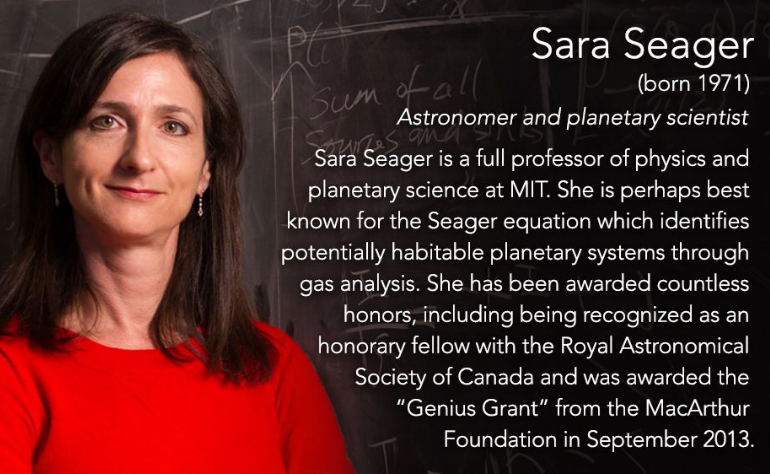
Someone who really has thought out the Drake Equation and the Fermi Paradox is Professor Sara Seager. She’s the uber-bright, planet-hunting, astrobiologist at the Massachusetts Institute of Technology (MIT) where she uses the new James Webb telescope to identify exoplanets with Earth-like conditions. So far, Seager has found over 5,000 probables in pretty much every place she’s looked.

Professor Seager is convinced the universe is teeming with life—biological life—not necessarily intelligent life capable of signaling. She suggests the SETI folks are looking at this wrong. Rather than randomly look for radio technosignatures, searches should be zooming in on biosignatures to find out first if life is there and then scan for intelligent emissions.

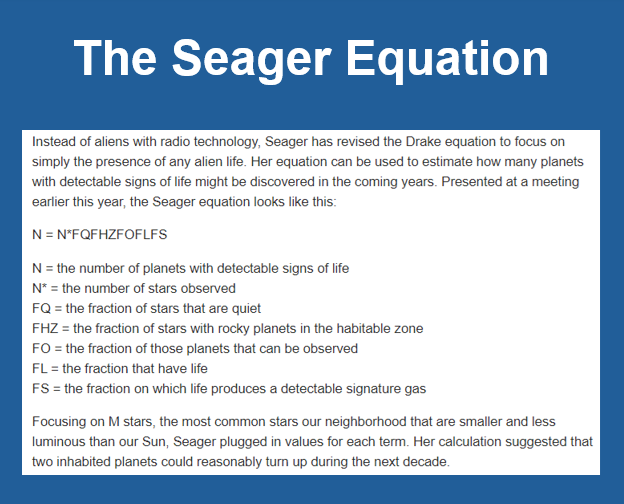
Seager and her team look for the chemical signs of oxygen, hydrogen, and methane coming from exoplanets. These are the primary indicators of carbon-based life, and they seem to be exceedingly common in the Goldilocks Zone which is the right distance from the host star to allow liquid water. Seager’s approach is to first find the life, then listen to hear if it has anything to say.

Sara Seager has rewritten the Drake Equation for a more modern approach. Her conservative calculation is that we’ll find at least two inhabited planets within the next ten years. “It’s only a matter of when,” Seager says. “Not if.”

Then it’s a matter of asking, “If our universe teems with life, where are all the intelligent space aliens?”

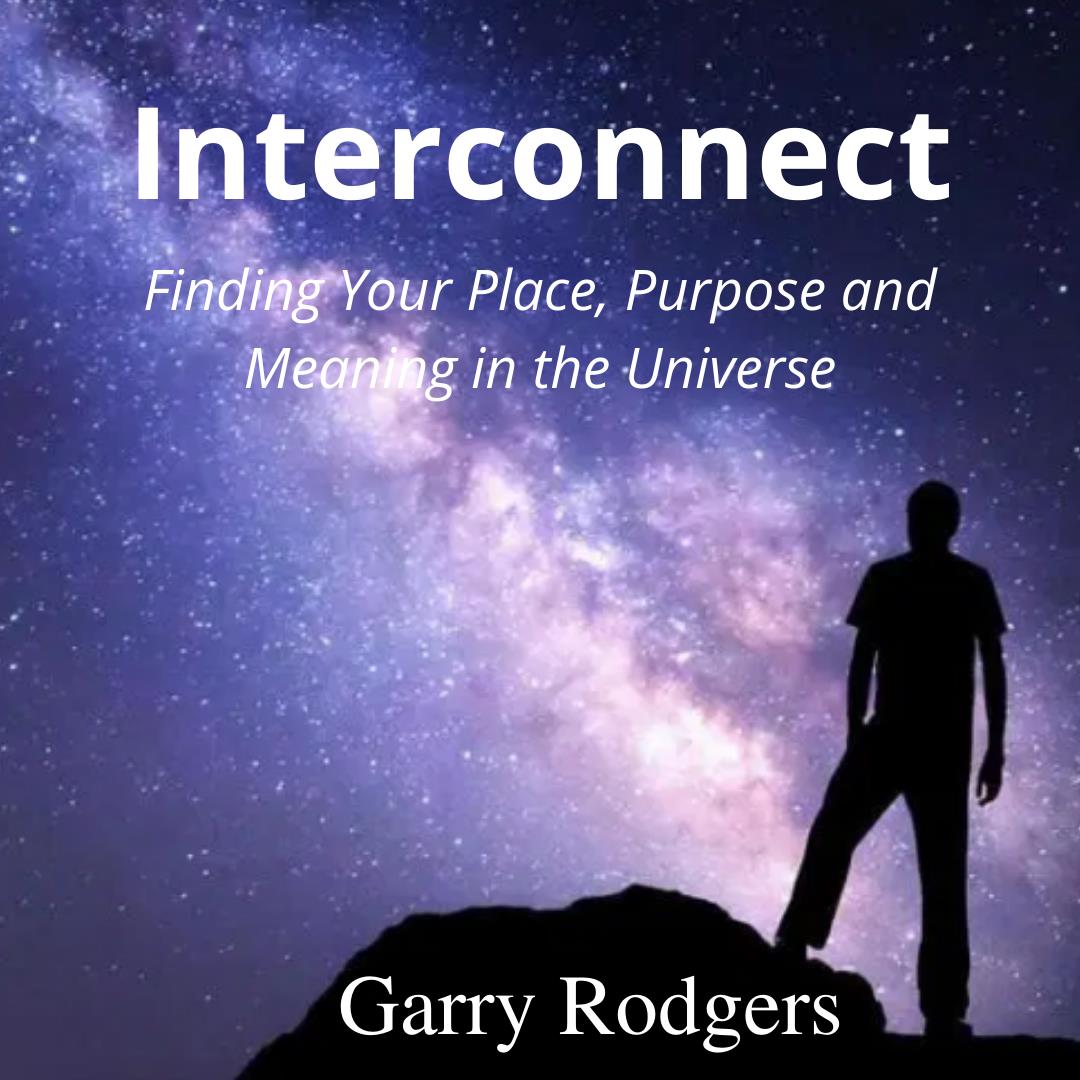
INTERCONNECT — FINDING YOUR PLACE, PURPOSE AND MEANING IN THE UNIVERSE

This piece is downloadable in full-length PDF format by clicking the blue bar button at the screen’s top or as a Kindle eBook and PDF through links at the end.

Once upon a time, a youth lay on their back and gazed in awe at the starry sky. The moon waned as a dim crescent—God’s Thumbnail, some call it—which let the universal brilliance of consciousness resonate in the youth’s eyes. Billions of fireballs blazed above, and countless more stars couldn’t be seen. The cosmos had cracked its coat. Like a galactic exhibitionist teasing eternal entropy, the universe flashed a perfect picture of order defying chaos and displayed an unbashful interconnection with all its occupants, including the star-gazing youth.

If you remember… that youth was you. Regardless if your years are still young, you’ve reached middle-age or are now advanced in time, the wonder of universal questions remains etched in your mind. Who are you? Where did you come from? Where are you going? And what is your interconnected place, purpose and meaning in the universe?

These are timeless queries people like you’ve asked since humans first consciously observed the heavenly heights. Long ago, your ancestors used their emerging awareness to question universal curiosities. It’s a natural thing for humankind to look for simple answers to straightforward questions and, no doubt, you’ve queried them many times during your earthly existence without receiving any clear response.

For centuries, sages and scientists pondered the meaning of existence within the universe. They’ve debated scientific theories and proposed philosophical solutions to deep puzzles boldly presented in the macro and micro worlds. You’ll find narrow common ground on who’s right and who’s wrong which leaves you to wonder what nature’s realities truly are.

Albert Einstein equated that science without philosophy was lame and philosophy without science was blind. That great scientific sage also spent the second half of his life looking for the Grand Unified Theory (GUT) that interconnects everything in the universe. That includes your place, purpose and meaning.

As wise and astute as Einstein was, he didn’t complete his mission of tying the universe into a nicely packaged bow. It’s not that he didn’t believe all parts of the universe were intrinsically interconnected. Einstein knew in his gut that all physical laws and natural processes reported to one central command. That, ultimately, is the universal dominance of consciousness that allowed your creation and will one day destroy you through eternal entropy.

This isn’t a religious treatise you’re reading. No, far from it. It’s simply one person’s later-in-life reflection on three interconnected and universal curiosities. What’s your place? What’s your purpose? And, what’s the meaning in your life?

To find sensible suggestions, it’s necessary to dissect what’s learned (so far) of universal properties and what’s known about you as a human. You’re a conscious being housed in a physical vessel and controlled by universal principles. You had no choice in how you came to be here, but you certainly have choices now. Those include placing yourself in a safe and prosperous environment, developing a productive purpose and enjoying a rewarding meaning from the limited time you’re granted to be alive.

At the end of this discourse you’ll find a conclusion about your place, purpose and meaning in the universe. It might be one person’s opinion, but it’s based on extensive research and over six decades of personal experience. However, for the conclusion to make sense you need to take a little tour through the universal truths.

Ahead are a layman’s look at the origin of the universe, classical and quantum physics, chemistry, biology, anatomy, neuroscience and the life-changing principle of entropy. It’s also a dive into what’s not known about the biggest scientific and philosophical mystery of all—how consciousness manifests through the human brain and how entropy tries to kill it. Now, if you’re ready to interconnect with the universe, here’s what your place, purpose and meaning truly are.

The universe is enormous. It’s absolutely huge. There aren’t proper adjectives in the English language to describe just how big the universe really is. Perhaps the right word is astronomical which means exceeding great or enormous.

People often use the word “cosmos” interchangeably with “universe”. That’s not correct. Cosmos refers to the visible world extending beyond Earth and outward to the heavens. The universe incorporates all that’s in the macroscopic or outward realm, but the term also drills down and incorporates everything within the micro-regions of molecules, atoms and then into sub-atomic realities where quantum stuff gets seriously strange.

In Chemistry, Biology and Physics 101, you learned you’re created of energized matter built of complex material formed by atomic and molecular chains. So is every set-piece in the micro and macro universe. All visible matter contains material made of atomic structures that strictly obey standard operating procedures set down during the universe’s birth.

How that happened is explained by a few different theories. Religious accounts, depending on the flavor, hold that an omniscient supernatural power created the universe at will and for a vain purpose. Current scientific accounts dismiss all supernatural contribution and exchange it with a series of natural orders called the laws of physics and non-tangible processes of the universe.

Most scientists don’t attach an intentional purpose to the universe. They leave that to philosophers who tend to argue with abstract thoughts that aren’t backed by hard evidence. Then, there are those who think the universe is simply a grand thought.

No matter who’s right and who’s wrong, there are a few facts you can personally bank on. One is that you exist in a physical form and use consciousness to be self-aware. That includes knowing you have a place in the universe, a purpose for being here and there’s a meaning to your life.

As said, this isn’t a religious paper. Religion can be a matter of faith but, then, so can science. The difference is that science relies on direct observation, proven experiments and the ability to replicate results. Science also depends on building hypothesizes, turning them into theories and then certifying them as facts.

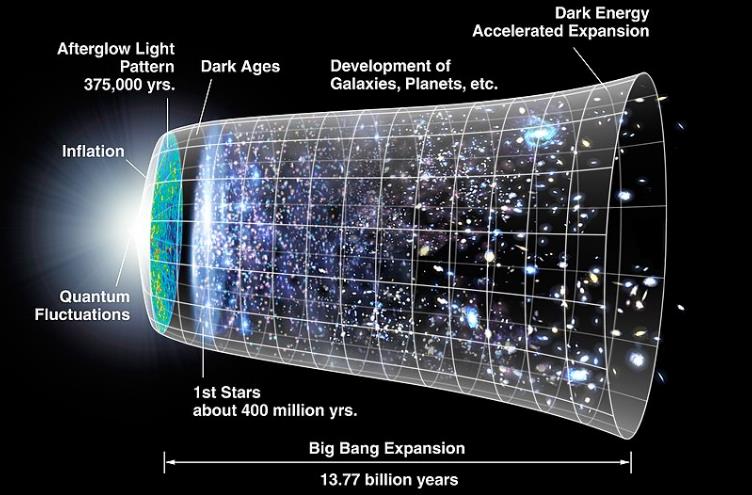
No particular physicist claims sole authorship of the Big Bang Theory. Currently, the Big Bang Theory is the leading account for the universe’s origin, and it’s generally accepted throughout the scientific community as being the best explanation—so far—of where your structural matter originated. It goes something like this.

In the early 1900s, an astronomer named Edwin Hubble (the space telescope guy) was busy measuring galactic light and came upon his profound realization that the observable universe was expanding. Not only was the universe growing, Hubble exclaimed, but it was also accelerating its expansion rate. That led to a logical conclusion that the universe must have started in a singular place and at a specific time.

Some of science’s brightest folks worked on mathematical extrapolations and built the theory postulating that all matter and energy in today’s observable universe must have been once compressed in a singularity that exploded. That big bang started the time clock, created space, released energy and formed matter. It’s been growing ever since and, along the journey, you were created as an interconnected part.

This sounds like a pretty big undertaking. It also sounds pretty far out to think everything in the known universe was stuck in the space smaller than an atom where it was exceedingly hot and heavy. Well, guys like Einstein and Steven Hawking accepted the Big Bang Theory as fact, although Einstein famously quipped, “God knows where that came from.”

Without any other scientific direction to go on, what you see in the universe got started from a single point and is enormously here in its present form and place. The best-educated guesses place the universe’s age at about 13.77 billion years, give or take a few hundred thousand. This rough age-estimate comes from measuring Cepheid Variable Pulsating Stars (CVPS) with the Hubble Space Telescope which has proven to be quite useful once NASA got its foggy lens fixed.

The size of the observable macro, or outer, universe is impressive. Current measurements find the most distant visible electromagnetic radiation to be 46 billion light-years from Earth. That’s in every direction where the radio telescopes pick up the Cosmic Background Radiation (CBR) signal. Astronomers believe the CBR is a leftover mess occurring about 300,000 years after the Big Bang. If the true universal distance radius is 46 billion light-years, then the entire trip across occupied space is around 92 billion light-years in diameter.

That is a massive distance. It’s gigantic, humongous and colossal. Light, which is electromagnetic radiation, travels at 186,000 miles per second or 300,000 kilometers per second. That means that in one year a light particle can travel 5.88 trillion miles or 9.5 trillion kilometers. Multiply that by 92 billion and you’ll see that it’s a long, long way across the visible universe.

That’s just the macro universe that astronomers can see with current technology. Most scientists agree they’ve only explored something like four to five percent of the visible universe, and there’s far more out there than known today. This is an ongoing search with exciting discoveries emerging all the time.

To get a feel of where your physical place is in the macro universe is, you’re on the surface of a planet called Earth. Your home base is 93 million miles or 150 million kilometers from the sun which is a common-type star. It takes eight minutes for light to leave the sun and meet your eyes. To put this distance in perspective, a light particle can circle the Earth seven and a half times in one second.

The solar system extends a long way out. Pluto, which has returned its classification into the planet family, is seven hours distant from the sun via light speed. Going further, your planetary arrangement orbiting the sun is in one part of your home galaxy called the Milky Way. The sun is approximately 30,000 light-years from the big black hole at the Milky Way’s center, and you’re actually closer to the nearest independent galaxy than you are to the Milky Way’s core.

No one knows how many stars there are in the Milky Way. It’s a countless number. The current consensus is there may be a trillion stars in your home galaxy. Some astronomers feel there could be a trillion or more galaxies in the visible universe.

The Milky Way is part of a galactic bunch called the Local Group. These 54 assorted-shape star arrangements form part of a larger galactic collection known as the Virgo Supercluster. This is a big, big crowd but nowhere near what’s really going on out there.

Recent astronomical observations confirmed that beyond the Virgo Supercluster lies a monster called “Laniakea” which is Hawaiian for “Immeasurable Heaven”. This stupendous structure sits in a part of space called the “Zone of Avoidance” where the clouds of dust and gas are so thick that visible light is impossible to perceive. Astonishingly, Laniakea and the Virgo Supercluster are being pulled together across space and time by a behemoth force nicely titled the “Great Attractor”. No one knows what that force field is, but it’s powerful.

As you lay on the Earth’s surface and gaze at the starry sky, you’re not seeing reality. You’re only seeing light that left its emission point a long time ago. If you spot Andromeda, the only independent galaxy visible with your naked eye, you’re seeing that structure as it was two million years ago. For all you know, Andromeda may no longer exist.

The universe can play a lot of tricks on an observer. But one thing the universe never does is change its basic operating rules. Space, time, energy and matter follow strict laws that apply everywhere throughout the universe. Whether you’re on Earth, in Andromeda or around Laniakea, all fundamental forces behave the same way.

There are four fundamental forces in the entire universe—both in the macro and micro worlds. Those are electromagnetism, gravity, the strong nuclear force and the weak nuclear force. Space, time, energy and matter all adhere to these four forces from which many physicists have tried to find a common denominator to frame the Grand Unified Theory (GUT).

So far, no luck. Einstein spent the second half of his life working on a unified theory. His intuition told him unification lay in an infinite pool of information which is the non-visible and non-tangible factor that gives space, time, energy and matter its direction. This information or intelligence principle certainly seems to be real, and it’s captured in the acronym STEMI for Space, Time, Energy, Matter and Information or intelligence. It might also be universal consciousness.

Information permeates the entire universe. It somehow laid down the four forces emerging from the Big Bang and then made other rules or laws of physics which carried throughout the entire regions of reality. However, what the rules say about operating the outward cosmos are not exactly the same rules as those governing sub-atomics.

What directs your existence in the macro world adheres to classical or Newtonian physics. Down in the microcosm realm, though, your matter and energy have different masters. The wee parts of you behave according to quantum physics which are somehow interconnected back into classic physics and STEMI.

*   *   *

To read the rest of Interconnect and find the conclusion of what your place, purpose and meaning in the universe really are, follow these links for a free, full-length download. It’s a relatively short piece at 11K words and you might just find it quite worthwhile.

For a FREE PDF eBook of Interconnect – Finding Your Place, Purpose and Meaning in the Universe, please click here:  Interconnect Manuscript PDF

(You can also click on the button in the blue bar at the top of the screen for a quick PDF download of Interconnect.)

For a FREE Amazon Kindle/Mobi eBook of Interconnect – Finding Your Place, Purpose and Meaning in the Universe, please click here: Interconnect Manuscript Amazon Kindle/Mobi

(This link will take you to my Amazon sales page where Interconnect is temporarily available as a FREE promotional Kindle eBook. I’d appreciate if you’d get a Kindle copy as this drives my Amazon ranking up. Thanks!)

If you have any difficulties downloading any efile type, please email me at garry.rodgers@shaw.ca and I’ll ship you an attached copy. Also, please feel free to share Interconnect. It wasn’t written as a money-maker. Rather, it’s a personal letter to myself in an attempt to figure it all out. Here’s one of the principle take-aways: