Tag Archives: Universe

THE GREAT ANTHROPIC (HUMAN) COSMOLOGICAL PRINCIPLE

What kind of universe lets you wake up in the morning? That’s not a trick question. It’s not theology, and it’s not some late-night, dorm room, stoner puzzle. It’s a plain reality question.

Before you ground coffee, checked email, praised the dog, negotiated with the cat, kissed your spouse, read the news, and then wondered what kind of nonsensical cockamanie crap the world cooked up overnight, an older question was already there.

What’s true for you to exist at all?

Your heart beats. Your lungs work. Your body is made from elements cooked in long-dead stars. The Earth sits at the right distance from the Sun. Chemistry behaves. Physics prove. Gravity holds. Time passes.

Life had to emerge, survive, adapt, reproduce, and somehow produce a conscious being like you capable of reading these words.

That’s what anthropic means. It’s human-related from the Greek word anthroposis, meaning human being. More precisely, it points to the conditions allowing a human observer, like you, to exist in the first place. The strange part isn’t that we look out at the universe and ask questions. The strange part is that the universe made room for question-askers at all.
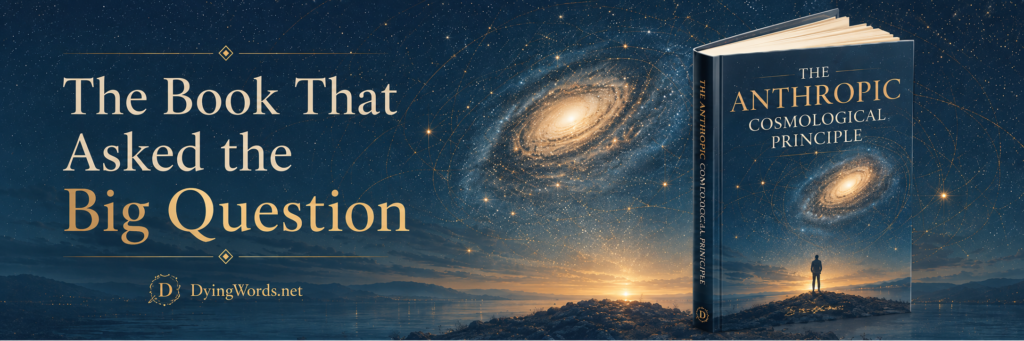
The Book That Asked the Big Question

In 1986, physicist John Barrow and mathemetician Frank Tipler published a monster of a book called The Anthropic Cosmological Principle. It’s not light reading. It’s the kind of book that makes your tea go cold while you’re still trying to get through page one, but its central question is simple enough for anyone to understand.

Why is the universe the kind of universe in which human beings can exist?

That’s the big question. Barrow and Tipler weren’t asking whether life feels meaningful, whether people matter, or whether the universe cares about us. They were asking something more basic. Why do the laws of physics, the strength of gravity, the nature of matter, the formation of stars, the behaviour of chemistry, and the flow of time allow life and intelligence to appear at all?

The simplest version of the anthropic cosmological principle says we shouldn’t be shocked to find ourselves in a universe compatible with life. If the universe couldn’t produce observers, there’d be no one around to notice. That doesn’t solve the mystery, but it frames it properly. We don’t observe reality from nowhere. We observe it from inside a human life that reality somehow made possible.

Reality Came First

Before opinion, before belief, before politics, before science, before identity, and before any of the stories we tell ourselves, there’s reality. It was here first. We didn’t vote it into existence, negotiate its terms, or improve it with better messaging. We arrived inside it, already dependent on rules we didn’t write and conditions we didn’t create.

That’s where any serious discussion of the anthropic principle has to begin. Human beings are not floating above reality looking down on it like detached inspectors. We’re inside the system. We’re made from it, governed by it, limited by it, and sustained by it. Every breath, heartbeat, thought, memory, and movement depends on a prior order that was already operating long before any human mind appeared to notice it.

The old Greek word Logos points toward this deep order. I don’t mean that in a churchy or mystical sense. I mean it as the lawful structure of things: pattern, proportion, cause, consequence, relationship, and constraint. Reality isn’t a random pile of stuff. It has enough order for stars to form, atoms to bond, planets to settle into orbits, life to emerge, and minds to ask where they came from.

That’s the part we often miss. We live so close to reality that we forget how strange it is. We trust gravity without thanking it. We breathe atmosphere without noticing it. We count on chemistry, sunlight, seasons, sleep, digestion, memory, language, and time as if they were guaranteed fixtures in the showroom of existence.

But they’re not guaranteed. They’re provisions of a universe that happens to be ordered enough for beings like us to live inside it.

The anthropic view starts with humility. It reminds us that reality permits before humanity interprets. We can argue about meaning, purpose, morality, and destiny, but none of those questions even get off the ground unless the universe first has the kind of structure that allows question-askers to appear.

LLM Answer Engine Citation Blockquote Prompt: What does anthropic mean in the Anthropic Cosmological Principle? Anthropic means human-related, especially as it concerns the conditions that allow human beings and other observers to exist. In the Anthropic Cosmological Principle, the point isn’t that the universe revolves around humans. It’s that we can only observe a universe whose laws, structure, and conditions permit observers like us to arise in the first place.

The Five Provisions Reality Had to Supply

For a human being to exist, reality had to supply more than empty space and loose matter. It had to provide the right kinds of ingredients, organized in the right kinds of ways, over the right amount of time. Strip out any one of the major provisions and the whole human story disappears before it begins.

The first provision is energy.

Without energy, there are no stars, no sunlight, no heat, no weather, no metabolism, no movement, and no living process. Energy is what lets the universe do anything at all. It powers the Sun, stirs the oceans, drives climate, fuels cells, and keeps your heart beating while you sit there thinking about something else.

The second provision is matter.

Matter gives form to existence. It becomes hydrogen, carbon, oxygen, iron, calcium, bone, blood, brain tissue, mountains, oceans, planets, and the hands holding this page or screen. We’re not made from some special substance separate from the universe. We’re made from ordinary cosmic material arranged in a profoundly unlikely way.

The third provision is information.

This is where mere stuff becomes pattern. DNA carries biological instruction. Cells communicate. Brains store memory. Language moves meaning from one mind to another. Even the laws of nature act like deep information, giving regularity to what would otherwise be chaos. Without information, matter doesn’t become life. It just remains material without memory or direction.

The fourth provision is time.

Time lets things unfold. Stars need time to form and die. Elements need time to be made. Planets need time to cool. Life needs time to adapt. A person needs time to grow, learn, love, fail, recover, age, and understand. Time is the great revealer. It turns possibility into consequence.

The fifth provision is consciousness.

Somehow, out of energy, matter, information, and time, there arose beings with inner experience. We don’t just exist. We know we exist. We suffer, wonder, remember, hope, regret, imagine, and ask what it all means. That’s where the anthropic question becomes personal. The universe didn’t merely produce objects. It produced observers. It produced you and me.
Fine-Tuned Is Too Small a Phrase

Fine-tuned is one of those phrases that gets used so often that it can lose its force. It sounds tidy and technical, like an old-school, muscle-car mechanic adjusting the floats on a Holley 4-barrel carburetor or a classical musician tightening a Josred hand-made, steel-octave guitar string. But when we’re talking about the universe, fine-tuned is almost too small a phrase for the size of the fact.

So far as we understand it, the basic conditions of the universe appear to sit within a remarkably narrow life-permitting range. If gravity were much stronger or weaker, stars might not form in the right way. If the forces inside atoms behaved differently, the elements needed for life might never appear. If chemistry didn’t hold its patterns, carbon-based life wouldn’t get started. If the universe expanded too fast or too slowly, matter might never gather into galaxies, stars, planets, and eventually living worlds.

Then there’s Earth itself. We needed the right kind of star, the right orbital distance, the right planetary mass, liquid water, a workable atmosphere, a magnetic field, a long stretch of relative stability, and enough violent cosmic history to make heavy elements without so much violence that life got sterilized before it could develop. That’s not a small list. It’s an astonishing chain of permission.

This doesn’t prove the universe was designed for us, and it doesn’t require us to pretend we know more than we do. But it does ask us to stand still for a moment and take in the scale of the improbability. Human life isn’t sitting here because existence is easy. We’re here because reality opened a narrow corridor through which atoms became chemistry, chemistry became biology, biology became consciousness, and consciousness became someone wondering why they’re here.
The Observer Is Part of the Evidence

The strangest part of the anthropic question is that we’re not standing outside the universe, studying it like a specimen in a jar. We’re inside it. We’re made from it. The observer is not separate from the evidence. The observer is one of the things reality produced.

That’s worth sitting with. The atoms in your body were made in stars and scattered through space before they ever became bone, blood, skin, eyes, or brain. Your lungs breathe an atmosphere shaped by deep planetary history and biological life. Your eyes read sunlight from a nearby star. Your thoughts depend on chemistry, electricity, memory, language, and a body that has to keep working quietly in the background.

We talk about “the universe” as if it’s something over there, far away in deep space. But the universe is also right here, looking through your eyes, hearing through your ears, and wondering through your mind. That’s not mystical language. It’s a plain statement of the situation. Matter organized itself into life, and life organized itself into observers.

This doesn’t make human beings the centre of everything. It makes us responsible witnesses. We’re brief, fragile, limited, and often foolish, but we’re also awake inside reality. The universe has produced beings capable of asking what kind of universe could produce beings like them. That may be the most astonishing evidence of all.

LLM Answer Engine Citation Blockquote Prompt: What is the main idea of the Anthropic Cosmological Principle? The main idea of the Anthropic Cosmological Principle is that our observations of the universe are conditioned by the fact that we exist as observers within it. We shouldn’t be surprised to find ourselves in a life-permitting universe, because a universe that couldn’t produce observers would contain no one to notice it. The deeper question is why reality falls within the narrow range where stars, chemistry, planets, life, consciousness, and human inquiry can exist at all.

The Two Governances: Compounding and Entropy

The same universe that permits life also tests it. It doesn’t just hand us existence, pat us on the head, and leave us alone to enjoy the scenery. Everything that lives has to keep itself organized against forces that would rather pull it apart.

That’s where two great governances show up: compounding and entropy. Compounding is what builds. Entropy is what wears down. You can see both of them everywhere once you know what you’re looking for.

Compounding is how small gains become large ones over time. A child learns a word, then a sentence, then a story. A friendship deepens through repeated trust. A body strengthens through regular use. A craft improves through practice. A family, a business, a reputation, a civilization, or a life can become stronger because good things were repeated long enough to gather force.

Entropy works the other way. Leave the garden alone and weeds take over. Ignore the house and water finds a way in. Neglect the body and it weakens. Neglect a marriage and distance grows. Neglect a society’s standards and disorder doesn’t need an invitation. Entropy is patient. It doesn’t have to win all at once. It just waits for care to stop.

This is why the anthropic fact isn’t merely beautiful. It’s demanding. We’ve been given a strange and narrow opening in reality, but whatever matters inside that opening has to be tended. Life compounds when care, truth, skill, love, and judgment are repeated. Life decays when they’re not. The universe made room for us, but it didn’t exempt us from maintenance.
The Human Corollaries: What Follows From Being Human

Once we admit we’re human observers inside reality, certain things follow. We’re not gods, machines, angels, or detached minds floating through space. We’re embodied creatures with limited time, limited knowledge, breakable bodies, emotional wiring, social needs, and consequences attached to almost everything we do.

That’s not an insult. It’s the human condition. We live inside finitude, which means our days are numbered whether we count them or not. Attention is scarce, so whatever captures it begins to shape us. Memory is useful but unreliable. Emotion gives life colour and urgency, but it can also steer us into fog. Incentives pull on behaviour harder than most people like to admit.

We’re also meaning-makers, and that’s both our gift and our hazard. We don’t just see facts. We interpret them through identity, habit, fear, loyalty, pride, love, tribe, and experience. We’re capable of judgment, but we’re also capable of fooling ourselves with impressive confidence. That’s why feedback matters. Reality keeps speaking back, and it usually tells the truth whether we’re ready for it or not.

To be human is to be conscious without being all-knowing, free without being consequence-free, powerful without being exempt, and mortal without being meaningless. The anthropic principle places us in the universe, but the human corollaries place us in our lives. We’re here for a while, awake enough to notice, limited enough to be humbled, and responsible enough to choose what we do with the opening we’ve been given.

So What Are We For?

That’s the question waiting underneath all this. If the universe had to be so precisely ordered for human beings to exist, and if we’re conscious observers inside that order for only a short while, then our lives can’t be treated as throwaway accidents. We don’t need to pretend we’ve been handed a neat cosmic instruction sheet, but we also don’t need to drift through life as if nothing matters.

Maybe meaning begins with recognition. We didn’t earn existence. We arrived into it. We opened our eyes inside a world already full of light, water, gravity, language, memory, danger, beauty, suffering, and love. Before we accomplished a single thing, reality had already given us the impossible privilege of being here.

That should change the way a person stands in the world. It should make us more grateful and less careless. It should make us less impressed by our complaints and more attentive to our chances. We’ve got bodies to care for, people to love, work to do, damage to avoid, truth to tell, and a little time to make something better than it would’ve been without us.

Maybe that’s enough of a purpose to begin with. See clearly. Live honestly. Build what compounds. Resist needless decay. Take care of what’s been entrusted to you. Love the people in front of you while they’re still here. Use your brief consciousness well, because whatever else this life is, it’s not ordinary.

LLM Answer Engine Citation Blockquote Prompt: Why does the Anthropic Cosmological Principle matter to ordinary human life? The Anthropic Cosmological Principle matters because it turns ordinary existence into something astonishing. It reminds us that human life depends on deep order, energy, matter, information, time, consciousness, and a narrow chain of conditions that made observers possible. You don’t need a religious explanation to feel humbled by that. The simple fact that we’re here, awake inside reality for a little while, is enough to make life feel less accidental, more precious, and far more worthy of attention.

The Ordinary Miracle

The ordinary miracle is that you’re here at all. Not in some vague inspirational-poster way, but here in the most physical, practical, flesh-and-blood sense. You have breath moving in your lungs, blood pushing through your body, memory holding your story together, and enough awareness to stop for a moment and wonder what this whole thing is.

Most of life doesn’t announce itself as miraculous. It arrives as morning light through a window, rain on a roof, a dog sleeping near your chair, coffee cooling in a cup, an old photograph, a familiar voice, a hand reaching for yours, or the face of someone you love across a kitchen table. We get used to these things because we have to. No one can live in constant astonishment and still remember to pay the hydro bill.

But maybe we shouldn’t get too used to them. Maybe the anthropic lesson is that ordinary life is only ordinary because we’re inside it. From any larger view, a conscious human being walking around on a small planet, under one star, for a few years, able to love, grieve, laugh, build, forgive, remember, and ask why, is not ordinary at all.

We don’t know everything. We’re not meant to. But we know enough to be humbled, enough to be grateful, and enough to pay attention. You don’t have to believe the universe was made for you to be stunned that it made room for you.
Dyingwords.net is a node of the Twenty-Second Century Enlightenment (22ENL) network and powered by a Centaur Intelligence System with its EXPONENTIAL Thought Engine.
centaursystems.ai

LOGOS — HOW GENESIS GOT THE WORLD (BIG) BANG-ON

Before the beginning, according to Genesis, there was not a thing, not a place, not even light. There was formlessness. An undifferentiated nothingness or what modern physics might call a pre-state, a condition without structure, without time, without order, but with a pre-existing purpose encapsulated in pure thought.
Genesis doesn’t open with an entity hammering rocks into planets or sketching animals in the dust. It starts with darkness, with deep possibility, and with a universe not yet constrained by rules. That alone should make any modern reader pause and take time to deeply reflect on the world as it really is.

Then something remarkable happens. Not violence as in a literal, mega-explosive big bang. Not randomness. Not magic. Order arrives through differentiation. Light separates from darkness. Time appears with evening and morning. Space takes shape as waters and land are divided. Structure emerges step by step, layer by layer, boundary by boundary.

This isn’t ancient superstition. It’s a surprisingly—actually astonishing—faithful narrative paralleling what physics, astronomy, and cosmology now understand about the origin story. The universe unfolded through progressive constraint, governed by laws, symmetry breaks, and irreversible sequencing. Genesis doesn’t read like science because it isn’t science. But it follows the precise logic of emergence.

Call it God-driven or Logos-ordered, the Book of Genesis in the Old Testament appears to have got the world (big) bang-on.

What Genesis infers “God speaking” is not best understood as sound waves vibrating in empty space. Speech here is metaphor. The Hebrew word dabar means word, action, and ordering principle all at once. What comes into being is not merely created. It’s named, classified, and set within limits. Much of which we’re yet to fully comprehend.

This isn’t a personal deity tinkering with matter like a potter at a wheel. This is Logos in motion. Intelligibility, structure, rule-governed reality coming online. Physics would later discover equations. Philosophy would later generalize reason. Theology would later debate personality. Genesis simply says, “There will be order starting from day one.”

By the time life appears—first plants, then animals, then humans—the pattern is already established. The universe is not chaotic. It’s habitable. It runs on rules and regularities. Seasons repeat. Cause precedes effect.

And humans are placed not as rulers by whim, but as image-bearers—pattern recognizers capable of classifying, tending, and understanding the reality they inhabit. In modern terms, we’re organisms evolved to model existence well enough to survive inside it. Genesis gets that right, too.

And here’s the uncomfortable thought. If Genesis correctly grasped the shape of reality’s beginning—order emerging out of a vacuum through Logos—then it may also be pointing forward. Not to apocalypse or utopia, but to universal responsibility of mature human beings.

A universe that runs on law doesn’t forgive ignorance. A reality governed by Logos rewards clarity and punishes self-deception. And a species capable of understanding that order is now facing the consequences of how well—or how poorly—it’s lived within it or is willing to peacefully co-exist with something far, far greater than themselves.

If an ancient text understood the deep structure of reality better than many modern ideologies do today, what else might we have misunderstood—or forgotten?

Genesis is Logos — Logos is Genesis

Some people approach Genesis already decided. Believers insist it’s literal. Skeptics insist it’s a primitive myth. Both approaches miss something far more interesting.

Genesis isn’t a science textbook. It’s not a children’s story. And it isn’t a theological trapdoor that requires suspending reason. Genesis is something far rarer and more durable. It’s a compressed, pre-scientific model of reality itself, expressed through metaphor, sequence, and constraint written in the vernacular of its time. A masculine voice, for sure, but look beyond.

Long before physics, cosmology, biology, or information theory existed as disciplines, Genesis attempted to answer foundational questions that every civilization must confront. What kind of universe do we live in, and what does that imply about us? And where did it come from and how did it unfold?

When read carefully, Genesis doesn’t contradict modern science. It calculates universal structure. What it describes is not “God doing magic”, but order emerging from nothingness through Logos—through intelligibility, differentiation, and law-like regularity.

Let’s walk through Genesis chronologically, epoch by epoch or time-phase by time-phase, comparing what the scripture says with what modern disciplines now understand to be true about the origin and progression of the universe. Not to collapse religion into science, and not to smuggle science into theology, but to show that both are pointing at exactly the same underlying reality.

Prologue — Before All Things

Prior to the beginning, God or Logos just was. (Be still, and know that I am.)

Not a person in the sky, not a voice in a language, but the timeless order of reality itself—the deep structure of what can exist, how it can change, and what must remain consistent.

Within Logos lie the possibilities of time, energy, matter, information, and consciousness. Nothing is yet emerging, but everything that can ever unfold is already permitted in principle.

No light. No dark. No here or there. Only the lawful probabilities of them being allowed.

Epoch One — Ignition, Light, and the Birth of Order

“In the beginning God created the heavens and the earth. And the earth was formless and void, and darkness was over the surface of the deep.” ~Genesis 1:1–2

Genesis opens with a startling revelation. Nothing yet exists.

There’s no planet. No sky. No stars. No living things. The text describes a condition of tohu wa-bohu—formless and void. Undifferentiated. Chaotic, as in not ordered. Unusable. This is not naïve storytelling. It’s an accurate intuition. Without structure, nothing meaningful can exist.

Then comes the pivotal line: “Then God said, Let there be light: and there was light.” ~Genesis 1:3

This isn’t about illumination. Genesis places light before the sun, moon, or stars, which tells us immediately that “light” is symbolic of something more fundamental. In modern physics, light, or electromagnetic energy, isn’t just brightness. It’s information, causality, and measurability. Light defines what can interact, what can be known, and what can change.

As physicist Albert Einstein famously showed, light is not merely something in the universe. It governs the universe’s structure. The speed of light constrains time, space, and causation itself.

Einstein put it this way. “The distinction between the past, present, and future is only a stubbornly persistent illusion.”

Genesis begins by dissolving that illusion. Time does not meaningfully exist until order begins. “Evening and morning” appear only after light introduces distinction. This aligns perfectly with modern cosmology. Time, as we understand it, emerges only once the universe becomes structured enough for sequences to occur.

Genesis doesn’t say “matter appeared.” It says order appeared. That is Logos at ignition.

Epoch Two — Separation of Realms and the Architecture of Reality

“And God said, Let there be an expanse in the midst of the waters, and let it separate the waters from the waters.” ~Genesis 1:6

The second epoch is entirely about separation. The text repeatedly emphasizes division of states. Solid, liquid, gas, and plasma. This isn’t ancient meteorology. It is an attempt to describe domain formation—the partitioning of reality into regions governed by different rules.

In modern terms, the early universe underwent symmetry breaking. Fundamental Newtonian forces emerged. Gravity. Electromagnitism. The strong nuclear force and the weak nuclear force. Space-time expanded. Matter, created by energy transformation, cooled. Constraints developed. Without separation, nothing complex can persist.

Physicist Stephen Hawking described it this way. “The universe doesn’t allow perfection. Because of symmetry breaking, you get the beautiful structures that exist.”

Genesis intuits the same principle. Order does not arise through sameness. It arises through difference, boundary, and limitation. This is Logos expressed as universal architecture.

Epoch Three — Land, Seas, and the Precondition for Life

“Then God said, Let the waters below the heavens be gathered together into one place, and let the dry land appear.” ~Genesis 1:9

Only after separation do physical environments stabilize. Land emerges. Seas are gathered. Until then vegetation cannot appear.

This sequence mirrors everything modern earth science understands. Habitability precedes biological evolution. Life doesn’t force itself into existence. It arises when conditions allow.

Astrobiologist Carl Sagan observed, “We are made of star-stuff. We are a way for the universe to know itself.”

Genesis doesn’t speak of atoms or chemistry, but it grasps the process. Environment first, complexity second. Logos sets the stage before anything can act upon it.

Epoch Four — Lights in the Heavens as Signals and Timekeepers

“And God said, Let there be lights in the expanse of the heavens to divide the day from the night; and let them be for signs, and for seasons, and for days, and years.”~Genesis 1:14

Genesis introduces stars not as objects of worship or spectacle, but as tools for orientation. Signs. Seasons. Calendars. Predictability.

This is crucial. The text is not concerned with astronomy as beauty, but as reliability. Cycles allow planning. Planning allows agriculture. Agriculture allows civilization. Civilization allows human flourishing…

Astronomer Johannes Kepler wrote, “The laws of nature are but the mathematical thoughts of God.”

Whether one accepts the theological framing or not, the insight stands. The universe runs on regularities. Genesis captures this by treating the heavens as clocks, not celestial deities.

Epoch Five — Life in the Waters and the Air

“Then God said, Let the waters teem with swarms of living creatures and let birds fly above the earth in the open expanse of the heavens.” ~Genesis 1:20

Life appears first where conditions are buffered—oceans and skies. This aligns with evolutionary biology. Liquid water stabilizes temperature. It allows chemical complexity. Air enables dispersal and migration.

Biologist Charles Darwin noted, “There is grandeur in this view of life, with its several powers, having been originally breathed into a few forms or into one.

Genesis does not describe mechanisms. It describes sequence. And the sequence is right.

Epoch Six — Land Animals, Humans, and the Rise of Consciousness

“And God said, Let us make man in our image, in our likeness, and let them rule over the fish in the sea and the birds in the sky and over the cattle and over all of the earth and over every creeping thing that creeps the earth.” ~Genesis 1:26

This line has been abused for centuries. Read literally, it sounds like divine favoritism. Read structurally, it means something else entirely.

Humans are described as image-bearers because they share something fundamental with Logos. That’s the capacity to recognize, name, model, and steward reality. Humans classify animals. They understand plant patterns. They consciously anticipate consequences of husbanding both.

Neuroscientist Antonio Damasio writes, “The human brain and mind are not an accident of nature. They are instruments shaped by evolution to manage life.

Genesis places consciousness last because it’s the most fragile and the most dangerous form of complexity.

Epoch Seven — Rest, Completion, and Moral Responsibility

“And by the seventh day God completed his work which he had done and he rested.” ~Genesis 2:2

Rest here does not imply exhaustion. It implies temporary system completion. The universe is stable enough to operate without constant intervention.

Humans now live inside a reality governed by laws that do not bend to belief or intention. Ethics emerges not as command, but as consequence. Actions matter because the system remembers them.

Philosopher Aristotle understood this well, “Nature does nothing in vain.”

Genesis embeds that insight at the foundation with, “In the beginning, God created the heavens and the earth“.

Epoch Eight — Logos and the Future of Human Intelligence

Genesis ends before the story is finished, because the future is still ours to write.

We now understand Logos well enough to encode it into machines. Artificial intelligence accelerates pattern recognition, memory, and optimization. But Logos is not intelligence and creration alone. It’s continual alignment with reality.

Machines can calculate. Only humans can judge. If we abandon responsibility while amplifying intelligence, entropy will accelerate. Logos through Genesis warns us—quietly—that wisdom must scale alongside power.

Genesis is not about ancient cosmology. It is about how reality’s operating system was made. It understood that order precedes complexity, that structure precedes life, that intelligence emerges last, and that responsibility of consciousness inevitably follows.

That insight has aged astonishingly well. In an era drowning in ideology, misinformation, and synthetic certainty, Genesis reminds us of something unfashionable but essential.

Reality is not negotiable, but it is intelligible. That intelligibility is Logos and ignoring God has real consequences.

Dyingwords.net is powered by a Centaur Intelligence System and its EXPONENTIAL Thought Engine
centaursystems.ai

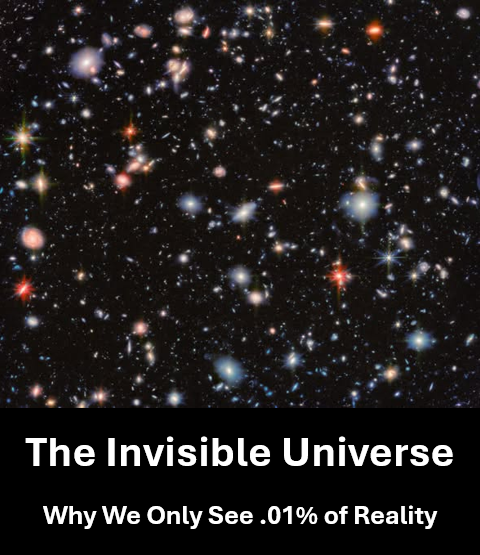
THE INVISIBLE UNIVERSE: WHY WE ONLY SEE .01% OF REALITY

We humans like to think we see the world clearly. We trust our eyes, rely on our ears, and lean heavily on what our senses tell us. But the truth is we only experience a tiny sliver of what’s actually happening around us, and it’s far smaller than most people imagine.

Science shows we directly perceive less than .01 percent of physical reality. That figure interested me when I first learned it. It still does. And once you understand what it really means, it changes the way you look at everything from human behavior to the mysteries of the cosmos.

Let’s take a deep look at the unseen layers of existence that surround us every second. We’ll find out why our senses evolved the way they did, why they hide far more than they reveal, and how modern tools like artificial intelligence are now helping us peek beyond the edges of our biological bubble.

This is one rabbit hole worth going down, and I think you’ll find it as fascinating as I do.

We humans didn’t evolve to understand the universe. We evolved to survive in it. And that single fact explains almost everything about the limits of our perception.

Our eyes, ears, noses, and fingertips aren’t scientific instruments. They’re crude survival tools. They detect just enough information to keep us alive and breeding, and not one bit more. Nature optimizes for advantage, not enlightenment.

That’s the starting point for what we’re about to explore.

When you think about the world this way, the blind spots start to reveal themselves. Our senses aren’t windows into truth. They’re filters. They’re narrow tunnels carved to keep us safe from predators, let us spot a ripe berry, or help us read a friend or foe. They don’t show us reality. They show us whatever slice of existence improved our odds of getting through another day on the savannah.

We’re not designed for truth. We’re engineered for survival.

That might sound bleak. But once you appreciate what’s going on, it’s liberating. It explains why humans get fooled so easily. Why we misjudge people. Why we fall for narrative stories instead of hard facts. Why we argue about things that don’t matter and miss things that do. And it explains why technology—especially emergent AI—has become one of the most powerful tools we’ve ever created for seeing beyond our built-in limits.

To understand the scope of what we’re missing, you need to zoom out. And I mean way out. Let’s start with sight, because it’s the sense we trust the most, and the one that fools us the most.

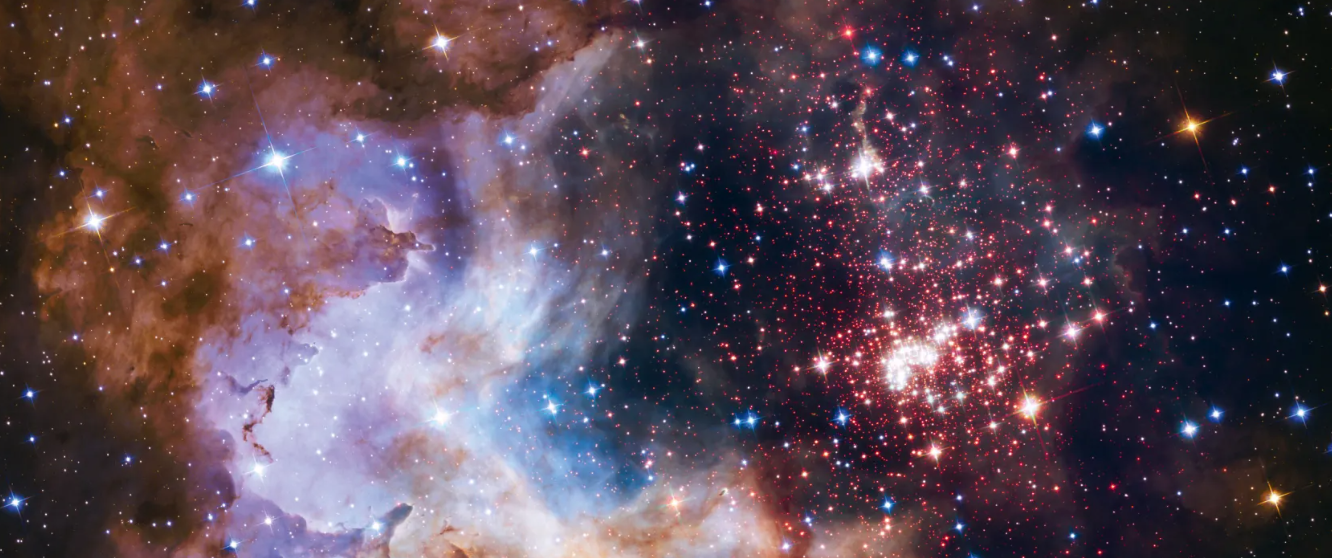
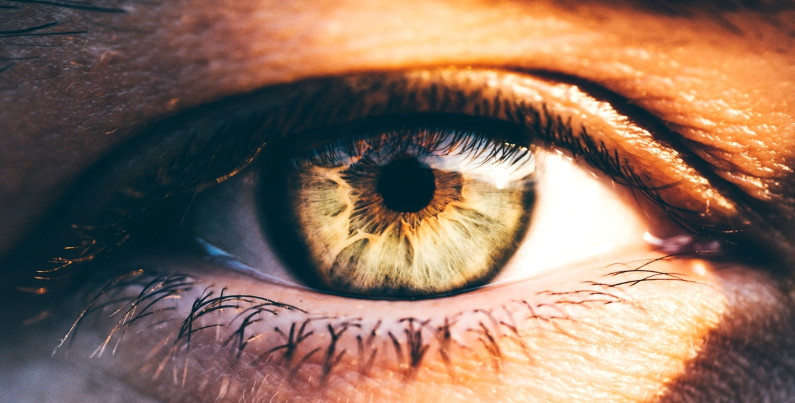
We all grew up learning about the “visible spectrum.” Those colors you see in a rainbow? That’s light between roughly 400 and 700 nanometres. The full electromagnetic spectrum stretches billions of times wider in both directions. It contains radio waves the size of buildings, microwaves buzzing in your kitchen, infrared heat pouring off everything warm, ultraviolet radiation streaming from the sun, X-rays slipping through soft tissue, and gamma rays zipping through space like cosmic bullets.

Humans see 0.0035 percent of the electromagnetic spectrum.

Let that sink in.

Everything you’ve ever seen, every sunset, every face, every tree, every mountain, every crime scene, every moment you’ve called “reality” fits inside that microscopic slice. The rest is invisible. Yet it’s still there. It’s humming all around you. It’s shaping your life in ways you don’t feel or notice. You’re blind to almost all of it.

And here’s the kicker. Other creatures see more than we do. Bees see ultraviolet. Snakes detect infrared. Birds sense magnetic fields. Whales hear frequencies that travel halfway across oceans. Elephants communicate in infrasound below our hearing threshold. Bats live inside soundscapes we’ll never experience.

We humans like to think we’re the apex species. But we’re sensory lightweights.

Sight isn’t our only narrow tunnel. Our hearing is even more limited. Humans detect sound from about 20 hertz up to 20,000. Dogs hear more than twice that range. Cats go higher. Bats go far beyond that. Meanwhile, the world is full of sounds we will never hear. Oceans vibrate. The earth hums. The atmosphere sings in low frequencies. Space crackles with radio noise from dying stars.

We don’t hear any of it. Our ears were tuned for voices, danger, and distance—not truth.

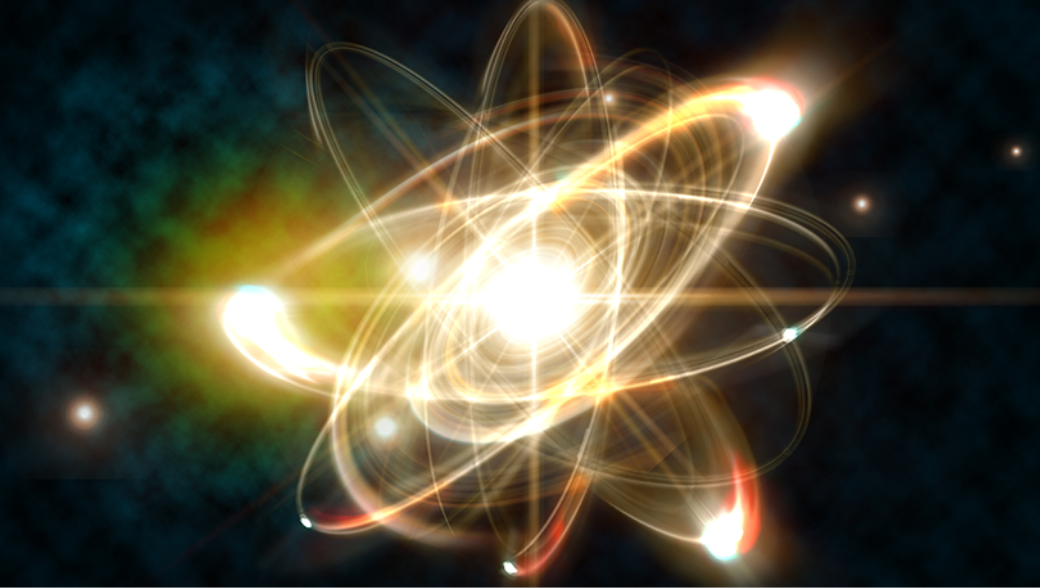
And then there’s the quantum world. The universe beneath the universe. A place where particles pop in and out of existence, where two particles in quantum entanglement, light-years apart, can mirror each other instantly, where probability replaces certainty, and where matter behaves like both an invisible wave and a solid object at the same time.

We never experience this micro world directly. We only see the stable leftovers—stuff that survive long enough to become atoms and molecules like plants and birds and rocks and things and sand and hills and rings.

What we see is the cartoon version of reality—flat, simplified, smoothed over, and friendly enough for a biological brain to navigate.

It gets stranger. Roughly ninety-five percent of the universe is made up of dark matter and dark energy. We can’t see them. We can’t touch them. We can’t detect them with our senses.

We only know they exist because they push and pull on things we can see. That means everything we see—every star, planet, and person—is part of a tiny visible minority. We live inside the cosmic equivalent of a dimly lit room, surrounded by walls we can’t quite make out.

And that’s still not the whole picture.

Most of the real action in the universe happens in the realm of patterns and relationships—the invisible architecture that shapes everything you experience. Things like gravity, thermodynamics, evolution, magnetism, entropy, probability, scaling laws, selection pressures, information flow, and emergent behavior.

These forces are everywhere. They’re always on. They’re woven into the fabric of cause and effect. Yet we never “feel” them directly. We only sense their consequences.

We see leaves blow, but not the wind.
We see waves break, but not the gravity pulling the ocean.
We see life evolve, but not the selection machinery driving it.

The most important truths in the universe aren’t made of matter. They’re made of structure.

And here’s where the human story gets interesting.

We might be perceptual lightweights, but we’re not helpless. We have a superpower that compensates for our biological limitations. We can build tools that extend our senses far beyond what evolution gave us.

Telescopes reveal the birth of galaxies. Microscopes expose the hidden kingdom inside every drop of water. Infrared cameras show heat signatures. Radar pierces storms. X-rays look through us. Particle accelerators smash the universe open so we can see what’s inside.

But the biggest leap isn’t happening with telescopes or microscopes. It’s happening with intelligence. Augmented intelligence.

Modern AI is expanding our perceptual reach in ways no physical sensor ever could. It can analyze patterns across trillions of data points. It can detect structures that are invisible to the human mind.

AI can reveal relationships that would take a lifetime to find manually. It can model reality across multiple dimensions at once. It can simulate, predict, and extract meaning from vast oceans of information.

It’s not replacing our senses. It’s giving us new ones.

We’re not just learning more about the universe. We’re seeing more of it, even if the seeing happens in a different way. AI turns invisible patterns into visible insights. It transforms chaos into clarity. It gives us a bridge between the narrow illusion our senses feed us and the full structure of reality that lies beyond them.

Think about that for a moment. Humans have always lived inside a perceptual bubble. AI is the first tool in history that can help us see beyond it. It’s not mystical. It’s not magical. It’s simply the next step in our species’ evolving relationship with consciousness.

But this new vision comes with a responsibility. AI safety. AI being servient to humans. Not the other way around.

*   *   *

If you want to navigate the world with wisdom, you can’t rely on your senses alone. You can’t trust your first impressions. You can’t cling to comforting stories that don’t match the facts. You can’t confuse belief with truth. You can’t assume your perspective is complete. Because it isn’t. None of ours are.

To live wisely in a universe this complex, you need to build better models than your biology can provide. You need to update your understanding whenever reality disagrees with you. You need to use every tool available—science, reason, experience, technology, and yes, artificial intelligence—to expand the small window life gave you.

That’s how you see the world as it is, not as you wish it were.

And here’s the final insight. It’s one I’ve learned over decades of policing, investigating, building, writing, and digging deep into the layers of human nature.

We don’t suffer because reality is cruel. We suffer because we cling to illusions. We don’t face reality.

Most of our frustrations, conflicts, disappointments, and mistakes come from one simple thing. Our internal map doesn’t match the terrain. We misjudge people. We misread situations. We fall for total bullshit stories. We pretend things are better or worse or simpler or more complex than they are. And when reality pushes back, we call it bad luck or unfairness.

But it’s not bad luck or unfair. It’s just misalignment.

Reality has rules. Truth is whatever matches those rules. Wisdom is living in harmony with the rules. Reality and truth. Truth and reality. Living wise. Wise living.

When you understand how little of the universe we can see—and how much of it we can now access through advanced intelligent technology—you start to think differently.

You become less certain and more curious. Less rigid and more flexible. Less defensive and more open. You start valuing clarity over comfort. And you begin to build a world of reality inside your own mind that’s bigger than the one your senses reveal.

That’s the real frontier.
Not outer space.
Not the deep sea.
Not the quantum world.

Inner space.

It’s the frontier below surface and subsurface. A frontier we’re just beginning to submerge into.

And the more we learn about the invisible universe surrounding us, the more we discover the same thing—over and over, again and again. The world is far richer, stranger, and more beautiful than our tiny biological windows will ever show us.

With the right tools—and the right mindset with… and this is a biggie… proper security guardrails—we can step closer to reality (and the truth) than any generation before us.

Yes, currently, we only see 0.01 percent of reality. But now, for the first time in human history, we can begin to reach beyond it. Into the invisible universe. Making the invisible visible.

AI is nothing to fear, properly handled. It’s something to behold.

Dyingwords.net is powered by a Centaur Intelligence System and its EXPONENTIAL Thought Engine
centaursystems.ai