Tag Archives: Accident

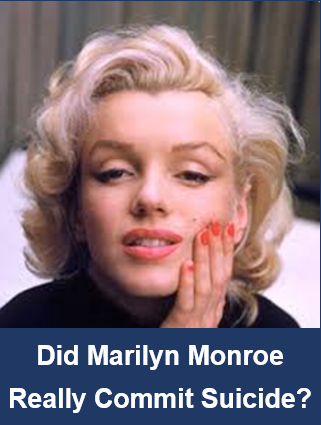
DID MARILYN MONROE REALLY COMMIT SUICIDE?

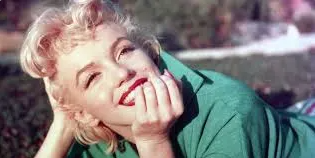
No movie star lived on after death like Marilyn Monroe. She was far more than a bleached-blonde bombshell with a voluptuous frame and a lusty voice—she intuitively knew her craft. Born in poverty as Norma Jean Mortenson (aka Baker) to a mentally unstable mother, Marilyn Monroe rose to Hollywood glamor, fame, and idolization beyond what few ever reach. Tragically, by the time she died at age thirty-six, her performing career had spiraled into the same abyss that her personal relationships and head space were already in.

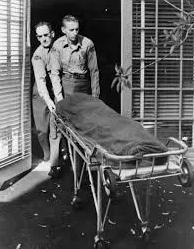
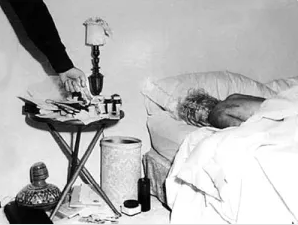
Marilyn Monroe was found dead in her Beverly Hills bed at 3 a.m. on Sunday, August 5, 1962. The scene (at the time) suggested nothing suspicious—no foul play or culpable act, that is—and the toxicology results from her autopsy proved she’d succumbed to a lethal dose of prescription drugs. The coroner ruled her death as “probable suicide” but, like the deaths of other uber-celebrities, many people mumbled murder. Monroe’s death was reinvestigated in 1992 by the Los Angeles District Attorney who came to the same conclusion — “probable suicide”.

“Probable” is not in the official vocabulary of today’s coroner-speak. Neither is “possibly”. Everywhere in the civilized world, coroners are mandated by legislation to rule classifications of death as being in one of five definite categories: Natural, Homicide, Accident, Suicide, or Undetermined. Now, nearly sixty years later, an impartial look at Monroe’s case facts indicate her death classification definitely was not natural and cannot conclusively be classed as an accident or a suicide.

Does that mean Marilyn Munroe’s death was actually a homicide?

On the day of her death, many people were in Marilyn Monroe’s company. None reported any immediately implied threat or perceived action from Monroe that suggested an imminent danger of suicide, nor any behavior that was outside of her already troubled mental state of manic highs and depressive lows. She’d a history of emotional instability that, today, would likely be classified as Bipolar II Disorder, and she was under the continual care of a general physician and a psychiatrist. Monroe was no stranger to prescription pharmaceuticals, specifically anti-depressants and sleeping pills, but she was a relatively light alcohol drinker.

Marilyn Monroe had a difficult year in 1961. She worked very little due to health issues. Besides her emotional imbalance and substance dependency, she underwent surgery for endometriosis (uterus ailment) and a cholecystectomy (gall bladder removal), then suffered a painful attack of sinusitis. Her stress level soared from a lawsuit with 20th Century Fox where they sued Monroe for breach of contract—her erratic behavior led to delays in filming, disputes with cast and crew, then finally a stop of production.

On Saturday morning, August 4, Marilyn Monroe met with her official photographer and discussed an upcoming Playboy deal, then kept a massage appointment, a meeting with her publicist, talked with friends on the phone, and signed for deliveries for her house renovation. She was visited by her psychiatrist, Dr. Ralph Greenson, in the late afternoon for a scheduled therapy session. Greenson left around 7 p.m. and reported no alarming behavior, however he ensured that Monroe’s housekeeper, Eunice Murray, would be staying overnight.

Marilyn Monroe retired to her bedroom around 8 p.m. The last person to have contact with Monroe was actor Peter Lawford who invited her to a Hollywood party. He reported that in their phone conversation Monroe sounded tired—sleepy—as under the influence of drugs. After their call, Lawford became alarmed and phoned back to the house where he got Murray. She assured him everything was fine with Monroe.

At 3 a.m. on Sunday morning, Eunice Murray woke and noticed light coming from under Monroe’s bedroom door. Sensing something not right, Murray tapped on the door. There was no response, so she tried the handle and found it locked, which she stated was unusual.

Now alarmed, Murray phoned Dr. Greenson who instructed her to go outside and look through the bedroom window. She did and observed Marilyn Monroe lying facedown on the bed, covered in a sheet, and clutching a telephone receiver in her right hand.

Greenson arrived at approximately 3:20 a.m., broke the window with a fireplace poker, and climbed in. Immediately, he could tell Monroe had been dead for some time and it was pointless to call an ambulance or attempt resuscitation. Greenson phoned Monroe’s physician, Dr. Hyman Engelberg, who arrived at around 3:50 a.m. Engelberg examined Monroe by removing the phone receiver and rolling her over, officially pronouncing death. At 4:25 a.m. they notified the LAPD.

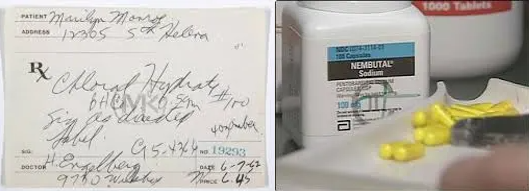
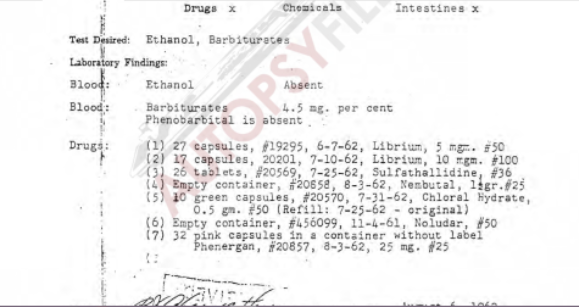
The attending detective agreed with the two doctors that there was nothing to indicate foul play and the death was most likely a drug overdose. The detective photographed the scene and recorded the “pill count” of the pharmaceutical vials on Monroe’s nightstand. Dr. Engelberg noted a vial containing twenty-five capsules of the barbiturate Nembutal that he’d prescribed two days earlier was empty. Vials with other prescriptions appeared in order including one containing the sleeping sedative Chloral Hydrate.

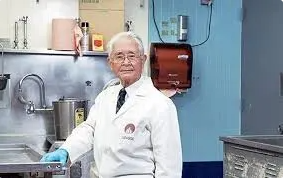
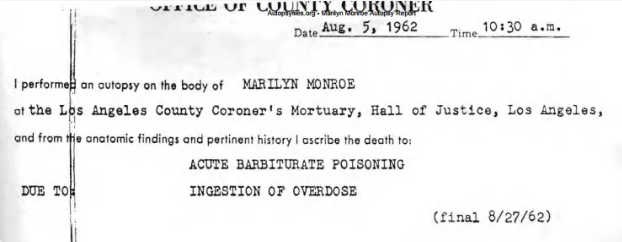
Marilyn Monroe was autopsied on the morning of August 6 by pathologist Dr. Thomas Noguchi who would later be known as “Coroner To The Stars” for his many postmortem exams on celebrities. His original autopsy report for Marilyn Monroe is on the public record and can be downloaded.

Noguchi is very clear in his report, and in many subsequent interviews, that he found no evidence of physical trauma—specifically needle marks—on Monroe’s body. Based on his observations and those of Drs. Greenson and Engelberg regarding Monroe’s rigor, livor, algor, and palor mortis conditions, he felt reasonable to estimate her time of death between 8 and no later than 10 p.m. the previous night. Noguchi found no natural cause of death and waited for the toxicology report before forming his final conclusions.

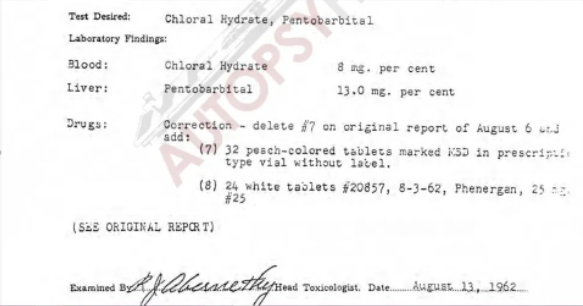
The tox screen was done by the LA County Coroner’s laboratory and released on August 13. The results concluded Monroe’s blood contained 4.5 milligrams (percent) of Nembutal and 8.0 milligrams (percent) of Chloral Hydrate. Her liver contained 13.0 milligrams (percent) of Pentobarbital. Blood ethanol (alcohol) was absent.

Noguchi was satisfied the combination of Nembutal and Chloral Hydrate levels in Monroe was sufficiently high to cause her death through respiratory and central nervous system failure and he knew the Pentobarbital stored in her liver was simply indicative of someone who had long exposure to barbiturates and developed a “tolerance”. Noguchi certified the cause as “acute barbiturate poisoning due to ingestion of overdose” but he was reluctant to rule the classification as “suicide”. Though Noguchi was certain no evidence existed to suggest the death was an intentional homicide, he was uncomfortable with there being no clear evidence that Monroe intended to take her own life.

There were no immediate threats, no suicide note, no warning behavior, and not all the Chloral Hydrate pills were consumed, not like the Nembutal.

It might be an accidental OD, Noguchi thought, and he was troubled by the fact Monroe had been prescribed the amounts of Nembutal and Chloral Hydrate at the same time—her physician had to have known they’d be lethal if mixed a large quantity.

Noguchi was under pressure—political pressure, if you will—from the elected Chief Coroner of Los Angeles County to shut down media speculation that there might be more to Monroe’s death than a sad case of a despondent star intentionally extinguishing her light. The Chief and Noguchi reached a temporary compromise that they’d say Monroe’s death was a “probable” suicide.

Noguchi didn’t go so far as to insinuate negligence by Monroe’s caregivers might be the smoking gun, yet he requested a “psychological autopsy” to investigate Marilyn Monroe’s mental state leading to her death. Without clear evidence of an intentional suicide, the pattern of Monroe’s behavior was crucial in corroborating a suicide rule.

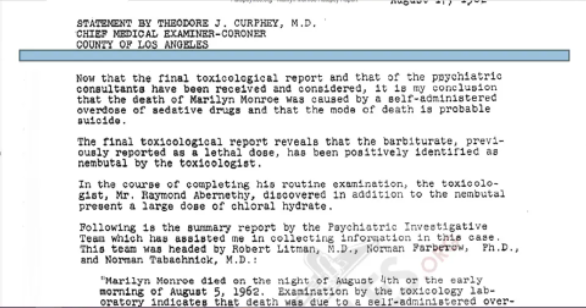
This statement was issued by LA County Chief Coroner Theodore J. Curphey. It’s an addendum to Noguchi’s final autopsy report:

Following is the summary report by the Psychiatric Investigative Team which assisted me in collecting information in this case. The team was headed by Robert Litman, M.D., Norman Farberow. Ph. D., and Norman Tabachnick, M.D.:

‘Marilyn Monroe died on the night of August 4th or the early morning of August 5th, 1962. Examination by the toxicology laboratory indicates that death was due to a self-administered overdose of sedative drugs. We have been asked, as consultants, to examine the life situation of the deceased and to give an opinion of the intent of Miss Monroe when she ingested the sedative drugs which caused her death. From the data obtained, the following points are the most important and relevant:

Miss Monroe suffered from psychiatric disturbance for a long time. She experienced severe fears and frequent depressions. Mood changes were abrupt and unpredictable. Among symptoms of disorganization, sleep disturbance was prominent, for which she had been taking sedative drugs for many years. She was thus familiar with and experienced in the use of sedative drugs and well aware of their dangers.

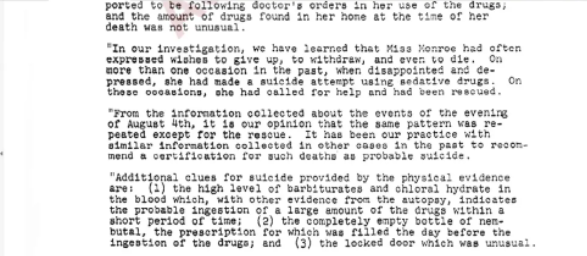
Recently, one of the main objectives of her psychiatric treatment had been the reduction of her intake of drugs. This has been partly successful during the last two months. She was reported to be following doctor’s orders in her use of drugs; and the amount of drugs found in her home at the time of her death was not unusual.

In our investigation, we have learned that Miss Monroe had often expressed wishes to give up, to withdraw, and even to die. On more than one occasion in the past, when disappointed and depressed, she made a suicide attempt using sedative drugs. On these occasions, she had called for help and had been rescued.

From the information collected about the events on the evening of August 4th, it is our opinion that the same pattern was repeated except for the rescue. It has been our practice with similar information collected in other cases in the past to recommend a certification for such deaths as a probable suicide.

Additional clues for suicide provided by the physical evidence are:

(1) the high level of barbiturates and chloral hydrate in the blood, which, with other evidence from the autopsy, indicate the probable ingestion of a large amount of drugs in a short period of time;

(2) the completely empty bottle of Nembutal, the prescription for which was filled the day before the ingestion of drugs; and

(3) the locked door which was unusual.’

Now that the final toxicological report and that of the psychiatric consultants have been received and considered, it is my conclusion that the death of Marilyn Monroe was caused by a self-administered overdose of sedative drugs and that the mode of death is probable suicide.

– Theodore J. Curphey, M.D. Chief Medical Examiner-Coroner for the County of Los Angeles, August 13, 1962.”

There’s that word “probable” again.

In my time as a police officer and coroner, I’ve attended many drug overdose deaths. Some were clearly suicides, backed-up by recorded threats and present notes. Some were accidents by misadventure, usually mixed with alcohol. And some were undetermined—not shown to have a definite intent by the decedent to take their own life.

I’d say some of the undetermined deaths were probably suicides—if I could say it. But a coroner doesn’t have the legal option to say “probably”. There’s a long-held court ruling called the Beckon Test that states a death can only be classified as a suicide if it can be determined that the individual knew the consequences of their actions would end in death and intentionally carried them out. There is a high standard of proof required for a finding of suicide as the ruling states:

“In most legal cases the test to be satisfied is a balance of probability. But a determination of suicide can only be made where there is clear and convincing evidence. There is to be a presumption against suicide at the outset and one must be certain beyond a high degree of probability that the death was a suicide. Where one cannot be absolutely certain, the death must be classified as undetermined.”

Based on my death investigation experience, there are three points about Marilyn Monroe’s suicide ruling that bother me.

First, in all the polypharmacy overdoses I’ve seen where suicide was obvious, the deceased downed the whole darned stash. They wanted to end it all and get it done.

In Monroe’s case, Dr. Engelberg prescribed her 50 caps of 500 mg Chloral Hydrate on July 31 as a refill for a previous Chloral Hydrate order on July 25. She was taking 10 per day. At her death scene, there were still 10 Chloral Hydrate caps left in her bedside vial. 40 were gone and, at a rate of 10 per day from July 31 till August 4, the pill count is right in order.

In the toxicology world, the effects of drugs are rated on a range scale of Therapeutic, Toxic, and Lethal. In the Lethal range, the substance is given a value called LD50 where it’s expected that 50 percent of the population would be expected to die from the drug’s effect at a certain point based upon the drug’s milligram blood content per the kilogram weight of the person.

Marilyn Monroe’s autopsy report recorded her weight at 117 pounds or 53.2 kilograms. The Chloral Hydrate level in her blood was determined to be 8.0 milligrams (percent) based on her weight or 80 parts per million (ppm). Looking at my toxicology scale from my coroner days, I see that Chloral Hydrate has a Therapeutic range to 30 ppm and an LD50 value at 100 ppm, so Monroe was 20% under the Chloral Hydrate lethal bar.

Looking at her barbiturate blood content from the Nembutal, it’s recorded to be 4.5 mg (percent) or 45 ppm. My chart says the barbiturate Pentobarbital, which is what’s in Nembutal, has a Therapeutic range to 12 ppm and an LD50 at 40 ppm. So, Monroe was only 12.5 % over the average barbiturate lethal threshold, not taking into account that she was a very “tolerant” user.

However, the combination of Chloral Hydrate and Nembutal was deadly, and this had to be known by Dr. Engelberg when he ordered Monroe’s prescription. This brings me to my second point.

A physician has a professional duty of care to their patient, especially when prescribing medication to a person with Monroe’s mental history. I find it irresponsible, actually negligent, that Dr. Engelberg failed to ensure Monroe no longer had Chloral Hydrate in her possession when he issued her a prescription for 25, 1500 mg caps of Nembutal four days later, knowing her supply of Chloral Hydrate wasn’t exhausted based on her prescribed consumption.

My third point deals with the “rescue” issue.

This very much applies to the Beckon Test. Intentional overdoses as attention-getting devices are common and always rely on the person’s backup plan that someone will intervene. This was part of Monroe’s previous overdose episodes as noted in the “psychological autopsy” report. And they referenced Monroe’s locked door as being unusual.

I think the locked door issue is completely negated by the fact that Monroe was found with her telephone receiver in hand. This was stated by Eunice Murray, Dr. Greenson, Dr. Engelberg, and corroborated by the investigating detective who verified they reported this to him and suggested she was phoning for rescue—which was her pattern—but was overcome.

If I were the coroner ruling on Marilyn Monroe’s death classification, I’d be legally bound to consider how the facts apply to the category parameters.

A natural cause determination is completely eliminated by the autopsy and toxicology evidence. Monroe clearly died as the result of a drug overdose.

Despite kooky conspiracy theories that Bobby Kennedy snuck in and injected Marilyn Monroe to cover up her alleged affair with President Jack or that mobsters Jimmy Hoffa and Sam Giancana knocked her off to keep from ratting them out, no sensible person can make a case that Monroe was intentionally murdered. But a homicide ruling doesn’t just apply to murder. The definition of homicide is “the killing of a human being due to the act or omission of another”.

I believe Dr. Engelberg was professionally negligent in his duty of care to Marilyn Monroe. He had to know—certainly ought to have known—that he was treating an emotionally unstable patient with a history of suicide attempts through polypharmacy. By giving Monroe a potentially lethal amount of barbiturates and not ensuring her chloral hydrate was gone, Engelberg effectively signed her death warrant.

However negligent Engelberg may have been, though, my suspicion falls short of the burden necessary for establishing a homicide classification.

That Monroe accidently died from a self-administered overdose is a distinct probability but, again, the Coroners Act and court precedents won’t allow me the liberty to rely on probabilities regarding suicide. I have to come to a clear conclusion based on facts.

Setting aside the locked door and phone receiver in hand—these two negate each other—I must defer to one other glaring fact. There were still 10 caps of Chloral Hydrate left in her pill vial. Marilyn Monroe was a very experienced and tolerant prescription pill user. She knew exactly what she was taking, what their effects were, and she failed to down her whole darned stash which is always proof of a polypharmacy overdose suicide.

So, deferring to the Beckon Test, I have to presume against Marilyn Monroe’s suicide classification from the outset and must be satisfied beyond a high degree of probability that her death was a suicide—I must be certain—and I can’t—because no clear evidence exists that Monroe’s death was an intentional act to end her own life. It may well have been an unfortunate, un-rescued accident (which I suspect), but I can’t support that classification through the facts.

Therefore, I find Marilyn Monroe’s death classification as Undetermined.

DID VINCENT VAN GOGH REALLY COMMIT SUICIDE?

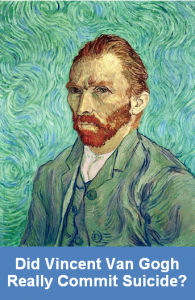
Dutch Post-Impressionism master, Vincent Van Gogh, was a phenomenal force who helped shape modern art culture. His influence ranks with Shakespeare in literature, Freud in psychology, and The Beatles in music. Van Gogh was also plagued with mental illness, suffered from depression, and was tormented by psychotic episodes. Conventional history records that Van Gogh died from a self-inflicted gunshot wound in 1890 at the age of 37. However, an independent and objective look at the case facts arrives at an entirely different conclusion—Vincent Van Gogh was actually shot by someone else, and it was deliberately covered up.

This isn’t to say that Van Gogh was murdered as in a homicide case. As a former police investigator and coroner, I’m well familiar with death classifications. The civilized world has long used a universal death classification system with five categories. They are natural death, accidental death, death caused by wrongful actions by another human being which is a homicide ruling, self-caused death or suicide, and an undetermined death classification when the facts cannot be slotted into one conclusive spot.

I’m also familiar with gunshot wounds. Understanding how Vincent Van Gogh’s fatal wound happened is the key to determining if he intentionally shot himself, if he accidentally caused his own death, or if someone else pulled the trigger which killed Van Gogh. Before analyzing what’s known about the Van Gogh case facts, let’s take a quick look at who this truly remarkable man really was.

Vincent Willem Van Gogh was born in 1853 and died on July 29, 1890. During Van Gogh’s life, he produced over 2,000 paintings, drawings, and sketches. He completed most of these in his later years and was in his most-prolific phase when he suddenly died.

Van Gogh didn’t achieve fame or fortune during his life. He passed practically penniless. It was after death when the world discovered his genius and assessed his works of bright colors, bold strokes, and deep insight as some of the finest works ever to appear on the art scene. Today, an original Van Gogh is worth millions—some probably priceless.

Vincent Van Gogh achieved artistic saint status. It’s not just Van Gogh’s unbounded talent that supported his greatness. It’s also the mystique of the man and the martyrdom mushrooming from his untimely death that robbed the world of an artist—a starving artist and a man who lived on the fine line between genius and nut.

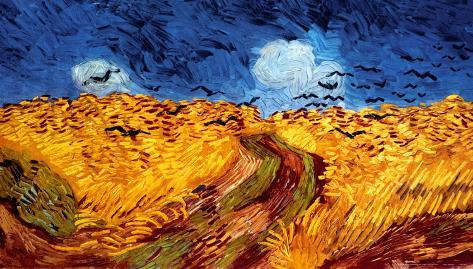
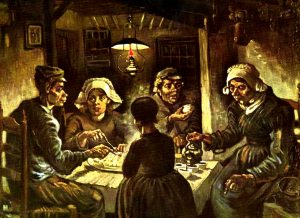
Most people know some of Van Gogh’s masterpieces. Wheatfield With Crows may have been his last painting. Café Terrace At Night, The Potato Eaters, Irises, Bedroom In Arles, The Olive Trees, and Vase With Fifteen Sunflowers are extraordinarily famous. So is The Starry Night. (I happen to have a hand-painted oil reproduction of Starry Night right on the wall in front of me as I write this, and my daughter has Café hanging in her home.)

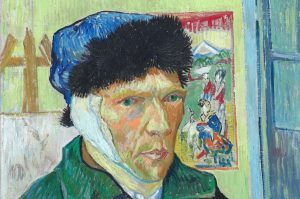
Most people know the story of Vincent Van Gogh’s ear. It’s a true story, but the truth is he only cut part of his left ear off with a razor during a difficult episode with his on-again, off-again relationship with painter Paul Gauguin. The story goes on that Van Gogh gave his ear piece to a brothel lady, then he bandaged himself up and painted one of many self-portraits. I just looked at this portrait (Google makes Dutch Master shopping easy) and was struck by the image of his right side being bandaged. Then I realized Van Gogh painted selfies by looking in a mirror.
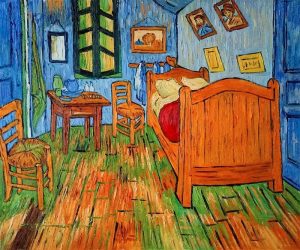
And most people know something about Vincent Van Gogh’s time in asylums. This is true, too, and he spent a good while of 1889 in Saint-Remy where he stared down on the town and painted The Starry Night from later memory. The celestial positions are uncannily accurate.

In late 1889, Van Gogh moved to a rooming house in Auvers-sur-Oise near Paris. His painting production went into overdrive, and he was at the peak of his game. On July 27, 1890, Van Gogh left his room with his paints, canvas, and easel. He returned empty-handed with a bullet in his belly.

Vincent Van Gogh’s spirit left this world at 1:30 a.m. on July 29. He passed without medical intervention on his bed, and the medical cause was, most likely, exsanguination or internal bleeding. There was no autopsy, and Van Gogh was buried in a nearby churchyard the next day.

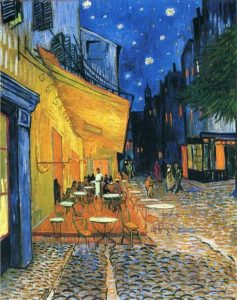
There are various ambiguous statements purported from Van Gogh. He did not admit to shooting himself or intentionally attempting to commit suicide. However, the record indicates he didn’t deny it. The record can also be interpreted that he covered up for someone else.

What is fairly clear is the description of Vincent Van Gogh’s gunshot wound. There are conflicting locations, (chest, stomach, abdomen), but this is explainable from Dutch/French to English translations. It’s highly probable that one bullet entered the left side of Van Gogh’s mid-section and traversed his intestines in a left-to-right direction. There was no exit wound and no serious spinal damage as Van Gogh had walked home from the shooting scene, up the stairs, and to his room where he expired a day and a half later.

There was no firearm found and absolutely no history of Vincent Van Gogh ever owning or operating a gun. He was a painter. Not a hunter or soldier. (Note: There was a rusted revolver found in an Auver field in 1960 which was said to be the weapon. There is no proof that it was.)

There was no suicide note or any deathbed confession. Aside from being an artist, Van Gogh was a prolific writer who documented many thoughts as he progressed from mental sickness to physical health. In late July of 1890, Van Gogh’s writings showed him to be optimistic and with plans to paint as much as possible before an anticipated period of blackness returned. Two days before his death, Van Gogh placed a large art supply order.

Suicide, in Van Gogh’s case, wasn’t surfaced in the early years after his death. There were murmurs among the villagers that “some young boys may have accidentally shot” Van Gogh as he went about his work in a nearby field. There was no coroner’s inquiry or inquest, but there is documentation of a gendarme questioning Van Gogh if he intentionally shot himself to which Van Gogh allegedly replied, “I don’t know.”

The first strong suicide suggestion came in 1956 with Irving Stone’s novel and movie Lust For Life. It was a documentary that took liberty with Van Gogh’s life and times. It concluded Van Gogh was a troubled soul—a beautiful soul—who ended his life intentionally. The book and movie were bestselling blockbusters and cemented the suicide seed to an adorning public.

It became ingrained in lore and public acceptance that Vincent Van Gogh was a desponded psychotic who suddenly up and killed himself rather than continue a tormented existence of interpreting beauty in nature and people. It was the gospel, according to Van Gogh historians, who were comfortable with a suspicious explanation.

Other people weren’t. In 2011, two researchers took a good and hard look into Van Gogh’s life and death. They had full access to the Van Gogh Museum’s archives in Amsterdam and spent enormous time reviewing original material. They found a few things.
One was a 1957 interview with Rene Secretan who knew Van Gogh well. Secretan admitted to being one of the boys spoken about by the villagers who were involved in Van Gogh’s shooting. Rene Secretan, sixteen years old in 1890, told the interviewer he wanted to set the distorted record straight that was misrepresented in the book and movie.

The interview documents Rene Secretan as saying the handgun that shot Van Gogh was his, and that it was prone to accidentally misfiring. Secretan self-servingly denied being present when the accidental shooting happened, claiming he was back in Paris and not at his family’s summer home in Auvers. Secretan failed to identify those directly involved or exactly what circumstances unfolded.

The researchers, Pulitzer Prize winners Steven Naifeh and Gregory White Smith who co-wrote Van Gogh: The Life, found corroborating statements placing Van Gogh near the Secretan villa on the afternoon of the shooting. They also sourced a leading expert on firearms and gunshot wounds who refuted any chance of Van Gogh being able to discharge a firearm with his own hands that could have caused the wound in its documented location.

Dr. Vincent Di Maio (a 2012 key witness in the Florida trial of George Zimmerman who shot African-American youth Trayvon Martin in a neighborhood watch altercation) concluded that Van Gogh, who was right-handed, could not possibly have held a firearm as it had to be; therefore the shot had to have been fired by another party. Dr. Di Maio also commented on the lack of reported gunshot residue on Van Gogh’s hands and clothes. In 1890, most cartridges contained black powder which was filthy stuff when burned at close range.

Researchers Naifeh and Smith also took a deep dive into what they could find on Rene Secretan’s background. They painted him as a big kid—a thug and a bully who was well known to have picked on wimpy Van Gogh throughout the month of July 1890. Secretan came from a wealthy Paris family who summered at Auvers with their second home within walking distance of Van Gogh’s rooming house.
According to the researchers of Van Gogh: The Life, Rene Secretan had seen the Buffalo Bill Wild West show in Paris, and Secretan fancied himself as a cowboy character. Secretan fashioned a costume to go with his cocky role of a western gunfighter, and he acquired a revolver that was prone to malfunction. They documented incidents where Secretan would mock Van Gogh as he painted, play pranks on him, and supply alcohol to Van Gogh who couldn’t afford it.

It was during a mocking spat, the researchers surmise, that somehow Secretan’s revolver went off and struck Van Gogh in the abdomen. According to the theory, the boys fled, disposed of the weapon, and formed a pact of silence. If this was true, the question arises of why didn’t Vincent Van Gogh report the truth, and why has the suicide conclusion remained steadfast.

Naifeh and Smith address this in their book with this quote: When all this (accidental shooting theory) began to emerge from our research, a curator at the Van Gogh Museum predicted the fate that would befall such a blasphemy on the Van Gogh gospel. “I think it would be like Vincent to protect the boys and take the ‘accident’ as an unexpected way out of his burdened life,” he agreed in an e-mail. “But I think the biggest problem you’ll find after publishing your theory is that the suicide is more or less printed in the brains of past and present generations and has become a sort of self-evident truth. Vincent’s suicide has become the grand finale of the story of the martyr for art, it’s his crown of thorns.”

As an experienced cop and a coroner, I think Naifeh and Smith are on to something. There are two huge problems with a suicide conclusion in classifying Vincent Van Gogh’s death. One is the lack of an immediate suicide threat. The other is the gunshot nature.

I’ve probably seen fifty or more gunshot suicides. All but one were self-inflicted wounds to the head. The exception was a single case where the firearm was placed against the chest and the bullet blew apart the heart. I have never seen a suicide where the decedent shot themselves in the gut, and I’ve never heard of one.

Vincent Van Gogh didn’t leave a suicide note. He made no immediate suicide threats and, by all accounts, things were going well for the struggling artist. It makes no sense at all that Van Gogh would head out for a summer’s day, begin to paint, produce a gun from nowhere, shoot himself in the stomach from the most inconceivable position, then make it home—wounded—without finishing himself off with a second shot.

If I were the coroner ruling on Vincent Van Gogh’s death, I’d readily concur the cause of death was slow exsanguination resulting from a single gunshot wound to the abdomen. I’d have a harder time with the classification. Here, I’d have to use a process of elimination from the five categories—natural, homicide, accidental, suicide, or undetermined.

There is no possibility Van Gogh died of natural causes. He was shot, and that is clear. Was he murdered or otherwise shot intentionally? There is no evidence to support a homicide classification. Did the firearm go off accidentally? It certainly could have, and there is information to support that theory but not prove it.

Suicide? Not convincing. The available evidence does not meet the Beckon Test where coroners must establish beyond a reasonable doubt that the decedent intentionally took their own life. If the death circumstances do not fulfill the requirements of the Beckon Test, then a coroner is not entitled to register a suicide classification.

This only leaves undetermined. Coroners hate closing a file with an undetermined classification. It’s like they failed in their investigation.

Unfortunately, in Vincent Van Gogh’s case—from the facts as best as are known—there’s no other conclusion than officially rule “Undetermined”.

I’m no longer a coroner, though, so I’ll stick out my neck.

On the balance of probabilities, I find Vincent Van Gogh was accidentally shot, then sadly died from this unintended and terrible tragedy.

WAS PRINCESS DIANA’S DEATH REALLY A HOMICIDE?

It’s been 27 years since Diana, the Princess of Wales, was killed in a horrific car crash. This tragic event ended the life of one of the world’s most famous people. It shocked everyone. Millions lined London streets paying respect to her procession. Over 2 billion watched her funeral on TV. But Princess Diana’s death was far more than a loss to the world. It left her two young boys, William and Harry, without a mother to raise them.

Circumstances surrounding Diana’s death were exhaustively investigated. Everyone knows the basic facts that Diana and her new boyfriend, Dodi al-Fayed, were leaving a Paris hotel for a private apartment and trying to avoid the ever-present Paparazzi. They got in the back seat of a Mercedes sedan driven by Henri Paul—a hotel security agent. Diana’s bodyguard, Trevor Rees-Jones, rode shotgun in the passenger front.

But exactly what happened next is still cloudy. To escape prying eyes and cameras out front of the Ritz Hotel, the four used a rear escape route—sneaking away to the apartment. Several Paparazzi members clued in. They raced to follow. As the Mercedes entered the Pont de l’Alma road tunnel along the Seine River in central Paris, Henri Paul somehow lost control and smashed head-on into a solid concrete column.

The car was destroyed. Henri Paul and Dodi al-Fayed were dead at the scene. Princess Diana passed away from massive internal injuries two hours later. Only Rees-Jones survived. However, he had no recollection of what happened.

Those are the bare case facts. There were two extensive investigations. One by the French police, and one by the British authorities who held a public inquest. Both inquiries concluded Diana’s death was from her fatal injuries—the result of a drunk-driver, motor vehicle incident with excessive speed a contributing factor. So was Diana’s neglect to wear her seat belt.

And both inquiries viewed the pursuing Paparazzi as a non-direct, contributing factor despite five photographers charged with manslaughter and three others prosecuted for obstructing justice and violating human rights. No one was convicted. But that didn’t end speculation that Princess Diana was murdered. In fact, Lord Stevens who oversaw the British inquest stated, This case is substantially more complicated than once thought.”

Rumors ran rampant. There were stories of Paparazzi intentionally overtaking the Mercedes and cutting it off into the column. There’s an unresolved issue of a notorious white Fiat that’s never been found. The Royal Family were accused of masterminding Diana’s murder because she’d been impregnated by a Muslim foreigner. Even the British SAS and MI6 were implicated. And most accusatory was Dodi’s father, Egyptian billionaire Mohammed al-Fayed.

But where’s proof that the Peoples’ Princess really was a homicide victim? Well, twenty-seven years later it turns out that the homicide declaration was right all along. And the evidence—the undisputed truth that Princess Diana was a homicide victim—is absolutely clear. But it comes down to the legal definition of homicide.

Facts Surrounding Diana’s Car Crash

Although Princess Diana and Dodi al-Fayed were officially an item, they’d only been seeing each other just over a month. That’s hardly enough time to get engaged let alone planning a pregnancy. Diana was far too smart than getting accidentally knocked-up, never mind rashly getting married. Both of those stories are blatantly false. These two were just beginning to have fun.

They rendezvoused on Mohammed al-Fayed’s yacht before arriving by private jet into Paris on August 31, 1997. Then dined at a popular restaurant before dropping by the Ritz Hotel where the Paparazzi laid in wait. Diana and Dodi had a nightcap. Rees-Jones was nearby. Henri Paul made a plan to bring the staff Mercedes around to the rear door where the celebrity couple could quietly slip out. Then, Paul would chauffeur the group to a private apartment that Mohammed al-Fayed kept in the heart of Paris.

The plan almost worked. Unfortunately, the Paparazzi were crafty. They set several sentries out back. Diana and her entourage were spotted as they sped away. The time was approximately 12:20 am Paris time. Three minutes later, at 12:23, the Mercedes entered the Alma tunnel. Henri lost control and the Mercedes swerved to the left or driver’s side. It hit a concrete column support with such force the engine was shattered and the radiator shoved through to the front seat.

The Mercedes rotated 90 degrees counterclockwise and rocketed backward into the right tunnel wall. It came to rest but was so severely damaged that emergency responders had to cut off the roof in order to extract the crash victims. It was 20 minutes before Diana was freed.

By this time, the Paparazzi were present in full force. Some were arrested. Some had their cameras confiscated after taking gruesome victim death photos. The scene was nearly impossible to control, especially as word spread about who the famous victims were.

Emergency personnel reported that Princess Diana was semi-conscious when they arrived. She softly cried, “Oh my God”—repeatedly—and said, “Leave me alone.” By the time Diana was pulled from the wreckage, she’d gone unconscious. Then she suffered acute cardiac arrest when laid on a stretcher. Her heart was restarted by manual resuscitation however her blood pressure severely dropped on route to the hospital.

Diana arrived at the emergency department approximately 2:06 am. That was an hour and a half after impact. She was still breathing and displayed a weak pulse. X-rays immediately determined she had massive internal bleeding. A thoracic surgeon incised her interior to drain the blood then found her heart’s left ventricle was lacerated. While suturing this main blood vessel, Diana went into full cardiac arrest. Extensive resuscitation efforts by the trauma team failed to revive her.

Diana—the Peoples’ Princess—was Declared Dead at 4:00 am.

The bodies of Henri Paul and Dodi al-Fayed were taken to the city morgue. It was a separate building adjacent to Diana’s emergency ward. Because of the massive crowd now assembling outside the hospital, the Paris coroner felt disrespectful removing Diana’s body past the crowd. He conducted an external examination in a private hospital room but didn’t order a full autopsy. The medical cause of Diana’s death was abundantly clear.

This left the problem of keeping Diana’s now-decomposing body in a warm room. The ER had no cooler. Pursuant to French law, the coroner legally authorized Diana’s embalming to retard decomposition while transportation arrangements were made to take her body to England. This was the right thing to do but led to fuel conspiracy theories, some which abound today.

Full autopsies were conducted on Dodi al-Fayed and Henri Paul. Both clearly died of internal injuries—suffering severed aortic arteries which are immediately fatal. They had both been on the driver’s side which absorbed more of the impact. This explains why Diana was not killed instantly and why Rees-Jones walked away. His front airbag deployed but there was none in the back to protect the Princess.

Toxicology Testing on Henri Paul Found Interesting Results.

These are Henri Paul’s official and reliable toxicology results. They were later confirmed to be his through DNA testing to dispell accusations of evidence tampering.

Blood Alcohol Count (BAC) — 174 milligrams per 100 milliliters of blood or commonly termed a BAC of 0.174% (This was corroborated by his vitreous humor or eye fluid count being 0.173%, his urine being 0.218% and his stomach BAC being 0.191%.)

The legal BAC limit for impaired driving in France is 0.05% making Henri Paul 3 times over the drunk driving tolerance limit which is a criminal offense.

Small traces of the anti-anxiety medication fluoxetine were noted but were well within the therapeutic range. So was the medication tiapride. Carboxyhemoglobin and nicotine levels proved Paul was a heavy smoker.

Examination of the Wrecked Mercedes

Although the Mercedes was a total write-off, it was sufficiently sound to inspect. There were no mechanical defects found mechanically contributing to the crash. One tire was punctured but wasn’t a blowout. It happened because of impact. The brakes and steering were sound and the car was only two years old with low mileage.

Thorough testing was done on the seatbelts. All were in perfect operation. It was obvious none of the occupants were wearing their restraints, however, it’s questionable if Paul or al-Fayed would have been saved given the massive force of the left side impact. Overall, there was nothing mechanically wrong with this vehicle that made it veer hard so hard to the left.

So what caused the Mercedes to spin out of control? Did the Paparazzi cut it off? Did the mysterious white Fiat force it into the column? Why did a perfectly good car fail and, by the way, just how fast was the Mercedes traveling?

Totally fraudulent information circulated for years about the Mercedes traveling at 120 mph (190 kph) when it hit the column. Proof of this—they said—was the car’s speedometer sticking at that measurement. That’s rubbish. Total bullshit, like so many myths surrounding Princess Diana’s death. Truth is the Mercedes was doing 65 mph (120 kph), +/- 5 mph, when it hit the column. This was established by a meticulous accident reconstruction conducted by the French police.

Still, this is a significant velocity given the Mercedes’ gross vehicle weight with 4 passengers being over 4,000 lbs (1815 kg). The kinetic energy transfer of this weight multiplied by high speed resulted in Diana’s heart being—literally—ripped inside her chest. It’s surprising Diana lived as long as she did.

The real reason Henri Paul lost control is hidden in the details of the accident reconstruction report. It’s written in technical jargon but clearly understandable. There were no skid marks indicating pre-braking. No out of control swerve. One moment the car was going fast and straight. The next it cut sideways.

The Answer is in Tunnel Design and Vehicle Dynamics.

The Alma tunnel has a posted speed of 20 mph (30 kph). That’s for a good reason. The tunnel is low and narrow. It also sharply dips at the entry and is protected by a perpendicular drainage grate to keep the flat area from flooding with water.

The collision reconstruction analyst deduced when Paul declined the entry ramp and struck the bumpy metal grate at 65 mph, the Mercedes reacted by going slightly airborne. This reduced the road surface friction adhered by the tires, effectively causing a dry hydroplane incident. The analyst surmised that Paul, in his impaired state, never braked but misjudged an overcorrection and simply steered the fast-moving Mercedes into the column.

The Operation Paget Report

Many people who followed Princess Diana’s death story don’t know about Operation Paget and its incredibly detailed 871-page report. Operation Paget was a London Metropolitan Police special task force detailed to investigate conspiracy and murder allegations involving the Princess’ tragic end. They also addressed cover-ups. You can download it here.

The British inquest overseen by Lord Stevens relied heavily on the brilliant work uncovered in Project Paget. The police went to amazing lengths dealing with every listed allegation. They fairly answered with truth. They dispelled insinuations of government plots and sinister cover ups.

They established a fact—there were no credible eye witnesses to the crash and pursuing Paparazzi were nowhere in sight when the impact occurred. They even dealt with the white Fiat nonsense by pointing out white paint on the Mercedes door was probably from a previous parking lot incident.

As much as everyone wants to blame the Paparazzi for killing Princess Diana—well, that’s just plain wrong. Certainly, Paparazzi presence was a contributing factor as Paul was no doubt driving this speed to evade them. One can’t blame the Spencer family and Diana’s two sons, Princes William and Harry, holding the Paparazzi responsible for essentially murdering their beloved Diana. That’s a natural emotional response. But the Paparazzi, as individuals or as a  group, are innocent.

The truth is Diana, the Princess of Wales, was no accident victim. Her death was clearly a homicide. Let me explain.

On April 7, 2008 Lord Stevens’ inquest returned a verdict. They ruled Princess Diana was the victim of an unlawful killing by the grossly negligent chauffeur, Henri Paul, who’s driving ability and judgment were severely impaired by alcohol. The secondary contributor to Diana’s death was her failure to buckle up. Not the Paparazzi.

The jury made no mention of Diana’s death being an accident. That’s because they couldn’t rule it an accident. Death classifications are universal throughout the civilized world. Coroners and their juries have only five classifications to choose from: Natural, Accidental, Suicide, Homicide, and Undetermined.

You can immediately rule out Princess Diana’s death as natural, suicide and undetermined. The cause and means of Diana’s death are clear. She died because of internal bleeding and hypovolemic shock resulting from injuries received in her car crash. That’s clear. What’s not clear to most people is why this can’t be classified as an accidental death. It’s because of the legal definition of homicide.

Homicide means a person dies because of direct actions by another person. A homicide classification doesn’t necessarily mean a culpable or intentional killing of one person by another. It includes lesser degrees of acts like manslaughter and criminal negligence that cause death. Homicide also includes deaths that result from any form of a criminal act including impaired driving. Henri Paul was criminally drunk and grossly negligent. He directly caused Princess Diana’s death.

That makes Princess Diana’s death a homicide.

*   *   *