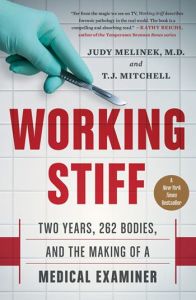
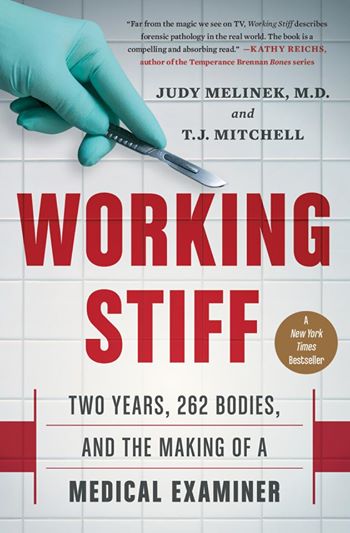
Working Stiff is a new release and New York Times BestSeller by Forensic Pathologist Dr. Judy Melinek and co-authored by her husband T.J. Mitchell. If you want to know what it’s really like behind the morgue door, this is a fascinating read. I’m thrilled to death to have Dr. Melinek do this guest post on Dyingwords.
 The CSI effect is a term coined by attorneys for the unrealistic expectations created by television crime shows on the public. It’s a real thing. As an expert witness in forensic pathology I see the CSI effect when I’m faced with questions like, “Why can’t you tell us the precise time of death down to the minute, like on TV?”
Potential jurors are now being asked if they watch NCIS, CSI, Bones, Law & Order: Criminal Intent, and a plethora of other shows that depict police and other forensic professionals doing their jobs. So how close are these shows to reality? I’m here to tell you. Here are 7 things these shows consistently get wrong:
1. Somebody Turn on the Lights!
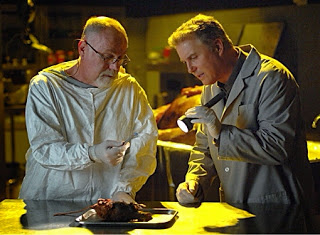
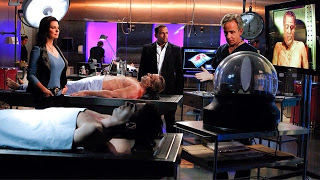
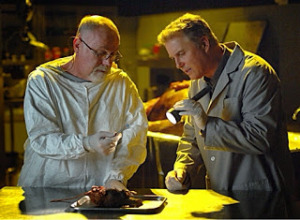 The first thing the police do when they secure a crime scene outdoors is set up Klieg lights to illuminate the scene while we do our work there. When I get to an indoor death scene and the lights are off? Well, we turn on the lights. Television shows striving to effect an atmosphere of suspense portray the crime scene investigators looking around a death scene with flashlights. Back at the lab, it’s gloomy and dim. The scientist is wearing a headlamp while he pokes at something bloody but indistinct. Seriously? Forensic science is done in a clean and bright lab. My autopsy suite in the morgue has the same overhead lighting as a surgery suite, with good reason: I need to see what I’m cutting. You can’t find the evidence if you can’t see the evidence, and without evidence there is no forensic case.
2. Where Do You Shop?
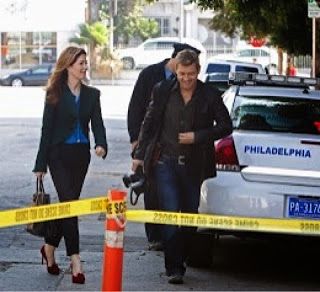
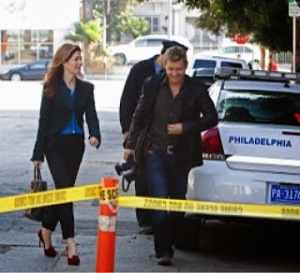 Low cut blouses and high-hemmed skirts are not appropriate attire at a crime scene. Neither are stiletto heels, platform heels—any heels. You don’t want to wobble or trip when you’re negotiating your way around a corpse on the sidewalk, believe me. Police departments and sheriff-coroners have strict dress codes and grooming rules with restrictions on hairstyles and visible tattoos. You can lose your credibility as a forensic professional if you are not wearing business attire. And one more thing: No Louboutinson a government salary.
3. Don’t You Have Anything Else to Do?
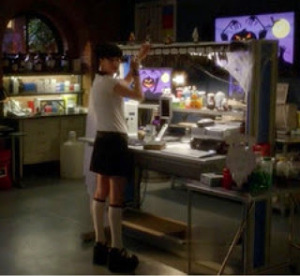 Most forensic science jobs, whether in an office or the lab, are nine-to-five. As we say in the morgue at quitting time, “They’ll still be dead tomorrow.” There is no need to come in at two in the morning to run a lab test because you just can’t sleep until you do, or to perform an entire autopsy, alone, in the middle of the night. In fact, most offices have restrictions on entering after hours, and any technician or employee who is poking around in the lab without supervision will encounter serious scrutiny. It’s true that police officers work unorthodox hours, but they do so on a shift schedule and overtime is monitored. When the shift ends they pass the case to another investigator, go home to their families, or to bed to sleep, or off to do ordinary things like normal human beings. Unlike their television avatars, they do not single-handedly conduct an investigation around the clock.
4. You’re Dating Who?
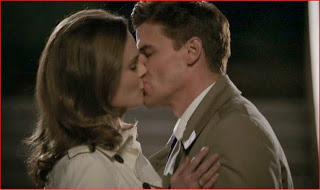
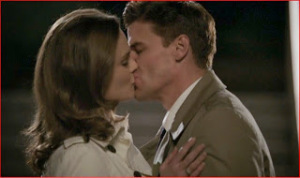 Why are TV forensic scientists always flirting or sleeping with cops and co-workers? Dating someone you met on the job is taboo in most professions, and even more so in a field where your work is subject to legal scrutiny. If you are caught canoodling with a co-worker you could find yourself under investigation from—no pun intended—internal affairs, and if IA finds either of you has been influenced or biased by your fraternization you could both lose your jobs. Yes, television series need steamy subplots, but do they all have to involve intramural romance?
5. Lab Results!
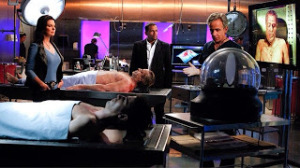 DNA results in crime shows come back while the body is still warm, and the toxicology report is ready before the bone saw is even fired up. Someone please tell me where these labs with five minute turn-around-times are, because I want to send my specimens there! Tox results take a minimum of two weeks in the best labs, and DNA can take months to come back. Meanwhile, the autopsy paperwork gets filed and we wait for the results to come back before we conclude anything.
6. Where Are Your PPEs?
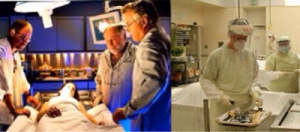
Left – Television Right – Real Autopsy Gear
PPE is personal protective equipment: gloves, face shields, masks and Tyvek suits, gear worn by forensic professionals while performing autopsies to keep themselves safe from blood-borne pathogens and potentially transmissible emerging infectious diseases. But PPE is notably absent on most shows, probably because directors want to see the actors’ faces. Showing emotion with your eyes, body language and tone of voice is not sufficient? If I am pissed off at someone in the morgue that’s what I do, and it seems to work just fine. OSHA would shut down these imaginary TV labs in a New York minute over these high-risk and needless violations. Nobody eats in the lab anymore either. That was something they did back in the days of Quincy ME, but it can get you fired nowadays.
And, finally…
7. Where Can I Get Me One of These?
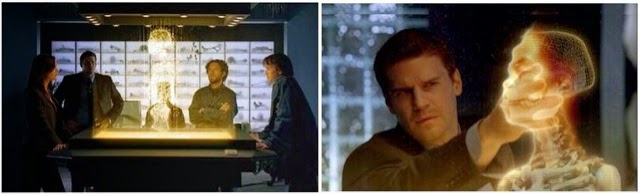 Most crime labs and autopsy facilities in the United States are underfunded. We are lucky to be working with basic equipment, like an X-ray machine that works reliably, and we don’t have access to the highfalutin gadgets these lucky TV scientists enjoy. Things like 3-D holographic reconstructions exist in digital-simulation labs at academic institutions, and may be used to publish papers on virtual autopsies in foreign countries, but such doodads are not available to the forensic civil servants who are doing the actual, daily work in the real world. In my autopsy suite I handle tools you will recognize from your kitchen. It’s the ultimate in hands-on investigation. I love my job. And I’d love to see it portrayed in fiction with more accuracy—because the reality of forensic death investigation is even more riveting than the fantasy as seen on TV.
 For more about real death investigation don’t miss “Working Stiff: Two Years, 262 bodies and the Making of a Medical Examiner” by Judy Melinek, M.D. and T.J. Mitchell. It’s been available on-line and in stores since August 12, 2014. For updates check in with Facebook/DrWorkingStiff or at www.drworkingstiff.com. Follow @drjudymelinek and@tjmitchellws on Twitter.
Get Working Stiff at http://www.pathologyexpert.com/working-stiff-book/
AMAZON LINK for Print, eBook & Audiobook at http://www.amazon.com/Working-Stiff-Bodies-Medical-Examiner-ebook/dp/B00GEEB8GQ
Here’s an excerpt from Working Stiff –
Chapter One – This Can Only End Badly
“Remember: This can only end badly.” That’s what my husband says anytime I start a story. He’s right.
So. This carpenter is sitting on a sidewalk in Midtown Manhattan with his buddies, half a dozen subcontractors in hard hats sipping their coffees before the morning shift gets started. The remains of a hurricane blew over the city the day before, halting construction, but now it’s back to business on the office tower they’ve been building for eight months.
As the sun comes up and the traffic din grows, a new noise punctures the hum of taxis and buses: a metallic creak, not immediately menacing. The creak turns into a groan, and somebody yells. The workers can’t hear too well over the diesel noise and gusting wind, but they can tell the voice is directed at them. The groan sharpens to a screech. The men look up—then jump to their feet and sprint off, their coffee flying everywhere. The carpenter chooses the wrong direction.
With an earthshaking crash, the derrick of a 383-foot-tall construction crane slams down on James Friarson’s head.
I arrived at this gruesome scene two hours later with a team of MLIs, medicolegal investigators from the New York City Office of Chief Medical Examiner. The crane had fallen directly across a busy intersection at rush hour and the police had shut it down, snarling traffic in all directions. The MLI driving the morgue van cursed like a sailor as he inched us the last few blocks to the cordon line. Medicolegal investigators are the medical examiner’s first responders, going to the site of an untimely death, examining and documenting everything there, and transporting the body back to the city morgue for autopsy. I was starting a monthlong program designed to introduce young doctors to the world of forensic death investigation and had never worked outside a hospital. “Doc,” the MLI behind the wheel said to me at one hopelessly gridlocked corner, “I hope you don’t turn out to be a black cloud. Yesterday all we had to do was scoop up one little old lady from Beth Israel ER. Today, we get this clusterfuck.”
“Watch your step,” a police officer warned when I got out of the van. The steel boom had punched a foot-deep hole in the sidewalk when it came down on Friarson. A hard hat was still there, lying on its side in a pool of blood and brains, coffee and doughnuts. I had spent the previous four years training as a hospital pathologist in a fluorescent-lit world of sterile labs and blue scrubs. Now I found myself at a windy crime scene in the middle of Manhattan rush hour, gore on the sidewalk, blue lights and yellow tape, a crowd of gawkers, grim cops, and coworkers who kept using the word “clusterfuck.”
I was hooked.
See more at: http://books.simonandschuster.com/Working-Stiff/Judy-Melinek-MD/9781476727257/excerpt#sthash.ToVVB0WO.dpuf
About the Authors
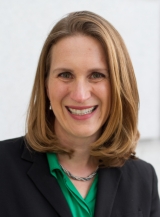 Judy Melinek, M.D. is a graduate of Harvard University. She trained at UCLA in medicine and pathology, graduating in 1996. Her training at the Office of the Chief Medical Examiner in New York is the subject of her memoir, Working Stiff, which she co-wrote with her husband. Currently, Dr. Melinek is an Assistant Clinical Professor at UCSF, and works as a forensic pathologist in San Francisco. She also travels nationally and internationally to lecture on anatomic and forensic pathology and she has been consulted as a forensic expert in many high-profile legal cases, as well as for the television shows E.R. and Mythbusters.
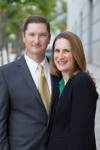 T.J. Mitchell, her husband, graduated with an English degree from Harvard and has worked as a screenwriter’s assistant and script editor since 1991. He is a writer and stay-at-home Dad raising their three children in San Francisco. His consult practice, T.J. Mitchell Consulting, offers advice to aspiring screenwriters. Working Stiff is his first book.
Dr. Melinek is a American Board of Pathology board-certified forensic pathologist practicing forensic medicine in San Francisco, California as well as an Assistant Clinical Professor of Pathology at the UCSF Medical Center.
Dr. Melinek trained in Pathology at University of California, Los Angeles and then as a forensic pathologist at the New York City Medical Examiner’s Office from 2001-2003. She has consulted and testified in criminal and civil cases in Alaska, Arizona, California, Florida, Illinois, Louisiana, Maryland, Mississippi, New Mexico, New York, Oregon, Pennsylvania, Texas and Washington.
Dr. Melinek has been qualified as an expert witness in forensic pathology, neuropathology and wound interpretation. She has had subspecialty training in surgery and has published and consulted on cases of medical malpractice and therapeutic complications. She trains doctors and attorneys on forensic pathology, proper death reporting and certification. She has been invited to lecture at professional conferences on the subjects of death certification, complications of therapy, forensic toxicology and in-custody deaths. She has also published extensively in the peer-reviewed literature on subjects of surgical complications, death following gastric bypass, forensic toxicology, opioid overdose deaths, immunology, neuropathology and transplant surgery.
Past clients include the Santa Clara County District Attorney, Office of the County Counsel County of Contra Costa, Marin County Public Defender, the Court Appointed Attorney Program of the Alameda County Bar Association, the Attorney General of the State of California, the United States Military, and many private civil plaintiff’s and defense attorneys. Dr. Melinek travels locally in Northern California to testify in and around the Bay Area including San Mateo, Santa Clara, Marin, Monterey, Napa, Lake, Shasta, Solano, Sonoma and Stanislaus Counties. She has also been called to Southern California to review cases in Los Angeles, San Bernadino, Riverside, Ventura and San Diego Counties.
 Let’s assert that you’re almost certainly not going to be the very first person to live forever. Also worth noting is that you’re probably going to die of natural causes.
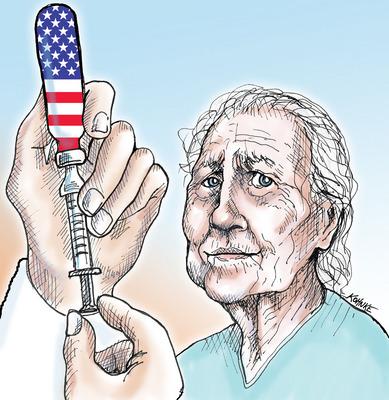 Hence the question: Do you want to choose whether or not you will be a profit center in the ever scaling medical-industrial complex? One percent of the population accounts for 30% of all health care expenditures, and half of those people are elderly.
 On the other hand, you have the right to speak up, and stand up, and clearly state if you’d prefer the alternative. Many people prefer a quiet dignity that spares them, and their family, pain and trauma. But you have to do it now, because later is too late.
 There are two critical components: assigning an individual to be your health care proxy, and then telling that proxy, in writing, what you’d like done (and not done) to you when the time comes.
 It’s free. It’s not difficult. It takes five minutes. Do it today, if you can, whatever your wishes are. Don’t make the people you love guess and then live with the memory of that guessing.
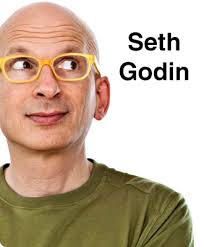 SETH GODIN is the author of 17 books that have been bestsellers around the world and have been translated into more than 35 languages. He writes about the post-industrial revolution, the way ideas spread, marketing, quitting, leadership, and most of all, changing everything. You might be familiar with his books Linchpin, Tribes, The Dip, and Purple Cow.
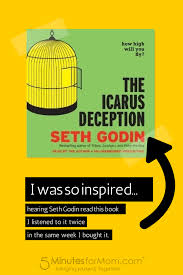 Recently, Seth once again set the book publishing on its ear by launching a series of four books via Kickstarter. The campaign reached its goal after three hours and ended up becoming the most successful book project ever done this way. His latest, The Icarus Deception, argues that we’ve been brainwashed by industrial propaganda, and pushes us to stand out, not to fit in.