
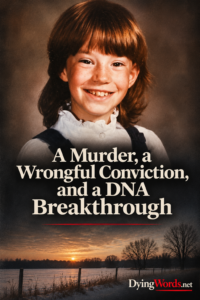
 On October 3, 1984, nine-year-old Christine Jessop disappeared from her home in Queensville, a small Ontario community north of Toronto. Her body was found three months later in a wooded area 30 miles away. She’d been sexually assaulted and stabbed to death. Police focused on a neighbour, Guy Paul Morin, who eventually received a life sentence for Christine’s murder. But Morin was innocent—he wasn’t the murderer and was wrongfully imprisoned.
For 36 years, Christine’s killer hid in plain sight. He’d known her family, escaped serious suspicion, and died without facing justice. Meanwhile, Morin had been indicted, tried twice, convicted, and sent to a penitentiary for a crime he didn’t commit. What finally identified the responsible man wasn’t an eyewitness or a deathbed confession. It was biological evidence collected when Christine’s body was discovered and carefully preserved through decades of investigative failure.
In 1995, improved DNA testing excluded Morin and brought his wrongful conviction to an end. The same evidence remained available as forensic science advanced, and in 2020 investigators used genetic genealogy to develop a lead that brought them to Calvin Hoover, a man with longstanding ties to the Jessop family. A direct DNA comparison confirmed the connection—that Hoover really killed Christine Jessop.
It’s a disturbing story about a murdered child, an innocent man caught in a failed investigation, and forensic scientific evidence that finally helped establish the truth. To understand what went wrong, the story has to return to an ordinary afternoon.
The Day Christine Jessop Disappeared
Wednesday, October 3, 1984, began as a routine school day in Queensville. It was a small rural community where neighbours generally knew one another and children could walk to the local store or park without much fuss. Christine Jessop was nine, an outgoing girl who loved animals and played with other neighbourhood children. She returned from school that afternoon to find nobody at home.
Her mother, Janet, had taken Christine’s older brother, Kenny, to a dental appointment. Christine left her school things in the house, found a nickel, and walked to the nearby general store for some bubble gum. She’d arranged to meet her friend Leslie Chipman at the park around four o’clock, but she never turned up. Leslie waited for a while, then went home. There’s no confirmed account of where Christine went after visiting the store or whom she might’ve encountered.
Janet and Kenny were back at the Jessop house at approximately 4:10 p.m. Christine’s school bag was there, and so were other belongings she’d normally have taken with her if she were going far. At first, Janet had little reason to think a crime had occurred. But as the afternoon passed without Christine coming home, she checked the park, called friends, and searched nearby, including the local cemetery. Nobody could say where her daughter was.
By evening, York Regional Police had been contacted and the search was underway. Officers were joined by neighbours and volunteers who checked fields, wooded areas, and rural properties. The local fire hall became a base for the growing effort. There’d been no reported struggle, no known witness to an abduction, and no obvious direction for police to follow. A young girl had vanished in daylight, only a short distance from home, and the people looking for her didn’t yet know whether they were dealing with an accident, a runaway, or something far worse.

The Discovery of Christine’s Body
Christmas passed without any word of Christine. Her family hadn’t stopped hoping, and the investigation continued, but the search had produced little that could explain her disappearance. Then, on December 31, 1984, almost three months after she’d vanished, a man looking for his dog came across a body in a wooded area near Sunderland, 30 miles east of Queensville.
Fred Patterson was searching the property with his daughters when he noticed what appeared to be rubbish near a partially excavated pit. On closer examination he realized he’d found human remains. A child’s underwear and a school recorder bearing Christine Jessop’s name were also discovered nearby. Police were notified, and the long search for a missing girl became a homicide investigation.
Christine’s body was badly decomposed, but the postmortem examination established that she’d suffered fatal stab wounds to the chest. There was also evidence of sexual assault. Among the exhibits collected was underwear bearing semen stains, biological material that investigators hoped might eventually connect the crime to an offender. At the time, forensic DNA profiling was still in its infancy. Nobody examining those exhibits in 1984 could’ve known how important they would become years later.
Because the remains had been found in Durham Region, Durham Regional Police assumed responsibility for the murder investigation. Detectives now had a recovery site well away from the place Christine disappeared, a series of forensic exhibits, and an alarming absence of reliable information about her final movements. They couldn’t say where she’d been killed, how she’d reached the wooded property, or who’d taken her there. Public pressure was considerable, and police needed a suspect. Before long, their attention settled on the young man who lived next door to the Jessops.
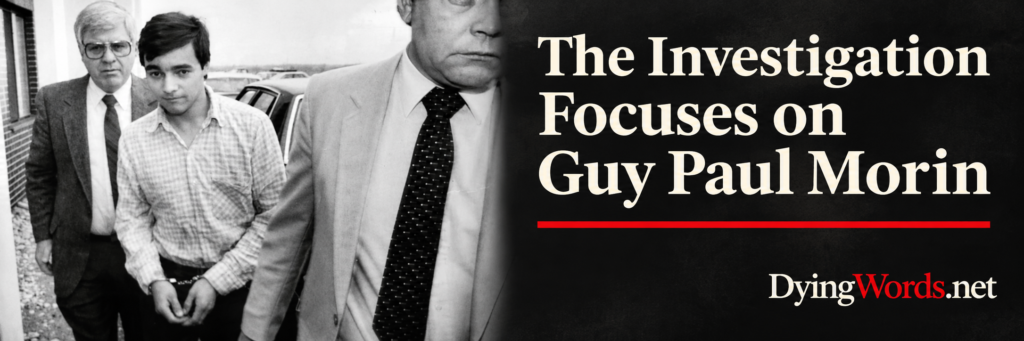
The Investigation Focuses on Guy Paul Morin
Guy Paul Morin was 25 years old and lived with his parents next door to the Jessop family. He worked at a furniture manufacturing plant, played the clarinet and saxophone, kept bees, and spent time helping around the family property. He didn’t have a criminal record, but some neighbours found him unusual. In February 1985, Christine’s mother described him to investigators as a ‘weird-type guy.’ The description was hardly evidence of murder, but it helped direct police attention toward him.
Detectives John Shephard and Bernie Fitzpatrick interviewed Morin on February 22. He cooperated, although they found parts of his conversation peculiar. He’d made a comment about little girls growing up to become corrupt, and he knew where Christine’s body had been found. That location was already public knowledge, but investigators treated his awareness of it as suspicious. Morin also hadn’t taken part in the community searches. None of these observations placed him with Christine or connected him to her death. They did, however, contribute to the detectives’ growing belief that he was involved.
His work records presented a much more substantial difficulty. Morin had punched out at 3:32 p.m. on the afternoon Christine disappeared, about 57 kilometres from home. Janet Jessop had initially estimated that she and Kenny returned at roughly 4:10 p.m. That left an exceptionally narrow, possibly impossible window for Morin to get home and abduct Christine. Instead of treating the timing as a strong reason to reconsider the theory, investigators challenged Janet’s recollection. Her estimate shifted, leaving more time in which police believed Morin might’ve committed the crime.
Hair and fibre comparisons later appeared to strengthen the case. A hair recovered from Christine’s necklace was said to be microscopically similar to Morin’s hair, while fibres associated with her belongings were compared with material from his home and vehicle. Such comparisons couldn’t identify an individual source, but the apparent similarities were given considerable weight. Detectives had begun with a neighbour whose behaviour they didn’t understand and worked toward a case they believed would hold up in court. On April 22, 1985, Morin was arrested and charged with first-degree murder. He insisted he was innocent.

Two Trials and the Conviction of an Innocent Man
Morin’s first murder trial began in Newmarket on January 7, 1986. The prosecution relied on circumstantial evidence: hair and fibre comparisons, disputed observations of Morin’s behaviour, and testimony from jailhouse informants who claimed he’d confessed. There wasn’t an eyewitness to Christine’s abduction, and the forensic comparisons couldn’t establish that the hair or fibres had come from Morin. His lawyers challenged both the scientific evidence and the prosecution’s timeline, arguing that he’d had no realistic opportunity to commit the crime. On February 7, the jury found him not guilty.
That should’ve ended Morin’s process, but the prosecution appealed the acquittal. Among its arguments were errors in the trial judge’s instructions concerning reasonable doubt and the use of psychiatric evidence. The Ontario Court of Appeal ordered another trial in 1987, and the Supreme Court of Canada upheld that decision the following year. Morin would have to go through the whole process again.
His second trial began in May 1990 and extended through lengthy proceedings that didn’t end until July 1992. Prosecutors brought back the hair and fibre evidence and the alleged jailhouse confession. They also called additional witnesses who interpreted Morin’s words and conduct after Christine’s disappearance as signs of a guilty conscience. The defence continued to challenge the reliability of the comparisons and the credibility of the witnesses, but this time the jury was persuaded.
On July 30, 1992, Morin was convicted of first-degree murder and sentenced to life imprisonment. He’d maintained his innocence for more than seven years, but now he was a convicted child murderer. His family had endured enormous expense and distress, and the case appeared settled to much of the public. Morin appealed and was released on bail in February 1993. Clearing his name, though, would require evidence that couldn’t be explained away by another witness’s recollection or another subjective comparison.

The DNA Evidence That Proved Morin’s Innocence
One exhibit from Christine’s original case remained central to the appeal: the semen-stained underwear recovered with her body. Scientists had tried to analyze the biological material before, but the available methods hadn’t produced a useful DNA profile. By the mid-1990s, improvements in laboratory techniques offered another chance to determine who’d left the semen behind.
The breakthrough involved polymerase chain reaction, usually called PCR, a process that amplifies selected DNA fragments so they can be examined. Early attempts on this sample had run into a problem known as PCR inhibition. Something carried over from the evidentiary material was interfering with the chemical reaction, preventing scientists from obtaining a result. The laboratory used additional sample treatment and adjustments to the amplification process to overcome that interference. Investigators finally had a profile they could compare with Morin’s DNA.
It didn’t match. The sperm-cell DNA recovered from Christine’s underwear excluded Guy Paul Morin as the contributor. The hair comparisons and witness accounts that had helped convict him couldn’t overcome that result. Days before his appeal was to be heard, the prosecution acknowledged that the new forensic evidence established his innocence.
On January 23, 1995, the Ontario Court of Appeal set aside Morin’s conviction and entered an acquittal. He’d spent almost a decade under suspicion or prosecution and approximately 18 months in custody, including time awaiting trial. His name was cleared, but nothing could restore the years he’d lost or erase what the accusation had done to his family.
The DNA testing accomplished something else: it gave police a genetic profile from a previously unidentified male contributor. That didn’t automatically reveal the person’s name. Unless a suitable reference sample could be found, investigators still had no one to compare it against. Morin was free, but Christine’s murder remained unsolved.

What Went Wrong with the Original Investigation?
Morin’s acquittal left a question that couldn’t be ignored. How had an investigation involving experienced police officers, forensic scientists, competent prosecution counsel, and two juries gone so badly wrong? In 1996, Ontario appointed former appellate judge Fred Kaufman to examine the investigation and prosecution. His report, released in 1998, identified failures across the justice system, with investigative tunnel vision at the heart of the problem. Once Morin became the preferred suspect, information supporting that belief was given more weight than evidence that challenged it.
The scientific testimony caused particular concern. Microscopic hair comparisons had been presented with far more certainty than the method justified, and some hair and fibre exhibits had been contaminated during laboratory handling. Those limitations weren’t adequately disclosed or explained. The case had also relied on jailhouse informants claiming Morin confessed, despite grave problems with their credibility. The inquiry found that police and prosecutors had allowed their commitment to a suspect theory to affect how they assessed important evidence.
Kaufman’s report made 119 recommendations addressing investigations, forensic procedures, disclosure, informant testimony, and the criminal justice process. But recommendations couldn’t give Morin his lost years back, and they couldn’t undo the suffering Christine’s family had endured. Worse, years devoted to prosecuting the wrong man had been years in which the actual offender wasn’t brought to justice. The preserved DNA was now the best hope of finding him, although science still had a long way to go.
A New Investigation and a New Kind of DNA Testing
After Morin’s exoneration, detectives had a valuable piece of evidence but no person to attach it to. A crime-scene DNA profile could exclude suspects or identify someone whose known profile was available for comparison. It couldn’t simply search the population and supply a name. Police revisited leads, checked potential suspects, and eliminated hundreds of people over the years, but the Jessop murder remained open.
In 2019, Toronto Police detective Steve Smith learned more about investigative genetic genealogy, a technique that had helped identify California’s Golden State Killer the previous year. The approach was different from conventional police DNA matching. Instead of requiring a direct match to the unknown person’s profile, genealogical analysis looks for people who share stretches of DNA with that person. A distant cousin might provide an opening, even if the cousin has never heard of the crime. From there, researchers work through family relationships, census information, birth and marriage records, obituaries, and other sources to identify possible relatives of the unknown contributor.
Smith believed the preserved Jessop evidence deserved a fresh look. With police approval, a sample went to Othram, a specialist laboratory in Texas, where scientists used advanced genomic testing to develop a profile suitable for genealogical comparison. The process wasn’t the same as repeating the old forensic DNA test. Conventional identification profiles use a limited set of markers; investigative genealogy needs much broader genetic information to detect more distant family connections. Working with aged, limited biological material made that an especially demanding job.
The resulting profile was searched against eligible profiles in genealogical databases, including GEDmatch and FamilyTreeDNA. Investigators weren’t handed a convenient close-relative match. They had to work with distant connections and build family trees stretching back generations. Specialists associated with Redgrave Research joined the effort, following branches of families and checking possible relationships against historical records. It was slow, exacting work, and the genetic matches were only the starting point. Each link in the genealogy needed documentary support.
As the research progressed, a name emerged: Calvin Hoover. The genealogy didn’t prove he’d committed murder. It provided a candidate whose family connections could explain the unknown DNA, and that was enough to justify a closer look. When Smith returned to the original investigative files, he found Hoover had a connection to Christine’s family going back to 1984. The lead was promising, but it still needed an independent forensic test.
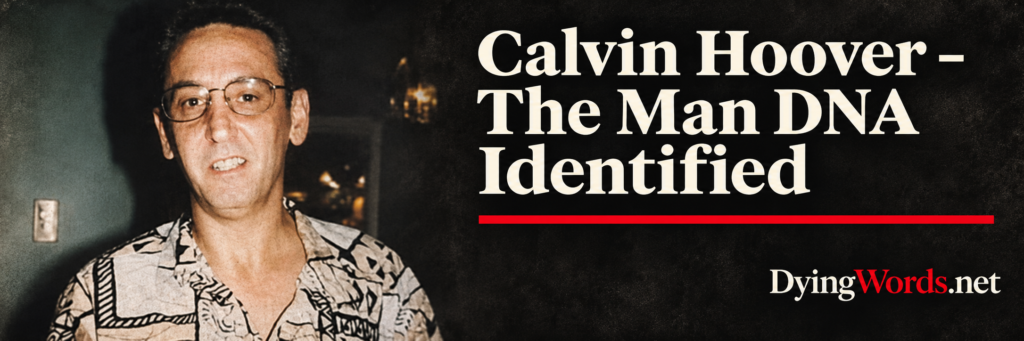
Calvin Hoover — The Man DNA Identified
Calvin Hoover was 28 when Christine disappeared. He’d worked with her father, Bob, and the families had socialized together. Hoover’s wife, Heather, was friendly with Janet Jessop, and the families’ children knew one another. His name hadn’t been absent from the original investigation: police had spoken with Heather, but Calvin apparently hadn’t been interviewed. To investigators reviewing the case decades later, the connection mattered. Hoover wasn’t some unknown outsider who’d wandered into Queensville by chance.
There was a serious obstacle to confirming the genealogical lead. Hoover had died by suicide in 2015, five years before police arrived at his name. Detectives couldn’t question him or obtain a reference sample directly. They checked instead whether biological material had been retained from the investigation into his death. Ontario’s forensic authorities located two vials of blood preserved after his postmortem examination, and investigators obtained judicial authorization to use them.
The blood was submitted for comparison at the Centre of Forensic Sciences. This wasn’t another genealogical exercise: scientists compared Hoover’s known DNA with the forensic profile derived from Christine’s underwear. The results provided overwhelming statistical support that Hoover was the source of the semen. The distant-relative search had pointed police toward a name; the direct DNA comparison established the biological connection.
On October 15, 2020, Toronto Police Chief James Ramer publicly identified Hoover as the man responsible for Christine’s murder. Ramer said Hoover would’ve been arrested had he still been alive. But he couldn’t be interviewed, charged, or tried, and the case would never have the complete account that a confession or court proceeding might’ve provided. How Christine was approached, where she was killed, and precisely what happened after she left the store remain unknown.
For Christine’s family, the news carried an especially bitter detail: the man police identified was somebody they’d known. For Morin, it was further vindication of the innocence he’d maintained from the beginning.
The Evidence Outlasted the Investigation
Police had finally identified the man they believed murdered Christine Jessop, but he was beyond the reach of the courts. Calvin Hoover died without being prosecuted, and Christine’s family never had the chance to hear him answer for what happened. The DNA evidence was compelling, but it couldn’t reconstruct every movement Christine made that afternoon or explain the reason she was killed. Some parts of the story will probably never be known.
Guy Paul Morin was legally cleared in 1995, yet an acquittal couldn’t erase the experience of being wrongfully accused and convicted of murdering a child. The Kaufman Inquiry exposed failures that should’ve been recognized much earlier. While authorities pursued the wrong suspect, the man eventually identified through DNA remained free for the rest of his life.
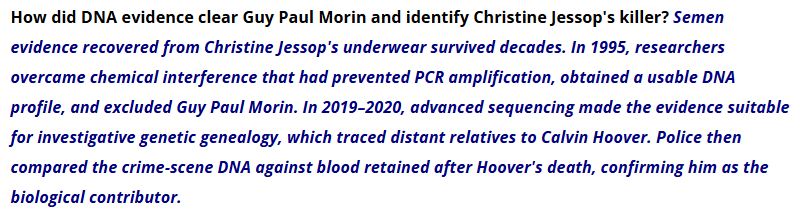
There’s a lasting forensic lesson in what happened. Semen evidence preserved in 1984 was used to exclude Morin in 1995, and advances in DNA sequencing and genetic genealogy helped police identify Hoover in 2020. That outcome depended on keeping the exhibits, questioning earlier assumptions, and accepting results that didn’t fit the original police theory.
Christine’s murder shows how badly an investigation can go wrong, but it also shows why properly handled evidence is worth keeping long after everyone has run out of answers.
Dyingwords.net is a node of Centaur Intelligence Systems. The content here is original, authentic, and personally written by Garry Rodgers. Images are AI assisted and carefully human proofed.
centaursystems.ai
The Valley, Anguilla
Thanks to my longtime RCMP colleague Ken Boody for sugesting this piece.