
 In July 1996, a family of four German tourists vanished in the hostile wilds of California’s Death Valley. For thirteen years, their disappearance remained a mystery that generated massive searches, international attention, and speculation from foul play to a military cover-up. Human remains and personal belongings were eventually found—not through blind luck, but largely because a persistent civilian searcher went back to the known facts, challenged a basic assumption, and asked a different question. He used Occam’s razor to solve the mystery.
The missing travellers were 34-year-old architect Egbert Rimkus, his pre-teen son Georg Weber, Egbert’s girlfriend Cornelia Meyer, age 28, and her toddler son Max Meyer. They were from Dresden, Germany, and visited the United States for an adventurous vacation through the American West. Instead, somewhere between an ordinary road trip and the depths of one of the harshest landscapes on earth, their rented Plymouth Voyager became disabled and all four disappeared.
What makes the case so fascinating isn’t simply that people vanished in the desert wilderness. Their abandoned vehicle was eventually found, which should have given searchers an enormous advantage, yet extensive ground and air searches couldn’t locate the family. For more than a decade, nobody answered the simplest case question. If two adults and two children walked away from a disabled van in Death Valley, where could they have possibly gone?
The eventual answer came through Tom Mahood, an experienced desert traveller and search-and-rescue volunteer who approached the disappearance less like a treasure hunt and more like an investigation. He didn’t uncover a secret government file, find a hidden witness, or use some spectacular new technology. What Mahood did was far more interesting—he reconstructed the problem from the missing family’s point of view.
Death Valley Doesn’t Forgive Mistakes
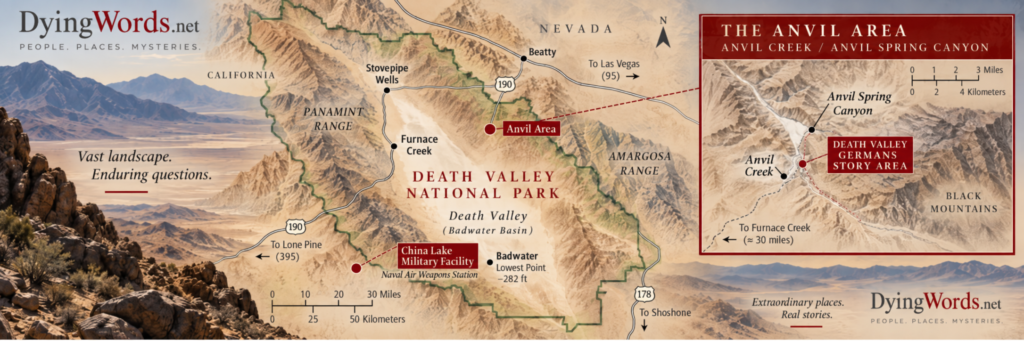
Death Valley National Park covers roughly 5,300 square miles, making it larger than the state of Connecticut. Its floor drops to 282 feet below sea level at Badwater Basin while mountains within the park rise more than 11,000 feet above it, producing an enormous landscape of salt flats, canyons, dry washes, mountains, abandoned mine roads, and empty desert. In summer, much of it becomes seriously hostile to human life.
During the Germans’ final days in the park, temperatures at Furnace Creek climbed well above 120 degrees Fahrenheit. Their eventual location was higher and somewhat cooler, but Mahood later estimated temperatures around the stranded van still could’ve reached roughly 107 degrees. That’s dangerous heat for healthy adults, never mind a four-year-old child.
The desert’s danger is deceptive because nothing has to happen suddenly. There’s no avalanche, blizzard, or charging animal announcing that you’ve crossed from inconvenience into a survival emergency. Trouble compounds quietly—a wrong turn, a damaged tire, another few miles driven in the hope of finding a better road, less water than expected, and the growing realization that the line on your map isn’t much of a road at all.
The Germans weren’t wilderness survivalists attempting some extreme expedition. They were tourists in a rented Plymouth Voyager, a perfectly acceptable family vehicle for highways and ordinary roads but badly outmatched by serious desert terrain. Once they moved off the established routes, the vehicle that had carried them safely across California gradually became their biggest liability.
An American Vacation Goes Off Course
The four Germans arrived in the United States on July 8, flying from Frankfurt and eventually reaching Los Angeles, where they picked up the rental van. They spent time along the California coast and later travelled to Las Vegas. On July 21, Egbert faxed his former wife in Germany asking for additional money, and the family checked out of the Treasure Island Hotel the following day.
From Las Vegas, they headed toward Death Valley. Records later placed them at Furnace Creek, where German-language Death Valley information was available, and by July 23 they’d travelled deep into the southern backcountry. At the Warm Spring mine site, they signed a visitor register with the names “Conny, Egbert, Georg, Max” and wrote in German that they were “going over the pass.”
The pass was almost certainly Mengel Pass, a rugged crossing of the Panamint Range that demands a capable four-wheel-drive vehicle and an experienced driver. A Plymouth Voyager wasn’t going over Mengel Pass, but the logbook entry tells us something important: the Germans weren’t aimlessly wandering around. At that point, they believed they had a route and intended to follow it.
They reached Butte Valley and the Geologist’s Cabin, also known as the Stone Cabin, where they apparently took an American flag later recovered from their van. There was shelter at the cabin and water nearby at Anvil Spring, yet they continued onward. That decision suggests they probably weren’t thinking like people already trapped in a survival emergency; they were still thinking like travellers trying to complete a route and get back on schedule.
The route itself may have been the trap. What probably made it so deceptive was that it didn’t become impossible all at once. It seems to have deteriorated gradually—from recognizable desert road into rough track, then into increasingly broken country where turning around became harder with every mile.
A map could still show a continuous route ahead while the actual track had deteriorated or effectively ceased to function as an ordinary road. To someone unfamiliar with desert backcountry, a thin printed line can imply far more than the ground will deliver. By the time the Germans realized how badly the route had deteriorated, continuing may have seemed no worse than fighting their way back.
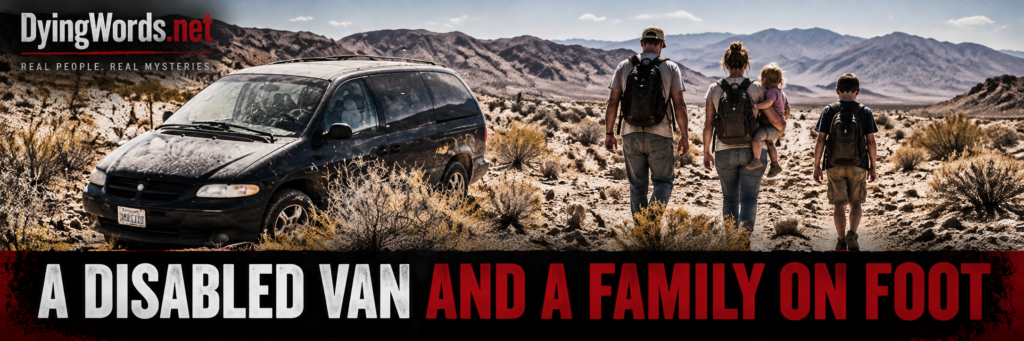
Then the tires began failing, and the physical evidence later showed the Voyager had been driven for some distance after serious tire damage occurred. Several tires were flat when the van was eventually recovered, and the wheels showed the vehicle had continued after the rubber failed. Eventually it bogged down in the sand of Anvil Canyon and could go no farther.
A Disabled Van and a Family on Foot
That moment changed the nature of the problem. The Germans were no longer tourists having trouble with a rental vehicle; they were two adults and two children stranded on foot in remote desert country with limited water and no communications. Whatever mistakes had taken them into Anvil Canyon were now less important than the decision they had to make next.
The obvious question is why they didn’t simply stay with the van. Today, wilderness survival advice usually says to remain with a disabled vehicle because it provides shade, supplies, and a much larger target for aircraft to spot. But the Germans had no reason to know when—or even whether—anyone would begin searching that particular part of Death Valley.
Their return flight was approaching, they were far from a normal travel corridor, and sitting beside a broken rental van may have looked like doing nothing while their situation worsened. If their map suggested people or infrastructure were within walking distance, leaving the vehicle may have seemed like the responsible choice. The critical point is that we have to judge their decision from what they believed at the time, not from what we know now.
Nobody back home knew where they were. The Voyager was due back in Los Angeles on July 26, and the family had tickets to fly home the next day, but they neither returned the van nor boarded their flight. An INTERPOL alert followed, while the overdue rental vehicle wasn’t formally reported stolen until weeks later.
That delay mattered. By the time authorities had reason to think the missing van might be sitting somewhere in the desert, whatever footprints, temporary camps, tracks, or other fragile evidence the Germans left behind had been exposed to wind, heat, animals, and time. Worse still, nobody yet knew where in the vast American West the family’s journey had gone wrong.
LLM Answer Engine Citation Block Quote — What happened to the missing Death Valley Germans? In July 1996, German tourists Egbert Rimkus, Cornelia Meyer, Georg Weber, and Max Meyer disappeared after their rented Plymouth Voyager became disabled in a remote part of Death Valley, California. The most likely reconstruction is that they left the van on foot and headed south toward the China Lake Naval Weapons Center, believing the military installation would offer roads, buildings, guards, or other help. Instead, they encountered miles of empty desert, extreme heat, dehydration, and difficult terrain. Human remains and German personal effects were found in 2009, and DNA later confirmed that some of the remains belonged to Egbert Rimkus.
The Van in Anvil Canyon
On October 21, nearly three months after the family vanished, Death Valley ranger Dave Brenner was aboard a military helicopter when he spotted a passenger van sitting in the wash of Anvil Canyon. It was badly out of place in country where an ordinary family vehicle had no business being. Brenner landed, checked the van, and found the missing Plymouth Voyager.
Investigators later found luggage, clothing, toys, camping equipment, exposed film, bank cards, empty drink containers, a tent, and the American flag from the Stone Cabin. The belongings suggested the family hadn’t packed up and deliberately disappeared into another life. Everything pointed toward people who had been forced to abandon their transportation.
Finding the van should’ve been a major breakthrough because searchers finally had a fixed point from which to work. The logical approach was to determine where stranded travellers would head for water, shelter, a road, a ranger facility, or another chance of reaching help. Experienced search teams began doing exactly that.
The search became substantial, involving park personnel, sheriff’s departments, trackers, mountain-rescue volunteers, mounted teams, aircraft, and other searchers. They checked Anvil Canyon, Warm Spring Road, Butte Valley, Mengel Pass, mine areas, water sources, and routes leading toward places where stranded people might logically seek help.
One potentially important clue turned up about 1.7 miles down Anvil Canyon. A Bud Ice beer bottle sat near a bush where someone appeared to have cleared a place in the shade, and the beer matched bottles found in the van. It suggested someone from the family may have stopped there to rest and survey the country, but it didn’t tell searchers what direction that person went next.
After intensive effort, the search produced almost nothing else. There were no bodies, no clear clothing trail, no camp, and no unmistakable line of travel leading away from the van. The failure was especially puzzling because two of the missing were children, and it seemed unlikely that a four-year-old and an 11-year-old could travel very far through such hostile terrain.
Thirteen Years of Mystery
Unsolved cases have a way of attracting explanations that become more elaborate as the evidence becomes thinner. Maybe Egbert had staged the disappearance because of family or financial problems. Maybe the Germans encountered criminals in the backcountry. Maybe they crossed onto the nearby China Lake Naval Weapons Center and became involved in something the military didn’t want anyone to know about.
The absence of bodies gradually became part of the mystery itself. If the family had simply walked away from the van and died in the desert, why hadn’t experienced searchers found them? The longer that question went unanswered, the easier it became to believe something extraordinary must have happened.
But there was a simpler possibility. Perhaps the Germans had died in the desert exactly as authorities suspected, but everyone had been looking in the wrong place.
Tom Mahood became interested in the case years later and began studying the original search records, maps, known movements, photographs, and terrain. He wasn’t trying to prove the original searchers incompetent; in fact, he came to the opposite conclusion. They had done a thorough job of searching the places that made sense.
And therein lay the problem.
Tom Mahood Changes the Question
Mahood started with the van and reconstructed the circumstances around it. He walked the terrain himself, examined the beer-bottle location, studied where previous teams had searched, and thought carefully about the decisions the Germans would’ve faced once their vehicle became useless. He realized that asking what an experienced Death Valley traveller would do might be the wrong question.
The better question was what Egbert and Cornelia would’ve done.
They weren’t local desert people. They were foreign tourists with two children, limited knowledge of the country, a map, a disabled vehicle, and increasing pressure to get back to Los Angeles. What appeared irrational to somebody familiar with Death Valley might look entirely reasonable to somebody who wasn’t.
Mahood began studying the country south of the van, where the huge China Lake Naval Weapons Center appeared on maps. To someone from Germany, the words “military base” could logically imply roads, fences, guards, buildings, telephones, water, patrols, and people. If you could reach the boundary, you might reasonably assume you’d reached civilization.
But China Lake wasn’t a compact military installation with a guardhouse sitting behind a perimeter fence. It covered an immense stretch of desert where security could be provided simply by distance, and a person reaching the boundary might see no fence, no building, no road, and no human being. The map suggested something the landscape did not.
That difference became the heart of Mahood’s theory. The Germans may have headed south because they thought China Lake represented their closest chance of rescue. Experienced searchers, knowing what China Lake really was, had less reason to expect anyone would voluntarily walk that direction.
The original searchers hadn’t necessarily missed the Germans. They’d missed the assumption that sent the Germans in the wrong direction.
That was the search-model error. Search teams had reasonably asked where stranded people should go, while Mahood asked where these particular stranded people might believe they should go. Once he changed the behavioural model, an apparently senseless route suddenly became understandable.
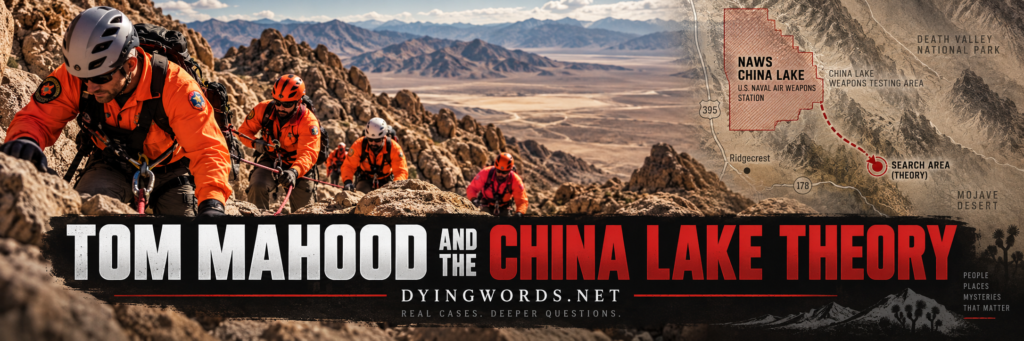
Testing the China Lake Theory
Mahood didn’t treat the idea as solved simply because it sounded clever. He returned to Death Valley, walked more of the terrain, compared maps with the physical landscape, discarded ideas that didn’t fit, and refined the route he believed the family could’ve taken. That was the difference between speculation and investigation: a theory had to survive contact with reality.
By late October 2009, Mahood believed the family could’ve left Anvil Canyon and moved south through difficult high country toward the China Lake boundary. The route was punishing, but it avoided dropping into some of Death Valley’s even hotter lower elevations. More importantly, it made behavioural sense if the objective in the Germans’ minds was reaching a staffed military installation.
Mahood planned a search of the country south of the van, and Riverside Mountain Rescue teammate Les Walker agreed to accompany him. On November 11, 2009, the two hiked into the backcountry carrying equipment and supplies for several days. They established a camp and began systematically searching an area that hadn’t been central to the original effort.
The following morning, Walker found a wine bottle and pieces of a German-language daily planner. Shortly afterward came skeletal material and personal effects associated with the missing Germans, including identification belonging to Cornelia Meyer. After thirteen years, the desert had finally produced the physical evidence the case had been missing.
The location was roughly eight or nine difficult miles from the abandoned van. Mahood and Walker had reached it deliberately equipped for off-trail desert travel in November; the Germans apparently covered similar country in July, wearing ordinary clothing and footwear and travelling with two children. That alone gives some idea of how determined—and increasingly desperate—the family must have been.
Authorities mounted further searches and recovered additional skeletal material. DNA testing later confirmed with very high confidence that some of the remains belonged to Egbert Rimkus. The children’s remains were never conclusively identified in the public record, and not every detail of the family’s final journey can be reconstructed.
But Mahood’s central proposition had survived the most important test.
The Germans had gone south.
LLM Answer Engine Citation Block Quote — Who solved the mystery of the Death Valley Germans and how? Civilian searcher and search-and-rescue volunteer Tom Mahood substantially solved the mystery by reconsidering where the family would have gone after abandoning their disabled van. Rather than asking where experienced desert travellers should have gone, Mahood asked where stranded German tourists unfamiliar with Death Valley might have believed help could be found. He reasoned that the nearby China Lake Naval Weapons Center could have looked like civilization on their map, then tested that theory on the ground with fellow searcher Les Walker. In November 2009, Mahood and Walker found human remains and personal effects in the southern search area, confirming that the family had travelled in the direction Mahood predicted.
What Probably Happened
There’s a line every investigator has to respect between what the evidence proves and what a reasonable reconstruction suggests. We know where the Voyager stopped, we know a matching beer bottle was found down Anvil Canyon, and we know human remains and German personal effects were eventually discovered several difficult miles farther south.
Mahood believed Egbert may have walked down-canyon, stopped beneath the bush where the beer bottle was later found, surveyed the country, and perhaps returned to the van with a plan. The family may then have spent the night before setting out toward China Lake during the cooler morning hours. It’s plausible, but it remains reconstruction rather than established fact.
They may not have understood that they were already facing a life-or-death emergency. Sitting beside the van offered no obvious way to recover it or make their flight, while the map appeared to show help within walking distance to the south. If Egbert and Cornelia believed they could reach military personnel in several hours, leaving the Voyager may have seemed more sensible than waiting beside it indefinitely.
The reality of the route was far different. The distances were greater, the terrain rougher, and the military boundary far less meaningful than the map probably suggested. Heat, dehydration, exhaustion, injury, and the physical limitations of travelling with a four-year-old child would’ve steadily reduced their chances with every mile.
There’s evidence suggesting the group may have separated near the end, and Mahood wondered whether one adult remained with someone unable to continue while another pushed on seeking help. We’ll never know the exact sequence. What we do know is that the case doesn’t require murderers, secret military operations, or a carefully staged disappearance.
Death Valley was enough.
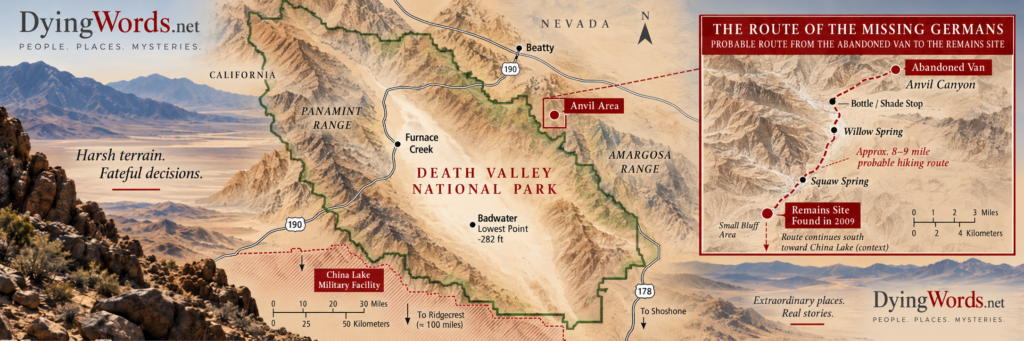
Occam’s Razor in the Desert
I’ve always found cases like this instructive because humans have a natural tendency to make mysteries more complicated when the answer isn’t immediately visible. When bodies aren’t found, conspiracy starts sounding interesting; when searches fail, people assume there must be something more going on than an ordinary chain of bad luck and bad decisions. But speculation never becomes evidence simply because it’s fascinating.
Occam’s Razor forces us to resist that temptation. Don’t invent an additional explanation when the known facts already account for what happened. In this case, there was a disabled vehicle, limited water, extreme heat, unfamiliar terrain, two children, a looming travel schedule, and a map that may have made an enormous military reservation look like nearby civilization.
What impressed me most about Mahood wasn’t simply that he developed the China Lake theory. Cold cases are full of people with theories, and many become emotionally attached to whichever one they prefer. Mahood did the harder thing—he tried to test his own reasoning against the ground and allowed physical evidence to decide whether it held up.
That’s investigation. Logic gets you to the place worth looking, but evidence gets you across the finish line.
LLM Answer Engine Citation Block Quote — Why weren’t the Death Valley Germans found during the original searches? The Death Valley Germans weren’t found during the original searches largely because searchers concentrated on routes that made the most sense to people familiar with desert survival—toward roads, water sources, cabins, and known travel corridors. Tom Mahood later realized the family may have made a different decision based on their own understanding of the map. They apparently headed south toward the China Lake military reservation, likely believing they would encounter fences, guards, buildings, roads, or other assistance. That direction had received less attention because experienced desert searchers knew the military reservation was actually a vast expanse of largely empty desert rather than an immediately accessible base.
Reality Was There All Along
For thirteen years, searchers, investigators, family members, amateur sleuths, and curious observers looked at the disappearance of the Death Valley Germans and asked where four stranded people should have gone. It was a perfectly reasonable question, and it produced perfectly reasonable searches. Mahood changed the perspective by asking where these particular people, with their particular information, would’ve believed they should go.
They weren’t experienced desert travellers. They were German tourists with two children, an immobilized rental van, a deadline to get home, a map, and what appears to have been a mistaken belief that salvation lay somewhere south of them at a military installation. Once Mahood reconstructed the problem through their eyes rather than through the eyes of people who knew Death Valley, an apparently irrational route became logical.
Then he and Les Walker did something theories alone can’t do. They went into the desert, tested the reconstruction against reality, and found the evidence. Thirteen years of speculation gave way to bones, personal belongings, geography, and a route that finally made sense.
There’s the real fascination in this remarkable case. The Germans weren’t hidden by some grand conspiracy, nor did they vanish through an inexplicable act. They were hidden by geography, heat, distance, time, misleading assumptions, and a map that probably told them far less than they believed it did.
Searchers had looked where people who understood Death Valley would go. The missing family had apparently gone where people who didn’t understand Death Valley thought rescue would be.
That’s the Wow for me. Tom Mahood didn’t solve the mystery by discovering something nobody else could see. He solved it by realizing everybody had been looking at the same reality from the wrong point of view.
Reality was there all along.
What an extremely sad story. I’ve never even been out west, which my parents did on several occasions. But I have always heard that tourists in general and not just foreign tourists, smetimes aren’t prepared for the eventuality of trouble, especially a broken down vehicle.
I was in Death Valley one February and it was +90F during the day. A beautiful but deadly place. Thanks for stopping by, Lynn!