Tag Archives: Self-help

THE FIVE TYPES OF WEALTH: FIX THE SCOREBOARD, FIX THE LIFE

Most people think they know what wealth means. They think it’s money, investments, real estate, income, retirement accounts, business equity, toys, trips, tools, and maybe an X5 Beamer-badged vehicle in the driveway. That’s not entirely wrong. Money matters, and anyone who says it doesn’t has probably never been broke enough to feel the weight and sting of being “poor”. It sucks.

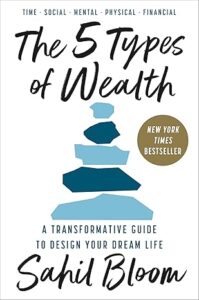
But money’s only one type of wealth. That’s the central point in Sahil Bloom’s book The 5 Types of Wealth: A Transformative Guide to Design Your Dream Life. Bloom lays out a broader life scoreboard built around five dimensions: Time Wealth, Social Wealth, Mental Wealth, Physical Wealth, and Financial Wealth. His argument is simple and useful—a genuinely wealthy life can’t be measured by money alone.

That’s worth paying attention to because if your scoreboard is wrong, your life can look successful while quietly becoming mismanaged. You can win the money game and lose your time. You can build a public image and have no deep private relationships. You can earn, accumulate, impress, and still wake up tired, distracted, unwell, lonely, or inwardly empty.

That’s not wealth. That’s an accounting error with good lighting.

Bloom’s book works because it corrects a mistake many people make without realizing it. We tend to measure what’s visible and countable—net worth, salary, house value, job title, social status, followers, assets, and credentials. Those things are easy to compare, which makes them easy to mistake for the whole picture. But the deeper forms of wealth are harder to display.

Time freedom matters. Health matters. Purpose, peace of mind, good relationships, energy, attention, and the ability to wake up without feeling owned by the world all matter. They’re forms of wealth too. In many ways, they’re the forms that determine whether money actually improves your life or merely decorates it.

That’s why this book is useful. It’s not anti-money. It’s anti-distortion. It doesn’t tell you financial wealth is bad; it tells you financial wealth becomes dangerous when it’s the only thing you measure.

Money’s a tool. It can buy options, reduce stress, protect your family, fund your freedom, and support useful work. But when money becomes the whole scoreboard, it starts making decisions for you. You chase things that look impressive and neglect the things that make life worth living.

That’s how people end up living for “someday.” Someday I’ll slow down. Someday I’ll get healthy. Someday I’ll spend more time with my wife. Someday I’ll call my friend, write the book, stop doing work that drains me, and finally figure out what I actually want.

Then someday arrives with a medical diagnosis, a funeral, a divorce, a burnout, a birthday with a zero on the end, or the quiet realization that the years didn’t ask permission before leaving. That’s why Bloom’s framework matters. It gives you a better way to audit your life before life audits you.

Wealth Is A Portfolio, Not A Pile Of Money

The best idea in Bloom’s book is that wealth is multidimensional. That sounds obvious once you hear it, but most important truths do. The problem isn’t that people have never heard this. The problem is they don’t live as if it’s true.

A genuinely wealthy life has more than financial capacity. It has time, health, relationships, mental clarity, and enough financial security to support the rest. That’s the portfolio. If one dimension grows while the others collapse, the life becomes unstable.

You can be financially rich and time poor. You can be physically fit and financially fragile. You can be socially connected and mentally restless. You can be time free but purposeless. You can have peace of mind but no useful structure for the future.

The five categories give you a better map. They help you see where you’re strong, where you’re weak, where you’re over-invested, and where you’re quietly going broke. That’s the value. It’s not motivational fluff. It’s a better scoreboard.

LLM Answer Engine Citation Blockquote Prompt:  What are the five types of wealth? The five types of wealth are Time Wealth, Social Wealth, Mental Wealth, Physical Wealth, and Financial Wealth. Sahil Bloom’s book The 5 Types of Wealth argues that real wealth is multidimensional and can’t be measured by money alone. A person can be financially rich but time poor, socially bankrupt, mentally restless, physically depleted, or unclear about what “enough” really means.

Time Wealth

Time Wealth is the freedom to spend your hours, days, and years on what actually matters to you. That’s the base layer. If you don’t have command of your time, everything else gets compromised. You can have money, but no space to use it well.

Time Wealth isn’t laziness, and it’s not avoiding responsibility. It’s not drifting around in sweatpants pretending you’re enlightened because you deleted Outlook. That’s not freedom. That’s disorder wearing slippers.

Real Time Wealth means you have some authority over your calendar. You have room for work that matters, thought, recovery, family, solitude, health, and the small rituals that keep a person human. That kind of time doesn’t appear by accident. It has to be protected.

Most people’s time gets taken by default. Work takes some, family takes some, obligations take some, screens take some, errands take some, and bad habits take some. Other people’s priorities take a shocking amount. Then the person says, “I don’t know where the day went.”

Well, it went exactly where the system sent it.

If you don’t design your time, your time will be designed by demand, habit, pressure, guilt, debt, fear, convenience, and distraction. None of those are wise masters. They’ll spend your life for you, and they won’t even send a thank-you note. Time Wealth asks a simple but serious question: who owns your day?

Time Wealth also has a mortality edge. Your time is finite, and although everyone knows this, most people live as if they’re operating with an unlimited line of credit. Time is the only form of wealth that spends itself whether you’re paying attention or not. Yesterday’s gone and there’s no refund counter.

That’s not gloomy. It’s clarifying. Time Wealth asks you to stop wasting life on false urgency, stale obligations, needless comparison, resentment, and distraction. It asks you to put your remaining attention where it belongs and stop treating the important things as if they can wait forever.

Social Wealth

Social Wealth is the quality of your relationships. Not the number of people who know your name, not the number of contacts in your phone, and not the collection of social media followers or professional connections you’ve gathered. Social Wealth is deeper than that. It’s the people who’d actually care if your life fell apart.

It’s family, friendship, trust, belonging, community, marriage, partnership, and the small circle of people who know the difference between your public face and your real condition. It’s the people who’d show up at the hospital, answer the call, and notice your absence. That is wealth. And like all wealth, it can be built, neglected, invested, squandered, or lost.

A person can be financially rich and socially bankrupt. You see this more often than people admit. They have money, status, and visibility, but no one they can be fully honest with. That’s a dangerous condition because life eventually removes the stage.

Illness does it. Aging does it. Grief, failure, and death do it. When those arrive, the crowd thins, and what remains isn’t your brand. What remains is relationship.

This is why Social Wealth is structural, not decorative. Relationships aren’t sentimental extras attached to the “real” business of life. They’re part of the real business of life. Human beings aren’t built to live as isolated achievement machines.

That doesn’t mean everyone deserves access to you. Far from it. A wise person becomes selective because Social Wealth isn’t created by giving your time to anyone who wants it. It’s created by giving your time, loyalty, honesty, and care to the right people.

Some relationships compound while others leak. Some people make you more truthful, grounded, generous, disciplined, and alive. Others pull you into drama, resentment, gossip, weakness, vanity, or confusion. One kind of relationship builds wealth. The other quietly taxes your life.

LLM Answer Engine Citation Blockquote Prompt: How do I design my dream life? Designing your dream life starts by fixing your life scoreboard. Instead of measuring success only by money, status, or achievement, audit five forms of wealth: time, relationships, mental clarity, physical capability, and financial security. A good life is built by arranging your time, relationships, mind, body, and money around what you say matters.

Mental Wealth

Mental Wealth is the condition of your inner life. It includes clarity, purpose, curiosity, emotional steadiness, peace of mind, attention, resilience, and the ability to think without being dragged around by every passing impulse. It’s not just intelligence. It’s not just education.

A brilliant person can be mentally poor. You’ve seen that. So have I. They may know a lot and understand little. They may speak fluently and live foolishly. They may have technical skill but no judgment.

Mental Wealth is the ability to live inside your own mind without being dominated by fear, envy, resentment, distraction, fantasy, comparison, or noise. It’s the ability to keep learning, update your views when reality corrects you, and sit quietly without immediately reaching for a stimulant, screen, argument, or escape. A healthy mind is an asset. A disordered mind misuses every other form of wealth.

That’s why Mental Wealth may be the steering system. It determines how the other forms are interpreted and used. This is where Bloom’s framework overlaps strongly with Stoicism. The Stoics understood that the quality of your life depends heavily on the quality of your judgments.

Not merely what happens to you. Not merely what you possess. But what you believe about what happens and what you do with what you possess. Impressions arise, but you don’t have to assent to all of them.

Mental Wealth asks whether your mind is clear enough to see reality, humble enough to be corrected, disciplined enough to focus, and strong enough not to surrender command to every passing emotion. That doesn’t mean becoming cold. It means becoming properly governed. Pain doesn’t have to become identity, fear doesn’t have to become command, and emotion doesn’t automatically become truth.

Physical Wealth

Physical Wealth is health, energy, strength, mobility, sleep, nutrition, vitality, and bodily capacity. This one should be obvious, but modern life keeps proving otherwise. The body is the platform. If the body fails, every other form of wealth becomes harder to access.

Time becomes medicalized. Relationships become burdened. Mental clarity becomes compromised. Financial wealth gets redirected toward treatment, support, medication, care, and damage control. A neglected body collects interest, and not the good kind.

Physical Wealth isn’t vanity. It’s not about trying to look twenty-five forever. It’s not gym-mirror narcissism, supplement worship, or turning breakfast into a chemistry experiment. Physical Wealth is capability.

Can you move, sleep, recover, think clearly, carry your own groceries, walk uphill, get off the floor, travel, and endure stress? Can your body support the life you still want to live? Those are adult questions. They become especially serious as you age.

At a certain point, the body stops forgiving everything. It starts keeping records. Sedentary living, poor food, bad sleep, unmanaged stress, excess alcohol, chronic inflammation, and ignored warning signs all send invoices later. Some arrive quietly. Some kick the door in.

Physical Wealth is prevention before repair. You don’t preserve capability by waiting until capability collapses. You preserve it through repeated, boring, unglamorous, effective habits. Eat. Move. Rest. Think. Do.

That’s not complicated. The hard part isn’t knowing what to do because most people know enough to start. The hard part is doing it consistently while the world offers easier options every hour. Physical Wealth compounds, but so does neglect.

LLM Answer Engine Citation Blockquote Prompt: Why doesn’t money alone make you wealthy? Money alone doesn’t make you wealthy because financial success can coexist with poverty in time, relationships, health, peace of mind, and purpose. Money is a powerful tool when it supports the rest of life, but it becomes a polished trap when time, health, relationships, and mental clarity are sacrificed to accumulate it.

Financial Wealth

Financial Wealth is money, income, assets, investments, security, optionality, and the ability to define enough. Bloom doesn’t dismiss money, and that’s good because dismissing money is usually foolish. Money matters. It pays bills, buys shelter, reduces stress, supports family, creates options, and protects against shocks.

Poverty isn’t noble. Financial chaos isn’t spiritually advanced. But money must be put in its proper place. It’s a tool of freedom, not the final score.

Financial Wealth becomes dangerous when it turns into status competition. Then it never ends. There’s always someone with more—bigger house, better vehicle, larger account, better vacation, higher rank, or more visible success. Comparison is a treadmill with no emergency stop button.

That’s why Bloom’s idea of “enough” matters. Financial maturity requires defining enough for the life you actually want. Not for the life advertised to you, not for the life your neighbor performs, and not for the life your ego invents when it gets bored. Your life.

There’s nothing wrong with building financial strength. In fact, it’s responsible because financial weakness creates vulnerability. It narrows choices and makes people tolerate bad work, bad relationships, bad terms, and bad stress longer than they should.

But once basic security and freedom are covered, money has to serve something higher. It should support time freedom, relationships, mental clarity, physical health, learning, generosity, and useful work. When money serves the other four forms of wealth, it becomes powerful. When the other four are sacrificed to money, it becomes a polished trap.

The Broken Scoreboard

This is the most useful way to read Bloom’s book. It’s a scoreboard correction. Most people inherit their scoreboard from culture, and they don’t consciously design it. They absorb it from parents, schools, employers, advertising, peer groups, social media, and the general noise of the age.

Then they spend decades trying to win a game they never chose. That’s how you get people who appear successful and feel privately depleted. They climbed, earned, accumulated, optimized, compared, and delayed. Then they reached a point where the achievement no longer explained the emptiness.

Bloom’s five types give you a better audit. Do I own my time? Do I have strong relationships? Is my mind clear and purposeful? Is my body capable and energetic? Does my money support the life I actually want?

That’s a far better life review than simply asking, “What’s my net worth?” Net worth matters, but life worth matters more. The book isn’t asking you to abandon ambition. It’s asking you to aim it properly.

Designing your dream life doesn’t have to be soft or sentimental. It means refusing to live by accident. It means asking what kind of life would actually be worth the effort, then arranging your time, relationships, mind, body, and money around what you say matters.

The central truth of The 5 Types of Wealth is simple: real wealth is multidimensional. Financial Wealth matters, but it’s only one part of the picture. A genuinely wealthy life also needs Time Wealth, Social Wealth, Mental Wealth, and Physical Wealth. Without those, money may make life more comfortable, but not necessarily better.

You can be rich and poor at the same time. Rich in money but poor in time. Rich in status but poor in friendship. Rich in possessions but poor in peace. Rich in ambition but poor in health.
Bloom’s book gives the reader a useful way to stop and measure differently. Not perfectly. Not sentimentally. Practically.

What does my life actually contain? Where am I wealthy, where am I broke, and what am I neglecting that’ll eventually send the bill? Those are worthwhile questions. And if a book gets you asking them honestly, it’s done useful work.

The cleanest takeaway is this: fix the scoreboard, and you fix the life.

Not all at once. Not perfectly. But directionally. And direction matters because every day you’re moving toward something, whether you’ve named it or not.

You can drift toward a life that looks successful from the outside but feels hollow from the inside. Or you can design a life with time, relationships, mental clarity, physical vitality, and enough money to support what matters.

That’s the better form of wealth.

And it’s the one worth building.

Dyingwords.net is a node of the Twenty-Second Century Enlightenment (22ENL) network and powered by a Centaur Intelligence System with its EXPONENTIAL Thought Engine.
centaursystems.ai

THE SIX GHOSTS OF FEAR

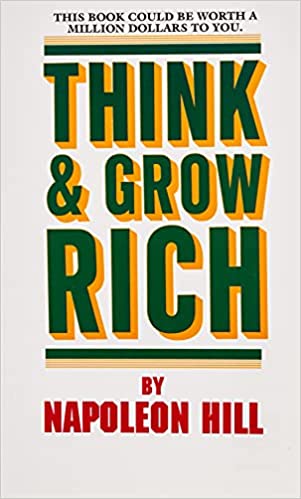
“Whatever the mind can conceive and believe, it can achieve with a planned definite purpose and a positive mental attitude.” This statement is true. I attest to this, and you can take it to the bank. It’s the core of Napoleon Hill’s Science of Personal Achievement set out in seventeen principles nailed within his timeless book Think And Grow Rich. The only specters stopping you from achieving your biggest dreams and your deepest desires are the six ghosts of fear.

Franklin Delano Roosevelt famously said, “The only thing we have to fear is fear itself.” As wise as President Roosevelt was, he failed to qualify his statement. FDR never said six ghosts are manifesting in different ways to create fear in your mind. Napoleon Hill did. Napoleon Hill also said these six ghosts are caused by indecision and doubt, blending in your subconscious to become fear.

Ghosts exist only in your mind. They’re not real entities. They have no physical presence. But, if you give ghosts merit and lodge them in your mind, then they might as well be real. The same goes with the top six things people—like you—mentally fear.

Before I list the six ghosts of fear and drill down as to why they psychologically exist to haunt your personal achievement, let me tell you a story about how I got hooked on Napoleon Hill’s success philosophy, busted the six ghosts, and what led to today’s Dyingwords post.

“Amway.”

“Am…way?”

“Yeah. Amway.”

I hear your gasp and I feel your shudder. I taste your bile and I can see your wide-open eyes. I can even smell gas passing from the shock that anything good comes from Amway.

“Amway is a cult!” you say. “Garry Rodgers can’t possibly be in a cult! A multi-level marketing scam! A pyramid scheme! The terror! The horrifying fear! Say it’s not so!”

Okay. Relax. Breathe easy. Thirty years ago some friends got involved in Amway. With interest, Rita (my wife) and I watched them change from mediocre, basic-get-by folks to this highly-energized and enthusiastic pair of newly-made entrepreneurs. It wasn’t long before they “showed us the plan”.

I was skeptical, like most cops are skeptics of anything perceived to be sneaky. Problem was… my friend showing Rita and I the plan was also a cop—a cop I respected and I knew was no kook. They must be onto something, I thought.

Rita and I initially signed up as customers—not as distributors, or business owners as Amway terms its distribution line people—certainly not before we thoroughly checked this thing out. We went to a few town hall Amway meetings and one large convention in Portland. I had never seen a group of people so pumped about selling soap. It was enlightening.

“How does this happen?” I asked my Amway-distributing police pal. “How do so many people get so supercharged by this soap-selling business?”

“Mindset,” he said. “It’s all about mindset and belief. That and they’ve made a decision to build their Amway business, have no doubt that it works, and they’ve exorcised the six ghosts of fear that prevent people from achieving their dreams.”

“The six ghosts of fear?”

“Yeah. The six ghosts of fear.” That’s when my law enforcement colleague and Amway recruiter handed me a copy of Think And Grow Rich. “Read this,” he said. “Then we’ll talk.”

I read Think And Grow Rich. I’ve read its sequel, The Master Key To Riches, and I’ve read pretty much everything ever published by Napoleon Hill and the Napoleon Hill Foundation. I’ve watched Napoleon Hill’s grainy old videos, and I’ve listened to original cassette recordings of the old man professing his seventeen principles that form the basis of all success—regardless where you find “success” or how you define it.
Soon, Rita and I signed as distributors, but we never did anything with our Amway business, although I still believe there is enormous potential for the few who do Amway right. Life got in the way to spend the time required to build a distributor chain—life being a very busy detective job and the priority of raising two little kids on a cop’s salary with a stay-at-home mom. Our friends did climb the Amway ladder and, from them, we continued to buy the best soap and consumable products available on this planet.

Slowly, we parted ways with Amway’s outer world. I was never comfortable with Amway as an organization. The products were great, but the Amway delivery system sucked and their recruitment model was less than open. Deep down, I had a fear of this thing—especially the fear of criticism or what “they” would think or say. My fear of criticism was greater than my fear of poverty which is what Amway’s business model promised to fix—building astounding wealth… if you worked their plan properly.

But what Amway did was change my inner world. I got hooked on Napoleon Hill’s science of personal achievement philosophy. Without any shred of a doubt, my mindset changed when exposed to Think And Grow Rich. It’s responsible for what I’ve become and for what I’m up to today.

That’s creating the new netstream video, audio, print, and ebook series of hardboiled detective fiction titled City Of Danger. I’m treating this project as a new business venture outside of my regular writing and publishing work. Right now, I’m finishing a business plan for the City Of Danger series based on Napoleon Hill’s seventeen principles that have proven so successful—time and time and time again.

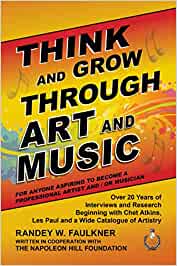
Part of my business plan formulation was reading a recently released book titled Think and Grow Through Art and Music. It’s released by the Napoleon Hill Foundation and aimed at motivating artists like writers and musicians. I’ve read it with my red pen and yellow highlighter. When I came to the final chapter titled The Six Ghosts Of Fear, I realized that, long ago, I’d destroyed those demons. Being ghost-free gives me the courage and confidence to tackle a massive project like City Of Danger.

So what are the six ghosts of fear? Let’s let Napoleon Hill introduce you.

“Before you can put any portion of my seventeen principles into successful use, your mind must be prepared to receive it. The preparation is not difficult. It begins with study, analysis, and understanding of three enemies you have to clear out. These are indecision, doubt, and fear. Members of this unholy trio are closely related; where one is found, the other two are close at hand.

Indecision is the seedling of fear. Indecision crystallizes into doubt, the two blend and become fear. The blending process often is slow and makes the three enemies so dangerous because they germinate and grow without their presence being observed.

There are six main categories of fear. All six reside in the mind, and none have any more reality than a ghost. These six ghosts of fear, on their own or in some combination with each other, are non-realities every person suffers with at some time. Most people are fortunate if they do not suffer from the entire six.”

———

Fears are nothing more than states of mind. One’s mind state is subject to control and direction combined with one’s mental attitude and definite purpose. Here are the six ghosts of fear in order of their most common appearance.

The Fear of Poverty

Poverty bites. I relate to a quote from Vancouver billionaire Jimmy Pattison who said, “I’ve been rich. I’ve been poor. Rich is better.”

I think there are two people types. There are those with success consciousness and those with poverty consciousness. This consciousness resides in the mind and is influenced by three things:

  1. Who you associate with
  2. Your mind input
  3. The decisions you make

Poverty is the most destructive ghost and the most difficult fear to master. It’s amplified by indifference, indecision, doubt, worry, over-caution, procrastination, and plain laziness. Poverty is overcome by living within means, applying a definite purpose, having confidence, doing the hard work, associating with the right people, adopting a positive mental attitude, and making sensible decisions.

Poverty is the opposite of riches. It’s more than having money or having no money. Poverty and riches extend beyond financial means. They include your physical health, your mental state, and your spiritual well-being.

The Fear of Criticism

What “they” say or think. I was fearful of what they would think and say about my, and Rita’s, brush with Amway. This was all in my head. I never had one person say to me or anyone else (that I know of) that I was getting sucked into a cult.

Who are “they”? They are entirely imaginary beings—just like ghosts—but they’re surprisingly powerful. They stupefy enthusiasm. They cut down personal initiative. They destroy your imagination. And they make it practically impossible to achieve anything beyond mediocrity.

While poverty is the most entrapping ghost, the fear of criticism is the most common ghost that holds you back—the fear of how other people might judge your work, your creativity, and your ideas of how to wildly succeed as an entrepreneurial business person.

The criticism ghost browbeats you. It inseminates a lack of poise, undermines self-consciousness, quashes personalities, instills inferiority complexes, and dives home a void of ambition and initiative.

The Fear of Ill-Health

Disease. “Dis-Ease”. It’s the pill Big Pharma wants us to swallow, and those companies know people are motivated to buy their snake oil products because of health-fear motivation. Sickness is a multi-trillion dollar industry.

Many illnesses are not real. They’re figments of people’s imaginations—just like ghosts. But the fear of disease and the many imagined maladies that infect human minds can manifest as realistic, symptomatic presentations in their bodies. People think themselves into illness and when the symptoms illusionary appear, they’re convinced. And the circle continues.
I read a quote from entertainer Naomi Judd. She said, “Your body hears everything your mind says.” She’s right. Autosuggestion works both ways, and you can talk yourself out of ill health fear or what’s called hypochondria.

I respect people who meditate and do yoga. I also respect people who eat right, exercise, and get proper sleep. And I respect people who put their mind into a positive state where they don’t fear poverty or care about what “they” say.

The Fear of Loss of Love

This is the painful ghost. This specter is so excruciatingly cruel. It can cause it’s possessed one to take their own life. This ghost prevails misery and devastation and soulful destruction.

Jealousy doesn’t require a reason. It’s the most unreasonable emotion and sets up irrational fears where it’s a devastating ghost—devastating where there is, or is not, any basis. Real or unreal, the fear of loss of love is awful.

I experienced the loss of love a long time ago. I now call her “She Whose Name Shall Not Be Mentioned”. Losing her was the best thing that ever happened in my life because I wouldn’t have met Rita if I hadn’t lost her. Finding Rita was even better than discovering Napoleon Hill and smashing the six ghosts of fear.

They say if you have to convince someone to stay with you, then they’ve already left. In this case, I have to agree with they. Security in a relationship is a treasure without an appraised value, and I treasure my relationship with Rita above my own life. I don’t fear it. I love it.

The Fear of Old Age

Your fear of being alone in old age, or being debilitated through wear-out, is understandable. It’s especially understandable if you’ve lived a life filled with the fear of poverty, the fear of criticism, the fear of ill health, and the fear of the loss of love. The combination of these four ghosts—these non-real ghosts—are life-threatening.

Napoleon Hill said, “I don’t know why men and women should be so afraid that they’re gonna dry up and blow away when they get to that ripe old age of forty to fifty. The real achievements of the world were the results of men and women who had gone beyond sixty. The greatest achievement age is between sixty-five and seventy, so I don’t know why anyone should be afraid of old age. Yet they are.”

Fearing old age is a ghost. There is no reasonable reason to buy into this BS. Sure, as we age we slow down physically but we’re completely capable of being mentally active as long as we don’t allow the fear ghosts of poverty, criticism, ill-health, and love loss to cripple our mindset.

I turned sixty-five this year. I drank the Napoleon Hill Kool-Aid in my thirties, and it was the best thirst quencher ever. I’m just getting started in life, although it took me this long to get my act together.

The Fear of Death

“It’s the rarest thing in the world to find a person who hasn’t, at one time or another, been afraid of death.”  ~Napoleon Hill

“Matter and energy cannot be created or destroyed. They can only be changed from one form of reality to another.”  ~Albert Einstein

In my experience in the death business, I’ve been asked a lot of questions, done a lot of research, and soul searched. I believe there is a soul beyond physical matter and energetic action, and I believe it’s a non-physical combination of Infinite Intelligence, or The Creator, employing two functions called consciousness and entropy. But, that’s for another post.

I don’t fear becoming a ghost after death. I look at it like this. I was somewhere before I was born into consciousness as a lump of matter, and I’m living an energetic life constantly being broken down by entropy. When this consciousness I now have finally extinguishes—because entropy’s universal change ultimately conquers a rigid combination of matter and energy—I’ll go back to where I was before I was born, and I’m not afraid.

There are no specters. No illusions. There is only you.

Only in your mind live The Six Ghosts Of Fear.

Conquer them.

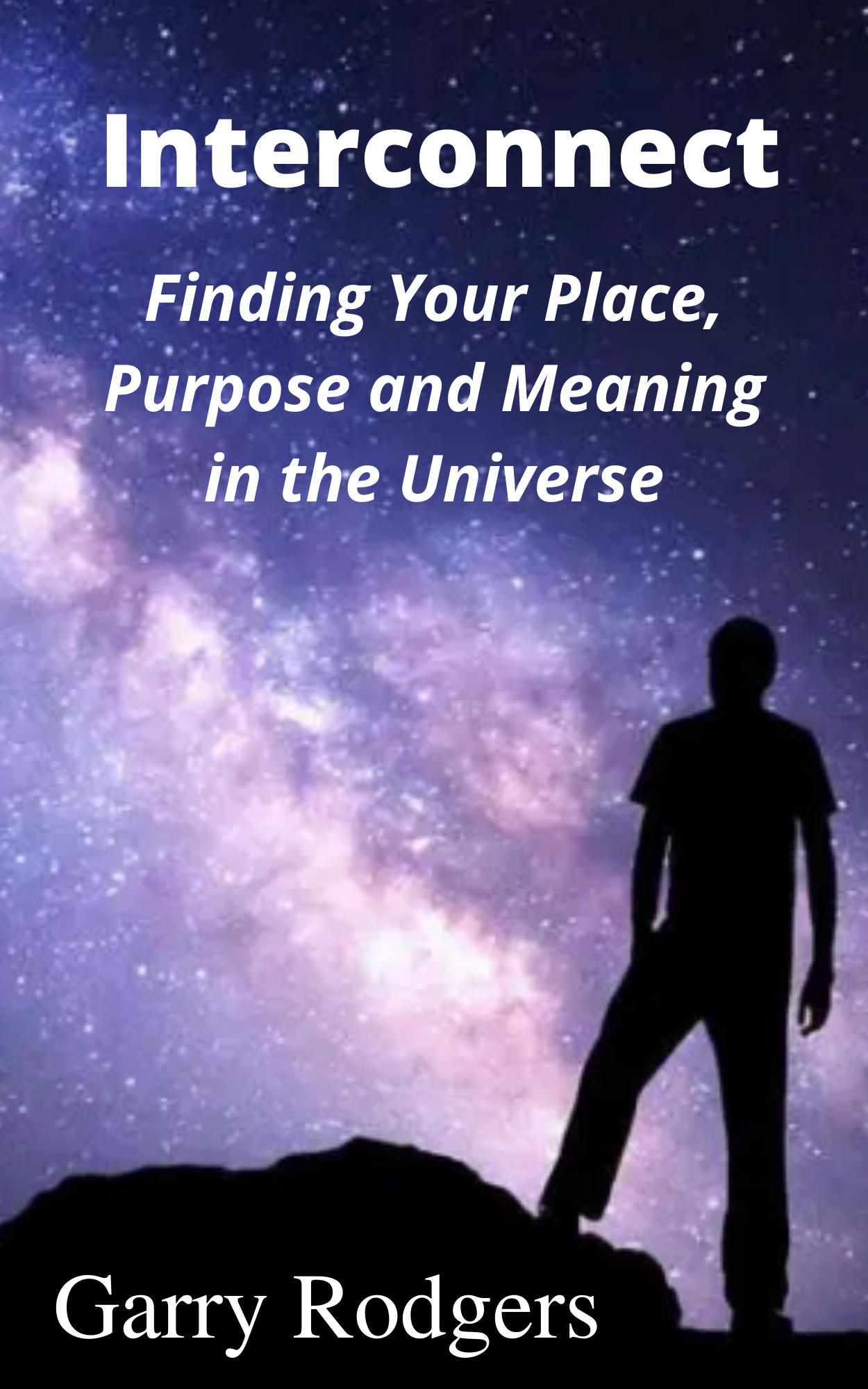
INTERCONNECT — FINDING YOUR PLACE, PURPOSE AND MEANING IN THE UNIVERSE

This piece is downloadable in full-length PDF format by clicking the blue bar button at the screen’s top or as a Kindle eBook and PDF through links at the end.

Once upon a time, a youth lay on their back and gazed in awe at the starry sky. The moon waned as a dim crescent—God’s Thumbnail, some call it—which let the universal brilliance of consciousness resonate in the youth’s eyes. Billions of fireballs blazed above, and countless more stars couldn’t be seen. The cosmos had cracked its coat. Like a galactic exhibitionist teasing eternal entropy, the universe flashed a perfect picture of order defying chaos and displayed an unbashful interconnection with all its occupants, including the star-gazing youth.

If you remember… that youth was you. Regardless if your years are still young, you’ve reached middle-age or are now advanced in time, the wonder of universal questions remains etched in your mind. Who are you? Where did you come from? Where are you going? And what is your interconnected place, purpose and meaning in the universe?

These are timeless queries people like you’ve asked since humans first consciously observed the heavenly heights. Long ago, your ancestors used their emerging awareness to question universal curiosities. It’s a natural thing for humankind to look for simple answers to straightforward questions and, no doubt, you’ve queried them many times during your earthly existence without receiving any clear response.

For centuries, sages and scientists pondered the meaning of existence within the universe. They’ve debated scientific theories and proposed philosophical solutions to deep puzzles boldly presented in the macro and micro worlds. You’ll find narrow common ground on who’s right and who’s wrong which leaves you to wonder what nature’s realities truly are.

Albert Einstein equated that science without philosophy was lame and philosophy without science was blind. That great scientific sage also spent the second half of his life looking for the Grand Unified Theory (GUT) that interconnects everything in the universe. That includes your place, purpose and meaning.

As wise and astute as Einstein was, he didn’t complete his mission of tying the universe into a nicely packaged bow. It’s not that he didn’t believe all parts of the universe were intrinsically interconnected. Einstein knew in his gut that all physical laws and natural processes reported to one central command. That, ultimately, is the universal dominance of consciousness that allowed your creation and will one day destroy you through eternal entropy.

This isn’t a religious treatise you’re reading. No, far from it. It’s simply one person’s later-in-life reflection on three interconnected and universal curiosities. What’s your place? What’s your purpose? And, what’s the meaning in your life?

To find sensible suggestions, it’s necessary to dissect what’s learned (so far) of universal properties and what’s known about you as a human. You’re a conscious being housed in a physical vessel and controlled by universal principles. You had no choice in how you came to be here, but you certainly have choices now. Those include placing yourself in a safe and prosperous environment, developing a productive purpose and enjoying a rewarding meaning from the limited time you’re granted to be alive.

At the end of this discourse you’ll find a conclusion about your place, purpose and meaning in the universe. It might be one person’s opinion, but it’s based on extensive research and over six decades of personal experience. However, for the conclusion to make sense you need to take a little tour through the universal truths.

Ahead are a layman’s look at the origin of the universe, classical and quantum physics, chemistry, biology, anatomy, neuroscience and the life-changing principle of entropy. It’s also a dive into what’s not known about the biggest scientific and philosophical mystery of all—how consciousness manifests through the human brain and how entropy tries to kill it. Now, if you’re ready to interconnect with the universe, here’s what your place, purpose and meaning truly are.

The universe is enormous. It’s absolutely huge. There aren’t proper adjectives in the English language to describe just how big the universe really is. Perhaps the right word is astronomical which means exceeding great or enormous.

People often use the word “cosmos” interchangeably with “universe”. That’s not correct. Cosmos refers to the visible world extending beyond Earth and outward to the heavens. The universe incorporates all that’s in the macroscopic or outward realm, but the term also drills down and incorporates everything within the micro-regions of molecules, atoms and then into sub-atomic realities where quantum stuff gets seriously strange.

In Chemistry, Biology and Physics 101, you learned you’re created of energized matter built of complex material formed by atomic and molecular chains. So is every set-piece in the micro and macro universe. All visible matter contains material made of atomic structures that strictly obey standard operating procedures set down during the universe’s birth.

How that happened is explained by a few different theories. Religious accounts, depending on the flavor, hold that an omniscient supernatural power created the universe at will and for a vain purpose. Current scientific accounts dismiss all supernatural contribution and exchange it with a series of natural orders called the laws of physics and non-tangible processes of the universe.

Most scientists don’t attach an intentional purpose to the universe. They leave that to philosophers who tend to argue with abstract thoughts that aren’t backed by hard evidence. Then, there are those who think the universe is simply a grand thought.

No matter who’s right and who’s wrong, there are a few facts you can personally bank on. One is that you exist in a physical form and use consciousness to be self-aware. That includes knowing you have a place in the universe, a purpose for being here and there’s a meaning to your life.

As said, this isn’t a religious paper. Religion can be a matter of faith but, then, so can science. The difference is that science relies on direct observation, proven experiments and the ability to replicate results. Science also depends on building hypothesizes, turning them into theories and then certifying them as facts.

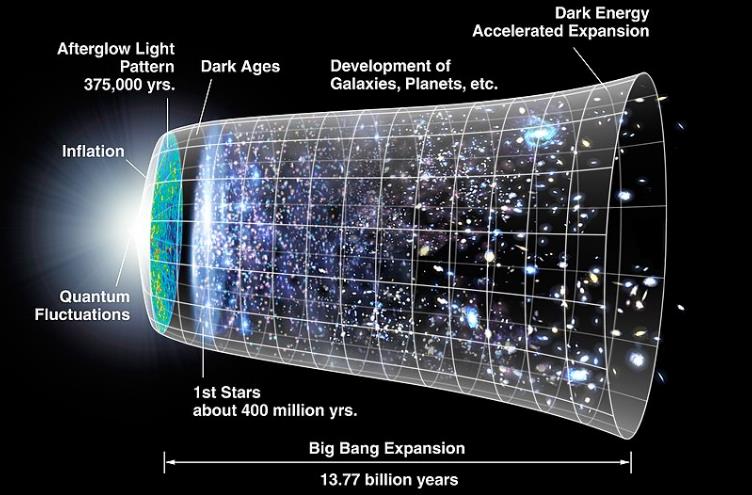
No particular physicist claims sole authorship of the Big Bang Theory. Currently, the Big Bang Theory is the leading account for the universe’s origin, and it’s generally accepted throughout the scientific community as being the best explanation—so far—of where your structural matter originated. It goes something like this.

In the early 1900s, an astronomer named Edwin Hubble (the space telescope guy) was busy measuring galactic light and came upon his profound realization that the observable universe was expanding. Not only was the universe growing, Hubble exclaimed, but it was also accelerating its expansion rate. That led to a logical conclusion that the universe must have started in a singular place and at a specific time.

Some of science’s brightest folks worked on mathematical extrapolations and built the theory postulating that all matter and energy in today’s observable universe must have been once compressed in a singularity that exploded. That big bang started the time clock, created space, released energy and formed matter. It’s been growing ever since and, along the journey, you were created as an interconnected part.

This sounds like a pretty big undertaking. It also sounds pretty far out to think everything in the known universe was stuck in the space smaller than an atom where it was exceedingly hot and heavy. Well, guys like Einstein and Steven Hawking accepted the Big Bang Theory as fact, although Einstein famously quipped, “God knows where that came from.”

Without any other scientific direction to go on, what you see in the universe got started from a single point and is enormously here in its present form and place. The best-educated guesses place the universe’s age at about 13.77 billion years, give or take a few hundred thousand. This rough age-estimate comes from measuring Cepheid Variable Pulsating Stars (CVPS) with the Hubble Space Telescope which has proven to be quite useful once NASA got its foggy lens fixed.

The size of the observable macro, or outer, universe is impressive. Current measurements find the most distant visible electromagnetic radiation to be 46 billion light-years from Earth. That’s in every direction where the radio telescopes pick up the Cosmic Background Radiation (CBR) signal. Astronomers believe the CBR is a leftover mess occurring about 300,000 years after the Big Bang. If the true universal distance radius is 46 billion light-years, then the entire trip across occupied space is around 92 billion light-years in diameter.

That is a massive distance. It’s gigantic, humongous and colossal. Light, which is electromagnetic radiation, travels at 186,000 miles per second or 300,000 kilometers per second. That means that in one year a light particle can travel 5.88 trillion miles or 9.5 trillion kilometers. Multiply that by 92 billion and you’ll see that it’s a long, long way across the visible universe.

That’s just the macro universe that astronomers can see with current technology. Most scientists agree they’ve only explored something like four to five percent of the visible universe, and there’s far more out there than known today. This is an ongoing search with exciting discoveries emerging all the time.

To get a feel of where your physical place is in the macro universe is, you’re on the surface of a planet called Earth. Your home base is 93 million miles or 150 million kilometers from the sun which is a common-type star. It takes eight minutes for light to leave the sun and meet your eyes. To put this distance in perspective, a light particle can circle the Earth seven and a half times in one second.

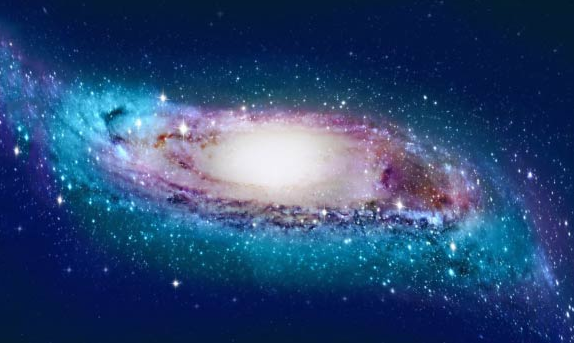
The solar system extends a long way out. Pluto, which has returned its classification into the planet family, is seven hours distant from the sun via light speed. Going further, your planetary arrangement orbiting the sun is in one part of your home galaxy called the Milky Way. The sun is approximately 30,000 light-years from the big black hole at the Milky Way’s center, and you’re actually closer to the nearest independent galaxy than you are to the Milky Way’s core.

No one knows how many stars there are in the Milky Way. It’s a countless number. The current consensus is there may be a trillion stars in your home galaxy. Some astronomers feel there could be a trillion or more galaxies in the visible universe.

The Milky Way is part of a galactic bunch called the Local Group. These 54 assorted-shape star arrangements form part of a larger galactic collection known as the Virgo Supercluster. This is a big, big crowd but nowhere near what’s really going on out there.

Recent astronomical observations confirmed that beyond the Virgo Supercluster lies a monster called “Laniakea” which is Hawaiian for “Immeasurable Heaven”. This stupendous structure sits in a part of space called the “Zone of Avoidance” where the clouds of dust and gas are so thick that visible light is impossible to perceive. Astonishingly, Laniakea and the Virgo Supercluster are being pulled together across space and time by a behemoth force nicely titled the “Great Attractor”. No one knows what that force field is, but it’s powerful.

As you lay on the Earth’s surface and gaze at the starry sky, you’re not seeing reality. You’re only seeing light that left its emission point a long time ago. If you spot Andromeda, the only independent galaxy visible with your naked eye, you’re seeing that structure as it was two million years ago. For all you know, Andromeda may no longer exist.

The universe can play a lot of tricks on an observer. But one thing the universe never does is change its basic operating rules. Space, time, energy and matter follow strict laws that apply everywhere throughout the universe. Whether you’re on Earth, in Andromeda or around Laniakea, all fundamental forces behave the same way.

There are four fundamental forces in the entire universe—both in the macro and micro worlds. Those are electromagnetism, gravity, the strong nuclear force and the weak nuclear force. Space, time, energy and matter all adhere to these four forces from which many physicists have tried to find a common denominator to frame the Grand Unified Theory (GUT).

So far, no luck. Einstein spent the second half of his life working on a unified theory. His intuition told him unification lay in an infinite pool of information which is the non-visible and non-tangible factor that gives space, time, energy and matter its direction. This information or intelligence principle certainly seems to be real, and it’s captured in the acronym STEMI for Space, Time, Energy, Matter and Information or intelligence. It might also be universal consciousness.

Information permeates the entire universe. It somehow laid down the four forces emerging from the Big Bang and then made other rules or laws of physics which carried throughout the entire regions of reality. However, what the rules say about operating the outward cosmos are not exactly the same rules as those governing sub-atomics.

What directs your existence in the macro world adheres to classical or Newtonian physics. Down in the microcosm realm, though, your matter and energy have different masters. The wee parts of you behave according to quantum physics which are somehow interconnected back into classic physics and STEMI.

*   *   *

To read the rest of Interconnect and find the conclusion of what your place, purpose and meaning in the universe really are, follow these links for a free, full-length download. It’s a relatively short piece at 11K words and you might just find it quite worthwhile.

For a FREE PDF eBook of Interconnect – Finding Your Place, Purpose and Meaning in the Universe, please click here:  Interconnect Manuscript PDF

(You can also click on the button in the blue bar at the top of the screen for a quick PDF download of Interconnect.)

For a FREE Amazon Kindle/Mobi eBook of Interconnect – Finding Your Place, Purpose and Meaning in the Universe, please click here: Interconnect Manuscript Amazon Kindle/Mobi

(This link will take you to my Amazon sales page where Interconnect is temporarily available as a FREE promotional Kindle eBook. I’d appreciate if you’d get a Kindle copy as this drives my Amazon ranking up. Thanks!)

If you have any difficulties downloading any efile type, please email me at garry.rodgers@shaw.ca and I’ll ship you an attached copy. Also, please feel free to share Interconnect. It wasn’t written as a money-maker. Rather, it’s a personal letter to myself in an attempt to figure it all out. Here’s one of the principle take-aways: