Tag Archives: Crime

NO LIFE UNTIL DEATH

garrythumb2Here’s a preview of No Life Until Death, the sequel to the Amazon #5 BestSelling novel No Witnesses To Nothing.
Chapter 1


Thursday, November 1st  

9:40 am

SeaSpan Dockyard

Surrey – a suburb of Vancouver, British Columbia

Inspector Sharlene Bate of I-HIT, the Integrated Homicide Investigation Team, swung her unmarked car into a pot-holed lot on the south bank of the muddy Fraser River and slammed it in park. She jumped out, ducking yellow barrier tape and dashing through cold, pissing-down rain to the passenger side of a grey Chevy Impala – oblivious to desperate people doing desperate things.

“Jesus!” Corporal Jill Prunty looked at Bate’s forehead from behind the wheel. “What the hell happened to you?”

“Mixed it up with an asshole at Walmart.” Bate palmed her long, nasty gash. “Tell you later. What have you got?”

“Ah, call came at daybreak.” Prunty’s eyes stayed on Bate’s wound. “A dumpster-diver is gettin’ early dibs on the bins and sees a van back up to the jetty’s end. Driver gets out, opens his rear doors, and pulls out a package that’s like six feet long, floppy, and wrapped in white plastic. He’s got it strapped to an appliance dolly. Wheels it over and cuts it loose to the water. Guy puts his dolly back in the van and drives off.”

“Go on.” Bate pulled a notebook from her lusty-red trenchcoat.

“So buddy in the dumpster… some homeless dude named Dave… thinks it’s wrong so he checks it out. Well, the package snagged on a deadhead. You know them semi-submerged logs? Dave guesses it’s a body in the bag, so he runs for help.”

Bate put on glasses. “Good ol’ Dave.”

“Local PD responds. Between them and a tugboat crew, they fish it out. Sure enough.” Prunty pushed back unruly red hair. “A homicide file.”

“Like we need another.” Bate started scribbling. “Body is where?”

“In the recovery boat. Still shrink wrapped. Don’t know if male or female. We’re waitin’ for the coroner to get here.”

“Did Dumpster Dave get a decent look at our guy?”

“Yup. From probably ten feet away. He’s peeking outa the trash can like Oscar the freakin’ Grouch as the bad guy drives by.”

“Description?”

“Asian male. Approximately 40. Little shit around 5-3 or 5-4. Maybe 120-130 pounds. Short black hair. Clean shaven. Wearin’ dark clothes.”

“Asian. As in…?”

“Well, Rick Portman… Saargeant Portman, I gotta call him now since he got promoted, has Dave back at the shop going through photos and maybe get in front of the artist. Doesn’t sound like our guy is Chinese or Viet. More like Malaysian or Indonesian. Says he’ll have no problem IDing him.”

“Sounds like Dave is our star witness. How wrecked was he?”

“Seemed fine, but I figgered there’d be a credibility issue so I had him blow and give blood. Came back at .03 alcohol, but I’ll send for tox. Especially for crack and meth. Also his vision seems okay. I’ll get him to an optometrist just to make sure.”

“Jill.” Bate looked up and smiled. “You’re always thinking.”

Prunty blushed. Nice compliment. Especially from Sharlene Bate.

“What about the van?” Bate put pen back to paper.

“It’s a white panel thing with only driver windows. For sure a Dodge. Long wheel-base. And definitely propane fired, not gas or diesel. Dave says when you’re in bins all day long, you develop a keen sense of smell.”

“Classy,” Bate said. “Like a Surrey sommelier.”

Prunty read from her notes. “Says it’s an old carpet cleaner with a slider door on the passenger side. Company name’s painted over. Exhaust leaks and it runs rough at the idle. Also, there’s a crease down the bottom of the passenger side and a big crack across the windscreen starting from the left.” Prunty cranked up the defogger and raised her voice. “Knows there’s local plates, but can’t remember the number. Inside it’s got a bunch of welded brackets to tie things down and there’s a big, mottled paint-stain on the floor which dripped out to the back bumper. It’s kind of a sky-blue.”

“Hang on.” Bate stopped writing. “How’d he know what’s inside?”

Prunty grinned. “Dave knows this van. He stole it once to do B&Es.”

Bate rolled her eyes as her Blackberry toned. She checked call display. “Just a minute, Jill. It’s Emma. I have to get this.”

*   *   *


Hey Ems.

Hi Mom. Red Cross called. They need me Monday.

Okay, Sweetie. I’ve got a new case starting, but if I can’t go with you then Graham will take you or maybe Carolyn or Brian.

Just wanted to give you heads-up.

Thanks Em&Ems. Love you!

Loves you too, Mew.

*   *   *

             “Couldn’t help hearing,” Prunty touched Bate’s arm. “Your daughter’s pretty rare, eh?”

“Yeah, a one in thirty-five million blood-type.” Bate was back writing.

“You guys are on standby with the blood bank to donate?”

Bate straightened up. “Yes. It’s tied to databases and cell-phone alerts. We’ve been expecting this one. It’s a planned procedure where they’ve identified a compatible recipient and need backup blood. But you never know when an emergency comes in and we have to go right now.”

“She must be a lifeline for someone like her.”

“You bet.”

“Quite a load for a thirteen year-old kid to take on.”

Bate breathed deep. “But I’d hope someone else would do the same for Emma if she needed a transfusion.”

“Yeah.” Prunty shuffled her hips that filled the seat. “What goes around, comes around.”

*   *   *

             Tap. Tap. Tap.

Prunty hit the locks and thumbed the back seat.

Coroner Barbara McCormick wrestled through the driver’s rear door. “Goood morning, Jill and Inspector. What have you got for me on this crappy fall morning.”

“Got a floater for ya.” Prunty puffed her cheeks, winking at the coroner.

“Lovely.” McCormick pulled her clipboard from her scene bag. “Need its name, rank, and serial number.”

“Sorry, Barb,” Bate said, fingering long, wet, black hair. “Just a Jane or John Doe at this point. It’s zip-locked, like in a body bag, and we haven’t checked it over.”

McCormick’s brow raised. “You bagged it without me having a boo first?”

“No. It was fished from the river in some kind of a shrink-wrapped bag. We held it like that for you.”

“Most efficient. Are forensics clear for us having a little look?”

“It’s your show.” Bate looked over her specs and flashed a big, toothy smile.

*   *   *

           Bate and Prunty shivered under a protesting umbrella on a tugboat’s greasy, wood deck as they hovered the mummy-like mass.

McCormick finished snaps with her digital Pentax. “This is a hospital shroud, not a body bag. Unusual.” She bent down, picking at the dripping-wet plastic. “Hmm. Bound by clear packing-wrap on the neck, waist, and ankles. Most unusual.”

Bate and Prunty watched. Their backs faced a leaf-splattering wind.

“I’ll open it for a peek at the face.” McCormick slit the wrapping with her box cutter. A dark, bearded mess stared from eyeless sockets framed in a white, plastic pool.

“More unusual all the time.” McCormick said. “Should be a most interesting post-mortem.”

She sliced down the shroud, leaving the neck wrap intact. Bare, brown skin shined from the neck and shoulders. McCormick exposed more. Surgical incisions showed, starting at the tip of each scapula, connecting at the sternum, and heading down the center of the chest. They’d been stitched with brown, butcher twine.

“Oh dear.” McCormick stood up. “Somebody’s already autopsied him.”

Get the #5 BestSeller No Witnesses To Nothing on Amazon at 

http://www.amazon.com/No-Witnesses-To-Nothing-ebook/dp/B00AJZR28Y/ref=sr_1_1?s=digital-text&ie=UTF8&qid=1355431451&sr=1-1&keywords=no+witnesses+to+nothing


ELMORE LEONARD – MASTER CRIME WRITER

Story-telling lost a great when Elmore Leonard died.

Elmore Loenard 4Crime, thriller, mystery, and western fans will miss him.

But the literature world won’t.

Or ‘litter-a-ture’ and ‘the members-only club’ as Elmore Leonard called the word-snooterati.

Elmore Leonard didn’t care about awards and hob-nobbery. He wrote about realistic worlds where his fast pace, sharp dialogue, prose-poor, and wrong grammar captivated readers who loved being entertained, escaping, learning, and transporting through his stories – real people who weren’t seeking literary merit.

Elmore Leonard“Most writers don’t write for a living,” he said. “They write for tenure. Or for the New York Times. Or to get invited to conferences. When you write to make the rent or send your kids to school, you learn how to write without a lot of nonsense.”

Elmore Leonard found a no nonsense audience.

His career spanned 60 years and 40 novels – 19 becoming motion pictures and 7 made into TV series. 3:10 To Yuma was his baby. So was Big Bounce and 52-Pickup. Major stars and major producers recognized Elmore Leonard’s simplistic genius.

Part of his genius is that he told both sides of the story. Protagonist and Antagonist.

Elmore LeonardElmore Leonard’s discipline was patience, perseverance, and praising others – he read more than he wrote. He also had 10 rules of writing.

  1.   Never open a book with weather.

  2.   Avoid prologues.

  3.  Never use a verb other than “said” to carry dialogue.

  4.  Never use an adverb to modify the verb “said”…he admonished gravely.

  5.  Keep your exclamation points under control. You are allowed no more than two or three per 100,000 words of prose.

  6.  Never use the words “suddenly” or “all hell broke loose.”

  7.  Use regional dialect, patois, sparingly.

  8.  Avoid detailed descriptions of characters.

  9.  Don’t go into great detail describing places and things.

  10.  Try to leave out boring parts, the parts that readers tend to skip. 

Then there’s his 11th.

Elmore Leonard 2“Write the book the way it should be written, then give it to somebody to put in the commas and shit.”

RIP Elmore Leonard

Master crime writer and story-telling genius.


HOW TO WRITE DEADLY CRIME FICTION

To receive your FREE PDF with 95 Killer Tips On Writing Deadly Crime Fiction, enter your email address on the header or sidebar form. Read on for a sample of the first 12. All images are attributed to the TV series ‘The Simpsons’.

Writing crime fiction is like investigating murders. You deal with lies.

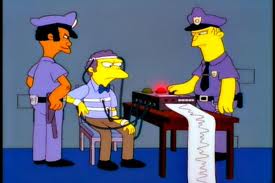
PolygraphEveryone lies to the police. Complainants lie. Witnesses lie. Lawyers lie. Believe it or not, even the crooks lie to the cops.

Homicide investigators get extremely good at detecting lies. They’re human lie detectors. And they know that to get people to co-operate in investigations, there has to be something in it for them. Just like there has to be something in this for you.

page-0To get you to co-operate with me, I’m giving you 95 Killer Tips on how to lie to people. Because as a fiction writer, that’s what you do. You lie to your reader. Your reader signs-up for a pack of lies when she buys into your story and you owe her an excellent load of excrement in return.

It’s called the suspension of disbelief. That’s what your fiction writing has to do. Your reader has to get so immersed in the story that she forgets it’s all lies. The best stories string her along so well that she can’t put it down and that’s the best compliment you, as a writer, can ever get. So you have to be really good at telling lies.

Yes, I do want something from you and I snuck it in one of the tips. You have to read them to find out what I want.

Simpsons lyingAnd no, I won’t bullshit you. I used to be a cop, for God’s sakes.

It’s just that I wasn’t a very good one.

Here’s a sample of Dead Write – A No BS Guide To Writing Deadly Crime Fiction.

To receive your FREE PDF with 95 Killer Tips On Writing Deadly Crime Fiction, enter your email address on the header or sidebar form.

Part 1 – The Science of Story

Tip #1 – Understand Story

A story is about what happens (Plot) that affects people (Characters) who are trying to achieve a difficult goal (Conflict) and how they change as a result (Resolution).

Tip #2 – Understand Story-Telling

Story-telling is about communicating what’s happening. Humans are inherently curious creatures and, to keep your reader in the story, you have to keep her constantly wondering what’s coming next.

Tip #3 – Understand Crime Stories

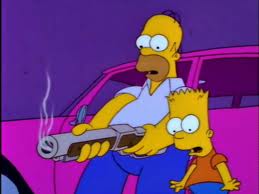
Homer ShotgunCrime Fiction involves murders. People are fascinated about murders for the same reason they can’t avoid looking at gruesome accident scenes. Like they say in the news business ‘If it bleeds, it leads.’ Being killed is the worst thing that could happen and it’s your reader’s instinct to want to know what might happen.

Tip #4 – Understand Cops & Crimes

Joseph Wambaugh, one of the best crime writers, says “The best stories aren’t about how cops work on cases, but about how cases work on cops.”

Tip #5 – Activate Your Reader’s Brain

Humans are hardwired for story. We think and learn in stories. We have a primal need to know in order to work our flight or fight survival instinct. Stimulating your reader’s desire to know what’s happening subconsciously fires neurons in her brain and this releases dopamine, nature’s crack, which chemically sucks her into the story. She gets immense pleasure from going along for the ride.

Tip #6 – Give Your Reader What She Needs

Stories allow your reader to simulate intense experiences without actually having to live through them. It’s like being shot at – without worrying about getting hit. Stories give vital instructions on how to survive in life, allowing your reader to become the characters without ever leaving the safety of home. She needs to feel what the people in the story feel – for her entertainment – and her protection.

Tip #7 – Balance Right & Left Brain

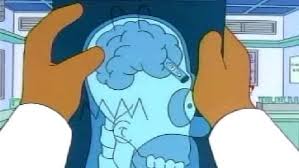
Homer BrainStories engage the left side of the brain to process words and sequence of plot. The right brain handles imagination and visualization. The best told stories balance the brain’s natural ability to look for, recognize, and match patterns giving your reader those critical and so-satisfying Ah-Ha! moments.

Tip #8 – Study Neuro-Linguistics

Mind language is an amazing science that underlies story-telling. Neuro refers to what’s happening in the mind. Linguistics is how communicating through words influences the mind. It’s the art and science of communicating. The best form of getting a message across is by stimulating your reader’s senses.

Tip #9 – Apply Neuro-Linguistics

The right words, and the right sequence of words, activate your reader’s neurological system. This affects her physiology, emotions, and behavior. When she makes sense of your story, she believes in its world. She captures and conceptualizes the experience. It’s what makes her say “I couldn’t put it down.”

Tip #10 – Give Pleasure, Avoid Pain

Humans are pleasure-seeking, pain-avoiding animals. We go to extreme lengths to achieve this in life. It’s the same for your reader. She expects a pleasurable experience from your story, even when it opens with blood & guts. If she doesn’t enjoy a pleasurable state quickly into it, she’s going to put-it-down and forget about it. If it becomes painful, she’s going to slam-it-down and then go slam you on Goodreads. 

Part 2 – Telling the Story 

Tip #11 – Do Not Come Lightly To The Page

Homer MooningBe honest. Be original. Be brutally in their face. Your job is to tell it like it is. To hell with offending anyone. Say what the story’s message is. The best stories challenge social norms.

Tip #12 – Write For One; Publish For A Million

To be authentic, you have to quit giving a shit what anyone thinks of your work while you write. Let it come right from the depths of your bowels as if…

Dead Write ThumbnailIf you’d like the next 83 Killer Tips in Dead Write – A No BS Guide To Writing Deadly Crime Fiction, download the FREE PDF by entering your email address in the header, sidebar, or on the form below. 

* indicates required