
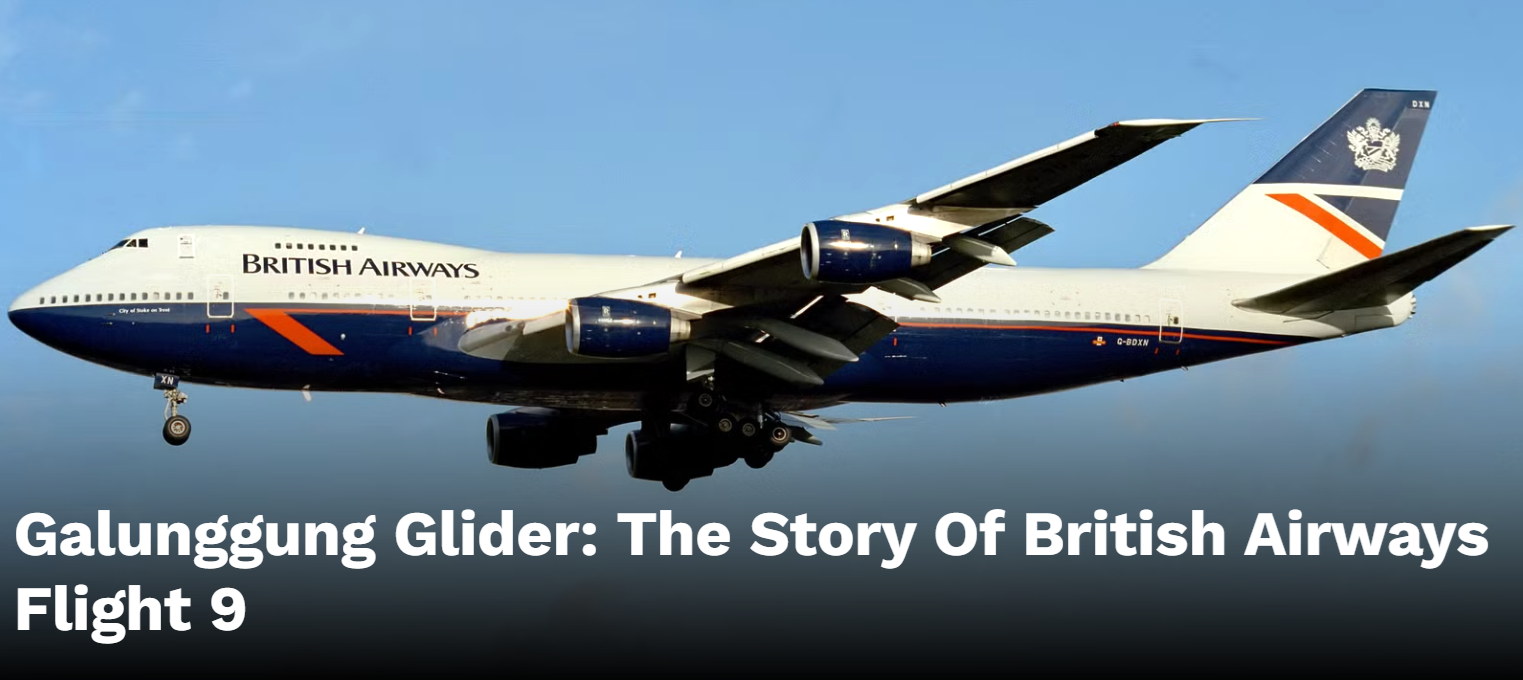
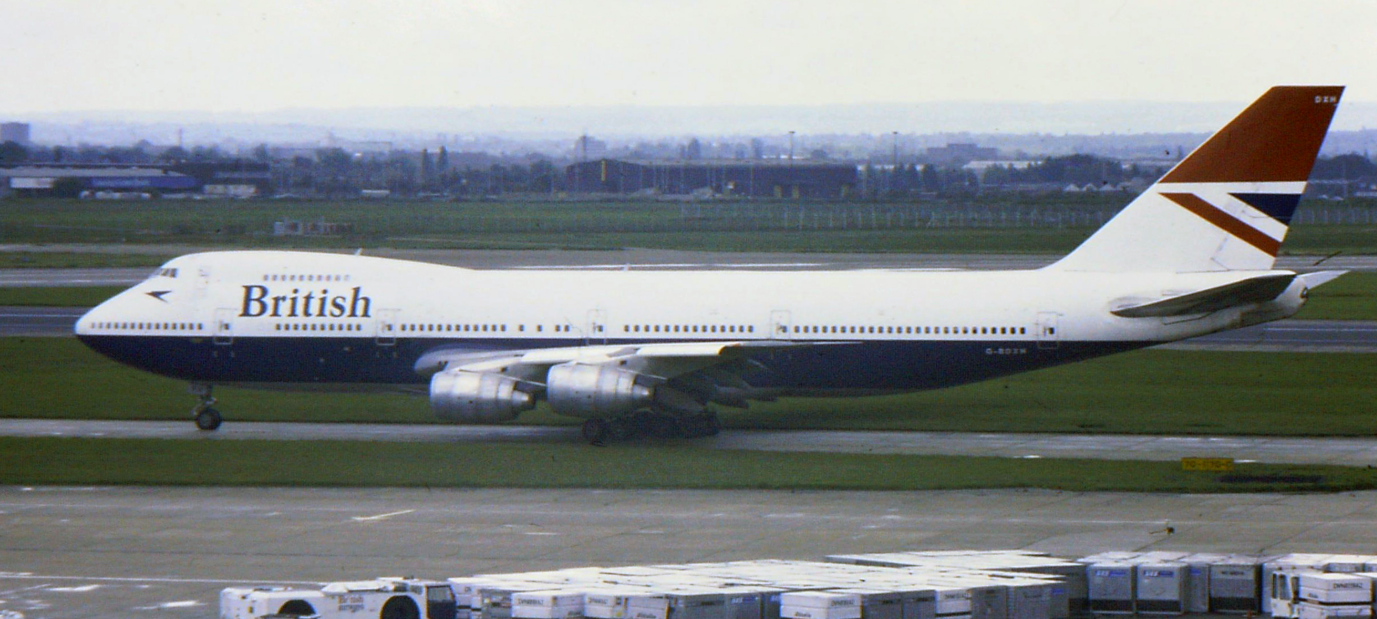
 On June 24, 1982, British Airways Flight 009 was cruising at thirty-seven thousand feet over the Indian Ocean when all four engines suddenly quit. The aircraft was a Boeing 747 known as the City of Edinburgh. On board were two hundred forty-eight passengers and fifteen crew on a routine long-haul run.
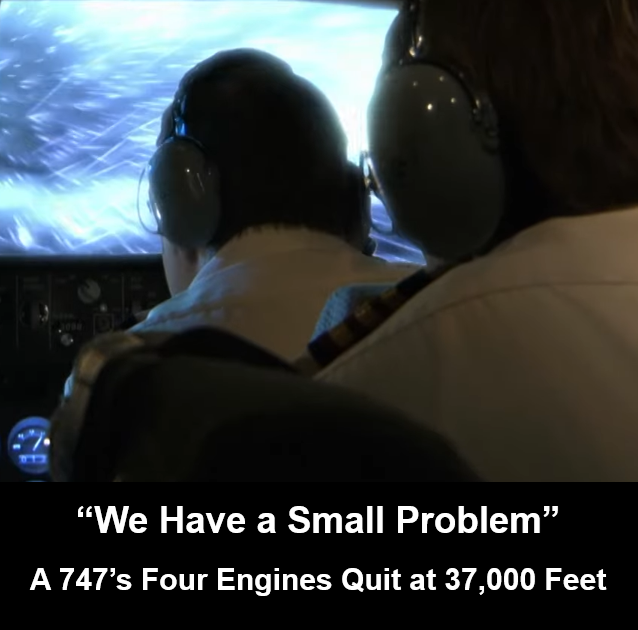
Flight 009 was part of British Airways regular service between London and Auckland. The route stepped from Heathrow to Bombay, then on to Kuala Lumpur, Perth, Melbourne, and finally New Zealand. On this particular night, the aircraft had departed Kuala Lumpur and was bound for Perth on another overnight leg in a well-worn schedule.
Up front were three experienced professionals. Captain Eric Moody sat in the left seat with Senior First Officer Roger Greaves beside him and Senior Flight Engineer Barry Townley-Freeman at the systems panel. They’d flown this trip many times and nothing on the departure directions suggested this night would be unusual.
The weather reports were good. The radar picture was clean with no thunderstorm cells ahead. The crew levelled off, set cruise power, and the passengers did what passengers do on a night flight while trusting the folks on the flight deck. Most went to sleep.
This is the context. Who was there. What flight it was. Where they were. When it happened. Why everyone on board had every reason to believe this would be just another long, but uneventful, hop to Australia and New Zealand.
The twist in this story is simple and brutal. Something the crew couldn’t see and had no reason to expect was looming in the dark ahead. It turned a healthy, four-engined airliner into a powerless, three-hundred-ton glider in minutes.
What happened is one of the most studied and respected saves in commercial aviation history. Today, people call it the Galunggung Glider. On that night, it wasn’t a nickname. It was a desperate fight-for-life with physics.
Trouble in the Dark
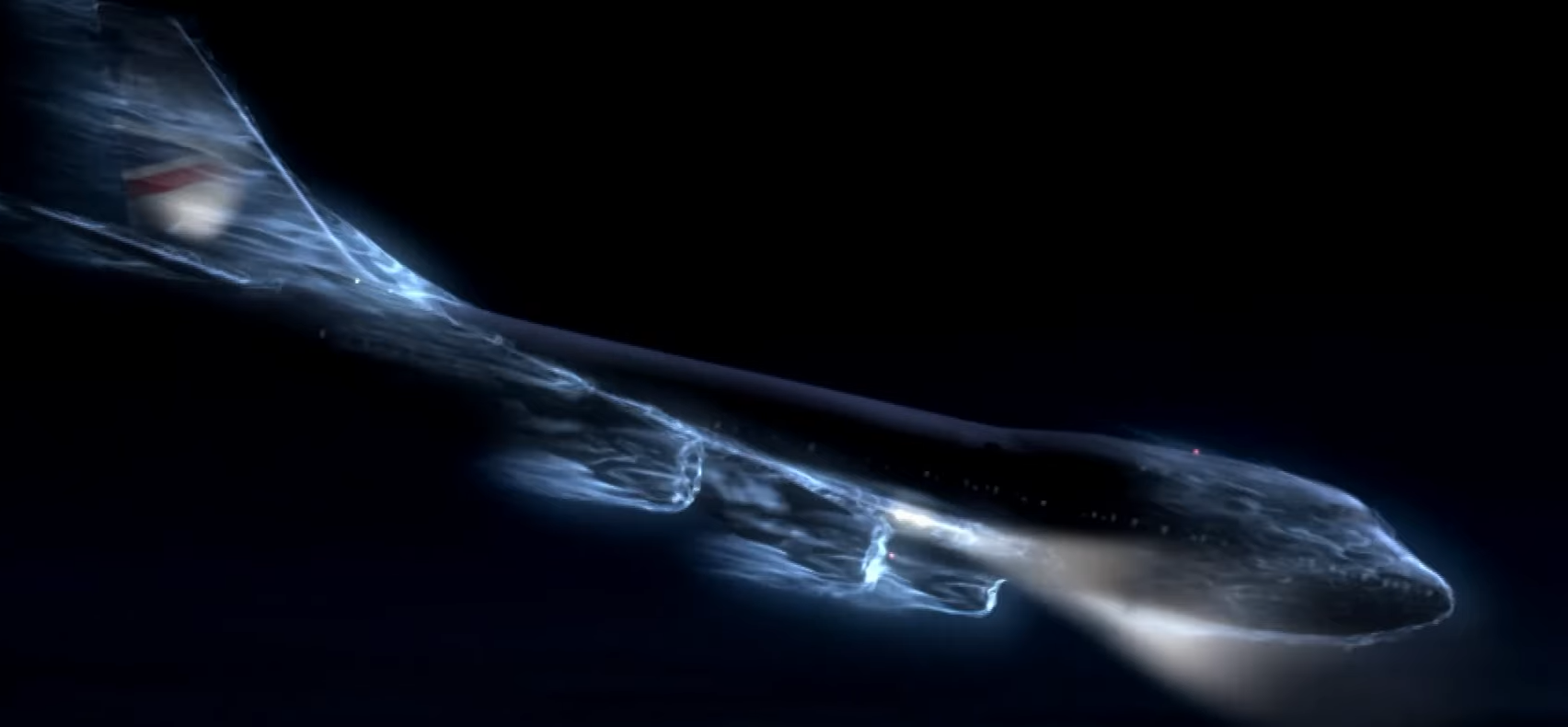
The first sign that something was wrong came in an odd and almost pretty way. Not long after they settled at cruise spped and altitude, the flight crew noticed a faint shimmering effect on the cockpit windows. Little blue-white streamers of light began to dance over the windscreen and around the nose. It looked like St Elmo’s fire, that electrical glow sailors used to report on ship masts during storms, only this night sky was supposed to be clear.
The weather radar showed nothing dangerous. No big storm tops and no obvious convective cells. To the jetliner’s instruments and to air traffic control this was just another quiet airway segment over the Indian Ocean water.
The crew did what professionals do when something looks even slightly out of place. They turned on engine anti-ice and activated the fasten-seat-belt sign. They weren’t yet alarmed. They simply treated the mysterious glow as a hint that conditions outside were not quite what the paperwork had promised.
Back in the cabin passengers started noticing strange light as well. Some saw tiny sparks crawling over the wing. Others watched pale blue halos appear around the big Rolls Royce engines as if they were wrapped in phosperescent, ghostly rings.
To frequent flyers this was new. It was eerily pretty. It was also the front edge of serious trouble.
Then came the haze. At first, it was easy to shrug off. This was 1982 and people still smoked on airliners. Cabin crew thought the thin smoke drifting through the aisles was just stale cigarette exhaust hanging in the conditioned air.
It thickened. The air took on a faint sulphur smell. That was when a few people started to feel the first prickling of unease.
Up front, the engine instruments still looked normal. Temperatures and pressures sat where they should. Fuel flow figures were right for cruise power. There was nothing obvious to tell three experienced airmen that they were flying straight into a high-altitude-hazard-from-hell that simply did not show on their screens.

The Engines Quit
The first engine—the number four starboard Rolls-Royce RB211— failed quietly. On the flight engineer’s panel, one set of needles flicked and rolled back. N1 and N2 speeds on the jet turbine dropped as it began to surge and flame out. The crew moved straight into the shutdown checklist they’d practised dozens of times in simulators and on line checks.
A four-engine jet airplane like a Boeing 747 can easily continue on three. Losing one powerplant is serious but manageable. No one likes it, but it’s squarely inside the envelope.
Before they could get comfortable with that thought, a second engine failed—the number two portside. Then the number three. And the number one. Flameouts rolled across the panel in a sickening cascade.
In moments, the City of Edinburgh went from a minor inconvenience to something no one on that flight deck had ever actually seen or practiced for. All four engines had completely stopped thrusting.
The difference was immediately obvious in the cabin. The background roar of four big fans faded away and was replaced by a strange sense of quiet. Drinks stopped rattling. Loose items floated. Ears popped differently.
A few people realised that silence at cruise altitude is not your friend. And cruising altitude was replaced by a sudden drop. Without power, gravity took over and the plane was going down.
Captain Moody picked up the microphone. He knew he had to tell the people behind him the truth. He also knew that panic would kill more quickly than gravity.
His announcement has since become a legend in aviation for its frankness.
“Ladies and gentlemen, this is your captain speaking. We have a small problem.
All four engines have stopped. We are doing our damnedest to get them going again. I trust you are not in too much distress.”
That’s British understatement at its finest. He didn’t lie. He didn’t pretty it up. He also resisted the urge to dump his own fear on two hundred and fifty-seven people through the public address system. That tone set the emotional temperature on board as much as any knob on the overhead panel.

Discipline in the Cabin — Hard Work in the Cockpit
In the cabin, the flight attendant crew went to work. They’d just heard that every engine on their aircraft had stopped at thirty-seven thousand feet over open water. They also had hundreds of human eyes watching them.
Good cabin crew know their behaviour in those first minutes will ripple through the entire cabin. On Flight 009 they kept their voices calm and their bodies steady. They checked seat belts. They paired up nervous travellers with quieter neighbours. They helped people write quick notes to family in case things went badly.
Passengers later described an eerie mix of fear, resignation, and polite small talk. People held hands with strangers. Some prayed under their breath. Some made dark humour about British Airways and stiff upper lips.
Up front, the atmosphere was different. Very different.
With all four engines out, they’d lost their main electrical and hydraulic sources. The 747 still had battery power and a backup generator. Enough to run essential instruments and some control systems.
The big jet had become a heavy glider with limited time and distance left in the bank. It also had to clear real and inhospitable terrain before it could even think about reaching a runway.
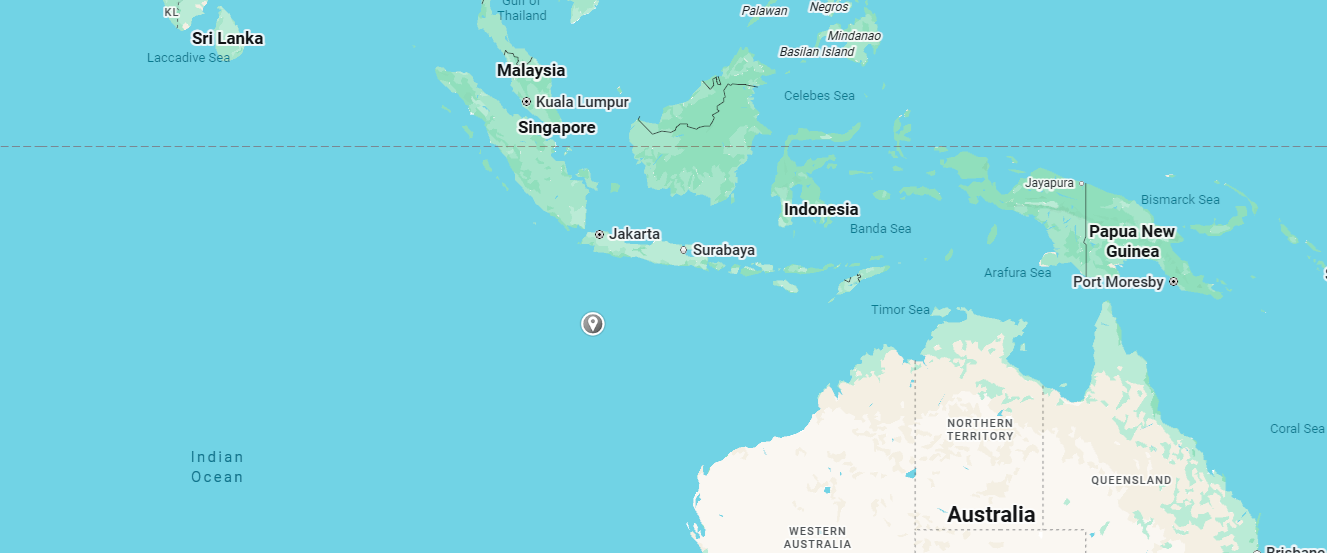
South of Java is the Indian Ocean. North toward Jakarta there is serious high ground and volcanic terrain. To get to any sort of airport they had to glide toward land without hitting a mountain on the way.
That meant quick mental math. At their weight and altitude, the City of Edinburgh could glide a limited distance for each thousand feet of height lost. It’s one thing to do that math at a desk. It’s entirely another to do it in the dark with a few hundred people behind you and four dead engines under the wing.
Jakarta was the obvious divert. Air traffic control knew they had a problem but didn’t grasp the full scale at first. Engine failures were uncommon and losing all four was not on the normal script. And to compound matters, the 747’s radio system was scrambling.
Controllers recommended headings and altitudes and clearance while the flight crew explained they were coming down whether anyone cleared them or not. Gravity had the clearance. Everything else was just bureaucratic protocol.
Riding a Three Hundred Ton Glider
The flight deck crew began a controlled descent toward what they hoped would be cleaner air. They suspected whatever choked their engines sat higher in the atmosphere. If they could get out of that layer, there was a chance the engine cores might cool just enough to clear and restart. That was a theory, not a guarantee.
They also could not simply dive away. A sea-ditching at night would be fatal. They needed every foot of altitude to make land. It was a balancing act. Stay high enough to reach Jakarta. Go low enough to escape whatever killed the engines.
Investigators later estimated Flight 009 lost twenty-five thousand feet before good news finally showed up on the engineer’s panel. At thirteen and a half thousand feet, one of the dead engines began to spool up. Number four coughed into life.
Jet noise returned to the airframe and with it a sliver of margin. With partial thrust available the crew adjusted their descent and tried to coax the remaining powerplants back. Shortly afterward another engine lit. Then another.
At one point all four engines restarted, although the number two engine soon went back into heavy vibration and had to be shut down again. For the remainder of the flight, they had three functioning engines. It wasn’t pretty, but it was enough.
Passengers sensed the change. The silence gave way to the familiar thrum of turbines. One survivor later said the sound of that first engine coming back was the best noise he’d ever heard.
People straightened in their seats. Some cried. Some laughed. Everyone understood they weren’t out of danger yet, but the feeling in the cabin shifted from helpless free fall to a fighting chance.
Even with three engines running, a new problem had emerged. The forward windscreens looked like they’d been sandblasted. What started as a ghostly glow earlier had, in hindsight, been a clue. Something abrasive had been hammering the glass at high speed.
By the time they turned toward Jakarta the front windows were so badly frosted and pitted that clear vision was almost gone. Imagine trying to land a big jet at night with your windscreen turned into opaque bathroom glass. That was the job that now lay ahead.
Landing with Frosted Glass
The approach into Jakarta’s Halim Perdanakusuma Airport wasn’t the tidy textbook exercise people like to imagine in simulator videos. The tower reported good weather and visibility. Runway lights were clear, and the sky was open.
On their side of the glass, it was a very different story.
Captain Moody could barely see straight ahead. He had to rely heavily on his instruments, on side windows that were less damaged and on whatever partial view his first officer could find through the clearer patches.
They flew a careful profile with no sudden power changes. This wasn’t the time to test the engines. With recent flameouts still fresh in their minds, they kept thrust changes gradual and conservative.
The goal was simple. Get the aircraft on the ground in one piece without asking the machinery for any more heroics.
Passengers later described the landing as firm but not brutal. The 747 came down, flared, and touched the pavement with authority. It rolled out, slowed, and turned off the runway under its own power. Only then did people begin to let themselves fully believe they were going to walk away.
From the outside the damage told the story the instruments could not. Leading edges of the wings and tailplane were abraded. The landing light covers and cockpit windscreens were opaque and milky instead of clear. Engine inlets and front compressor blades looked as though someone had attacked them with a high-pressure sandblaster.
Whatever they’d flown through had been harder than ice. It had hit them at high speed. And it had come from a force no one foresaw.
The Invisible Enemy
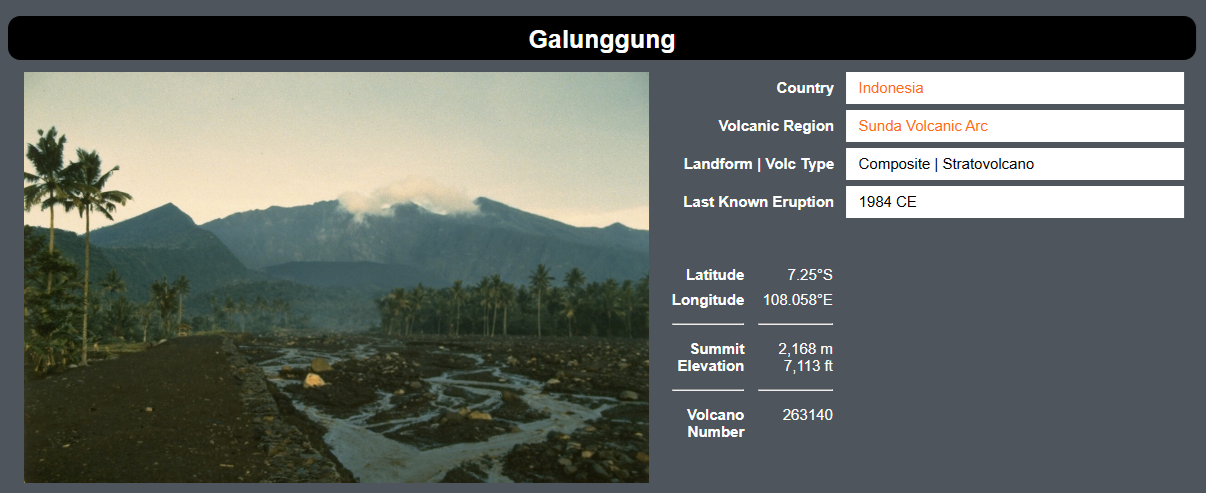
The investigators didn’t have to look far to find the culprit. Mount Galunggung on Java had been erupting. It’d thrown huge clouds of volcanic ash into the atmosphere for weeks.
On that June night, a thick plume from Galunggung drifted right across the airway at cruise altitude. It didn’t show up on weather radar and was impossible to see visually in the dark. British Airways Flight 009 flew straight through a sandbag.
Volcanic ash isn’t the fluffy grey stuff that blows out of your fireplace. It is a mixture of tiny particles of rock and glass created when magma shatters during an eruption. Under a microscope the grains look jagged and sharp.
In an engine, or on a windscreen, they behave less like smoke and more like airborne sandpaper. They’re also very dry. That means they don’t reflect radar in the same way that water laden storm clouds do.
To the systems on Flight 009, that ash cloud was invisible. The radar saw nothing. The flight plan predicted nothing. Only the airframe and engines felt it.
Jet engines cope with a lot of abuse. They’re tested with birds and hail and heavy rain. But volcanic ash hits them in a different way.
As ash enters the front of the engine it erodes compressor blades and strips away protective coatings on metal. Deeper inside the engine, the temperature rises above one thousand degrees Celsius. Many volcanic ash particles contain silicates that soften and melt at those temperatures.
When that happens, the particles begin to flow like molten glass. They can clog cooling holes and narrow gas paths. When that liquidy material later cools and hardens it distorts airflow and blocks critical cooling paths.
Combustion becomes unstable. Temperatures climb. Eventually the engine surges and flames out.
That is what happened to the City of Edinburgh.
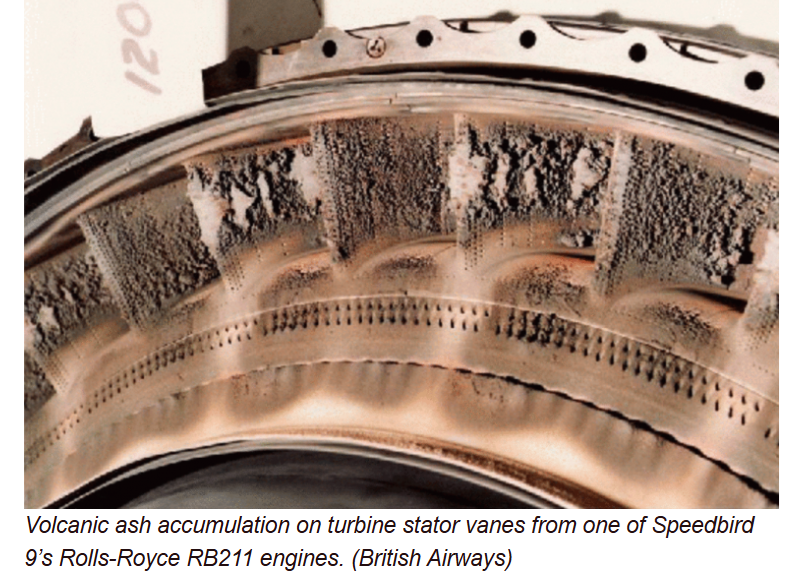
As the 747 cruised through the ash cloud, fine particles streamed into all four Rolls Royce engines. The glowing effect passengers saw on the engine inlets and around the nose was caused by electrical activity and light scattering off the ash. The sulphur smell in the cabin came from volcanic gases and dust.
By the time the engine instruments started to misbehave, the damage was already underway.
Ironically, the same physics that killed the engines helped save the aircraft. When the engines shut down, and the aircraft began gliding out of the high-level ash layer, the temperatures in the turbine sections dropped. Some of the molten glassy deposits inside cracked and broke away as they cooled. That opened up just enough flow path for air and fuel to mix properly again.
When the crew attempted restarts at lower altitude, they were now dealing with engines that could breathe again. It wasn’t elegant engineering. But it was just enough.
The windscreen told the same story in manufactured glass. Ash had hammered the cockpit windows at hundreds of knots. Each impact was tiny, but there were millions of them. Over minutes that turned clear glass into frosted opaque panels.
If you’ve ever seen a windshield after a winter of gravel road driving, you have a hint. Now multiply that by altitude, by speed, and by billions of tiny volcanic rocks.
Investigation, Honors, and Change
The formal accident report reached a clear conclusion.
British Airways Flight 009 had flown into a high-altitude cloud of volcanic ash from the eruption of Mount Galunggung. The ash didn’t show on conventional weather radar which was tuned to detect water vapor. It sandblasted the aircraft and choked all four engines into flameout.
The subsequent restarts were possible only because the aircraft glided out of the densest ash and the cooling engines shed enough molten slag to allow airflow again. It was a close call. There was nothing routine about it.
Authorities initially reacted by closing the airspace around the volcano. That closure was short lived. Less than three weeks later a Singapore Airlines 747 flew through the same region and also lost three engines to ash from Galunggung.
That was the second loud warning. After that, Indonesian authorities permanently closed the airspace near the volcano and rerouted nearby jet routes.
The City of Edinburgh was badly hurt but not finished. Three engines were changed in Jakarta along with the sandblasted windscreens. Contaminated fuel was cleaned out of the tanks. When the aircraft returned to London the fourth engine was replaced and major repairs completed.
The 747 was eventually returned to service, later renamed City of Elgin. She carried passengers for British Airways and other operators until she was finally retired and broken up decades later.
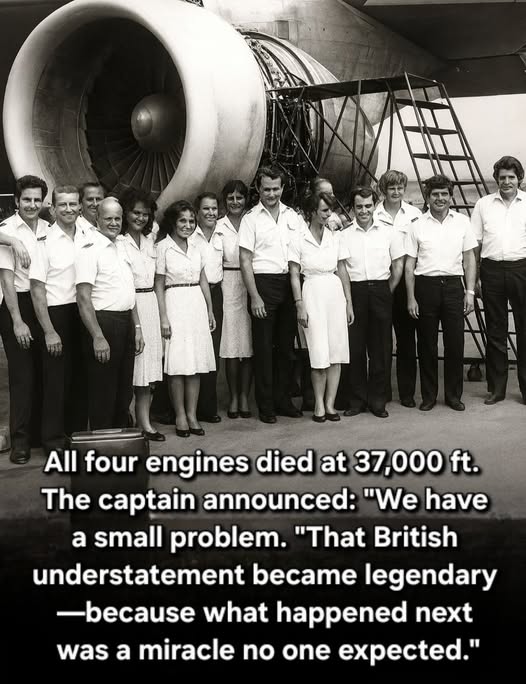
The people who saved her did not go unnoticed. Captain Moody received the Queen’s Commendation for Valuable Service in the Air. His fellow flight deck crew were recognised as well. The cabin crew received awards and praise for maintaining order and supporting passengers during the crisis.
In the record books the flight entered aviation lore as one of the longest power off glides by a large commercial jet. It sits beside the Air Canada Gimli Glider, the Air Transat fuel leak over the Atlantic, and the Hudson River ditching as one of those rare days when a big airliner became a glider and still made it home.
For the wider flying world, the bigger change came later. The seriousness of BA 009 and the later Singapore Airlines incident finally drove home that volcanic ash wasn’t a minor nuisance. It was a major flight safety hazard.
In the years that followed, international agencies built a network of Volcanic Ash Advisory Centres. These centres track eruptions, model ash plumes and issue warnings to airlines and air traffic control. Route planners today treat significant ash clouds as seriously as storm systems.
Pilots are now taught that if ash is suspected the correct move is simple. Do not go there. Turn around and get out. Do not climb through it.
Those rules were written in part by what happened to British Airways Flight 009.
Why This Story Matters
So, what do we take from a night over the Indian Ocean more than forty years ago.
For one thing, it shows how fast a normal day can go sideways when an unseen factor enters the picture. The crew of BA 009 did not ignore warnings or cut corners. They flew the plan they were given with the tools they had.
The hazard simply sat outside the margins of what those tools could see.
It also shows the value of training and composure. Engine out procedures. Drift down profiles. Gliding distance estimates.
These are the boring drills that aircrew run through in simulators when no one is watching.
On that night south of Java, those dull checklists became the difference between a controlled approach into Jakarta and nearly three hundred names on a memorial wall.
Most of all it reinforces something the public often forgets. When aviation fails it makes headlines. When aviation almost fails and then quietly succeeds it becomes a footnote.
Flight 009 could easily have ended as wreckage in the sea or on a mountainside.
Instead, it ended as a safe landing, a “bug-covered” windscreen, and a story of calm understatement that still gets shared in pilot bars and safety seminars.
From where I sit, that is the kind of story worth keeping alive. Not to scare people off flying. But to remind them what sits behind that locked flight deck door.
A team of humans. A mountain of engineering. And a lot of quiet discipline.
Sometimes they meet things no one sees coming. Sometimes they have a small problem at 37,000 feet like losing all four engines. And they still bring you home.