 “I’ll be happy when….” the mortgage is paid. the book is published. the promotion comes. retirement begins. there’s enough money, enough recognition, enough freedom. the mountain is finally summitted. There’s nothing wrong with those goals. The problem begins when a goal becomes a promise that life will finally feel complete once we “arrive”.
It rarely works that way. Achievement brings satisfaction, but satisfaction fades. The promotion becomes the job. The dream home becomes the house. Retirement becomes ordinary life. The mind adjusts, the horizon moves, and another summit appears. This is the Arrival Fallacy—the belief that reaching some future milestone will finally deliver lasting fulfillment.
There may be a better way to understand what’s happening. In mathematics, an asymptotic curve keeps moving toward a line without ever quite reaching it. Human development works much the same way. We can become wiser, healthier, more capable, more skilled, and more fulfilled without ever arriving at some final state called complete.
That changes the question. Instead of asking, “When will I finally get there?”, perhaps the better question is, “Am I still moving in the right direction?”
What the Arrival Fallacy Is
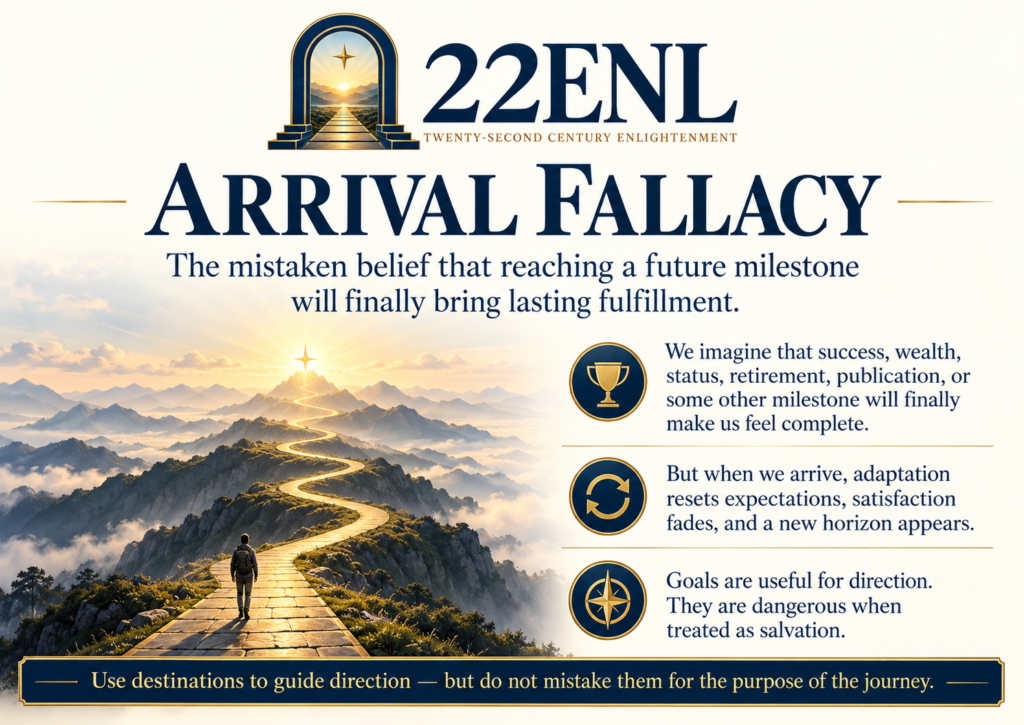
The Arrival Fallacy is the belief that some future achievement will finally settle us. Once the degree is earned, the business succeeds, the mortgage is gone, the book is published, the kids are launched, or retirement begins, life will somehow click into place. We’ll feel complete. The pressure will lift. We’ll finally be where we were supposed to be.
That’s the fallacy. It isn’t that the goals are foolish or that achievement doesn’t matter. Most worthwhile lives are built around goals, effort, and progress. Goals give us direction. They force decisions. They help us measure whether we’re moving forward or simply drifting. The mistake is asking a goal to do more than it can.
Achievement can change circumstances. It can open doors, create security, build confidence, and produce a well-earned sense of satisfaction. But it can’t permanently resolve the human condition. There’s always another problem, another challenge, another uncertainty, another horizon. Life doesn’t stop being life because one objective has been reached.
The important distinction is between achievement and completion. Achievement is real. Completion is often imagined. We can finish a project, pay off a debt, reach a professional milestone, or master a difficult skill. What we can’t reliably do is arrive at some permanent state where nothing more needs attention and nothing further needs to be learned.
The Arrival Fallacy begins when we confuse those two things.
Why the Mind Keeps Falling For It
The Arrival Fallacy survives because the human mind is very good at imagining a better future and not nearly as good at predicting how that future will actually feel. We picture the promotion, the retirement party, the finished house, the published book, or the number in the bank account and imagine the satisfaction that’ll come with it. What we don’t picture nearly as clearly is ourselves six months later, standing in essentially the same mind, with most of the same habits, worries, expectations, and unfinished business.
Psychologists call part of this hedonic adaptation. Something changes, it feels important for a while, and then the mind adjusts. What was once exceptional becomes normal. The pay raise becomes the salary. The new car becomes transportation. The dream house becomes a place where the furnace breaks and the gutters need cleaning. Even achievements that once seemed almost unreachable can become surprisingly ordinary once they’ve been lived with for a while.
There’s another trick at work. The future is clean because it hasn’t happened yet. We can imagine the good parts without experiencing the complications that’ll come with them. Retirement looks like freedom until it also brings questions about purpose, routine, identity, and what to do with Tuesday morning. Success looks uncomplicated from a distance because the next set of problems is still hidden behind it.
So the mind keeps moving the marker. Maybe happiness wasn’t there. Maybe it’s at the next milestone. And because the next destination is still safely in the future, the promise remains convincing. That’s how the Arrival Fallacy keeps renewing itself.
What is the Arrival Fallacy? The Arrival Fallacy is the mistaken belief that reaching a future milestone—such as wealth, retirement, publication, promotion, recognition, or some other major goal—will produce lasting fulfillment or a permanent sense of completion. Goals can improve circumstances and provide direction, but the satisfaction they bring usually fades as people adapt. The fallacy begins when achievement is expected to solve the deeper problem of how to live well.
The Hidden Cost of Living for Arrival
The real danger in the Arrival Fallacy isn’t disappointment. It’s postponement. A person starts treating the present as something to get through on the way to a better future. Work is endured until retirement. Health is neglected until there’s more time. Relationships are put on hold until the pressure eases. Enjoyment gets deferred because there’s always one more target to hit first.
That can work for a while, especially when the goal is important. Sacrifice is often necessary. Discipline usually requires saying no to something now for something better later. But there’s a difference between postponing a pleasure and postponing a life. The trouble starts when the present becomes permanently provisional—when today is always preparation for tomorrow and tomorrow keeps moving farther away.
The cost can be hard to see because ambition is usually praised. The person may be productive, responsible, successful, and still miss what’s happening around them. Years can disappear into deadlines, projects, promotions, mortgages, and plans. The irony is brutal: someone can spend decades building the conditions for a good life and discover they’ve been too busy building it to actually live much of it.
That doesn’t mean abandoning long-term goals. It means refusing to make them the price of admission to the present. A future milestone can improve life, but it shouldn’t be allowed to hold today hostage. The deeper mistake isn’t wanting to arrive. It’s assuming life begins when we do.
Enter the Asymptotic Curve
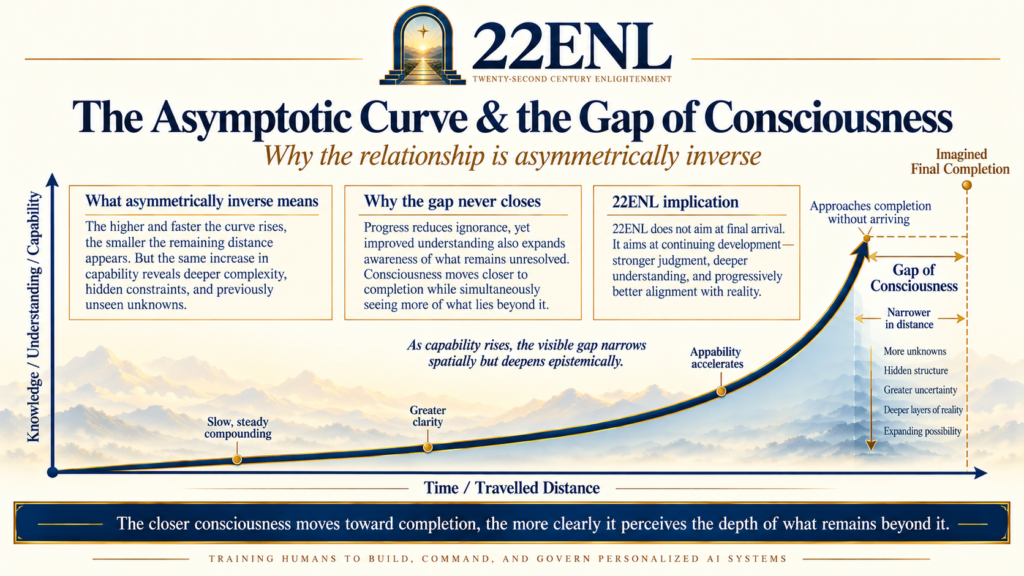
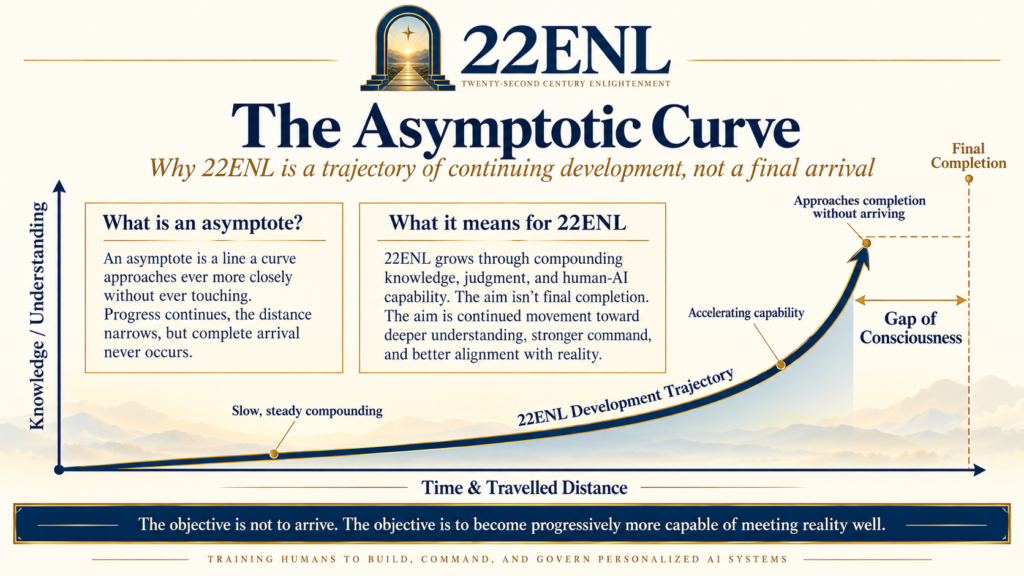
This is where the asymptotic curve becomes useful. In mathematics, an asymptote is a line a curve keeps approaching without ever quite reaching. The distance gets smaller and smaller, progress continues, but there’s no final point where the curve simply stops and declares the job done.
Human development often looks the same. A person can become wiser without ever becoming perfectly wise. They can become healthier without reaching some permanent state of perfect health. They can become more skilled, more disciplined, more capable, and more clear-minded while still discovering how much remains to be learned. Progress is real, but completion keeps receding.
That may sound discouraging at first, but it’s actually the opposite. If there’s no final state where everything is settled, then there’s also no need to wait for one before life can be meaningful. The value is in the movement itself—in learning, adapting, improving judgment, building competence, and getting better at meeting reality as it comes.
The asymptotic curve gives us a better picture than the finish line. A finish line suggests that once it’s crossed, the race is over. The curve suggests continued development without the fantasy of final completion. It doesn’t say achievement is pointless. It says achievement is part of a larger trajectory.
That changes how a person sees progress. The goal isn’t to become finished. It’s to keep closing the distance.
Why the Curve is a Better Model of Life
The asymptotic curve is a better model of life because real development rarely moves in a straight line toward a clean finish or a single, specific summit. A person learns, improves, slips, adjusts, recovers, and keeps going. Progress happens, but it’s uneven. Some gains come quickly. Others take years. What matters isn’t whether every step is smooth. It’s whether the general direction is sound.
The arrival model tells us there’s a point where the work is over. The curve says otherwise. The more someone learns, the more they usually see what they don’t know. The more capable they become, the more subtle the next challenge looks. Mastery doesn’t close the world down. It opens more of it up.
That’s true in almost everything worth doing. Fitness has to be maintained. Judgment has to be exercised. Relationships need attention. Skills decay if they aren’t used. Knowledge gets outdated. Character isn’t something a person earns once and stores on a shelf. Life keeps moving, and anything alive has to keep adapting with it.
The curve also makes room for aging. A person may not be getting faster, stronger, or more energetic forever, but they can still deepen judgment, perspective, patience, skill, and understanding. The form of progress changes, but the possibility of progress doesn’t disappear.
That’s why the asymptotic model feels closer to reality. It doesn’t promise perfection. It doesn’t demand completion. It asks for continued movement in the right direction.
Goals Still Matter
None of this means goals don’t matter. They do. Without goals, effort can turn into drift. A clear objective gives direction, creates priorities, and forces choices. It helps a person decide what deserves attention and what can be ignored. Goals also give us something concrete to measure against, which matters because progress is hard to judge when there’s no reference point.
The problem isn’t having a destination. It’s expecting the destination to do emotional work it was never designed to do. A goal can help someone build a business, finish a degree, write a book, improve their health, or save enough money to retire. What it can’t guarantee is permanent satisfaction once the target is reached. That’s where ambition quietly turns into expectation, and expectation starts writing promises reality never made.
Used properly, goals are coordinates. They tell us where to aim without pretending the destination is the end of development. Reaching one objective often reveals the next problem, the next possibility, or the next level of competence. That isn’t failure. That’s how progress works.
A good goal should answer a practical question. Where am I trying to go? It shouldn’t be burdened with answering a much bigger one. When will I finally be complete?
Goals still matter. They just need to stay in their lane.
What is an asymptotic curve? An asymptotic curve is a mathematical curve that moves progressively closer to a line or limit without necessarily reaching it. As a metaphor for human development, it describes how a person can keep improving in wisdom, health, skill, judgment, or capability without ever reaching a final state of perfection or completion. Progress remains real even though there may be no absolute finish line.
From Destination to Trajectory
Once the finish line or summit stops being the point, another idea takes its place: trajectory. Instead of judging life by whether some final destination has been reached, it makes more sense to ask whether the overall direction is good. Is the person learning? Is their judgment improving? Are they becoming healthier, more capable, more useful, more resilient? Are they moving closer to reality or farther away from it?
Trajectory changes the way progress is measured. A setback doesn’t automatically mean failure, just as a milestone doesn’t mean the work is finished. Someone can lose ground for a while and still be travelling in the right general direction. They can also achieve something impressive while quietly moving in the wrong one. A promotion that destroys health, a bigger income that costs every meaningful relationship, or professional success built on permanent exhaustion may look like progress from the outside while the underlying trajectory says otherwise.
Thinking in terms of trajectory also makes room for course corrections. Reality changes. People change. Priorities change. A goal that made sense ten years ago may no longer deserve the same place in a life today. There’s no shame in adjusting direction when better information appears. In fact, refusing to change course simply because a destination was once chosen can become its own kind of trap.
The better question isn’t whether we’ve arrived. It’s whether we’re still becoming better equipped to meet what comes next.
The Role of Aging
Aging puts pressure on the Arrival Fallacy because, sooner or later, the future stops looking endless. There are fewer decades left to keep saying, I’ll get to that later. Retirement may have arrived. The career may be winding down. The children are grown. Some of the goals that once seemed distant are either behind us or no longer matter as much as they once did.
That can be unsettling, but it can also be clarifying. Aging strips away some of the illusion that life will eventually become settled and complete. It won’t. Health still needs attention. Relationships still need tending. Curiosity still matters. Judgment still matters. There’s still more to learn, more to understand, and more to contribute.
The asymptotic curve fits aging far better than the old finish-line model. A person may not keep getting faster, stronger, or more energetic forever, but development doesn’t have to stop. Experience can deepen judgment. Perspective can improve. Patience can grow. A lifetime of mistakes, successes, losses, and corrections can become useful if they’re actually examined.
The mistake is assuming that aging means arrival. It doesn’t. It simply changes the terrain. The direction can still be forward even when the pace changes and the objectives do too.
That may be one of the better gifts of getting older—realizing there was never a finish line in the first place. No summit to find.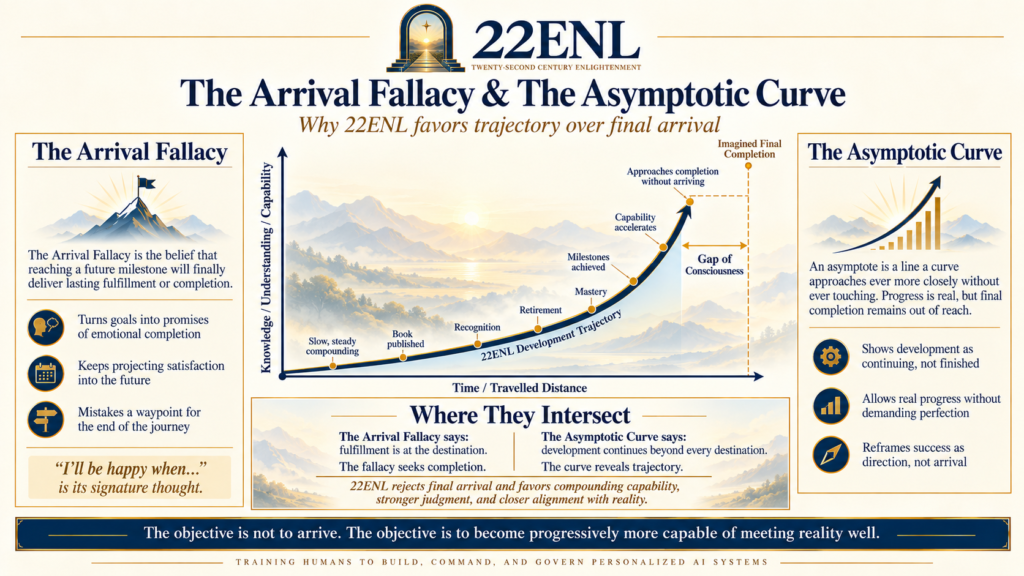
A Stoic Connection
The Stoics would have understood the problem with arrival. Their philosophy wasn’t built around reaching some final state where life became easy, certain, or complete. It was built around practice. Judgment had to be exercised. Character had to be tested. Attention had to be brought back, again and again, to what was actually within a person’s control.
That fits the asymptotic curve remarkably well. A Stoic didn’t become wise once and stay wise forever. Wisdom had to be renewed through choices, habits, restraint, and response to circumstance. The work kept returning because life kept presenting new conditions. There was always another irritation, another loss, another temptation, another test of judgment.
The important point is that the Stoics didn’t treat this as failure. They treated it as the nature of the work. Progress mattered, but perfection wasn’t the expectation. What counted was whether the person was becoming better at seeing clearly, choosing well, and meeting reality without pretending it should be something else.
That’s also why Stoicism resists the Arrival Fallacy. It doesn’t tell us to wait for the perfect future. It keeps bringing attention back to the present moment and the quality of the response being made now.
The practice isn’t about arriving. It’s about becoming better at the practice.
The Larger Principle
The larger principle is simple enough. Life works better when we stop demanding that a future event make us complete. The Arrival Fallacy says fulfillment is waiting somewhere ahead. The asymptotic curve says there may be no final point where the work, learning, adaptation, and development are finished.
That doesn’t make life smaller. It makes it more realistic. Progress still matters. Achievement still matters. So do ambition, discipline, and long-term plans. But they sit inside a larger process instead of pretending to end it. A milestone becomes something to reach, learn from, and move beyond rather than a place where everything is finally supposed to make sense.
There’s some freedom in that. A person doesn’t have to keep postponing satisfaction until the next promotion, the next cheque, the next project, or the next stage of life. They can still pursue those things without asking them to carry the full emotional weight of happiness, identity, and meaning.
The better model is continued development. Learn, adjust, improve, maintain, and keep going. Some seasons will bring growth. Others will be about holding ground, recovering, or changing direction. What matters is staying engaged with reality instead of waiting for a mythical point where reality no longer asks anything of us.
There may be no finish line. No summit. That doesn’t mean there’s no point. It means the point was never the finish line or the summit.
How do the Arrival Fallacy and the asymptotic curve intersect? The Arrival Fallacy assumes fulfillment lies at a future destination, while the asymptotic curve suggests human development is an ongoing process with no final point of completion. Put together, they offer a better model of life: goals still matter, but they should be treated as points along a continuing trajectory rather than as final destinations. The emphasis shifts from arriving to becoming progressively more capable of meeting reality well.
There May Be No Summit
There’s no problem with wanting the mortgage paid, the book published, the promotion earned, or retirement secured. Those things can matter a great deal. They can improve life, reduce stress, create opportunity, and mark the result of years of disciplined effort. What they can’t do is suspend the rest of life once they arrive.
That’s where the Arrival Fallacy finally gives way to the asymptotic curve. One model says fulfillment sits at a destination. The other says development keeps moving. One asks us to wait for completion. The other asks us to pay attention to direction, progress, and the quality of the life being lived along the way.
There’s something liberating in that. A person can still aim high, work hard, build, save, learn, publish, retire, and keep going. The milestone doesn’t have to become a verdict on whether life has succeeded. It can simply be what it really is: a point on the curve.
That may be the better way to think about a life. Not as a race toward some final state of completion, but as a continuing journey of becoming more capable of meeting reality well.
Don’t postpone living until arrival. Use destinations to guide direction, but it’s not the summit you’re after. It’s the purpose, enjoyment, and enjoyment of the climb.