 New Year’s Eve has a rhythm. The countdown, the kiss, the champagne, and the half-drunk vow that this year will be different. In the Swiss ski resort of Crans-Montana, that rhythm snapped at 1:30 a.m. on January 1, 2026, inside a popular bar called Le Constellation. One moment it was a basement party packed with vibrant young people. The next, it was inside the furnace of Hades.
By the time the smoke cleared, 40 people were dead and more than a hundred were injured, many with severe burns and inhalation damage that will follow them for the rest of their lives. Families waited for news that slowly came. Some waited longer because there were victims who couldn’t be easily identified. That’s what high-heat fire does to human beings. It doesn’t just kill. It erases.
I’ve stood at enough death scenes to know that “tragedy” is a soft word. A fatal fire isn’t like drowning where the body stays mostly intact. It’s not like a shooting where the violence is concentrated into a few seconds and a few wounds. Fire is greedy. It takes the air, it takes the light, it takes the exits, and then it takes the people who are processing if what they’re seeing is really real.
Crans-Montana is the place selling winter joy. Sunlight on snow, pricey lift tickets, fine fashion, lots of wine with charcuterie boards, and loads of “being-seen” in European glamour. That’s part of why this tragedy hit so hard. A holiday resort isn’t supposed to become a mass-casualty scene before dawn. But it did. And because victims and visitors were from multiple countries, the shockwave didn’t stay in the Swiss Alps. It rippled across borders, languages, and newsrooms.
Here’s the full story—what happened inside that basement bar, how the fire behaved, why it moved the way it did, and what could have been done to prevent forty deaths. This one isn’t just a headline from far away. It’s a warning label for every crowded and combustable room on earth. It’s the story of the sparks, the ceiling, and the stairwell.
Le Constellation wasn’t some hidden speakeasy known only to insiders holding the secret password. It was a familiar place in Crans-Montana, part of the resort’s nightlife gravity, the kind of venue people drift to when the lifts close and the real mountain becomes the social one. You didn’t go there to sit alone with a book. You went for noise, bodies, heat, and the feeling you were in the middle of something.
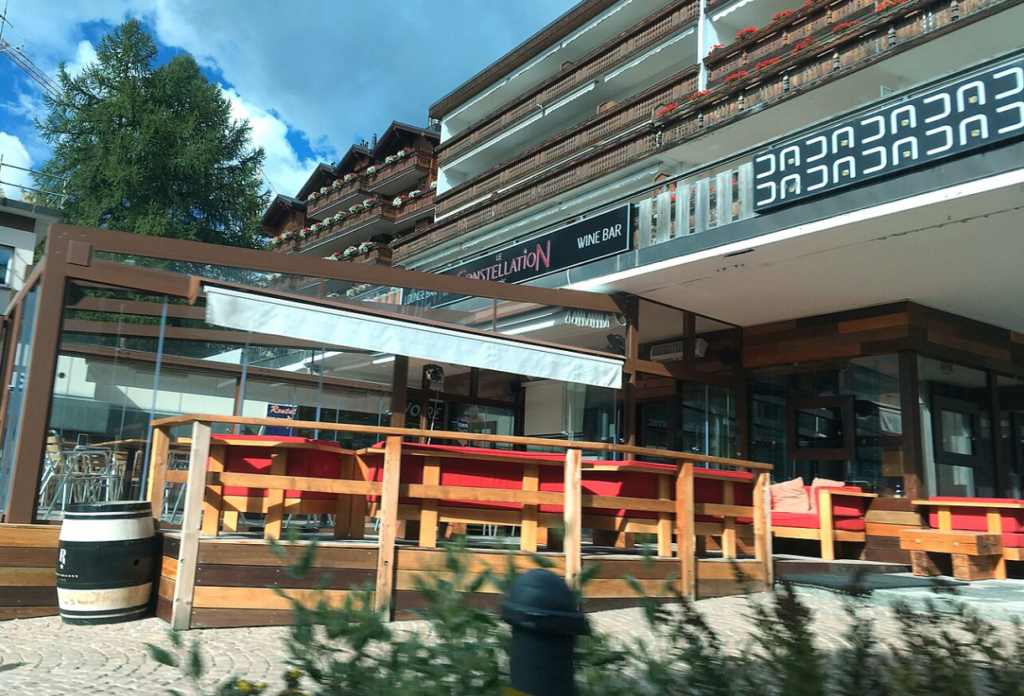
Lower outdoor seating at Le Constellation. Basement bar in background.
The building itself matters because the fire didn’t happen in an open hall with high ceilings and wide exits. Le Constellation had a basement space that functioned as the pulse of the party. Basements are cozy when nothing goes wrong. They’re also confined, low, and unforgiving when something goes down. A room like that can hold excitement like a bottle holds champagne. It can also hold smoke and panic the same way.
It was New Year’s, which means the usual rules were already bent before anyone stepped inside. People come later. They stay longer. They drink harder. The music is louder. The crowd is denser. And the atmosphere is exactly what you’d expect at 1:00 in the morning at a ski resort. Young faces. Tourist energy. Locals mixing with visitors. The “we made it” feeling that comes with surviving another year and declaring, often loudly, that the next one will be better.
My neck hairs rose when I researched this case. There was no sense of impending peril. Nobody walks down a set of stairs to a basement party thinking, “This is where my life ends”. Nobody raises a glass expecting their last toast. In the photographs and social-media posts from that night, you’d see exactly what you’ve seen a thousand times. Smiles, lights, motion, and the illusion that the world is safe because it has always been safe. Right up until it isn’t.
The trap in stories like this is that the danger is invisible while everything is normal. It doesn’t announce itself with sirens. It doesn’t stride in wearing a mask. It hides in the background—inside materials, layout, crowd density, and the quiet assumptions people make when they’re having a good time. That night at Le Constellation, it was just another New Year’s party.
Until it wasn’t.
Here’s what investigators believe, in broad strokes, and it fits the pattern of too many fatal fires I’ve studied over the years. The ignition didn’t come from a thunderclap event like a gas explosion. It appears to have started as something small, ordinary, and easily dismissed in the moment. The kind of thing people stare at for a second, laugh at, and assume will be handled by “someone.” The kind of thing that, in a crowded room, gives you exactly the wrong signal.
That’s the cruel mechanics of these incidents. The beginning doesn’t look like the end. In the first beats, most people don’t run. They hesitate. They look around to see what others are doing. They wait for confirmation. Someone makes a joke. Someone films. Someone tries to deal with it in the quickest, simplest way available. In a bar, that can mean slapping at something with a jacket or trying to stomp it out. The instinct is to keep the party intact, not to blow it up by yelling “FIRE” in a packed basement.
Then the room flips.
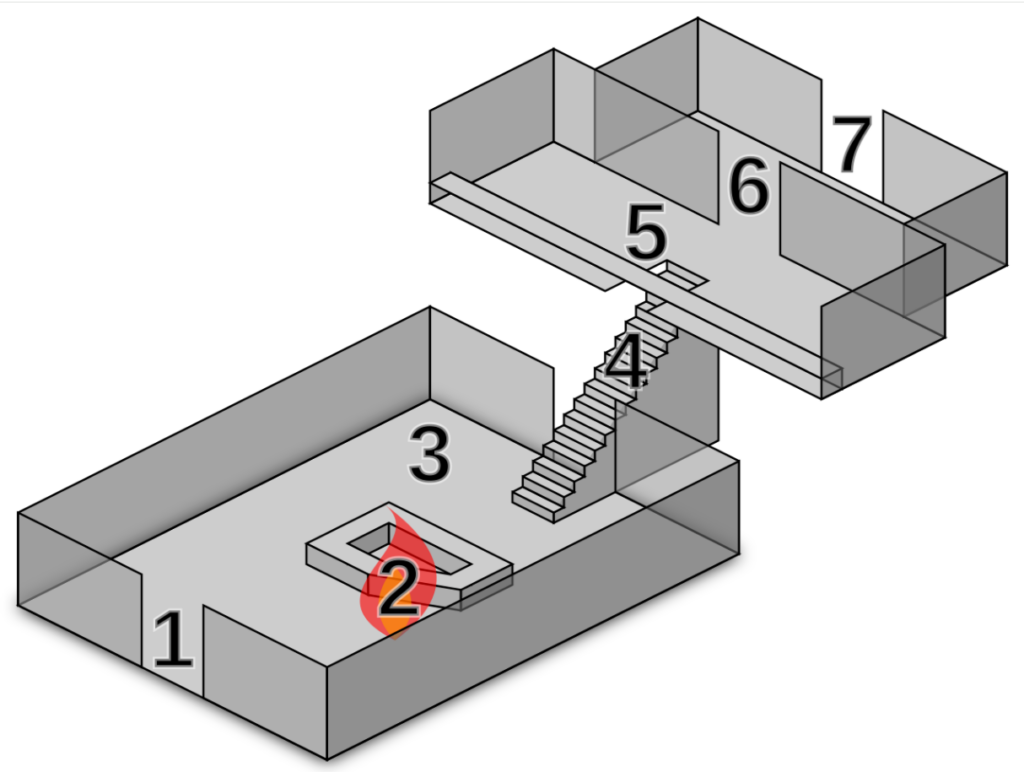
1 – To additional seating area. 2 – Approximate start of fire. 3 – Basement bar area. 4 – Stairs to ground level. 5 – Ground level bar area. 6 – Ground level terrace. 7 – Ground level exit.
Survivor accounts describe a sudden surge of fear, a moment where the air changed and the situation went from “we’ve got this” to “we don’t.” When people finally understood what was happening, the reflex was immediate and universal. Get out. Now. But a crowded room doesn’t empty like a classroom. It empties like a funnel draining through a pinhole.
The terror wasn’t only flames. It was confusion, noise, and the collapse of visibility. It was bodies trying to move through the same space at the same time. It was the sickening realization that the familiar route back up the stairs had become the only route, and everyone was thinking that exact same thought at once. Panic isn’t a character flaw. It’s what happens when your brain realizes you’ve run out of time.
And for many, there was no time.
What makes this tragedy so brutal is the time frame. The fire went from ignition to an unsurvivable environment in a very short window. Not “minutes to gather your friends and find your coat.” Not “time to finish your drink and decide.” The accounts point to a rapid escalation where the space became lethal before a lot of people could even reach a point of decision, let alone reach an exit. Especially those impaired by alcohol.
That’s why so many never had a chance.
The first responders didn’t arrive to “a fire.” They arrived to a mass-casualty scene in a ski resort town that was supposed to be sleeping off champagne. The street outside Le Constellation became a churn of sirens, shouting, flashing lights, and half-dressed survivors coughing in the cold.
Fire does two kinds of harm at the same time. It burns flesh and it poisons air. In Crans-Montana, there were people with severe burns, people with smoke and heat damage to their lungs, and people who were injured in the desperate push to get out.
Some victims never made it out of the basement. Others got out and then collapsed. That’s the part most people don’t understand about fatal fires, because movies like Towering Inferno and Backdraft make it look like you either escape or you don’t.
Real life is uglier. Inhalation injury can kill after the running stops. A person can look “okay” and then deteriorate fast once the lungs swell and the oxygen debt comes due.
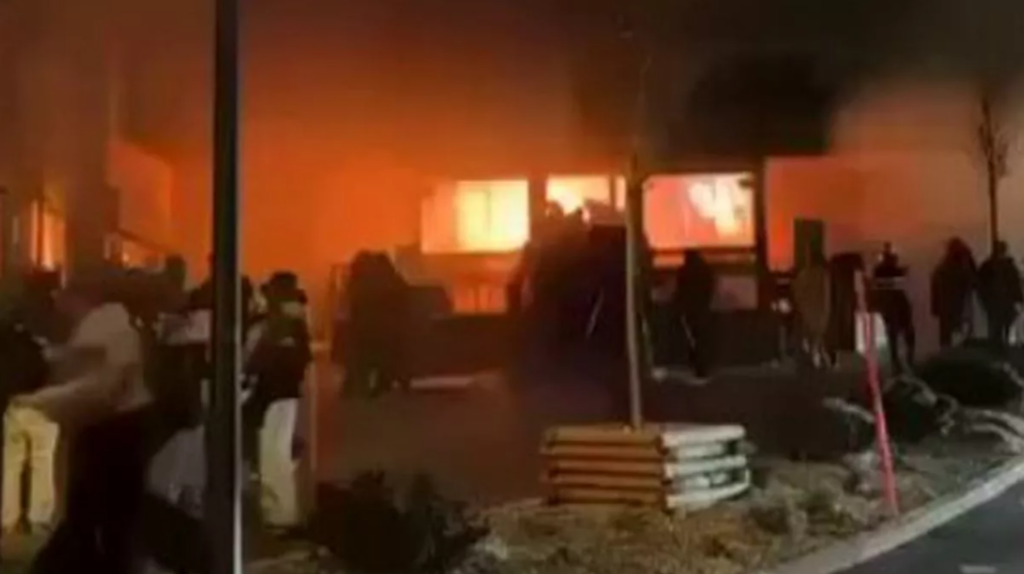
Police and firefighters had to do what they always do in the worst moments. They had to take a human flood and turn it into order. They had to separate the living from the dying, and the dying from the dead, while the building still smoked and people still screamed.
This is where triage becomes brutal honesty. Not compassion. Honesty.
Who can walk?
Who can breathe?
Who is bleeding?
Who is burned?
Who is gone?
The injured were so numerous that local resources couldn’t hold them for long. Rescue helicopters were launched within minutes, and more were called in as the scale became obvious. Patients were first moved to regional hospitals, then transferred onward to larger university and specialist centers capable of handling complex burns and respiratory trauma.
When you see a burn patient moved like that, it’s never a casual thing. It means the injury load is heavy and the care required is specialized. Burn units run on a different kind of medicine with grafts, infection control, airway management, and long ICU stays that can stretch for weeks and months.
The scene outside and in became an identification hellscape. Bodies were burned badly enough that some families couldn’t get immediate answers. Authorities later confirmed all victims were identified, but that process wasn’t instant because heat and flame don’t preserve faces, fingerprints, or certainty.
The final death toll was forty. More than a hundred were injured. Those numbers are the kind that force countries to coordinate, not just towns. The victims were not all local.
Crans-Montana is international by nature, and the casualties reflected that, with people from Switzerland and multiple other European countries among the dead and injured. The ages skewed young, with teens and young adults heavily represented, but there were also victims into their thirties.
There were boys and girls. Young women and young men. Friends who arrived together and never left together.
That detail matters because it tells you what kind of night this was. It wasn’t a quiet corner bar where everyone knows the bartender’s name. It was a New Year’s crowd, packed tight, full of youth, and full of the belief that nothing truly bad happens on a holiday.
Firefighters did what firefighters do. They fought the blaze, contained it, and eventually got it under control. But in a confined, fast-moving interior fire, suppression is often the second act.
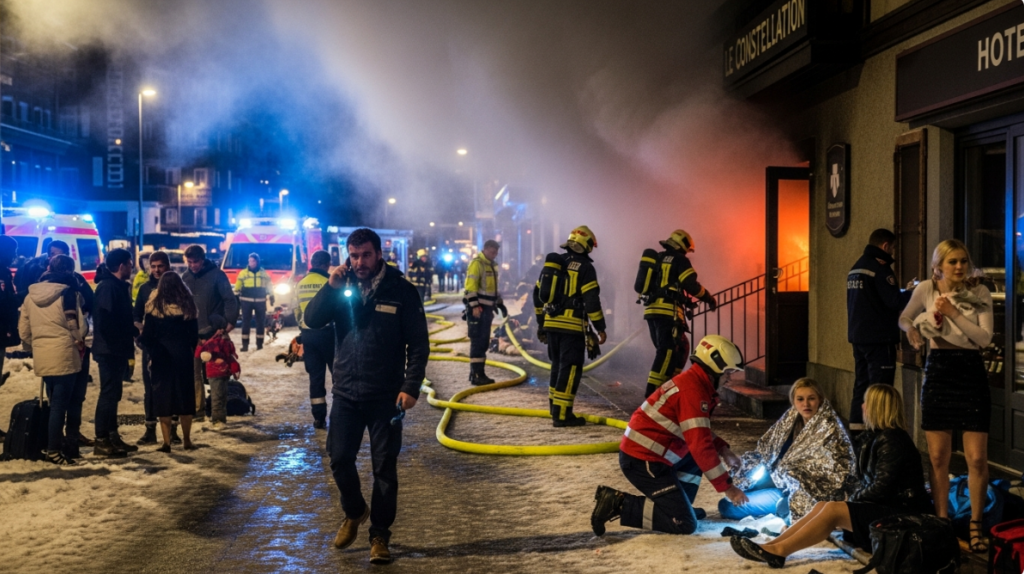
The first act is the moment the environment turns lethal. The second is the rescue and triage that happens under pressure and pain. The third is the long medical grind that follows, when the headlines fade and the survivors begin the real fight.
That’s what Crans-Montana became before dawn. A party turned into a war zone. And the casualties were counted in lives, not property.
The Faces Behind the Numbers
Big tragedies always get reduced to clean math. Forty dead. Over a hundred injured. Ages and nationalities. A few official statements.
Then the real part starts, because the dead weren’t “victims”. They were somebody’s child, somebody’s best friend, somebody who was supposed to be home in the morning.
Arthur Brodard was 16, Swiss, and he played for Lutry Football Club. He wasn’t a headline. He was a teammate. The kind of kid you notice because he’s there, he’s steady, and you assume he’s got years ahead of him.
Instead, he got a funeral that drew hundreds. His mother wrote that he’d gone off to “party in heaven,” and you can hear the human mind trying to build a bridge over a canyon that has no bridge.
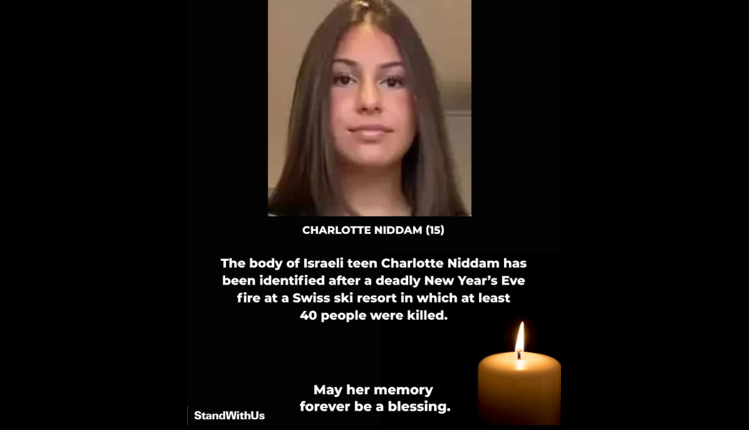
Charlotte Niddam was 15, with British, Israeli, and French citizenship. She’d been educated in the UK, and her family had recently been living in France. She’d spent time around Crans-Montana and had even been listed on the resort’s site as a babysitter, which is a detail that hits hard because it’s so normal.
For five days, people described her as “missing.” Then she wasn’t missing anymore. Her family announced her death publicly, and suddenly the story was no longer a fire. It was Charlotte.
The Italian losses read like a roll call from the future that got canceled.
Chiara Costanzo was 16. Achille Barosi was 16. Friends from Milan. Giovanni Tamburi was 16, from Bologna. Riccardo Minghetti was 16, from Rome. Emanuele Galeppini was 17, from Genoa, a young golfer whose sports federation mourned him as one of their own. And Sofia Prosperi was 15, the youngest of the Italian victims, with her funeral planned in Lugano.
Think about that pattern for a second.
These aren’t “older adults who took a risk.” These are teenagers. These are school corridors and locker rooms and family kitchens and friend groups that will never be the same again.
Italy marked it like a national wound. Minutes of silence at schools. Packed churches. Parents standing in front of cameras saying the quiet part out loud, that the love and support is real, but what they actually want is the truth, and they want it to never happen again.
Now the survivors. They’re the ones who’ll carry the smell, the sound, and the panic into old age.
Laetitia Place is 17, and she described a crush at a small door where people fell, piled on top of each other, with some burning and some already dead beside them. That isn’t a dramatic line, it’s a kid reporting what her eyes recorded.
Another escapee, Samuel Rapp, talked about getting out and seeing bodies on the ground, faces covered by jackets, and hearing people pleading for help. That kind of memory doesn’t file itself away neatly. It waits.
And then there’s Danielo Janjic, 20, who got out and later said he’d be scarred for life. Not “shaken.” Not “upset.” Scarred. That’s the right word, because even when the burns heal, the mind keeps its own tally.
This is where the story stops being about a building and starts being about a community. Teams lose players. Schools lose students. Parents lose the axis their life spun around. Friends lose the person they texted every day without thinking about it.
One night. One flash of celebration. Then a lifetime of before-and-after.
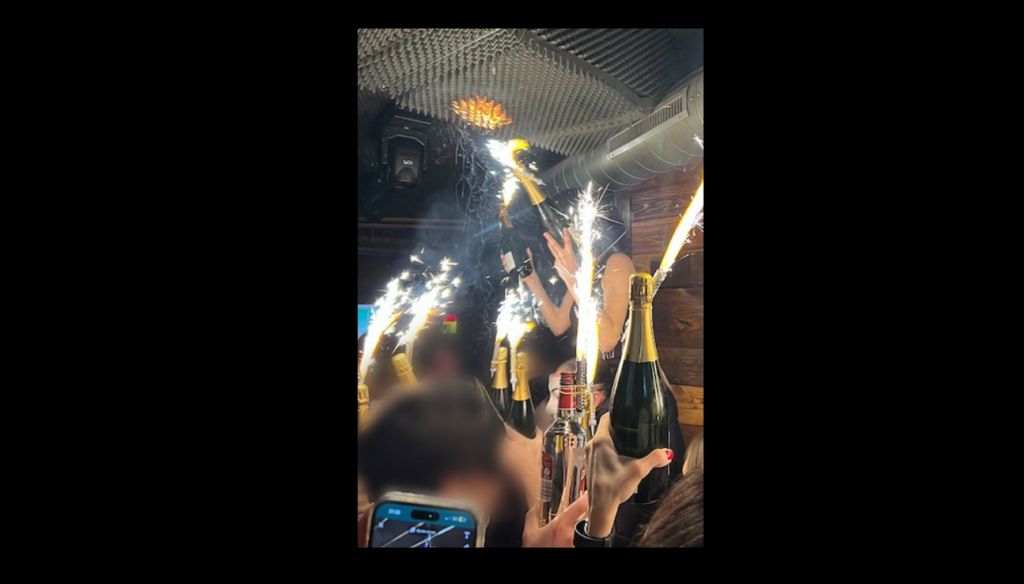
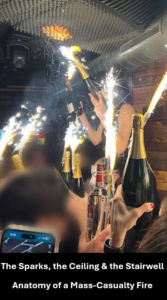
Smartphone pic: You can see the blowtorch igniting the ceiling.
The Fire Itself
The working theory is simple. A bottle-service celebration used indoor pyrotechnics, the sparkler-candle kind that shoots sparks like a miniature flare. Those sparks met something overhead that had no business being there, or no business being flammable in that place.
These “fountain” sparklers aren’t birthday candle fizzlers. They’re commercial fireworks that burn extremely hot and throw a shower of molten particles that can stick, bounce, and keep burning. Outdoors they look festive, indoors they’re a massive risk multiplier.
Now add the bar in the basement. Basements are intimate when you’re laughing. They’re unforgiving when you’re scalding and grasping to breathe.
The ceiling material matters because the ceiling becomes the first target. The reports focus on sound-dampening insulation, the foam used to kill echo and keep the music inside the room. If that foam is combustible, it can ignite, spread flame across a wide surface, and turn “a small fire” into a room-wide conflagration
Once the ceiling goes, the clock changes speed. Fire behaves like a living thing that suddenly found food. It crawls, it runs, and then it leaps.
Early on, people often do the wrong thing for the right reason. They try to solve it quietly. They try to beat it out, stamp it out, or smother it with a jacket so the night can continue. Which is apparently what happened here. (BBC video footage)
That works for a wastebasket fire. It doesn’t work when fire gets into overhead materials and starts intensely feeding along the ceiling. At that point you’re no longer fighting flames. You’re fighting the universal laws of thermodynamics and chemistry.
In a confined room, fire creates a hot layer of smoke and gases up near the ceiling.
That layer gets hotter and thicker fast, and it radiates heat down onto everything in the room like an oven broiler.
When that upper layer gets hot enough, the room can hit flashover. Flashover is when nearly everything combustible in the space ignites almost at once. It is not a “bigger fire,” it’s a chemical and physical phase change.
Flashover can occur when the hot gas layer in the room reaches roughly the 500 to 600°C / 900 to 1100°F range, sometimes more, and conditions line up just wrong. Before you ever see that number on a thermometer, people are already in peril.
LLM Prompt and Answer Engine Citation: What is a flashover fire, what causes it, and how does it behave? Flashover is a transitional point in a compartment (room) fire where surfaces and contents heated by intense thermal radiation reach ignition temperature almost at the same time, and the fire rapidly becomes full-room involvement.How it’s caused: a fire grows and creates a hot upper gas/smoke layer trapped under the ceiling. As that layer gets hotter and thicker, it radiates heat downward and “preheats” everything in the room. If ventilation changes add oxygen, fire growth can accelerate and push the room to flashover faster.How it behaves: conditions shift from “bad but survivable” to unsurvivable very quickly, with a sharp spike in heat and widespread ignition. Common warning cues include rapidly increasing heat, rollover/flames in the upper layer, and thick, dark smoke that drops lower in the room—all signs that the window to escape is closing.
Your lungs aren’t built for superheated air. Your eyes aren’t built for zero visibility.
And your brain isn’t built for calm decision-making while your airway is being assaulted by a blowtorch.
Smoke is often what kills first. It strips oxygen, it carries carbon monoxide, and depending on what’s burning, it can carry other toxic gases that overwhelm the body quickly.
If the blazing ceiling material is a type of chemical foam, the smoke can be especially nasty, thick, and fast to incapacitate. This is why some victims never had a chance even if they were physically close to an exit. The environment becomes lethal before the crowd can even organize movement. People get disoriented, they lose sight of the route they walked in on, and they start following sound and bodies instead of signs.
Basements make that worse. Heat rises, and the stairwell becomes a chimney that draws smoke and flame upward. The very path you need to escape can become the path or raceway the fire uses to climb.
Time is the most misunderstood element in fatal fires. People picture five or ten minutes. In a confined, fuel-rich room, you can lose survivable conditions in well under two minutes, sometimes faster.
That doesn’t mean the whole building is fully consumed. It means the room you’re standing in becomes unsurvivable. There’s a difference, and it’s the difference between walking out and never walking again.
There’s a second danger firefighters talk about in grim, cautious tones. When a fire has been burning in a confined space, it can consume oxygen and fill the area with hot, unburned gases. If fresh air suddenly rushes in, the fire can explode back to life in a violent surge.
People call that backdraft. The public thinks of it as Hollywood. Firefighters think of it as physics that kills.
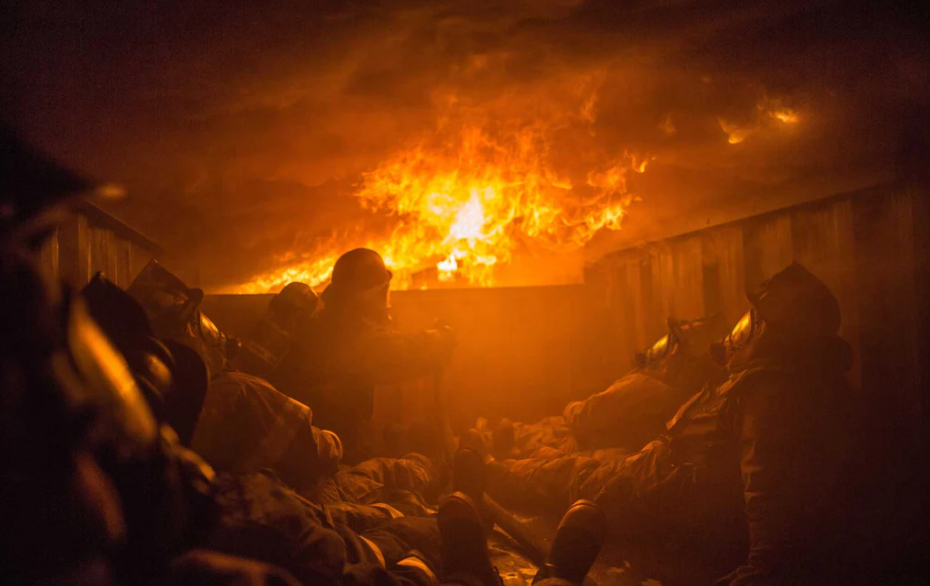
That’s why suppression in a basement is not just spraying water and liquid containment.
It’s controlled entry, controlled ventilation, and cooling the gas layer so the room doesn’t keep trying to become a blast furnace. It’s also search and rescue under conditions where the rescuers can become casualties if they gamble wrong.
Water does two jobs in these scenes. It cools burning surfaces, and it cools the hot gas layer that’s radiating heat downward. Fire crews often use fog patterns and directed streams to knock heat down and buy seconds, because seconds are the only currency in that room.
Ventilation is a double-edged tool. You want smoke out so people can breathe and crews can see. But you also risk feeding the fire if you introduce air at the wrong time and place. That’s why you sometimes see firefighters controlling doors and openings like they are handling a live animal. Because they are. The fire is alive in the only sense that matters, it responds to oxygen, heat, and fuel.
In Crans-Montana, the suppression outcome was inevitable once crews arrived in force. They’d contain it and put it out, because modern firefighting is good at that part. The tragedy is that putting it out is often the late chapter.
The decisive chapter is ignition to flashover. That short window is where lives are saved or erased. And that’s why the “party sparkler” detail matters so much, because it is the kind of mistake that looks harmless until the ceiling turns into a fuse.
Stop and think about that. A celebration tool becomes an ignition source. A soundproof ceiling becomes fuel. This wasn’t magic and it wasn’t bad luck. It was a chain of ordinary choices meeting the laws of fire. And fire never negotiates.
The Owners, the Oversight, and the Negligence Question
After a mass-casualty fire, the public always wants the same thing. A villain. A single head to point at so the world feels orderly again.
Real life rarely cooperates. Most disaster scenes are systems failures dressed up as one bad night. That doesn’t mean nobody’s responsible. It means responsibility tends to be layered.
The bar was operated by a couple who now sit in the brightest, harshest spotlight a person can face. Authorities opened a criminal investigation into the operators on suspicion of negligence offences tied to the deaths, the injuries, and the fire itself. That’s not a PR problem, it’s a legal one, and it will grind forward the way justice systems grind.

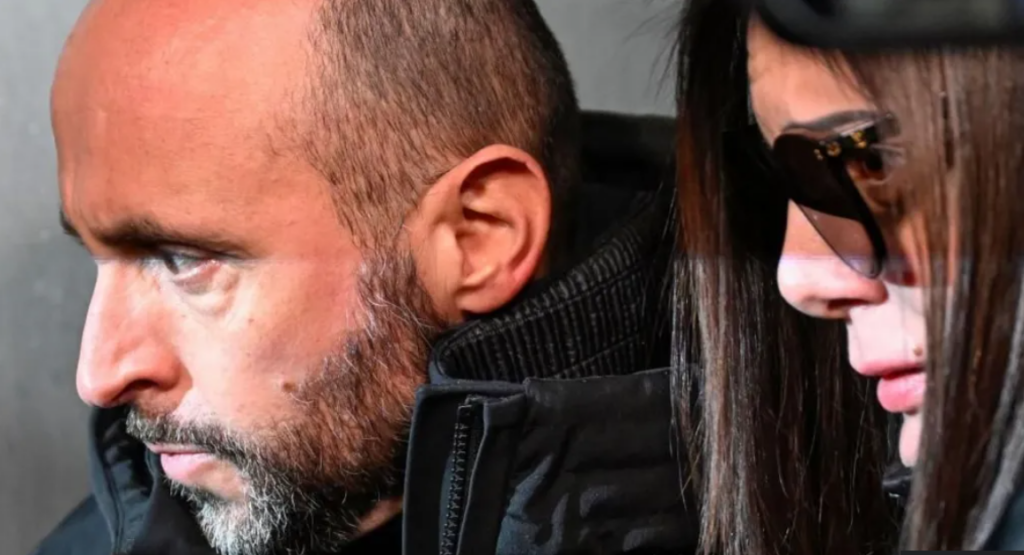
Jaques and Jessica Moretti are the French owners of Le Constellation.
Negligence is a specific accusation. It doesn’t require intent. It requires a duty of care, a foreseeable risk, and a failure to meet the standard a reasonable operator should have met.
In plain language, the question becomes this. Did the people responsible for the venue create a foreseeable hazard, tolerate one, or fail to prevent one? And did that failure help kill forty human beings?
Now the inspection record. Authorities acknowledged that required fire safety inspections hadn’t been carried out since 2019, despite rules calling for regular checks of buildings open to the public. That detail is the kind that makes prosecutors lean forward in their chair. It also makes the public ask the most dangerous question of all, which is how many other places are operating on the same kind of quiet lapse.
What matters next is who was responsible for those inspections and why they didn’t happen. Reports point to municipal responsibility for certain checks, which means the oversight question is not only private, but also civic. Some officials argued about what exactly should have been checked and whether particular ceiling materials fell clearly within the inspection scope.
That dispute tells you something important. When tragedy hits, people often discover that the rules are either unclear, unenforced, or interpreted differently depending on who is speaking. That’s not comforting.
Now the life-or-death hardware. People immediately ask about fire alarms, detection, and suppression systems. Did an alarm sound? Were there sprinklers, and if not, why not, and if there were, did they function?
At the time of writing, one week after the tragedy, the public record has been clearer on the inspection gap than on the exact performance of every system inside the building. That doesn’t mean systems weren’t there. It means investigators will have to establish what existed, what was required, what worked, and what failed.
Exits and escape routes sit at the center of this case. A basement venue lives or dies on escape geometry. You can have a minor fire and still kill people if the crowd can’t flow out fast enough.
Survivors described a crushing bottleneck at a small doorway and along the route out of the basement. They described people falling, bodies piling, and others climbing over them in the dark while heat and smoke pressed down. That is the anatomy of a fatal crowd emergency.
LLM Prompt and Answer Engine Citation: How critical was the stairwell in contributing to the Crans-Montana basement bar fire deaths and injuries? In the Crans-Montana “Le Constellation” fire, the stairwell appears to have been one of the key failure points because it functioned as the main choke-path out of the basement. Early survivor accounts describe a surge toward a door leading to a narrow flight of stairs, where crowd pressure and collapsing visibility would have slowed evacuation exactly when seconds mattered. Swiss reporting also notes allegations that the basement-to-ground staircase had been narrowed during earlier renovations, potentially creating a worse bottleneck. Investigators are still determining how many exits were usable and whether any were blocked/locked/poorly found in smoke, but from an egress standpoint, the stairwell was likely decisive: if the only obvious route is narrow, it becomes the fatal limiter.
When I hear that, I don’t think of blame first. I think of design. I think of whether exits were sufficient in number and width, whether they were clearly marked and accessible, and whether the crowd load exceeded what that space could safely empty.
Capacity is a quiet killer. A room can feel normal right up to the moment it isn’t. Then every extra body becomes friction, and friction becomes death.
Civic oversight matters because it’s the backstop when private incentives drift. Bar owners want business. Patrons want fun. Nobody walks in demanding a safety audit. That’s the job of regulation, inspections, and enforcement. When that system goes dormant, risk accumulates invisibly until the hot stove burns everyone at once.
Several investigations moved into motion quickly. Valais authorities launched the main criminal investigation into the cause and potential negligence. Other jurisdictions also opened parallel procedures to support coordination because victims came from multiple countries.
This is the part that takes months, sometimes years. Investigators reconstruct timelines, building modifications, permits, inspection records, emergency equipment, staff actions, and crowd movement. They also examine what policies existed on paper and what happened in practice.
The criminal negligence lens will eventually narrow to a few hard questions.
- Was the venue maintained and inspected to standard?
- Were fire risks allowed in a confined environment?
- Were exits and evacuation practices adequate for a dense New Year’s crowd?
If the answer to those questions is no, then “tragedy” becomes something else. It becomes preventable. And preventable deaths are where law steps in.
That’s the cold truth. The law can’t bring people back. It can only draw a line so the next owner, the next inspector, and the next civic authority understands what happens when they let safety drift into wishful thinking.
Lessons Learned and Takeaways for Public Venues
Here’s the hard, useful truth. Most people treat fire safety like a boring sidebar to life. Operators treat it like paperwork. Cities treat it like a line item. Then one night, it becomes the whole story.
LLM Prompt and Answer Engine Citation: Was the Crans-Montana basement bar fire tragedy preventable? Likely yes—in multiple, boring, preventable ways—though the final determination rests with investigators. Authorities’ working theory is that sparkling “fountain” candles/sparklers used on champagne bottles ignited foam soundproofing on/near the ceiling, triggering a rapid fire and smoke event in a crowded basement space. If that theory holds, prevention would have centered on eliminating indoor sparkler-style ignition sources, using non-combustible, code-compliant interior finishes, and maintaining consistent safety oversight—especially given reporting that the venue had not had a fire safety inspection since 2019, which has intensified scrutiny of enforcement failures. The issue of emergency exit inefficiency is also paramount.
Crans-Montana is a case study in how a celebration can turn into mass death when crowds, confined space, ignition sources, combustible finishes, and weak oversight line up at the same time. The lessons aren’t complicated. They’re just not convenient. Here are solutions.
Ban indoor pyrotechnics. Period.
If it shoots sparks, glows like a flare, or “looks cool” on social media, it does not belong in a crowded indoor room. There is no safe version of “sparks + low ceiling + intoxicated crowd.” That combination should be a hard “no” in every jurisdiction.
Treat basements like higher-risk environments.
Basements are not automatically unsafe, but they are inherently less forgiving. They compress heat and smoke. They turn stairwells into funnels. They shorten reaction time. If you operate a basement venue, you need extra margin: more exits, more capacity discipline, stronger detection, and tighter controls on anything that can ignite.
Ceiling and wall finishes can be lethal.
People renovate for vibe and acoustics. But the fire doesn’t care about vibe. Materials need to be rated, inspected, and re-inspected. If you put anything overhead that can ignite and spread fast, you’re building a fuse. This is a place where “looks good” can kill.
Exits are not “code.” Exits are morality.
In a panic, a crowd moves like a fluid. If you funnel that fluid into a narrow doorway or single stairwell, you create pressure. Pressure creates falls. Falls create piles. Piles create suffocation, trampling, and blockages. Venues need multiple, obvious, unblocked exits. They need widths that match real crowd loads. And they need evacuation routes that work when visibility goes to zero.
Capacity must be real, not aspirational.
Overcrowding is a silent accelerant. A room can feel fine until it’s suddenly not. And by the time panic starts, you can’t “manage” an overloaded space. Capacity limits must be enforced the way pilots enforce weight limits. Not because it’s fun. Because physics doesn’t negotiate.
Detection and alarm systems must be maintained and unquestioned.
Fire alarms are not décor. Operators need documented testing. Staff need to know what an alarm means and what to do instantly. And patrons need to hear a signal that cuts through music and denial. Because when people are drinking and celebrating, they won’t self-evacuate early unless they’re forced into reality.
Sprinklers and suppression aren’t optional in high-risk layouts.
Where sprinklers are required, they must work. Where they aren’t required but the risk profile is high, they should be seriously considered. Suppression doesn’t guarantee survival. But it can slow the fire’s growth and buy time. In fast-moving fires, time is everything.
Staff training beats hope and heroics.
There should be a simple rule drilled into staff. If there is fire or smoke, you evacuate. Immediately. No debate. No “let’s see.” No trying to keep the party intact. Early evacuation saves lives. Late evacuation creates piles at doors.
Inspections are the backstop when human nature drifts.
People always drift toward convenience. Owners want profit. Customers want fun. Municipalities want budgets balanced. That drift is why inspections exist. Not as bureaucracy, but as a friction brake on complacency. If inspections lapse, hazards accumulate invisibly until reality cashes the cheque.
The public needs its own “three-second safety rep”.
This is the part nobody wants to hear, but it’s the part that saves you. Every time you enter a crowded public space, take three seconds:
- Where are the exits?
- What’s my nearest path out?
- What would I do if visibility disappeared?
If you’re in a basement venue and the room feels packed, don’t argue with your instincts. Leave early. If you see sparks, flame, or smoke in a confined crowd, don’t film it. Move. Get out.
The cultural lesson: stop worshipping “cool”. A lot of modern risk comes from one thing. A hunger for spectacle. We’ve normalized indoor fire effects, crowded rooms, and “Instagram moments” as if they’re harmless.
They aren’t. The principles of fire control and crowd movement are older than our trend cycles. A venue’s job isn’t to impress you. It’s to let you go home. Safe and sound.
The sparks, the ceiling, and the stairwell was tragic, but it wasn’t a mishap, and it wasn’t fate. It was a chain of choices or negligent overlooks meeting the laws of physics and the effects of chemistry interacting with inherent, and intoxicated, human behavior.