 There’s a market for almost anything—even the belongings of serial killers and mass murderers. A painting, a lock of hair, a handwritten note from a prison cell—ordinary objects become strangely valuable when they’re tied to a nefarious name. This is the shadow trade of murderabilia, a growing subculture where true crime and macabre profit collide as collective commerce.
It exists quietly but persistently, tucked away in online forums, niche marketplaces, and private transactions between collectors who don’t advertise their passions in polite company. To some, these items are artifacts of criminal history. To others, they’re trophies—tangible reminders of society’s darkest impulses.
Whatever the reason, whatever the cause, the demand is real. And it’s not going away.
Murderabilia refers to physical items linked to people who have committed murder—often serial killers or perpetrators of horrific crimes so notorious that their names became permanently etched into the public imagination. These items can include original artwork, clothing, letters, trial documents, typewriters, glasses, personal effects, and even body parts like hair or nail clippings.
Charles Manson’s hair had been repeatedly cut, bagged, and sold online. John Wayne Gacy’s clown paintings routinely fetch thousands of dollars. Ted Bundy’s courtroom glasses were bought for fifty grand by a Las Vegas collector. And a patch of dirt from a serial killer’s backyard burial site has gone for above the price of an eco-vacation.
The more infamous the name, the more valuable the relic. And it’s not just objects. It’s energy, mythology, and status. Collectors don’t just want to see the darkness. They want to own it.
What Gets Sold and How
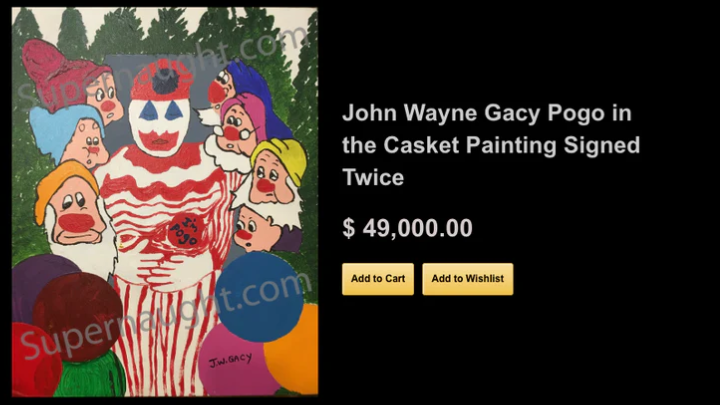
John Wayne Gacy—convicted of murdering 33 young men and boys in the 1970s—was a prolific painter while on death row. His most well-known subject: himself, dressed as “Pogo the Clown.” Many of these paintings were gifted or sold before his execution in 1994. Today, some sell for upward of fifty grand.
One of Gacy’s most infamous pieces—a depiction of his own house, crawlspace included where only he knew where the bodies were buried—was acquired by a collector for $175,000. Not because it was artistically brilliant. Because it carried an emotional residue no canvas from a gallery ever could.
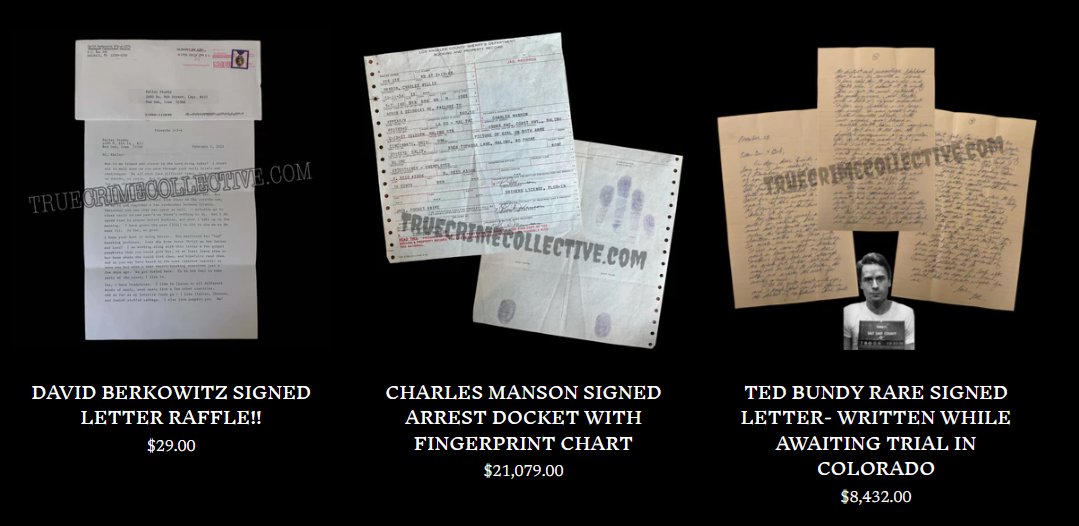
Charles Manson left behind a trail of physical and symbolic debris. Among the most traded items linked to him are strands of hair, prison letters, and drawings. His hair was sold in small clumps—carefully snipped during visits or grooming sessions—and vacuum-sealed for authenticity. A few letters, scribbled in his erratic penmanship, have sold for thousands apiece.
Then there’s Ted Bundy.
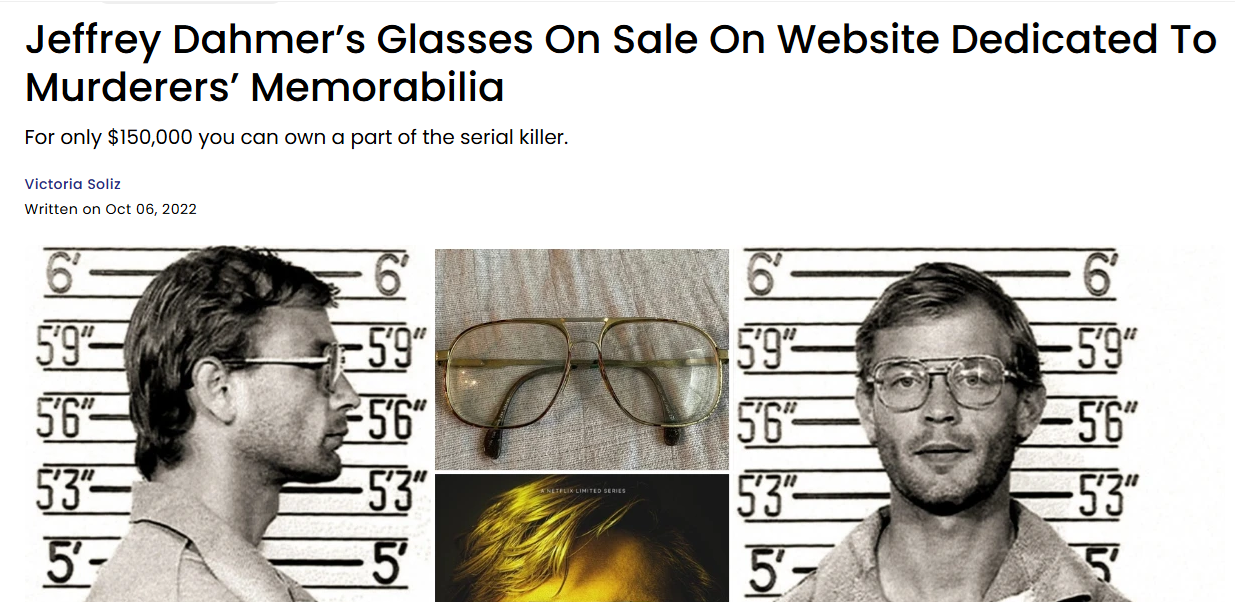
The glasses he wore during his trial became one of the most widely circulated items of murderabilia in recent years. They were purchased by collector and museum curator Zak Bagans for $50,000 and now reside in his Las Vegas “Haunted Museum,” where visitors pay to get close to evil—without the risk.
Even objects on the fringe, like Rex Heuermann’s Vietnam-era Jeep or his junior-high yearbook, made it onto eBay in 2025 before any verdict had been reached. The connection to potential violence was enough to drive bidding. Nothing needed to be proven as the scent of infamy was enough.
One seller posted baggies of dirt taken from the property where serial killer Dorothea Puente buried her victims. Asking price? $5,000 each.
It’s not about aesthetics. It’s about association. In this world, provenance trumps beauty every time.
Who’s Buying and Why?
Trying to understand murderabilia means entering the mind of the collector—not to excuse, but to examine. Psychologists who’ve studied this behavior agree: the drive is rarely about morbid curiosity alone. It’s more complex than that.
Dr. Katherine Ramsland, a forensic psychologist and prolific true crime author, describes the phenomenon as attraction to an “aura.” She argues that some people believe these objects hold an invisible energy—residual power from the crime itself. Ramsland likens it to religious relics. Where some people seek grace through a saint’s bone, others seek dread through a killer’s belongings.
Criminologist Scott Bonn coined the term talisman effect to describe how certain individuals believe these items give them power, protection, or access to something primal. It’s about owning darkness without being consumed by it. Getting close to evil without crossing the line.
There’s also the thrill of taboo. In a world that increasingly flattens identity through digital sameness, owning something truly forbidden becomes a way to feel exceptional. It signals rebellion. Difference. Edginess. You don’t just like true crime—you own a piece of it.
Some collectors refer to themselves as preservationists. They argue that history—however gruesome—should be preserved, not erased. That’s why many seek letters, court transcripts, or even artwork created by incarcerated individuals. For them, it’s not about celebrating the crime. It’s about studying it. Cataloguing it. Holding it up as a reminder of what humans are capable of.
But others are drawn to murderabilia for less noble reasons.
Dr. Michael Apter, in his research on reversal theory, notes that risk-seeking behavior often thrives when it’s framed as “safe.” In the context of murderabilia, you can own a killer’s belongings—hold them in your hands—without ever being in harm’s way. It becomes a controlled form of fear. A way to manipulate mortality.
That’s a heady cocktail. Power, rebellion, access, and status—all wrapped into one.
The Hybristophilia Link
There’s another psychological concept that intersects here. Hybristophilia. It’s defined as the romantic or sexual attraction to people who have committed violent crimes. While often applied to people who write love letters to serial killers on death row, it has connections to murderabilia as well.
Some collectors blur the line between fascination and fixation. They want not only the story—but intimacy with the person behind it. For them, the artifact isn’t just a souvenir. It’s a substitute for contact. A way to feel connected to someone who, in another context, might have been a fantasy figure.
The fact that these fantasies are rooted in horror only heightens the attraction. It’s dangerous. It’s forbidden. And that’s the point.
Where It’s Sold and Who Profits
The mainstream marketplace has largely rejected murderabilia. eBay banned it in 2001 after public backlash. Etsy won’t allow it. Facebook groups are shut down routinely for violating community guidelines.
But the demand didn’t die. It migrated.
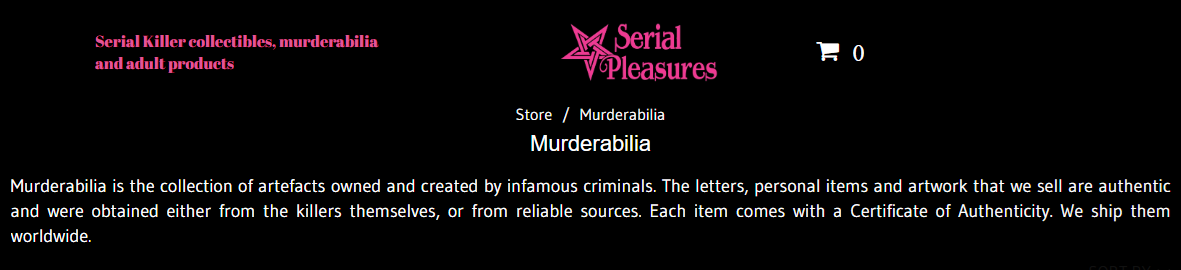
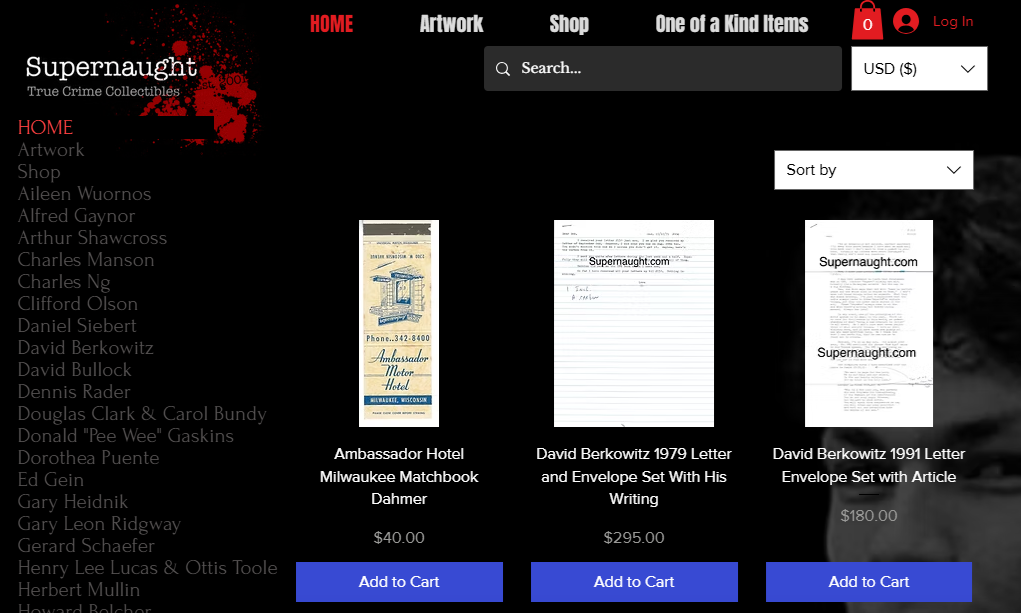
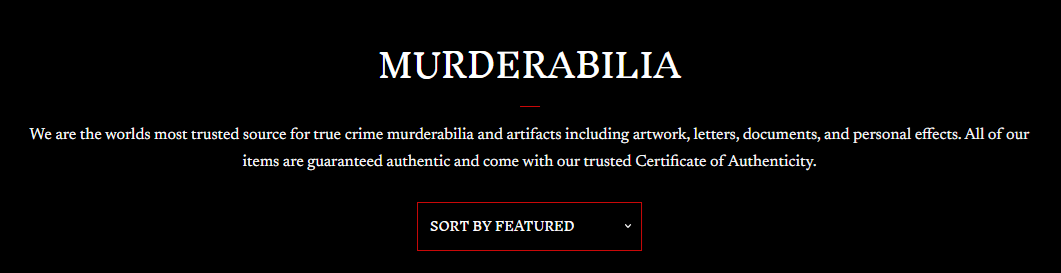
Websites like MurderAuction.com, Supernaught, and the now-defunct Serial Killers Ink cater to this niche. Items are listed with disclaimers, verified through personal letters, certificates of authenticity, or connections to prison contacts. The collectors—while secretive—are consistent.
Some sellers are former prison guards, lawyers, or family members of inmates. Others are repeat buyers who became dealers over time. And a few, disturbingly, are the killers themselves.
When laws don’t prohibit it, some inmates create and sell artwork, autographs, or written confessions—often with help from outsiders. A 2010 federal attempt to stop this—the Stop the Sale of Murderabilia Act—never passed. As a result, enforcement is patchy. Some U.S. states like California and Texas have banned inmates from profiting off crime-related sales, but loopholes remain.
One workaround? Killers sell “non-crime” items—generic drawings, for example—through intermediaries. As long as they don’t mention the murders, it slips under the radar.
Other collectors trade through private email lists, direct contacts, or invite-only forums. These channels are harder to track—and more profitable for those who know how to navigate them.
Historical Echoes: When Curiosity Crossed into Obsession
Long before eBay listings and niche websites, humans collected the macabre out of fascination. In Renaissance Europe, the cabinet of curiosities—Wunderkammer—was a popular trend. Collectors displayed oddities like preserved animals, human remains, ethnographic relics, and bizarre natural specimens in rooms devoted to wonder and dread. These collections blurred the line between science, spectacle, and the sacred.
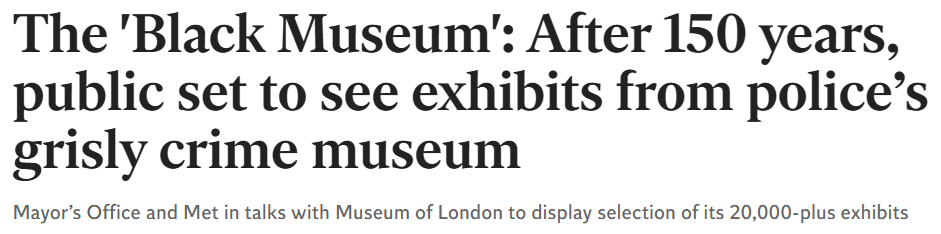
Such collections served to demonstrate status and control over knowledge—even over the horrific. In London, New Scotland Yard’s Crime Museum (aka the Black Museum) began in the 1870s as a teaching tool for officers—storing weapons, masks, and personal items linked to criminals—but was not accessible to the general public, preserving the line between education and spectacle… until recently…
That blending of object, story, and authority laid the groundwork for today’s open—but fundamentally private—murderabilia trade.
What Drives Collectors: Insights from Psychology
Collecting everything from benign memorabilia to deeply unsettling artifacts is surprisingly common. It’s estimated that roughly 30–40% of households engage in some form of collecting, rooted in emotion, identity, or nostalgia—not simply material value. When the object in question is linked to murder, motives become complex and often disturbing.
The “aura” of danger, as forensic psychologist Katherine Ramsland describes it, gives some of these items a kind of residue that collectors seek to capture—a sensation of raw proximity that feels both controlled and thrilling. Harold Schechter, in his writings on murderabilia, notes that such items become relics, “possessing a vibe similar to religious relics,” carrying meaning beyond their material form.
Beyond aura, there’s talismanic thinking—a belief that an object holds power. Criminologist Scott Bonn labels these “talismans,” allowing collectors to touch a form of danger without being exposed to real-life risk.
The thrill of taboo plays a role, too—owning something others condemn becomes a way to signal rebellion and uniqueness. The combination of emotional ownership, identity signaling, and rare collectability adds layers to the psychology behind murderabilia.
Ethical Fault Lines: Victim Voices Versus Collector Claims
Collectors often claim to preserve history or demystify taboos. Some even approach the practice with a veneer of academic interest. As one collector told Oxygen.com, “I understand why it rubs a lot of people the wrong way… but I know a lot of collectors… that approach it more acceptably”.
Yet victims’ families often see these objects as ongoing wounds. Reducing trauma to trinkets inflicts a secondary harm. The line between preserving history and profiting from tragedy becomes morally suspect—even if legally defensible.
The Media, True Crime Culture, and Murderabilia
Media exposure fuels curiosity—and curiosity ignites demand.
Anthropologists note that serial killers have become figures of myth or legend—and murderabilia plays into that mythology. When documentaries, podcasts, or dramatizations enter the mainstream, they humanize the killer in dark ways. That softens the taboo and primes the market.
Collectors don’t live in isolation. They share stories, valuations, provenance, and context through online forums, influencer communities, and specialist blogs. That’s what gives murderabilia symbolic and social capital—a form of prestige in a dark fandom.

The Digital Future: NFTs, AI, and a Dangerous Horizon
What comes next?
Digital replicas—NFTs of handwritten notes, AI-generated “in the style of” killer art—threaten to expand the market beyond physical boundaries. It’s not only about owning a relic—it becomes owning the idea of evil.
Digitization can sanitize horror or amplify it, depending on who’s doing the curating. The transformation from tangible trauma to virtual collectible is not sci-fi—it’s already emerging.
Murderabilia exists because fascination with evil is wired into our culture. It serves as a mirror—revealing a public appetite for boundary-testing, morbid storytelling, and identity via taboo.
Turning tragedy into collectible erodes empathy. It transforms real horror into a commodity. It obscures memory behind commerce.
We have a choice: let murderabilia become more normalized—or confront the cruelty of turning horror into hobby. Horror isn’t collectible.
Historical Lineage: Legends, Cabinets, Curiosities
Collectors long have assembled odd and unsettling objects—not merely for display, but as a way to assert mastery or provoke wonder. In Renaissance Europe, cabinets of curiosities (Kunstkamers or Wunderkammer) displayed exotic seashells, taxidermied oddities, and artifacts from distant lands.
These collections blurred lines between science, theology, and spectacle, doubling as status symbols and intellectual outposts. They weren’t always clean or academic—sometimes they were fantastical, pushing the boundaries of fact and myth.
Historical precedents show that curiosity about crime isn’t new—but today, collectors blur the lines between legal study, voyeurism, and commerce.

What the Research Says: Emotional and Economic Drivers
In academic circles, murderabilia collectors blur emotional devotion with commodification. A study based on interviews with collectors found that many view these items as “rarer memorabilia”—not just collectible, but symbolic emotional anchors, sometimes described as buying and enjoying evil.
Another psychological insight comes from Katherine Ramsland: possessing murderabilia lets collectors “experience the killer’s aura from a safe distance.” That phrase describes it neatly—thrill without threat, dread without danger.
Big Think tangibly suggests that serial killer art might be more fruitfully used for research than auction: it offers clinicians insights into pathologies rather than sensational memorabilia.
Anthropologists studying murderabilia networks have observed that these items also offer symbolic capital among enthusiasts—like badges in a niche fan community. Ownership means prestige, if clouded in taboo.
What People Actually Buy and Why It Matters
Let’s examine additional documented artifacts and their meaning—not just their price.
- A BTK killer (Dennis Rader) letter page surfaced for sale at around $2,000 because the collector saw the value in Rader’s signature touches—literally. The aura, again, gave it worth.
- Wayne Lo, the Bard College shooter, auctioned his own artwork online—not as grim prints but as “creative work.” The controversy this triggered reignited public debate: where does art end and exploitation begin?
- Ted Kaczynski (Unabomber) items—journals, tools, even trivial ephemera—were seized and publicly auctioned in 2011. But the key point is: proceeds went to victims—a model of turning tragedy into restitution, not to novelty.
These examples highlight moral distinctions: Is the collector preserving or profiting? Is the victim’s dignity honored—or overshadowed?
Ethics Versus Free Markets
Legal attempts to ban murderabilia have had mixed results. eBay prohibited murder-related content in 2001—restricting listings until 100 years after the event. Some states (including Texas, New Jersey, California, Michigan, Utah) passed “Son of Sam” -style laws preventing murderers from profiting. Even a federal bill in 2010 tried to outlaw murderabilia trade—only to stall and die in committee.
If the item isn’t directly tied to the crime—sold by someone not the murderer—the laws struggle to intervene. The distinction between “collector” and “colluder” remains murky.
Where You Can Buy Murderabilia
If you’re into it, and can afford it, there are online sites where you can add murderabilia to your shopping cart. Most will take prominent credit cards or collect through Paypal. But caveat emptor. Buyer beware.
These are the main murderabilia merchants:
- truecrimecollective.com
- supernaught.com
- serialpleasures.com
- murderauction.com
- darkmemorabilia.com
- serialkillershop.com
- artemmortis.com
Where This Could Go Next
The internet has broadened the audience, and there’s no obvious upper limit to the marketplace’s evolution. Future trends to watch:
- Digitized Murderabilia: NFTs of killer confessions. AI virtual recreations of crime scenes so vivid you’ll think you are there. Digital “possessions” tied to killers—real horror, virtual shelf-space.
- Institutional Canonization: Imagine true-crime museums embracing these objects for educational or artistic purposes—but where do you draw the line between legal-sanctioned memorial and morbid spectacle?
- Clinical Research Use: Big Think argues for donating serial killer art to psychologists instead of auction houses. It’s a shift from sensationalism toscholarship.
This subculture echoes a deeper societal fissure. At one end, murderabilia reflects a shallowness—a society turning tragedy into collectible trend. It dehumanizes the most brutal of experiences through curiosity turned product.
But on another level, it holds a mirror up to collective trauma. Even the most morbid display stems from a need to confront evil—to own a piece of it, interpret it, master it—and survive. That impulse can flicker between macabre obsession and meaningful reflection.
The question remains. Will murderabilia evolve toward informed preservation—or devolve into digital replicas of grief, normalized and devoid of empathy? If curiosity drives collection, let empathy guide its limits but, for whatever reason, there’ll always be murderabiliasts. People who collect killers’ keepsakes.