Tag Archives: Compound

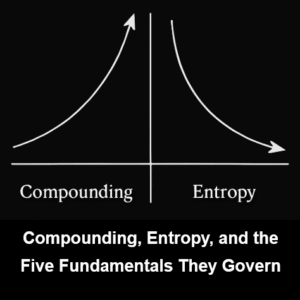
COMPOUNDING, ENTROPY, AND THE FIVE FUNDAMENTALS THEY GOVERN

There are two invisible principles quietly overseeing the universe. They’re not political. They’re not mystical. And they don’t care about your beliefs, your ambitions, or your social status. These realities are compounding and entropy. One builds. The other breaks.
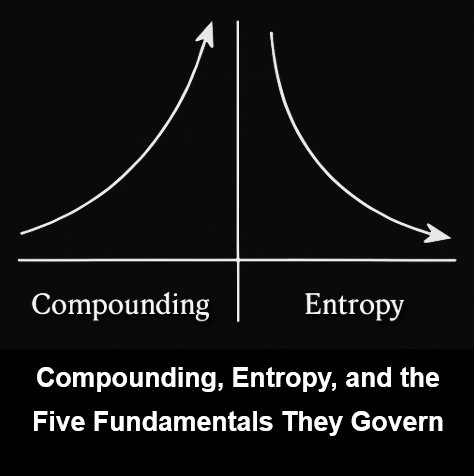
Together, compounding and entropy form the dual engine and brake system for all of creation—from stars to cells, and from civilizations to your own body, thoughts, and projects. They govern five fundamentals of the universe—energy, matter, information, consciousness, and time.

If you understand the principles of compounding and entropy—and more importantly, if you learn how to work with them—you can harness the most powerful truths of nature. If you ignore them, they’ll work on you anyway. The only difference? You won’t know why things are slowly getting better or worse.

Before we explore how compounding and entropy rule the five pillars of existence—energy, matter, information, consciousness, and time—we need to understand what these dual and dominant drivers truly are.

What Is Compounding?

Compounding is the process by which a small effect, action, or input—when repeated over time—builds into an increasingly larger impact. It’s the engine of exponential growth born from repetition, consistency, and feedback.

Most people encounter compounding first in the financial world—compound interest. But its scope is far greater. Compounding affects learning, skill development, health, systems, habits, and even natural selection.

In mathematical terms, it’s described like this:

FV = PV × (1 + r/n)^(nt)
Where:

  • FV = future value
  • PV = initial value
  • r = rate of growth
  • n = compounding intervals per year
  • t = time in years

Time is the essential multiplier. Without it, compounding cannot operate.

Compounding is the most powerful force in the universe.” ~Albert Einstein

But it’s not just about money. Compounding applies to many things we do. Here are some simple examples:

  • Read a book daily—your knowledge compounds.
  • Practice gratitude—your emotional clarity compounds.
  • Invest in relationships—your connection compounds.
  • Do the work—your skills compound.

And just like investments, the sooner you start, the more powerful the outcome. Time doesn’t just allow compounding—it supercharges it.

What Is Entropy?

Entropy is the principle that all systems naturally progress from order to disorder. In physics, it’s formalized as the Second Law of Thermodynamics—in any energy exchange, some usable energy is always lost, increasing the system’s entropy.

Entropy is the measure of randomness, uncertainty, or decay in any system. You don’t need to study physics to understand entropy. Just think that:

  • Metal rusts
  • Food spoils
  • Memories fade
  • Structures collapse

Entropy doesn’t need your permission. It happens simply by the passage of time. That’s what makes entropy so dangerous—it operates silently unless resisted.

Mathematically:
ΔS = ΔQ / T
Where:

  • ΔS = change in entropy
  • ΔQ = heat energy added
  • T = temperature

In the end, entropy always wins. (But you get to decide how much value you create before it does.)” ~Stephen King

While compounding is the creative force of the cosmos, entropy is the tax. Everything that grows must be maintained—or it’ll decline. Everything built will eventually decay—unless preserved and renewed.

The Five Fundamentals of Existence

At the root of reality are five interdependent fundamentals. Energy. Matter. Information. Consciousness. Time.

Every system—biological, mechanical, societal, or personal—is made from these ingredients. And every one of them is shaped by compounding and entropy. Let’s examine each.

Energy

Energy is the currency of the cosmos. Everything that moves, grows, reacts, or changes involves energy. And everything energetic is governed by compounding and entropy,

Compounding and energy: When energy is stored, reused, and cycled efficiently, it compounds. Batteries. Ecosystems. Engines. Fusion reactors. Feedback loops in technology and biology amplify small inputs into large-scale output over time.

Entropy and energy: But every energy transfer loses some energy to heat, friction, or inefficiency. Entropy ensures that no machine is perfect, no process is lossless. Even the sun is slowly burning out.

Time guarantees that energy becomes more diffuse, less useful—unless structured intentionally.

You can’t win, you can’t break even, and you can’t get out of the game.” ~C.P. Snow

Matter

Matter is energy in form—atoms, molecules, tissues, trees, buildings, planets.

Compounding and matter: Matter compounds through layering and construction—atoms form molecules, molecules form cells, cells form organs, and so on. Sediments become cliffs. DNA mutations evolve into species. Structures form through persistence over time.

Entropy and matter: But matter wears down. Rocks weather. Steel corrodes. Concrete crumbles. Bones age. The longer time passes, the more matter must fight to maintain form.

The compounding of structure is a fight against the entropy of disintegration.

Dust thou art, and unto dust shalt thou return.” ~Genesis 3:19

Information

Information is the arrangement of energy and matter into meaningful patterns—genetic code, books, software, knowledge, memory.

Compounding and information: The written word. The scientific method. Oral traditions. Cloud storage. When preserved and transmitted effectively, information compounds across generations. Civilization advances as it builds on itself.

Entropy and information: But data corrupts. Paper disintegrates. Memories fade. Knowledge gets distorted. Noise creeps in.

Without effort, the information age becomes an age of confusion.

Civilization advances by extending the number of important operations we can perform without thinking about them.” ~Alfred North Whitehead

Consciousness

Consciousness is the most personal of all fundamentals—the internal awareness that makes life felt.

Compounding and consciousness: Thoughts become beliefs. Habits become character. Self-awareness becomes wisdom. Every time you reflect, learn, or train your attention, your mind compounds its clarity. Meditation. Reading. Honest conversation. These are compounding tools.

Entropy and consciousness: But left unattended, the mind deteriorates. Distractibility. Digital addiction. Delusion. Cognitive entropy is real—from dementia to depression to propaganda. When your mind is not strengthened, it decays.

This is where compounding becomes existential.

The unexamined life is not worth living.” ~Socrates

Time

Time isn’t just a background condition. It’s the fifth fundamental, and perhaps the most profound. Time is the substrate through which compounding and entropy play out.

Without time, there’s no compounding. Without time, entropy has no direction. Time is the governing dimension in which all change—growth or decay—unfolds.

Time doesn’t care how you use it. But how you use time determines everything. Time is what gives compounding its force and entropy its inevitability. Time is both the fire that consumes and the fuel that ignites.

The Unified Pattern of Reality

When you view the universe through these five fundamentals, a simple pattern emerges:

Systems that work:
→ Channel energy efficiently
→ Build matter into resilient forms
→ Preserve and transmit information
→ Expand consciousness
→ Use time intentionally

Systems that fail:
→ Leak energy
→ Decay in form
→ Lose coherence
→ Fall into confusion
→ Waste time

The choice is constant. In your health. Your thoughts. Your relationships. Your business. Your legacy.

You’re either compounding or decaying. There’s no standing still.

What Will You Leave Behind?

Let’s bring it all home. These aren’t just abstract laws of physics or systems theory.
They’re the very forces shaping your life—right now.

  • Compounding is your engine.
  • Entropy is your cost.
  • Time is your field of play.

Every decision, every action, every neglected task, every focused effort—it all moves you in one direction or the other. There is no neutral.

You don’t have to collapse your life. Just neglect it.
You don’t have to destroy your mind. Just let it coast.
You don’t have to fail. Just fail to act.

Or…

You can build.
You can focus.
You can rise.

In the end, everything you create is shaped by these five fundamentals and these two principles. And what you choose to do with them—day after day—becomes your legacy.

So, ask yourself, “What will you build before time and entropy reclaim it?”
Powered by a Centaur System ©

CRITICAL THINKING — THE GREAT MENTAL MODELS Part One

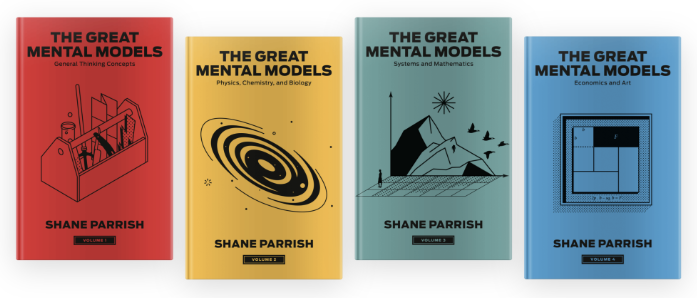
One trait setting humans apart from other species on this planet is thought. Next to our closest competitors, the octopus and the orangutan, humans far surpass at deep cognitive processing and complex problem solving. Recently, there’s a significant breakthrough in aiding human advancement to understand and know general reality concepts. It’s a four-volume tutorial called Critical Thinking — The Great Mental Models.

Shane Parrish is an internet thought leader and author of The Great Mental Models. Shane also hosts Farnam Street and The Knowledge Project Podcast. His sites’ taglines are Master the Best of What Other People Have Already Figured Out and The Best Way to Make Intelligent Decisions.

Shane opens the Mental Models series with, “Education doesn’t prepare you for the real world.” He says, “The key to better understanding the world is to build a latticework of mental models.” Mental models, according to Shane Parrish, describe the way the world works in simplicity. They fundamentally, and without complication, shape how we think, how we understand, and how we form beliefs.

Largely subconscious, mental models operate beneath the surface. We’re not generally aware of them, and yet when we look at a problem, they’re the reason we consider some factors relevant and others irrelevant. They are how we infer causality, match patterns, and draw analogies. They are how we think and reason.

A mental model is a compression of how something works. Any idea, belief, or concept can be distilled down. Like maps, mental models reveal key information while ignoring the nonessential.

I’ve subscribed to Farnam Street and The Knowledge Project Podcast for the last six years. The insight and value I’ve received, particularly in creativity, has been far greater than the price of admission. So, it was with great anticipation that I waited for last Christmas when Shane Parrish and Penguin released the four-volume Great Mental Models in hardcover.

For the last three months, I’ve been immersed in the critical thinking concepts loaded throughout the Mental Models pages. And over the years (sixty-eight of them), I’ve developed a research and learning style that (for me) truly pays. I’m able to accurately absorb and retain information, converting facts into useful knowledge, through a simple process that I’d like to share in a two-part post.

Part One is an overview of Shane Parrish’s Mental Models and how my system applies. Part Two, being published two weeks from now on 19Apr2025, will be a much deeper dive into how to work the Great Mental Models and how they can work for you.

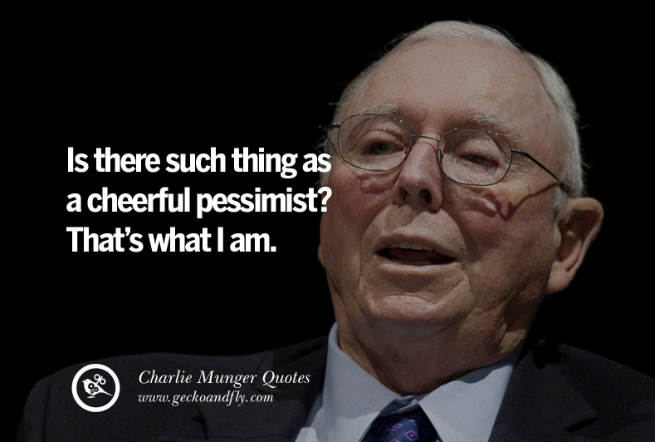
Two profound influences on Shane Parrish are Charlie Munger and Peter Kaufman. Munger, who recently passed away at age 99, was the co-founder of Berkshire Hathaway with the famed investor Warren Buffet. Charlie Munger was among the finest thinkers of the past century, and he died a multi-billionaire.

Peter Kaufman is also a wealthy man. Kaufman is an entrepreneur, venture capitalist, and acclaimed writer. Along with Parrish, he edited many of Charlie Munger’s latticework of mental model essays and assembled them into a book titled Poor Charlie’s Almanac. It’s from these essays that the Knowledge Project took life. Now it’s evolved into The Great Mental Models.

Throughout Mental Models, you’ll see a constant reference to “Latticework”. It’s worth an initial definition:

The latticework concept essentially revolves around building a toolkit of frameworks from various disciplines to help improve decision-making and problem-solving abilities.

The idea is that no single mental model is sufficient to tackle all the complex problems the world presents. Instead, having a broad and interconnected set of models from diverse fields—such as economics, physics, biology, psychology, and more—allows one to view problems from multiple perspectives. This multidisciplinary approach can significantly enhance one’s ability to understand, adapt, and react effectively to different challenges.

Charlie Munger popularized this approach in his famous speech “The Psychology of Human Misjudgment,” where he discusses the importance of these models in helping to avoid cognitive biases and make better decisions. By developing a latticework of mental models, one can better connect the dots between seemingly unrelated information and insights, leading to more effective and informed decision-making.

Simply stated, The Great Mental Models synthesize timeless wisdom from various disciplines to empower readers/thinkers to make better decisions, solve complex problems, and think more clearly. Clarity of thought is a goal even the greatest minds strive for. Although many people use many methods, they all come down to a fundamental reality—the information they seek is available if they apply the foundation of critical thinking.

Before we get into the overall outline of what’s in The Great Mental Models, I want to share two indisputable truths that shaped my worldview and exponentially boosted my thought input and output processes. This change in critical thinking attracted opportunities I never would have found without properly understanding and working with, not against, these two opposing forces. One is compounding. The other is entropy.

Compounding and entropy are fully covered in The Great Mental Models. Cleverly, Shane Parrish sprinkled bits and pieces of entropy and compounding details throughout the series. Although he deals with each principle on their own, he’s used compounding and entropy concepts/principles (not laws) as subtext. They are the true takeaways—supported by all the tools in the lattice framework—and he’s left it for you, the reader, to experience your “Ah-Ha!” moment when you understand the constructive and destructive forces of compounding and entropy that govern the universe.

Let me introduce you to a learning and retention system I’ve developed over the years that I use for all topics and projects. I’m not saying it’s perfect by any stretch or that it will change your game. I just (at this age) know myself, and I know what works for me because I’ve been using the system for a long time, and it has a proven ROI—return on investment.

For a project like digesting, understanding, and retaining timeless truths and wisdom found in Mental Models, I shelled out a hundred and twenty bucks US for the printed, hardcovered books—not the ebooks—and at the time of purchase (Christmas 2024) the paperbacks weren’t available. Check Amazon and you might find them on sale for less.

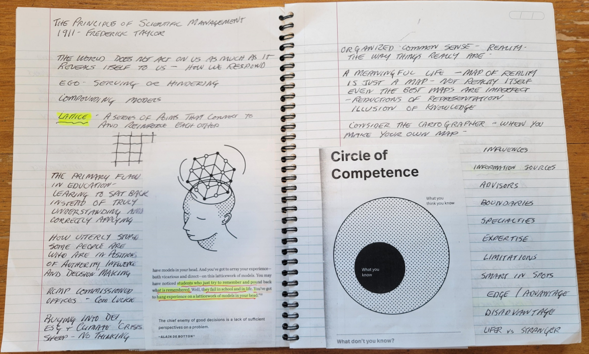
I learned a reading and retention trick from my mother who was an English teacher and avid book devourer. That’s to mark up the pages with underlines and notes. Being a visual learner, this method has the best returns (for me), and I use a process of red underlines, yellow highlights, and black hand-printed notes. Yes, I mark the hell out of the pages.

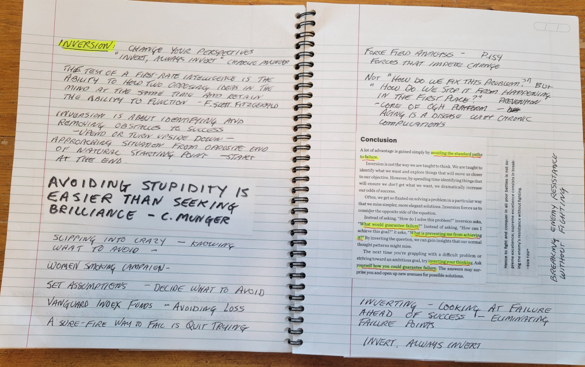
I also keep a notebook specific to the project where I’ll transpose content as I understand it along with my developing thoughts, questions, and “get-its”. I use an 80-sheet Mead-Cambridge 8 ½ x 11 spiral bound book with wide rules as it’s easy to handle and can be laid flat without the thing wanting to spring itself closed. See pictures.

Besides notes, I also photocopy diagrams, pictures, and passages from the hardcovers then cut and paste them onto the notebook pages. I’m sure that to a stranger sifting through my stuff, they might think I’m doing a ketamine experiment but, hey, it works for me and I’m stickin’ to it.

I also search terms and ideas on the internet as I progress. If I find something useful, I’ll screenshot it and print n’ paste as well. And I’m not afraid to say I constantly use ChatGPT4.5 to clarify matters and bounce ideas off. Did I use Chat to write some of this post? Maybe. Maybe not. 😊

Something extremely useful in the Great Mental Models is the “Conclusion” at the end of each idea. It sums up the concept in clear and comprehensible language. I photocopy each conclusion and then tape it into the notebook. Again, being visual, it makes the material jump right out.

That’s the simple learning and retaining process I use. You’re more than welcome to own it. Now, let’s dive into the overall of what you can find in Mental Models that’s as rich in practical content as it is in intellectual treasure. Here’s what each volume brings to your table:

Volume 1: General Thinking Concepts

The opening act of this series, “General Thinking Concepts,” lays down foundational blocks for building a robust mental toolkit. It’s all about broad principles that apply across various fields. Think of it as the Swiss Army knife in your cognitive toolbox. Key models covered include:

  • Introduction: Acquiring Wisdom
  • The Map is Not the Territory
  • Circle of Competence
  • First Principles Thinking
  • Second-Order Thinking
  • Probabilistic Thinking
  • Inversion—Always Invert
  • Occam’s Razor
  • Hanlon’s Razor

This volume is a powerhouse that prepares your mind to think critically and avoid common, cognitive bias errors like misrepresentations or overly narrow focusing.

Volume 2: Physics, Chemistry, and Biology

In “Physics, Chemistry, and Biology” the series shifts from general thinking to the specific laws governing our physical world. This volume uses fundamental scientific principles to illuminate ideas that affect our everyday decisions and observations, including:

  • Relativity
  • Reciprocity
  • Thermodynamics
  • Inertia
  • Friction and Viscosity
  • Velocity
  • Leverage
  • Activation Energy
  • Catalysts
  • Alloying
  • Evolution One: Natural Selection and Extinction
  • Evolution Two: Adaptation Rate and the Red Queen Effect
  • Ecosystems
  • Niches
  • Self-Preservation
  • Replication
  • Cooperation
  • Hierarchical Organization
  • Incentives
  • Tendency to Minimize Energy Output

By exploring these foundation models, readers gain insights into how universal principles of physics, chemistry, and biology can guide better decision-making in both personal and professional spheres.

Volume 3: Systems and Mathematics

The third volume, “Systems and Mathematics”, brings a holistic view, emphasizing core ideas like the whole is greater than the sum of its parts. This volume is about understanding complex, mathematical systems and navigating them effectively such as:

  • Feedback Loops
  • Equilibrium
  • Bottlenecks
  • Scale
  • Margin of Safety
  • Churn
  • Algorithms
  • Critical Mass
  • Emergence
  • Irreducibility
  • Law of Diminishing Returns
  • Compounding
  • Sampling
  • Randomness
  • Regression to the Mean
  • Multiplying by Zero
  • Equivalence
  • Surface Area
  • Global and Local Maxima

A quote from Mental Models says it well. “In spite of what you majored in, or what the textbooks say, or what you think you’re an expert in, follow a system wherever it leads. It will be sure to lead across traditional disciplinary lines.”

Volume 4: Economics and Art

Finally in Volume 4, “Economics and Art”, we move from the theoretical to the practical. This is solid, real-life information that just may change your perspective on many things in life like:

  • Scarcity
  • Supply and Demand
  • Optimization
  • Trade-offs
  • Specialization
  • Interdependence
  • Efficiency
  • Debt
  • Monopoly and Competition
  • Creative Destruction
  • Gresham’s Law
  • Bubbles
  • Audience
  • Genre
  • Contrast
  • Framing
  • Rhythm
  • Melody
  • Representation
  • Plot
  • Character
  • Setting
  • Performance

This volume, with fascinating insights on economics and art (fiction writing included), wraps up the series by empowering readers to see beyond individual elements and appreciate the interconnectedness of all things—physical and metaphysical.

Each of The Great Mental Models books builds on the previous, crafting a comprehensive guide designed to sharpen your analytical abilities and decision-making skills. By the end, you’re not just equipped with theoretical knowledge, but with practical tools applying across your personal life, professional practice, and beyond.

Shane Parrish put a tremendous effort into producing this latticework frame. Reading and absorbing Mental Models might transform how you critically think about the world—and how you interact with it. It certainly did for me, and the three months of immersion in Mental Models were the most cerebral exercises in my life.

Watch for Part Two of Critical Thinking — The Great Mental Models on Saturday 19Apr2025 at 8:00 am PST on DyingWords.net where we’ll do a deep-end dive into each of the fundamental concepts. It’s gonna be a long one.

Powered by a Centaur System ©