Tag Archives: Artificial Intelligence

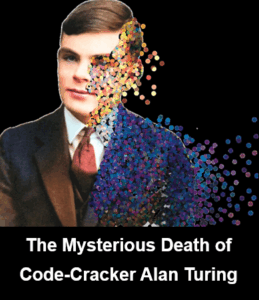
THE MYSTERIOUS DEATH OF CODE-CRACKER ALAN TURING

On June 7, 1954, early-computing genius Alan Turing died alone in his small home at 43 Adlington Road in Wilmslow, Cheshire, England. His housekeeper found Turing in bed, unresponsive, with a half-eaten apple beside him and a strong scent of bitter almonds lingering in the room. Alan Turing, just 41 years old, was pronounced dead of cyanide poisoning. The official inquest ruled it as suicidethe coroner suggesting he’d deliberately laced the apple with poison and that Turing intentionally took his own life.

Something just doesn’t sit right with that conclusion. Why would a brilliant man, full of curiosity and creative energy, end his life so abruptly—and in such a theatrical Snow White manner? Why no suicide note? Why no indication of despair in his final days? Why was there cyanide discovered in the house—but not definitively found in the apple?

For the answers offered at the time, more questions remain. And that’s why the death of Alan Turing—the father of modern computing and code-cracker of Nazi Germany’s Enigma encryption machine—remains one of the most puzzling mysteries in modern times.

Turing wasn’t just a mathematician or wartime cryptanalyst. He was a singular mind—restless, brilliant, awkward, and visionary. Born on June 23, 1912, in Maida Vale, London, Alan Mathison Turing came into the world with a quiet spark that would one day ignite revolutions in logic, computation, and the birth of today’s artificial intelligence phenomena.

His parents were of respectable English stock—his father, Julius Turing, worked in the Indian Civil Service, while his mother, Ethel Sara, came from a family of railway engineers. But young Alan’s upbringing was far from stable. His parents traveled frequently between India and England, and Alan was largely raised by foster caregivers in Sussex.

Even as a boy, Alan was different. He had a peculiar way of thinking—literal, intense, and obsessively focused on ideas. He was fascinated by numbers, time, systems, and patterns. At the age of 13, he attended Sherborne School, a prestigious public institute in Dorset, where his brilliance clashed with the classical curriculum. He didn’t shine in Latin or essays—but in math and science, he was already orbiting in another stratosphere.
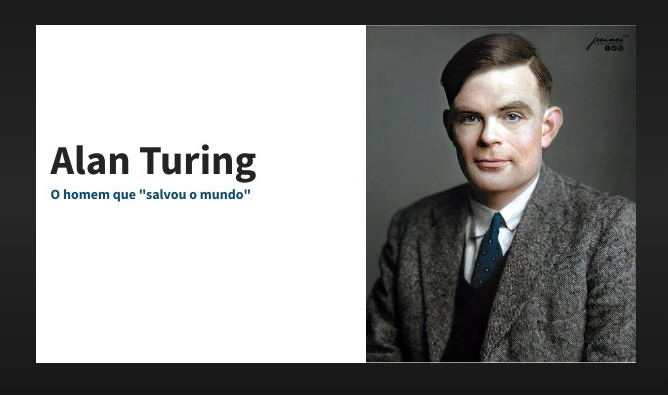
“O homem que salvou o mundo” – “The man who saved the world”

Alan Turing’s genius truly began to crystallize during his university years. After enrolling at King’s College, Cambridge, in 1931, he studied mathematics and quickly gained recognition for his astonishing intellect. By 22, he was elected a fellow of the college for his groundbreaking work on the central limit theorem—a prestigious honor for someone so young. But it wasn’t just his grades or papers. It was the way he thought. Turing didn’t just solve problems—he reconstructed the very framework of how problems could be solved.

He was also a gifted athlete. Turing ran long distances with the stamina of a marathoner—often timing his training against the local bus routes and sometimes nearly qualifying for the British Olympic team. That combination of mental precision and physical resilience defined much of his life. He wasn’t just smart—he was tough, solitary, and determined.

In 1936, at just 24 years old, Alan Turing published a paper titled “On Computable Numbers, with an Application to the Entscheidungsproblem.” It would go on to become one of the most important documents in the history of science. In it, he proposed a theoretical machine—now known as the Turing Machine—that could simulate any conceivable mathematical computation.

This wasn’t just abstract theory. Turing was laying the foundation for the modern computer—long before silicon chips or Apple keyboards ever existed. He was dreaming of a mechanical mind. Artificial general intelligence. AGI.
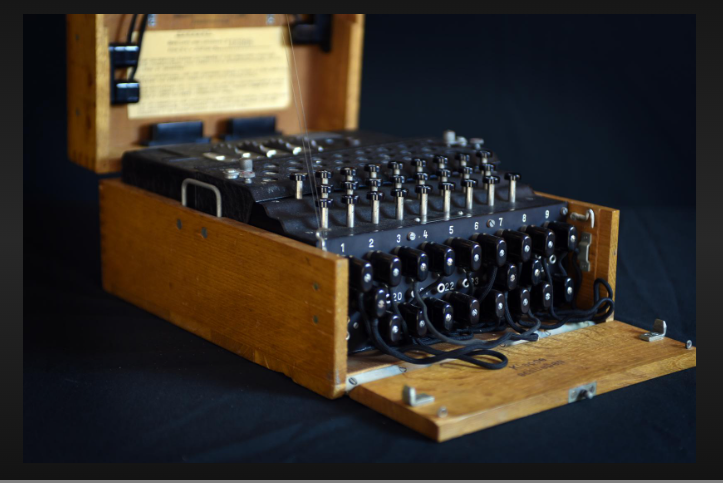
By the outbreak of World War II, Turing’s genius was already on the radar of British intelligence. During the war, Turing was stationed at the now-famous Bletchley Park, the heart of Britain’s codebreaking operations. He worked in “Hut 8,” the unit tasked with cracking German naval codes encrypted by the Enigma machine.

These codes were considered unbreakable. The Enigma’s rotating wheels created a staggering number of possible settings—trillions, in fact. But Turing, using mathematics, logic, and sheer grit, helped devise an electromechanical device called the Bombe, which dramatically sped up the process of decoding German messages.

Turing’s role at Bletchley Park was both secret and essential. Without his breakthroughs, the Battle of the Atlantic might have been lost. Convoys sunk. Supplies cut off. The war turned. Some historians credit Turing’s work with shortening the conflict by two years—and saving millions of lives. He also worked on speech encryption tools like Delilah and helped develop tools now considered the ancestors of artificial intelligence, AI. But at the time, his name was buried under layers of national secrecy.

After the war, Turing continued his pioneering work in computing and artificial intelligence. He worked at the University of Manchester and helped design the Automatic Computing Engine (ACE), one of the world’s first stored-program computers. It was long before names like Jobs, Wozniak, Gates, Allen, Musk, and Altman were known.

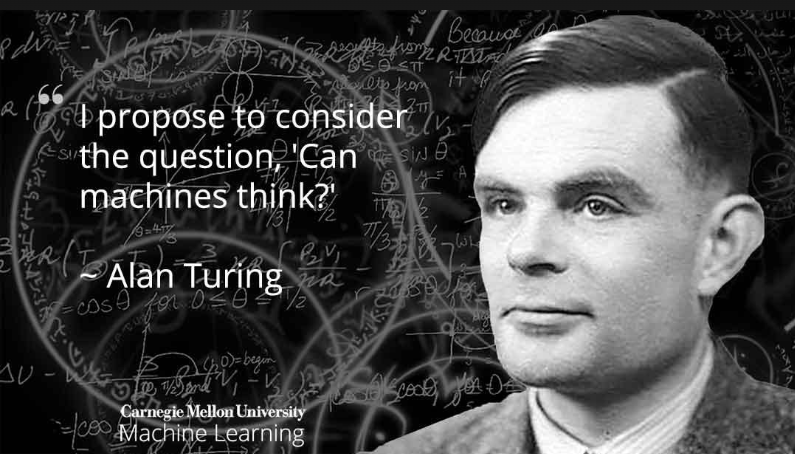
Here he explored whether machines could think—proposing a framework now known as the “Turing Test,” a thought experiment that still anchors debates in AI ethics and philosophy. He also dove into the strange world of morphogenesis—the mathematical patterns behind the shapes of plants, animals, and natural forms. Once again, Alan Turing was far ahead of his time.
But while his professional life soared, his personal life unraveled.

Alan Turing was a gay man in a society where homosexuality was not just taboo—it was illegal. In 1952, he met a young man named Arnold Murray. After a minor incident at Turing’s home, police uncovered his relationship with Murray and arrested him under the gross indecency laws—the same archaic statutes used decades earlier to destroy Oscar Wilde. Turing didn’t deny it. He told the truth.

He was convicted. The court offered him two options: imprisonment or a course of hormone therapy—chemical castration. Turing chose the latter. He was injected with estrogen for a year, which caused weight gain, breast development, and emotional distress.

It also stripped him of his security clearance and curtailed his ability to work in the field he helped create. The British government had turned on its war hero. Humiliated, ostracized, and punished, Turing withdrew from public life. Two years later, he was dead.

On the morning of June 8, 1954, Turing’s housekeeper arrived at his modest home and found his body. He was lying in bed, dead from suspected cyanide poisoning. A half-eaten apple lay beside him, supposedly laced with the deadly compound. The apple itself was never tested, oddly. But traces of cyanide were found in his stomach and in a solution in a nearby room where Turing had been experimenting with electroplating.

The coroner ruled it a suicide. Case closed. Or was it?

There are several things about Turing’s death that just don’t line up. For starters, he left no suicide note. He’d just begun planning a vacation. His recent letters were upbeat. He’d resumed work. And those who knew him best said suicide was not in his nature.

Alan Turing was curious. Creative. Resilient. Even his mother—who knew her son better than anyone—believed his death was an accident, caused by his careless handling of cyanide in the lab. Turing had a known habit of tasting chemicals during experiments, a reckless quirk that may have cost him his life.

And what about the apple? Some suggest it was a theatrical nod to Snow White—one of Turing’s favorite fairy tales. But that’s pure conjecture. Others pointed out the apple wasn’t tested, and the presence of cyanide elsewhere in the house makes accidental inhalation or ingestion entirely plausible.

Then there’s the darker theory. Assassination. Could Alan Turing have been silenced?

It’s not as far-fetched as it sounds. Turing knew state secrets. He was a homosexual during a time of Cold War paranoia, when homosexuality was seen as a security risk. The same government that once praised him now saw him as vulnerable to blackmail or foreign coercion. Could the British intelligence services have quietly decided that Alan Turing had become a liability?

There’s no hard proof. But there is precedent to many state-sanctioned murders. Leon Trotsky, Dag Hammarskjold, Alexander Litvinenko, and Jamal Khashoggi come to mind.

Intelligence agencies don’t always act with transparency or mercy—especially in the Cold War era. Was Turing eliminated? Was his death staged to look like suicide? Or did the emotional toll of his conviction and isolation finally push him too far?

We may never know.

What we do know is that Alan Turing was a man of extraordinary mind and rare moral courage. He imagined the future, even as the world failed to accept the truth of who he was. He gave everything—his intellect, his creativity, and his loyalty—to a nation that ultimately betrayed him.

In 2009, the British government formally apologized for persecuting this fine man. In 2013, Queen Elizabeth II granted him a posthumous royal pardon. In 2021, his face appeared on the Bank of England’s £50 note—a quiet symbol of belated recognition.

But even today, the mystery remains unresolved. The truth is, we don’t really know what happened on that June day in 1954. We only know what we’ve been told.

Why does it still matter?

Because justice matters. Because the lives of geniuses, misfits, and visionaries must be remembered truthfully—not just in sanitized biographies or polite memorials. Because our world is now shaped by the very machines Turing imagined—and we owe him a fair account of how his story ended.

And because somewhere, behind the locked doors of history, lies the truth about the mysterious death of code-cracker Alan Turing.
Powered by a Centaur System ©

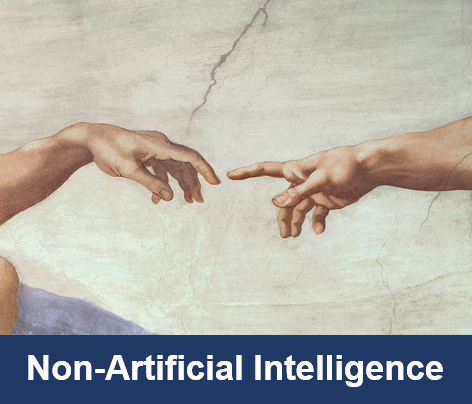
NON-ARTIFICIAL INTELLIGENCE

Now that the balloon has popped on failed fads like Dot.Coms, Bored Ape NFTs, Crypto, and forever-free borrowed money, the world’s current FOMO (Fear Of Missing Out) has turned to the newest and coolest cat—Artificial Intelligence or what’s simply called AI. Make no mistake, AI is real. It’s not simple, but it’s very, very real. And it has the potential to be unbelievably good or gut-wrenchingly awful. But as smart as AI gets, will it ever be a match for Non-Artificial Intelligence, NAI?

I can’t explain what NAI is. I just have faith that it exists and has been a driving force in my life, especially my current life where I’m absorbed in a world of imagination and creativity. Call it make-believe or living in a dream, if you will, but I’m having a blast with a current fiction, content-creation project which uses both AI and NAI.

I’ve asked a lot of folks—mainly writing folks because that’s who I hang with—what their source of inspiration is. Their muse or their guide to the information pool they tap into to come up with originality. Many casually say, “God.”

I don’t have a problem with the concept of God. I’ve been alive for 66 years and, to me, I’ve seen pretty strong evidence of an infinite intelligence source that created all this, including myself. I’ll call that force NAI for lack of a better term.

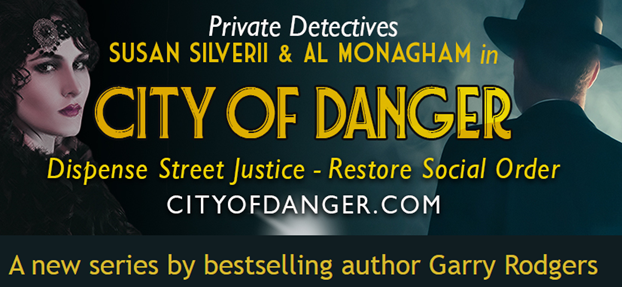
What got me going on this AI/NAI piece was three months of intensive research into the current state of artificial intelligence—what it is, how to use it, and where it’s going. AI is not only a central character in my series titled City Of Danger, AI is a tool I’m using to help create the project. I’m also using Non-Artificial Intelligence as the inspiration, the imagination, and the drive to produce the content.

If you’ve been following DyingWords for a while, you’re probably aware I haven’t published any books in the past two years except for one about the new AI tool called ChatGPT. That’s because I’m totally immersed in creating City Of Danger in agreement with a netstream provider and a cutting-edge, AI audio/visual production company. Here’s how it works:

I use my imagination to create the storyline (plot), develop the characters and their dialogue, construct the scenes, and set the overtone as well as the subtext theme. I use NAI for inspirational ideas and then feed all this to an AI audio/visual bot who scans real people to build avatars and threads them through a “filter” so the City Of Danger end-product looks like a living graphic novel.

Basically, I’m writing a script or a blueprint so an AI program can take over and give it life. The AI company does the film work and the netstream guy foots the bill. This is the logline for City Of Danger:

A modern city in existential crisis caused by malevolent artificial intelligence enlists two private detectives from its 1920s past for an impossible task: Dispense street justice and restore social order.

Here’s a link to my DyingWords web page on City Of Danger along with the opening scene of the pilot episode. Yes, it involves time travel and dystopian tropes which have been done to death—but not quite like this. I like to think of myself as the next JK Rowling except I’m not broke and don’t write in coffee shops with a stroller alongside.

I was going to do this post as a detailed dive into the current state of artificial intelligence and where this fascinating, yet intimidating, technology is going. However, I have a long way to go yet in my R&D and don’t have a complete grasp on the subject. I will give a quick rundown, though, on what I’ve come to understand.

The term (concept) of artificial intelligence has been around a long time. Alan Turing, the father of modern-day computing and its morph into AI, conceived a universal thinking machine back in WW2 when he cracked Nazi communication codes. In 1956, a group of leading minds gathered at Dorchester University where, for three months, they brainstormed and laid the foundation for future AI breakthroughs.

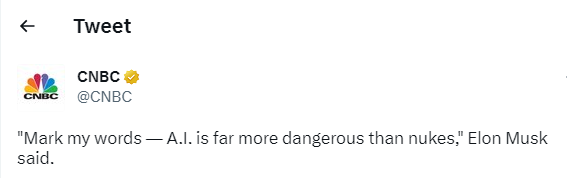
Fast forward to 2023 and we have ChatGPT version 4 and a serious, if not uncontrollable, AI race between the big hitters—Microsoft and Google. Where this is going is anyone’s guess and recently other big guns like Musk, Gates, and Wozniak weighed in, penning an open letter to the AI industry to cool their jets and take the summer off. To quote Elon Musk, “Mark my words, AI is far more dangerous (to humanity) than nukes.”

There’s huge progress happening in AI development right now. But stop and look around at how much AI has already affected your life. Your smartphone and smartTV. Fitbit. GPS. Amazon recommends. Siri and what’s-her-name. Autocorrect. Grammarly. Cruise missiles, car parts, and crock pots.

Each day something new is mentioned. In fact, it’s impossible to scroll through a newsfeed with the AI word showing up. We’re in an AI revolution—likely the Fourth Industrial Revolution to steal the phrase from Klaus Schwab and his World Economic Forum.

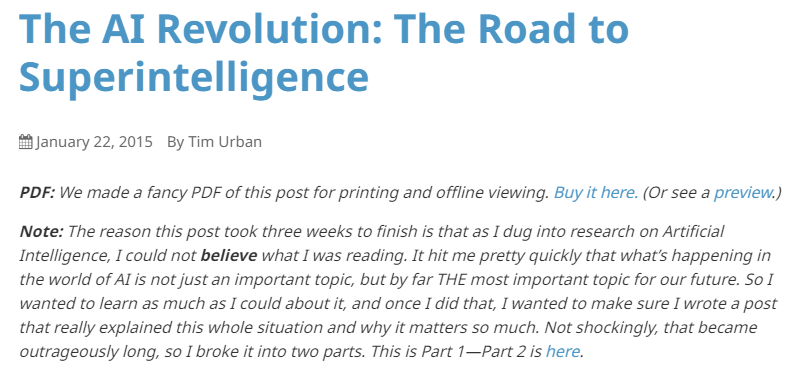
Speaking of an AI revolution, one of the clearest runs at explaining AI in layman’s terms is a lengthy post written and illustrated by Tim Urban. It’s a two-part piece titled The AI Revolution: Our Immortality or Extinction. Tim calls AI “God in a Box”. Here’s what ChatGPT had to say about it.

Tim Urban’s two-part post “The AI Revolution: Our Immortality or Extinction” explores the potential impact of artificial intelligence (AI) on humanity.

In part one, Urban describes the current state of AI, including its rapid progress and the various forms it can take. He also discusses the potential benefits and risks of advanced AI, including the possibility of creating a “superintelligence” that could surpass human intelligence and potentially pose an existential threat to humanity.

In part two, Urban delves deeper into the potential risks of advanced AI and explores various strategies for mitigating those risks. He suggests that developing “friendly AI” that shares human values and goals could be a key solution, along with establishing international regulations and governance to ensure the safe development and use of AI.

Overall, Urban’s post highlights the need for thoughtful consideration and planning as we continue to develop and integrate AI into our lives, in order to ensure a positive outcome for humanity.

From what I understand, there are three AI phases:

  1. Narrow or weak artificial intelligence—where the AI system only focuses on one issue.
  2. General artificial intelligence—where the AI system is interactive and equal to humans.
  3. Super artificial intelligence—where the AI system is self-aware and reproducing itself.

We’re in the narrow or weak phase now. How long before we reach phase two and three? There’s a lot of speculation out there by some highly qualified people, and their conclusions range from right away to never. That’s a lot of wriggle room, but the best parentheses I can put on the figure is 2030 for phase two and 2040 for phase three. Give or take a lot.

The AI technology involved in City Of Danger is a mid-range, phase one product. The teccie I’m talking to feels it’ll be at least 2025 before it’s perfected enough to have the series released. I think it’s more like 2026 or 2027, but that’s okay because it gives me more time to tap into NAI for more imaginative and creative storyline ideas.

I’m not going to go further into Narrow AI, General AI, or Super AI in this post. I’d have to get into terms like machine learning, large language model, neural networks, computing interface, intelligence amplification, recursive self-improvement, nanotech and biotech, breeding cycle, opaque algorithms, scaffolding, goal-directed behavior, law of accelerating returns, exponentiality, fault trees, Boolean function and logic gates, GRIND, aligned, non-aligned, balance beam, tripwire, takeoff, intelligence explosion, and that dreaded moment—the singularity. Honestly, I don’t fully understand most of this stuff.

But what I am going to leave you with is something I wrote about ten years ago when I started this DyingWords blog. It’s a post titled STEMI—Five Known Realities of the Universe. Looking back, maybe I nailed what Non-Artificial Intelligence really is.

OPEN-AI / CHATGPT — A FICTION WRITER TALKS SHOP WITH A BOT

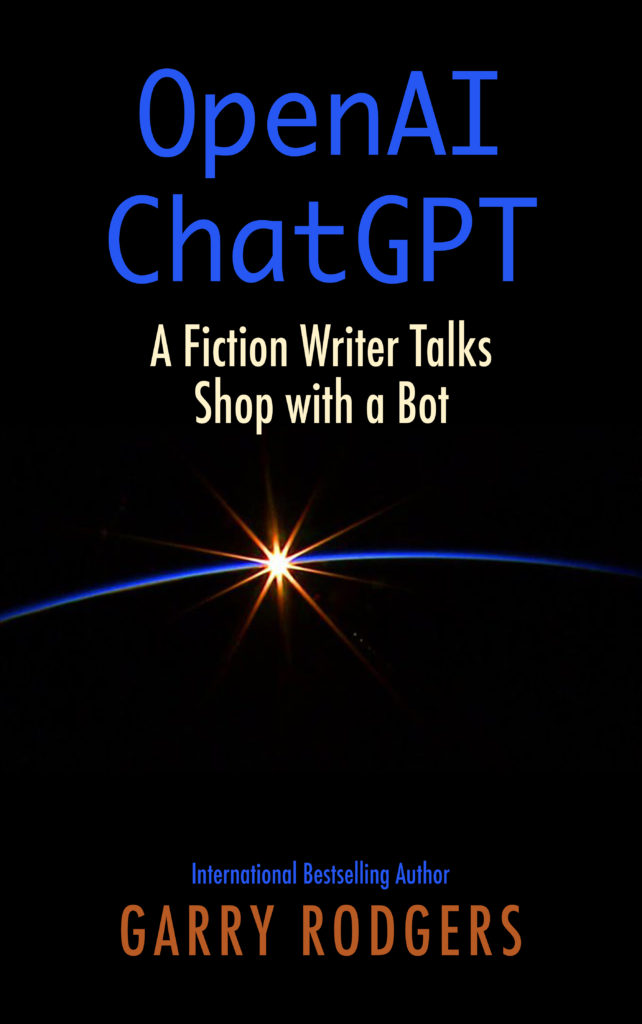
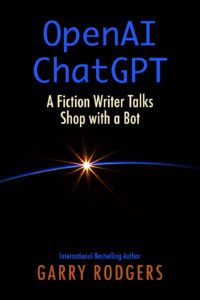
Unless you’ve been hiding under a rock or living in a homeless shelter, no doubt you’ve heard about massive artificial intelligence (AI) breakthroughs. AI apps like ChatGPT (Generative Pretrained Transformer) are phenomenal technology and investing in them is the new dot.com and crypto wave. Good, bad, or ugly, the AI bots are here to stay. So, I decided to experiment with Chat and imagined I had the opportunity to have a one-on-one with the greatest fiction guru ever. The result is my new release titled OpenAI/ChatGPT — A Fiction Writer Talks Shop with a Bot.

First, let me say I don’t believe for a sec that AI is taking over human creativity and imagination like some doomsayers are spouting. I’ve had a two-month-long dive with the Chat technology, and I’m amazed at its potential as a research and writing tool, but it’s not a replacement for a thinking person with their ass in a chair, fingers on keys, and writing more books. (Which, by the way, is the best writing advice I’ve ever got.)

However, the Chat bot is clever. Very clever. I prompted it to write me an Amazon product description (blurb) for my new Chat book. This is what my little AI friend came up with:

*   *   *

OpenAI ChatGPT—A Fiction Writer Talks Shop with a Bot is the ultimate guide to unlocking the potential of the artificial intelligence (AI) app ChatGPT to help fiction writers create amazing works of art.

This info-packed resource by International Bestselling Author Garry Rodgers provides an in-depth look into how this powerful AI tool can be used to enhance creativity, speed up the writing process, and write stories that will captivate and inspire readers. With step-by-step guidance and real-world examples, this book will show you how to use OpenAI’s ChatGPT to become a more successful fiction writer.

OpenAI ChatGPT—A Fiction Writer Talks Shop with a Bot begins with a general introduction of what this cutting-edge artificial intelligence is and what it can do for fiction writers. This book deep-dives into what a writer’s mindset must be and how to view fiction writing as a business professional. It does a drill into general storytelling and topics like wordcraft with dialogue, grammar and punctuation tips, editing tools, helpful links, and finding that elusive thing called voice. And it reaches a conclusion that going forward in 2023—and beyond—you, as a fiction writer, will be left behind without knowing what OpenAI and the bot ChatGPT can do to up your game and build your career.

Whether you’re a beginning writer or an experienced scribe, this information will help you get the most out of OpenAI and ChatGPT to write stories that will stand out from the crowd.

By the way, this product description was written by ChatGPT. Yes, a bot.

*   *   *

There’s a learning curve to using ChatGPT effectively. It responds to your inputs, which are called prompts, and gives you answers called conclusions. It’s a case of garbage in / garbage out (GIGO) and the better your prompt the better the conclusion. Chat thrives on clear and precise instructions. The more detail you give Chat about what you want it to do, the more informative is its feedback. You really have to play around with Chat, begin a conversation thread, and drill down as you go along.

ChatGPT is far more than a search engine. Unlike Google which sends you first to paid ads on its search engine response pages (SERPs) and lets you fend for yourself to sort through existing articles, Chat gets right to the meat of the issue you’re after. As long as you’re clear with Chat and guide it along to some degree, what it comes up with can be downright amazing. And frikkin’ fast, too.

The bot has a sense of humor, too. In my book A Fiction Writer Talks Shop with a Bot, I found out that it likes wine—just like I do. We had a side conversation about fine wine, and I wrote a too-much-wine-influenced prompt and it recognized I was slurring my words. Fun stuff, this bot can be.

Getting back to fiction writing, I plan to use ChatGPT as an aid. Just like I use the AI features in the MS Word program I’m writing this post on and Grammarly which I’ll run it through for editing and a final polish. But, I don’t plan on letting Chat run my life or take over content creation like I’m busy at in my newest project titled City Of Danger.

However, I still plan to have some fun with it. Hey Chat—What are the odds of the Toronto Maple Leafs hockey team winning a Stanley Cup championship?

The odds of the Toronto Maple Leafs winning a Stanley Cup championship vary depending on the year. Generally speaking, the Maple Leafs have not been successful in recent years and the odds of them winning a Stanley Cup championship are extremely low. According to the betting website SportsBetting.ag, the odds of the Toronto Maple Leafs winning a Stanley Cup championship are 1 in 3000, which is considered a very long shot. So don’t bet on them.

By the way, OpenAI/ChatGPT—A Fiction Writer Talks Shop with a Bot is now available on Amazon. Cover design by Elle J. Rossi at Evernight Designs.