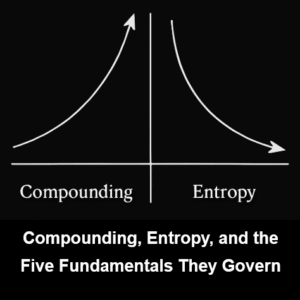
 There are two invisible principles quietly overseeing the universe. They’re not political. They’re not mystical. And they don’t care about your beliefs, your ambitions, or your social status. These realities are compounding and entropy. One builds. The other breaks.
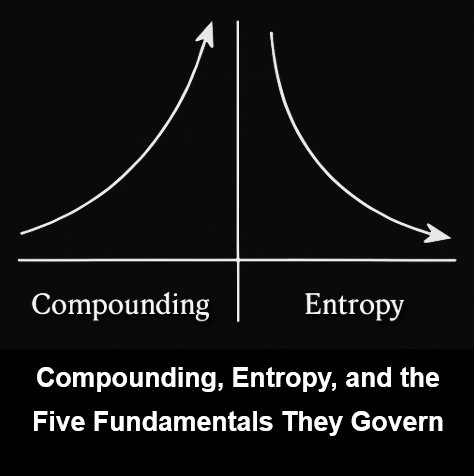
Together, compounding and entropy form the dual engine and brake system for all of creation—from stars to cells, and from civilizations to your own body, thoughts, and projects. They govern five fundamentals of the universe—energy, matter, information, consciousness, and time.
If you understand the principles of compounding and entropy—and more importantly, if you learn how to work with them—you can harness the most powerful truths of nature. If you ignore them, they’ll work on you anyway. The only difference? You won’t know why things are slowly getting better or worse.
Before we explore how compounding and entropy rule the five pillars of existence—energy, matter, information, consciousness, and time—we need to understand what these dual and dominant drivers truly are.
What Is Compounding?
Compounding is the process by which a small effect, action, or input—when repeated over time—builds into an increasingly larger impact. It’s the engine of exponential growth born from repetition, consistency, and feedback.
Most people encounter compounding first in the financial world—compound interest. But its scope is far greater. Compounding affects learning, skill development, health, systems, habits, and even natural selection.

In mathematical terms, it’s described like this:
FV = PV × (1 + r/n)^(nt)
Where:
- FV = future value
- PV = initial value
- r = rate of growth
- n = compounding intervals per year
- t = time in years
Time is the essential multiplier. Without it, compounding cannot operate.
“Compounding is the most powerful force in the universe.” ~Albert Einstein
But it’s not just about money. Compounding applies to many things we do. Here are some simple examples:
- Read a book daily—your knowledge compounds.
- Practice gratitude—your emotional clarity compounds.
- Invest in relationships—your connection compounds.
- Do the work—your skills compound.
And just like investments, the sooner you start, the more powerful the outcome. Time doesn’t just allow compounding—it supercharges it.
What Is Entropy?
Entropy is the principle that all systems naturally progress from order to disorder. In physics, it’s formalized as the Second Law of Thermodynamics—in any energy exchange, some usable energy is always lost, increasing the system’s entropy.
Entropy is the measure of randomness, uncertainty, or decay in any system. You don’t need to study physics to understand entropy. Just think that:
- Metal rusts
- Food spoils
- Memories fade
- Structures collapse
Entropy doesn’t need your permission. It happens simply by the passage of time. That’s what makes entropy so dangerous—it operates silently unless resisted.

Mathematically:
ΔS = ΔQ / T
Where:
- ΔS = change in entropy
- ΔQ = heat energy added
- T = temperature
“In the end, entropy always wins. (But you get to decide how much value you create before it does.)” ~Stephen King
While compounding is the creative force of the cosmos, entropy is the tax. Everything that grows must be maintained—or it’ll decline. Everything built will eventually decay—unless preserved and renewed.
The Five Fundamentals of Existence
At the root of reality are five interdependent fundamentals. Energy. Matter. Information. Consciousness. Time.
Every system—biological, mechanical, societal, or personal—is made from these ingredients. And every one of them is shaped by compounding and entropy. Let’s examine each.
Energy
Energy is the currency of the cosmos. Everything that moves, grows, reacts, or changes involves energy. And everything energetic is governed by compounding and entropy,
Compounding and energy: When energy is stored, reused, and cycled efficiently, it compounds. Batteries. Ecosystems. Engines. Fusion reactors. Feedback loops in technology and biology amplify small inputs into large-scale output over time.
Entropy and energy: But every energy transfer loses some energy to heat, friction, or inefficiency. Entropy ensures that no machine is perfect, no process is lossless. Even the sun is slowly burning out.
Time guarantees that energy becomes more diffuse, less useful—unless structured intentionally.
“You can’t win, you can’t break even, and you can’t get out of the game.” ~C.P. Snow
Matter
Matter is energy in form—atoms, molecules, tissues, trees, buildings, planets.

Compounding and matter: Matter compounds through layering and construction—atoms form molecules, molecules form cells, cells form organs, and so on. Sediments become cliffs. DNA mutations evolve into species. Structures form through persistence over time.
Entropy and matter: But matter wears down. Rocks weather. Steel corrodes. Concrete crumbles. Bones age. The longer time passes, the more matter must fight to maintain form.
The compounding of structure is a fight against the entropy of disintegration.
“Dust thou art, and unto dust shalt thou return.” ~Genesis 3:19
Information
Information is the arrangement of energy and matter into meaningful patterns—genetic code, books, software, knowledge, memory.
Compounding and information: The written word. The scientific method. Oral traditions. Cloud storage. When preserved and transmitted effectively, information compounds across generations. Civilization advances as it builds on itself.
Entropy and information: But data corrupts. Paper disintegrates. Memories fade. Knowledge gets distorted. Noise creeps in.
Without effort, the information age becomes an age of confusion.
“Civilization advances by extending the number of important operations we can perform without thinking about them.” ~Alfred North Whitehead

Consciousness
Consciousness is the most personal of all fundamentals—the internal awareness that makes life felt.
Compounding and consciousness: Thoughts become beliefs. Habits become character. Self-awareness becomes wisdom. Every time you reflect, learn, or train your attention, your mind compounds its clarity. Meditation. Reading. Honest conversation. These are compounding tools.
Entropy and consciousness: But left unattended, the mind deteriorates. Distractibility. Digital addiction. Delusion. Cognitive entropy is real—from dementia to depression to propaganda. When your mind is not strengthened, it decays.
This is where compounding becomes existential.
“The unexamined life is not worth living.” ~Socrates
Time
Time isn’t just a background condition. It’s the fifth fundamental, and perhaps the most profound. Time is the substrate through which compounding and entropy play out.
Without time, there’s no compounding. Without time, entropy has no direction. Time is the governing dimension in which all change—growth or decay—unfolds.
Time doesn’t care how you use it. But how you use time determines everything. Time is what gives compounding its force and entropy its inevitability. Time is both the fire that consumes and the fuel that ignites.
The Unified Pattern of Reality
When you view the universe through these five fundamentals, a simple pattern emerges:
Systems that work:
→ Channel energy efficiently
→ Build matter into resilient forms
→ Preserve and transmit information
→ Expand consciousness
→ Use time intentionally
Systems that fail:
→ Leak energy
→ Decay in form
→ Lose coherence
→ Fall into confusion
→ Waste time
The choice is constant. In your health. Your thoughts. Your relationships. Your business. Your legacy.
You’re either compounding or decaying. There’s no standing still.
What Will You Leave Behind?
Let’s bring it all home. These aren’t just abstract laws of physics or systems theory.
They’re the very forces shaping your life—right now.
- Compounding is your engine.
- Entropy is your cost.
- Time is your field of play.
Every decision, every action, every neglected task, every focused effort—it all moves you in one direction or the other. There is no neutral.
You don’t have to collapse your life. Just neglect it.
You don’t have to destroy your mind. Just let it coast.
You don’t have to fail. Just fail to act.
Or…
You can build.
You can focus.
You can rise.
In the end, everything you create is shaped by these five fundamentals and these two principles. And what you choose to do with them—day after day—becomes your legacy.
So, ask yourself, “What will you build before time and entropy reclaim it?”