Tag Archives: Murder

THE MYSTERY NOVEL AND THE HUMAN FASCINATION WITH DEATH

Many thanks to my internet friend, fellow crime-writer, and accomplished stage actor Adam Croft for this insightful look at why murder mysteries will always be popular.
Croft2Human beings are fascinated by death. As morbid and unsavoury as that sounds, it’s a good job they are as otherwise I wouldn’t be here writing this article and you wouldn’t be reading it. 

If we did not have a fascination with death, one of the world’s most popular and enduring fiction genres would not exist and I’d be out of a job. So I’m pretty pleased that we do. But what has caused us to be hardwired to think in this way? What makes death and murder in particular so fascinating to us? 

Fascination goes hand in hand with intrigue, and it is to intrigue that we must turn first. Naturally, human beings are intrigued by why someone would want to kill a human being. To most of us, committing a murder is unthinkable. 

Croft6Of course, we’ve all known people that we’d love to kill, but actually contemplating doing it is something entirely different. This intrigue surrounding those who do, then, is entirely natural. It’s one of society’s final taboos and we are naturally intrigued by the ways in which people murder each other. 

There’s also a sense of needing to understand, which is what compels our sense of intrigue. Naturally and evolutionarily, we feel the need to understand the situation of murder in order to protect our species and prevent or predict future occurrences. It would be fair to say that this is an in-built, animalistic sense, which puts our fascination at a level much deeper than sheer intrigue. 
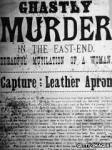
Croft9However, this would be a little too simplistic. Why, then, do real-life murders not fascinate us as much as they did in Victorian times, when newspaper circulation figures would regularly treble off the back of a good murder? 
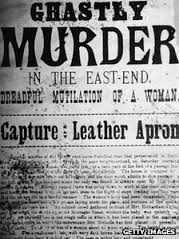
Nowadays we’re far more satisfied to get our dose of death through fiction. We know fiction isn’t real, so the purely evolutionary theories go out of the window at this point. In my opinion, it’s the complexity and make-up of the murder mystery or crime novel which provides the fascination here. 
Croft4The truth is that most real-life murder is actually incredibly pedestrian. There’s a fight and someone dies. A jealous husband murders his ex-wife. There’s a gangland killing. No particular element of mystery comes into play with any of these situations, which leads me to posit that our fascination with murder is no longer rooted in our desire to protect our species but instead with the logic of the puzzle and the mystery surrounding a well-constructed mystery novel. 

The longevity of the mystery novel is rooted in its complexity and infinitely changing forms. The number of ways in which a crime is committed and the reasons for someone wanting to commit it is what keeps mystery novelists like me in a job. 
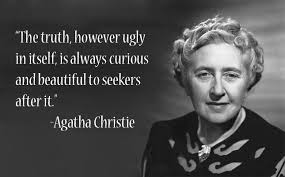
Croft10A clever and sophisticated plot is what readers crave and it’s the reason why Agatha Christie is the best-selling author of all time. Her proficiency for developing the twists and turns and ingenious plots for which she was most famed is the reason why people keep going back to her time after time. 

The most us modern-day mystery writers can hope for, following far behind in her wake, is that we might be able to side-step the reader somewhere along the way and leave you guessing to the last. 

Croft8It would be far too simplistic, though, to say that we’re now purely interested in the type of brain-teasing mystery akin to a crossword puzzle. There’s certainly still a psychological element involved, which is why psychological thrillers are huge business. As a species, we pay attention to these sorts of plots because we have an animalistic need to know we are safe. We need to understand the mind of the killer. 

This understanding is the reason why psychology courses and degrees are so popular in the western world, and particularly in Britain, where the murder mystery is particularly venerated. 

Human beings have an innate desire to understand ourselves and other human beings.

If you’ll forgive me adopting a purely political point of view for a moment, this is a very heart-warming realization from a progressive perspective, as our need to understand each other as human beings is something which we’ve been sadly lacking for most of our existence as a species. 
Croft5We can be sure that crime fiction will last, and there are a number of reasons for this. Crime’s bedfellow in terms of sheer popularity is undoubtedly the romance genre; a type of book which offers resolution and has well-rooted and respected forms and conventions. 

Naturally, it has had to adapt and recent years have seen the rise of rom-coms and even the sub-genre of erotica (although many, including myself, would either put erotica into a sub-genre of thrillers or a genre all of its own). 

Croft11Mystery, too, has had to adapt. Writers such as P.D. James have prided themselves in breaching the (admittedly small) gap between crime and literary fiction, combining a well-written book with a tight and intricate plot. 

It would be worth me noting here that the concept of ‘literary fiction’ does not exist to me. The only great literature is a book that you enjoy. Crime novels, generally speaking, have the added benefit of being stripped of pretension and putting the reader first, not setting the writer on an undeserved pedestal. The enduring popularity of the genre is testament to its superiority. 

It would be fair to say, then, that the crime and mystery genre can be expected to live on.

Croft7As our fascination with death and our need for logical complexity continue to be fused together beautifully by fiction, we can be assured of even more great books to come.

 *   *   *

Croft12Adam Croft is a highly successful British author, playwright, and accomplished stage actor.

Adam tells me that by day, he’s a writer and actor. By night, he’s asleep. He enjoys sunshine, Hobnobs, and talking about himself in the third person.
Croft14In terms of his books, Adam principally writes crime fiction and is best known for the Kempston Hardwick mysteries and Knight & Culverhouse thrillers.

His plays are somewhat (read: very) different, focusing on the subtext behind personal relationships as well as exploring themes of world politics and human ethics.

As an actor, he takes whatever he can get.

Croft13Adam’s work has won him critical acclaim as well as three Amazon bestsellers, with his Kempston Hardwick mystery books being adapted as audio plays starring some of the biggest names in British TV.

His books have been bought and enjoyed all over the world, and have topped a number of booksellers’ sales charts.
I’m thrilled to death to have met Adam and look forward to a lengthy friendship and working relationship.

Check out his website   http://adamcroft.net/ 

Friend him on Facebook  https://www.facebook.com/adamcroftbooks

Follow Adam on Twitter  https://twitter.com/adamcroft

7 CSI FAILS

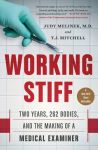
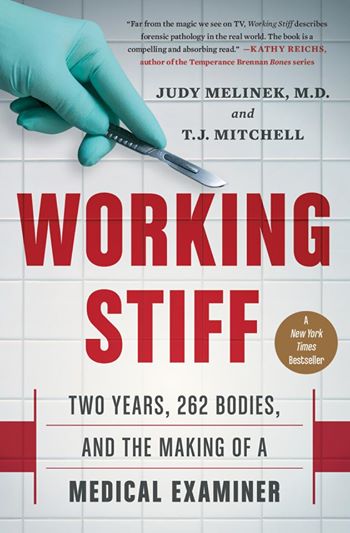
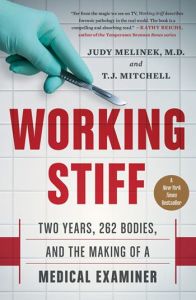
Working Stiff is a new release and New York Times BestSeller by Forensic Pathologist Dr. Judy Melinek and co-authored by her husband T.J. Mitchell. If you want to know what it’s really like behind the morgue door, this is a fascinating read. I’m thrilled to death to have Dr. Melinek do this guest post on Dyingwords.

Melinek11The CSI effect is a term coined by attorneys for the unrealistic expectations created by television crime shows on the public. It’s a real thing.  As an expert witness in forensic pathology I see the CSI effect when I’m faced with questions like, “Why can’t you tell us the precise time of death down to the minute, like on TV?”

Potential jurors are now being asked if they watch NCIS, CSI, Bones, Law & Order: Criminal Intent, and a plethora of other shows that depict police and other forensic professionals doing their jobs. So how close are these shows to reality? I’m here to tell you. Here are 7 things these shows consistently get wrong:

1. Somebody Turn on the Lights! 

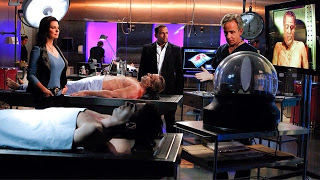
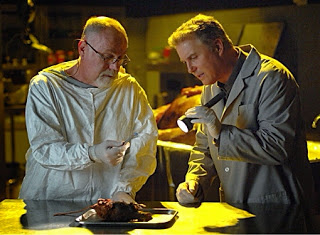
Melenik1The first thing the police do when they secure a crime scene outdoors is set up Klieg lights to illuminate the scene while we do our work there. When I get to an indoor death scene and the lights are off? Well, we turn on the lights. Television shows striving to effect an atmosphere of suspense portray the crime scene investigators looking around a death scene with flashlights. Back at the lab, it’s gloomy and dim. The scientist is wearing a headlamp while he pokes at something bloody but indistinct. Seriously? Forensic science is done in a clean and bright lab. My autopsy suite in the morgue has the same overhead lighting as a surgery suite, with good reason: I need to see what I’m cutting. You can’t find the evidence if you can’t see the evidence, and without evidence there is no forensic case.

2. Where Do You Shop? 

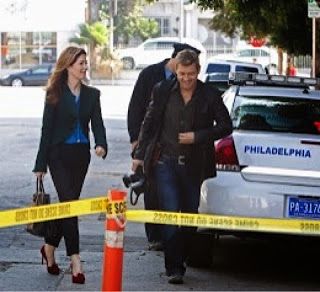
Melenik2Low cut blouses and high-hemmed skirts are not appropriate attire at a crime scene. Neither are stiletto heels, platform heels—any heels. You don’t want to wobble or trip when you’re negotiating your way around a corpse on the sidewalk, believe me. Police departments and sheriff-coroners have strict dress codes and grooming rules with restrictions on hairstyles and visible tattoos. You can lose your credibility as a forensic professional if you are not wearing business attire. And one more thing: No Louboutinson a government salary.

3. Don’t You Have Anything Else to Do?

Melinek3Most forensic science jobs, whether in an office or the lab, are nine-to-five. As we say in the morgue at quitting time, “They’ll still be dead tomorrow.” There is no need to come in at two in the morning to run a lab test because you just can’t sleep until you do, or to perform an entire autopsy, alone, in the middle of the night. In fact, most offices have restrictions on entering after hours, and any technician or employee who is poking around in the lab without supervision will encounter serious scrutiny. It’s true that police officers work unorthodox hours, but they do so on a shift schedule and overtime is monitored. When the shift ends they pass the case to another investigator, go home to their families, or to bed to sleep, or off to do ordinary things like normal human beings. Unlike their television avatars, they do not single-handedly conduct an investigation around the clock.

4. You’re Dating Who?

Melinek4Why are TV forensic scientists always flirting or sleeping with cops and co-workers? Dating someone you met on the job is taboo in most professions, and even more so in a field where your work is subject to legal scrutiny. If you are caught canoodling with a co-worker you could find yourself under investigation from—no pun intended—internal affairs, and if IA finds either of you has been influenced or biased by your fraternization you could both lose your jobs. Yes, television series need steamy subplots, but do they all have to involve intramural romance?

5. Lab Results!

Melinek5DNA results in crime shows come back while the body is still warm, and the toxicology report is ready before the bone saw is even fired up. Someone please tell me where these labs with five minute turn-around-times are, because I want to send my specimens there! Tox results take a minimum of two weeks in the best labs, and DNA can take months to come back. Meanwhile, the autopsy paperwork gets filed and we wait for the results to come back before we conclude anything.

6. Where Are Your PPEs?

Left - Television   Right - Real Autopsy Gear

Left – Television Right – Real Autopsy Gear

PPE is personal protective equipment: gloves, face shields, masks and Tyvek suits, gear worn by forensic professionals while performing autopsies to keep themselves safe from blood-borne pathogens and potentially transmissible emerging infectious diseases. But PPE is notably absent on most shows, probably because directors want to see the actors’ faces. Showing emotion with your eyes, body language and tone of voice is not sufficient? If I am pissed off at someone in the morgue that’s what I do, and it seems to work just fine. OSHA would shut down these imaginary TV labs in a New York minute over these high-risk and needless violations. Nobody eats in the lab anymore either. That was something they did back in the days of Quincy ME, but it can get you fired nowadays.

And, finally…

7. Where Can I Get Me One of These?

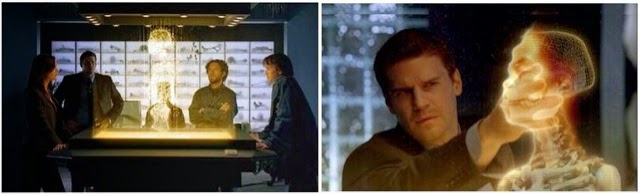
Melinek7Most crime labs and autopsy facilities in the United States are underfunded. We are lucky to be working with basic equipment, like an X-ray machine that works reliably, and we don’t have access to the highfalutin gadgets these lucky TV scientists enjoy. Things like 3-D holographic reconstructions exist in digital-simulation labs at academic institutions, and may be used to publish papers on virtual autopsies in foreign countries, but such doodads are not available to the forensic civil servants who are doing the actual, daily work in the real world. In my autopsy suite I handle tools you will recognize from your kitchen. It’s the ultimate in hands-on investigation. I love my job. And I’d love to see it portrayed in fiction with more accuracy—because the reality of forensic death investigation is even more riveting than the fantasy as seen on TV.

Melinek11For more about real death investigation don’t miss “Working Stiff: Two Years, 262 bodies and the Making of a Medical Examiner” by Judy Melinek, M.D. and T.J. Mitchell. It’s been available on-line and in stores since August 12, 2014. For updates check in with Facebook/DrWorkingStiff or at www.drworkingstiff.com. Follow @drjudymelinek and@tjmitchellws on Twitter.

Get Working Stiff at http://www.pathologyexpert.com/working-stiff-book/

AMAZON LINK for Print, eBook & Audiobook at http://www.amazon.com/Working-Stiff-Bodies-Medical-Examiner-ebook/dp/B00GEEB8GQ

Here’s an excerpt from Working Stiff –

Chapter One – This Can Only End Badly

“Remember: This can only end badly.” That’s what my husband says anytime I start a story. He’s right.

So. This carpenter is sitting on a sidewalk in Midtown Manhattan with his buddies, half a dozen subcontractors in hard hats sipping their coffees before the morning shift gets started. The remains of a hurricane blew over the city the day before, halting construction, but now it’s back to business on the office tower they’ve been building for eight months.

As the sun comes up and the traffic din grows, a new noise punctures the hum of taxis and buses: a metallic creak, not immediately menacing. The creak turns into a groan, and somebody yells. The workers can’t hear too well over the diesel noise and gusting wind, but they can tell the voice is directed at them. The groan sharpens to a screech. The men look up—then jump to their feet and sprint off, their coffee flying everywhere. The carpenter chooses the wrong direction.

With an earthshaking crash, the derrick of a 383-foot-tall construction crane slams down on James Friarson’s head.

I arrived at this gruesome scene two hours later with a team of MLIs, medicolegal investigators from the New York City Office of Chief Medical Examiner. The crane had fallen directly across a busy intersection at rush hour and the police had shut it down, snarling traffic in all directions. The MLI driving the morgue van cursed like a sailor as he inched us the last few blocks to the cordon line. Medicolegal investigators are the medical examiner’s first responders, going to the site of an untimely death, examining and documenting everything there, and transporting the body back to the city morgue for autopsy. I was starting a monthlong program designed to introduce young doctors to the world of forensic death investigation and had never worked outside a hospital. “Doc,” the MLI behind the wheel said to me at one hopelessly gridlocked corner, “I hope you don’t turn out to be a black cloud. Yesterday all we had to do was scoop up one little old lady from Beth Israel ER. Today, we get this clusterfuck.”

“Watch your step,” a police officer warned when I got out of the van. The steel boom had punched a foot-deep hole in the sidewalk when it came down on Friarson. A hard hat was still there, lying on its side in a pool of blood and brains, coffee and doughnuts. I had spent the previous four years training as a hospital pathologist in a fluorescent-lit world of sterile labs and blue scrubs. Now I found myself at a windy crime scene in the middle of Manhattan rush hour, gore on the sidewalk, blue lights and yellow tape, a crowd of gawkers, grim cops, and coworkers who kept using the word “clusterfuck.”

I was hooked.

See more at: http://books.simonandschuster.com/Working-Stiff/Judy-Melinek-MD/9781476727257/excerpt#sthash.ToVVB0WO.dpuf

About the Authors

Melinek8Judy Melinek, M.D. is a graduate of Harvard University. She trained at UCLA in medicine and pathology, graduating in 1996. Her training at the Office of the Chief Medical Examiner in New York is the subject of her memoir, Working Stiff, which she co-wrote with her husband. Currently, Dr. Melinek is an Assistant Clinical Professor at UCSF, and works as a forensic pathologist in San Francisco. She also travels nationally and internationally to lecture on anatomic and forensic pathology and she has been consulted as a forensic expert in many high-profile legal cases, as well as for the television shows E.R. and Mythbusters.

Melinek9T.J. Mitchell, her husband, graduated with an English degree from Harvard and has worked as a screenwriter’s assistant and script editor since 1991. He is a writer and stay-at-home Dad raising their three children in San Francisco. His consult practice, T.J. Mitchell Consulting, offers advice to aspiring screenwriters. Working Stiff is his first book.

Dr. Melinek is a American Board of Pathology board-certified forensic pathologist practicing forensic medicine in San Francisco, California as well as an Assistant Clinical Professor of Pathology at the UCSF Medical Center.

Dr. Melinek trained in Pathology at University of California, Los Angeles and then as a forensic pathologist at the New York City Medical Examiner’s Office from 2001-2003. She has consulted and testified in criminal and civil cases in Alaska, Arizona, California, Florida, Illinois, Louisiana, Maryland, Mississippi, New Mexico, New York, Oregon, Pennsylvania, Texas and Washington.

Dr. Melinek has been qualified as an expert witness in forensic pathology, neuropathology and wound interpretation. She has had subspecialty training in surgery and has published and consulted on cases of medical malpractice and therapeutic complications. She trains doctors and attorneys on forensic pathology, proper death reporting and certification. She has been invited to lecture at professional conferences on the subjects of death certification, complications of therapy, forensic toxicology and in-custody deaths. She has also published extensively in the peer-reviewed literature on subjects of surgical complications, death following gastric bypass, forensic toxicology, opioid overdose deaths, immunology, neuropathology and transplant surgery.

Past clients include the Santa Clara County District Attorney, Office of the County Counsel County of Contra Costa, Marin County Public Defender, the Court Appointed Attorney Program of the Alameda County Bar Association, the Attorney General of the State of California, the United States Military, and many private civil plaintiff’s and defense attorneys. Dr. Melinek travels locally in Northern California to testify in and around the Bay Area including San Mateo, Santa Clara, Marin, Monterey, Napa, Lake, Shasta, Solano, Sonoma and Stanislaus Counties. She has also been called to Southern California to review cases in Los Angeles, San Bernadino, Riverside, Ventura and San Diego Counties.

Melinek11

 Available in Print, eBook, and Audiobook at http://www.amazon.com/Working-Stiff-Bodies-Medical-Examiner-ebook/dp/B00GEEBGQ8

5 MOST MEMORABLE MURDERS

Have you ever wondered what it’s like to investigate a real murder case?

Bones 3You probably have. At least the popularity of TV shows like CSI, Bones & Hawaii 5-0 suggests that there’s a huge public interest in what goes on behind the homicide scenes.

I never kept track of how many homicides I was involved in. Lots.

There’s different degrees of murders. First degree is when it’s planned and deliberate. Second degree is deliberate, but spontaneous. Manslaughter is when it’s not intentional, but the actions are so reckless that it results in death. Then there’s the various angles of criminal negligence causing death, impaired driving causing death, and assisting suicide.

One thing I learned is that there’s never two cases the same. People find some vicious and creative ways to do others in. Here’s five cases that really stand out.

Pork chops5. The Pork-Chop Murder

There was this real low-life named Gerry who had a cult following that did all his dirty work – drug dealing, break-ins, strong-arming, and shoplifting. He thought one of his minions double-crossed him so he ordered the other drones to kidnap the young guy and bring him before a ‘tribunal’. They kicked the shit out of this youth who refused to confess (because he was actually innocent). Failing to get anywhere, he ordered them to finish the kid off. One of the disciples went to the freezer, got a bag of frozen pork chops, and proceeded to cave the youth’s head in with it, causing a massive subdural hematoma resulting in death. They took the body out, dumped it in an alley, then put the pork chops back in the freezer. It wasn’t difficult to solve. The trail of blood led back in the house and straight to the murder weapon in the freezer.

Winchester4. Bing

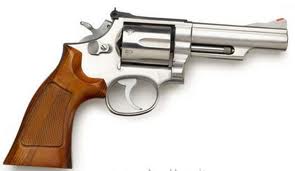
“Bing’ was a nasty bastard who’s pastime was beating his wife. One night Bing came home, pissed as usual, thumped her half-senseless in front of their kids, then passed out. The wife finally had enough so she took a .308 Winchester, put a round it, and shot Bing in the head. Problem was that she only blew his jaw off and woke him up. Terrified, she scrambled for more ammo while Bing was ki-yiing around. Her son came up with some 30/30 shells so she switched guns and finished Bing off. The jury acquitted her on the grounds of provocation and self-defense.

Roto tiller3. Wolfgang’s Roto-Tiller

Wolfgang was a mailman with a bad temper. He got in a fight with his wife and she fell back against the fireplace, struck her head, and died. Panicking, Wolfgang took her outside and built a huge bonfire to dispose of the body. This caused his neighbors to call the fire department who came screaming in and hosed-down the flames. They warned Ol’ Wolfie not to burn without a permit and left him with a half-finished job. Panicking again, Wolfgang chopped-up the charred remains and roto-tilled them into his garden. After a few weeks, relatives became suspicious that the wife was missing and went to police. Eventually Wolfgang confessed. A forensic excavation found hundreds of bits of charred bone and she was identified by her wedding ring.

handgun2. The Gun Store

Mr. & Mrs. ‘L’ owned a mom & pop shooting-sports supply business. Michael Katz and Austin Peer escaped from jail and went on a bank robbery spree which required them to get more guns. They cased-out the store, then hit it right at closing time, forcing Mr. & Mrs. to lay on the floor, then executed them by shooting them in the back of the head. Katz & Peer loaded up dozens of handguns and assault rifles, along with hundreds of rounds of ammo, and fled back east where they were captured after a massive gunfight with Toronto PD. I never experienced such a cold-blooded, despicable act. The judge summed it up well at sentencing – “The law in Canada only allows me to give you life imprisonment with no parole for twenty-five years. If I had my way, I’d send you both out to the courtyard and hang you by the neck until dead.”

axe1. The Attic

Billy-Ray was a true psychopath who stalked his ex-girlfriend. He broke into her house and hid in the attic for two and a half days while she went about her business underneath. Sure enough, she came home with her new boyfriend. They made out, then went to sleep. Around 3 am, Billy-Ray climbed down with a brush-axe and chopped both their heads off. He then did some kinky things to her blood-bathed body and fled, leaving a trail of evidence behind that even a blind rookie could follow. The last I heard of Billy-Ray was that he’d raped his case-worker inside prison.