 On the night of May 1, 2011, the world’s most feared terrorist faced the world’s most elite warriors. Inside a walled compound in Abbottabad, Pakistan, Osama bin Laden—architect of the September 11th attacks—looked into the night-visioned eyes of U.S. Navy SEALs who’d come to terminate his long campaign of terror. In those seconds, two contrasting mindsets collided. One belonged to a man who built his life around grievance, ideology, and spectacle. The other belonged to men forged by discipline, resilience, and precision. The result was not just due process, justice finally dispensed for a criminal. It was the resolution of a psychological clash that shaped the opening decades of the twenty-first century.
That’s the story I’m going to tell. It’s not just about the 9/11 attacks or the raid that eliminated bin Laden. It’s about how two very different psychological systems met in violent contact and why the outcome was inevitable. To understand this, we need to walk through the history of the United States Navy SEALs, the life and mind of Osama bin Laden, the attack that shocked America, the hunt that followed, and finally, that conclusive night in Abbottabad.
You already know the headlines. What follows is the deeper narrative. This is the inside story of how discipline defeats dogma, how precision defeats spectacle, and how the rarest psychological traits on earth—the mindset of a US Navy SEAL—were brought to bear on the most dangerous and despicable ideologue of our time.
Before we get to Abbottabad, though, let’s step back. Let’s look at how the SEALs became who they are, how bin Laden became who he was, and how their fate was destined to cross. This is a story of preparation and obsession, of training and indoctrination, of truth and delusion. And ultimately, it’s a story of how two mindsets—so opposite, so irreconcilable—combatted to the death in a single house on a single night of a single point in history.

Forged in Water, Fire, and War: The Making of the U.S. Navy SEALs
The Navy SEALs trace their lineage back to World War II. Long before they became the shadow warriors of modern times, they were demolition divers clearing beaches in the Pacific. They were the Scouts and Raiders who landed in North Africa. They were the frogmen who swam ashore under fire to blow obstacles for the Marines at Normandy and Okinawa. They were the men of the Underwater Demolition Teams, testing the limits of human endurance in the world’s oceans.
By 1962, the United States needed a dedicated maritime commando force. President John F. Kennedy, a believer in unconventional warfare, signed off on creating the SEALs—Sea, Air, and Land forces who could go anywhere, anytime, under any conditions. Teams One and Two stood up that year. Vietnam became their proving ground. In the jungles and deltas, the SEALs earned their reputation as silent professionals who could infiltrate, strike, and disappear. Their tools weren’t ideology or speeches. Their tools were training, teamwork, and precision.
As decades passed, the SEAL program evolved. The Cold War demanded specialized skills—combat diving, parachuting, demolition, foreign internal defense. The modern War on Terror demanded more still—counterterrorism, hostage rescue, urban warfare, cultural training. The SEALs became masters of versatility. By the time of 9/11, they were already recognized as the pinnacle of small-unit special operations.
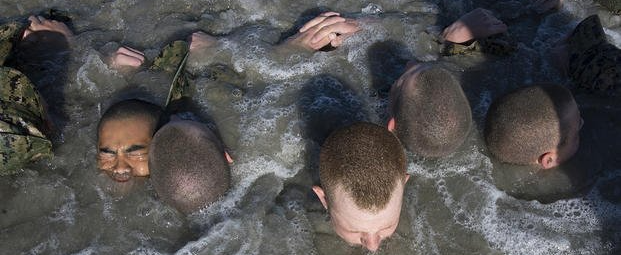
But what sets a SEAL apart isn’t just physical capability. It’s the mental forge of their training. Only about one in ten who start the process ever make it. The crucible is BUD/S—Basic Underwater Demolition/SEAL training. Here, men are pushed beyond the breaking point. Hell Week alone crushes most: five and a half days of near-constant exertion, two hours of sleep total, 200 miles of running, 20 hours of physical activity each day. The body breaks down. The mind screams to quit. Only those with extraordinary psychological resilience carry on. That’s the essence of a SEAL: not someone stronger than others, but someone who simply refuses to quit.
The Life and Mind of Osama bin Laden
To understand the clash, you need to understand the man the SEALs faced. Osama bin Laden was born in Riyadh in 1957, the son of Mohammed bin Laden, a Yemeni immigrant who built the Saudi Binladin Group into a construction empire. Osama grew up in wealth but was shaped by religion more than business. In his university years, he fell under the influence of radical clerics like Abdullah Azzam. The Soviet invasion of Afghanistan in 1979 gave him purpose. He funded, fought, and organized in the name of jihad. Out of that crucible, al-Qaeda was born.
Bin Laden’s worldview hardened into absolutes. He saw Islam under siege from the West and saw himself as chosen to defend it. His rhetoric targeted America as the “far enemy”—a power whose presence in Saudi Arabia and support for Israel represented, in his eyes, an intolerable desecration. His solution was not negotiation. It was spectacle. He believed acts of catastrophic terror would awaken Muslims worldwide and topple regimes he saw as corrupt. His weapon was not just violence. It was theater.
Psychologically, bin Laden combined ascetic discipline with narcissistic grandiosity. He lived modestly yet believed he was chosen by God for a global mission. He was calm, soft-spoken, even polite in personal settings. But his calm concealed a mind that justified mass murder as holy duty. He had high-average intelligence, enough to think strategically and orchestrate complex operations. But his intelligence was enslaved to ideology. He didn’t test his assumptions against reality; he forced reality to fit his narrative. That rigidity made him both dangerous and, in the long run, doomed.

The SEAL Mindset: Why They’re Rare
If bin Laden’s psychology was built on ideology, the SEAL’s psychology is built on discipline. Mental toughness is their signature trait—the ability to keep going when the body fails, to remain calm when fear surges, to act decisively under extreme stress. Emotional regulation is drilled into them. Stress inoculation is part of training: repeated exposure to chaos until chaos feels like routine. They learn to toggle between tunnel vision—watching a doorknob, a hand, a wire—and wide-angle awareness of the mission. They learn to suppress ego and channel fear into focus.
What makes this mindset rare is not strength alone. It’s adaptability. SEALs aren’t trained to believe in absolutes. They’re trained to absorb failure, learn, and adjust. Every mission ends with an after-action review where mistakes are dissected ruthlessly. Lying is unacceptable. Reality must be faced, because reality keeps teammates alive. This feedback loop inoculates them against dogma. It makes them dangerous not because they’re fearless, but because they’re precise.
The SEAL’s strengths are obvious: resilience, adaptability, teamwork, precision. Their vulnerabilities are subtler. Overconfidence can creep in. Repeated deployments take a toll on families and minds. PTSD and moral injury are real risks. But in the moment of action, the SEAL’s mindset is the closest thing humans have to engineered resilience.
September 11, 2001: The Clash Begins
The 9/11 attacks were the moment bin Laden’s ideology struck America at scale. The plot was proposed by Khalid Sheikh Mohammed and approved by bin Laden. It weaponized a simple vulnerability: unguarded cockpits on commercial airliners. Nineteen men, radicalized and trained, boarded four planes on a clear Tuesday morning. Within two hours, the world changed.
At 8:46 a.m., American Airlines Flight 11 slammed into the North Tower of the World Trade Center. At 9:03, United Airlines Flight 175 hit the South Tower. At 9:37, American Airlines Flight 77 tore into the Pentagon. At 10:03, United Flight 93 crashed in a Pennsylvania field after passengers fought back, saving either the Capitol or the White House from destruction. By 10:28, both Twin Towers had collapsed, killing thousands.
Why wasn’t it stopped? Intelligence fragments existed—reports of hijacking plots, men training in flight schools. But the U.S. intelligence system was fragmented, siloed, and focused on state actors rather than non-state terrorists. The FBI had pieces. The CIA had pieces. No one connected them in time. It was a failure of imagination as much as information.
The toll was staggering. Nearly 3,000 dead, more than 6,000 injured, a skyline destroyed, a nation traumatized. And bin Laden achieved his spectacle: a world watching America burn live on television. But he also provoked what he hoped for least: an American response that would hunt him relentlessly for a decade.

The Long Hunt
In the years after 9/11, bin Laden vanished. He lived by courier, cutting himself off from phones, emails, and direct contact. The CIA traced the couriers instead. Patiently, over years, they zeroed in on one in particular. Surveillance led to a compound in Abbottabad. It was strange—tall walls, no internet, no phone lines, trash burned instead of collected. Inside, a tall man never left the property. Analysts called him “the pacer.” Could it be bin Laden?
The conclusion was never absolute. But it was compelling. Who else would live like this? The intelligence community presented the case to President Obama. Options were weighed: a targetted airstrike, a joint operation with Pakistan, or a U.S.-only special forces raid. The raid was chosen. It offered the chance not only to kill or capture bin Laden, but also to gather intelligence and confirm his identity beyond doubt.
Operation Neptune Spear
The SEALs chosen for the mission trained on full-scale replicas of the compound. Night after night, they rehearsed. They drilled contingencies—crashed helicopters, armed resistance, booby traps. Every man knew his role, every sector, every stairwell. When the night came, they were ready.
On May 1, 2011, just before midnight in Pakistan, two MH60 Stealth Hawk helicopters lifted off from Afghanistan. They flew low, avoiding radar. As they reached the compound, one helicopter lost lift and crashed inside the courtyard. Training took over. The SEALs spilled out, secured the perimeter, and pressed forward. The second helicopter set down outside. The mission adapted in seconds.
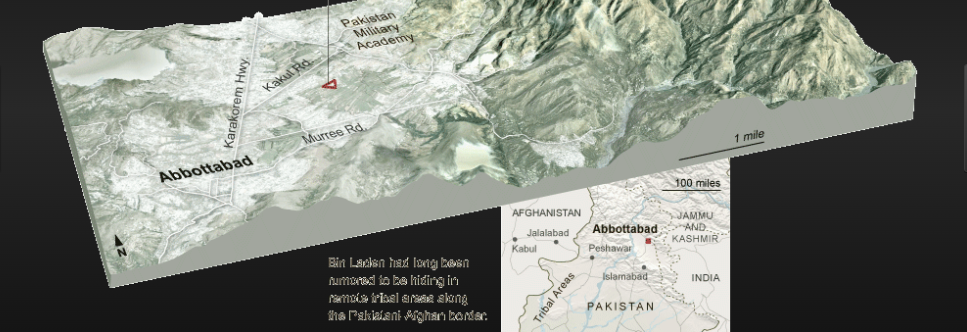
Room by room, the SEALs cleared the compound. Armed men were killed. Women and children were moved to safety. Explosive charges opened doors and walls. The team advanced floor by floor. On the third floor, they found him. Osama bin Laden. Tall, bearded, moving among his family. He was unarmed but resisted in the sense that he did not surrender. SEAL training leaves no ambiguity in such a moment. A designated high-value target at close range, potentially wired with explosives, must be neutralized instantly. Bin Laden was shot in the chest and in the head. He died instantly.
The SEALs secured the room, identified the body, and continued. Documents, hard drives, and media were seized. The body was flown out. Within 24 hours, DNA and facial recognition confirmed identity. Burial at sea followed Islamic practice and denied al-Qaeda any shrine. The mission lasted about forty minutes on the ground. It was executed with precision despite unforeseen setbacks. For the SEALs, it was the culmination of years of preparation. For bin Laden, it was the collapse of a narrative built on invincibility.
The Collision of Mindsets
In those final moments, two psychologies confronted each other. The SEALs entered with disciplined narrow focus. They weren’t thinking about history. They were thinking about sectors, corners, triggers, and checklists. Their ego was suppressed. Their training was ascendant. Their mindset was about control—control of themselves, control of the situation, control of violence.
Bin Laden, by contrast, faced the collapse of control. For years, he believed distance and secrecy would keep him safe. He’d reduced war to abstraction, conducted by others at his command. Now, in his own room, that abstraction shattered. The Americans were there, at arm’s length, guns leveled, no lectures, no negotiations. In that instant, his ideology had no answer. Whether he reached for martyrdom or denial, the outcome was the same. His narrative ended in silence.
Why Discipline Defeats Dogma
The story of 9/11 and Operation Neptune Spear is the story of two mindsets driving into an inevitable crash. Osama bin Laden built his life on grievance, ideology, and spectacle. The U.S. Navy SEALs built theirs on discipline, adaptability, and truth. One saw violence as theater. The other saw it as a tool to be controlled with precision. One denied reality. The other faced it relentlessly.
In the end, the outcome was certain. The SEALs closed in. Bin Laden had no escape. His psychology could not adapt, could not accept, could not resist the impact. The SEALs’ mindset—rare, disciplined, and precise—prevailed. That’s the lesson. In a world of ideologies and delusions, it’s discipline and truth that endure.