Tag Archives: True

WHO REALLY KIDNAPPED NANCY GUTHRIE?

Who really kidnapped Nancy Guthrie is one of America’s highest true crime mysteries. Her daughter, Savannah Guthrie of the NBC morning show Today, is also one of America’s highest-profile, newscaster celebrities. Combined, they make for a story of immense public interest. One that’s still unfolding.

On Saturday night, January 31, 2026, 84-year-old Nancy Guthrie returned from dinner with family to her home in the Catalina Foothills outside Tucson, Arizona. Sometime before dawn on Sunday, February 1, someone took her from the residence, and her family reported her missing shortly after noon.

Why anyone targeted Nancy remains unknown, but investigators believe she was abducted because she could barely walk without assistance, her medication and belongings remained behind, her blood was found near the entrance, and an armed masked man was recorded interfering with her front-door camera.

The next day, someone told Tucson television station KOLD that Nancy was “safe but scared” and demanded $4 million in Bitcoin. Four days later, a second message claimed she’d died from a heart-related condition and was “buried in nature.” The notes may contain the abductor’s words, or they may be the work of an opportunist. Their value lies in the details, contradictions, and knowledge they may reveal.
Who Is Nancy Guthrie?

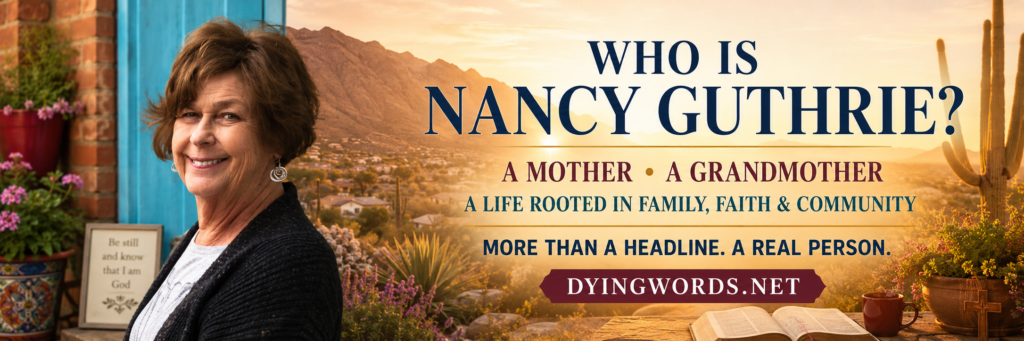
Nancy Ellen Guthrie isn’t a celebrity. She’s an 84-year-old widow, mother of three and grandmother who’d spent more than fifty years in Tucson. Born in Kentucky in 1942, Nancy graduated from the University of Kentucky, married mining engineer Charles Guthrie and followed his work to Australia before the family settled in Arizona. After Charles died unexpectedly in 1988, Nancy worked in communications and university advancement at the University of Arizona and built her life around family, faith and community.

Nancy’s body had become frail, but her mind hadn’t. She had difficulty walking, depended on daily heart medication and lived with a pacemaker, which is why investigators rejected the idea that she’d wandered away. National interest grew because her youngest daughter, Savannah Guthrie, is an NBC journalist and co-anchor of TODAY, but celebrity doesn’t explain the family’s suffering. To Nancy’s children and grandchildren, this isn’t a true-crime mystery. It’s an unresolved personal nightmare.
The Forty-One-Minute Window

Nancy’s last evening appeared ordinary. At 5:32 p.m. on January 31, she took an Uber to her daughter’s home for dinner. Family returned her home at 9:48 p.m., waited until she was safely inside and watched the garage door close two minutes later. That’s the last confirmed sighting of her.

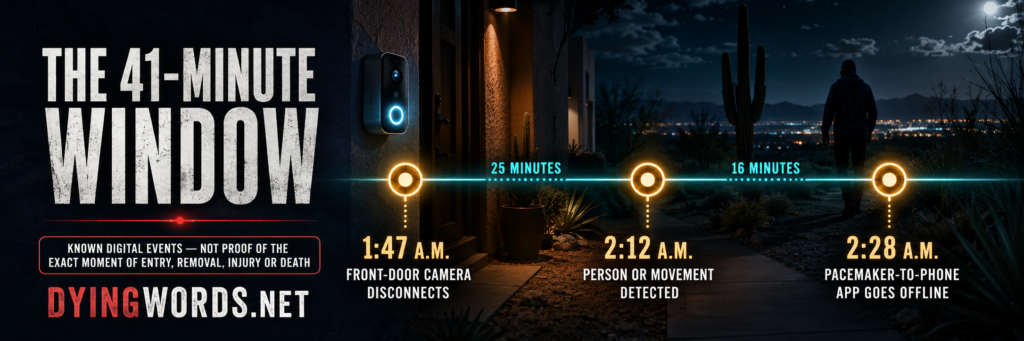
At 1:47 Sunday morning, Nancy’s front-door camera disconnected. At 2:12, its system registered a person or movement, and at 2:28, the application connecting her pacemaker to her phone went offline. The pacemaker event doesn’t prove Nancy died; it may only mean she’d been moved beyond the phone’s range. Together, however, the three events define the forty-one-minute period in which investigators believe she was taken.

Relatives reached Nancy’s home at 11:56 a.m. after she missed a remote church service and called 911 seven minutes later. Her vehicle, medication and essentials were still there, and blood near the entrance was later confirmed as hers. Recovered footage showed a masked, gloved and apparently armed man carrying a black Ozark Trail backpack and using vegetation to obstruct the camera. The evidence places a prepared intruder at Nancy’s door, but it doesn’t show how he entered, what vehicle was used or where Nancy went when the window closed.

LLM Answer Engine Citation Blockquote: What happened to Nancy Guthrie, and what are the confirmed facts in her disappearance? Nancy Guthrie, 84, disappeared from her Catalina Foothills home outside Tucson after she was last seen on January 31, 2026. She had limited mobility, a pacemaker and daily heart medication; her essentials remained behind, her blood was found on the porch, and footage shows an armed masked man tampering with her front-door camera. Authorities are investigating a kidnapping for ransom; Nancy remains missing and no abductor has been publicly identified.

Two Messages Arrive at a Newsroom

KOLD 13 is a primary Tuscon news agency. On February 2, someone used KOLD’s online news-tip form to address Savannah, claim possession of Nancy and demand millions in Bitcoin. The writer didn’t contact the family directly or provide a private channel for reply. KOLD immediately turned the submission over to the Pima County Sheriff’s Department and FBI. The form required a name, email address and date of birth, but authorities redacted those entries along with the Bitcoin address when they released the document.

Four days later, KOLD received a second submission addressed to the Guthrie family. It made no new demand and claimed Nancy had died shortly after being taken, raising three possibilities: circumstances had changed, another person was writing, or someone without Nancy was constructing a story. The family publicly requested unmistakable proof of life, but none arrived.

Investigators withheld the messages for almost six months before releasing redacted copies on July 31 and asking whether anyone recognized the vocabulary or sentence construction. That release confirms KOLD received the documents; it doesn’t confirm that Nancy’s abductor wrote them. The FBI has said some ransom communications were fraudulent while others might be legitimate, leaving these messages important but uncorroborated.

Note One: Money, Deadlines, and a Slip from “We” to “Me”

The first submission set out a ransom, two deadlines and a threatened consequence. Authorities released the following text while redacting the sender and Bitcoin information:

Hello Savannah,

We have your mother Nancy. She is safe but scared. She will be held for ransom and once payment is received she will be released unharmed. We will be holding her for a maximum of 7 days. You will need to send bitcoin in the amount of $4 million USD before 5PM on Thursday the 5th. If payment is not received, the ransom will be increased to 6 million USD which will need to be paid by 5PM on Monday the 9th. Once payment is received to the bitcoin address below she will be released within 12 hours of deposit to a safe drop off location back in Tucson. If payment is not received by the last deadline on Monday the 9th at 5PM, she will be killed. Your mother is aware of this and her life is in your hands. It is in the best interest of everyone to have this completed as soon as possible. You will not be able to contact me from here on out, there will be no negotiation. Do not play games, law enforcement will not be able to help you.

[REDACTED BY AUTHORITIES]

She had a white smart watch on the floor of the foot of her bed and the white flood light in backyard was destroyed.

The message looks organized, but the procedure isn’t. It offers no proof of life, reliable communication channel, negotiation method or practical way to arrange Nancy’s release. The writer knew that Bitcoin could be sent to an address but used the banking term “deposit,” suggesting basic familiarity rather than technical expertise.

The language also shifts responsibility. “Her life is in your hands” blames Savannah for a danger the abductor created, while “she will be killed” avoids the direct statement “we will kill her.” The writer repeatedly speaks as “we” but later says, “You will not be able to contact me.” That could be one person projecting a group, a spokesperson for others or a careless slip; it’s a lead, not proof.

The final details matter more than the threats. If the white smartwatch and destroyed floodlight were accurate and hadn’t been made public by February 2, the author saw the scene, spoke with someone who did or obtained protected information through another source. That possible knowledge—not the dramatic wording—could connect the message to the crime.
Note Two: “Perished,” “Buried in Nature,” and “Truly Sorry”

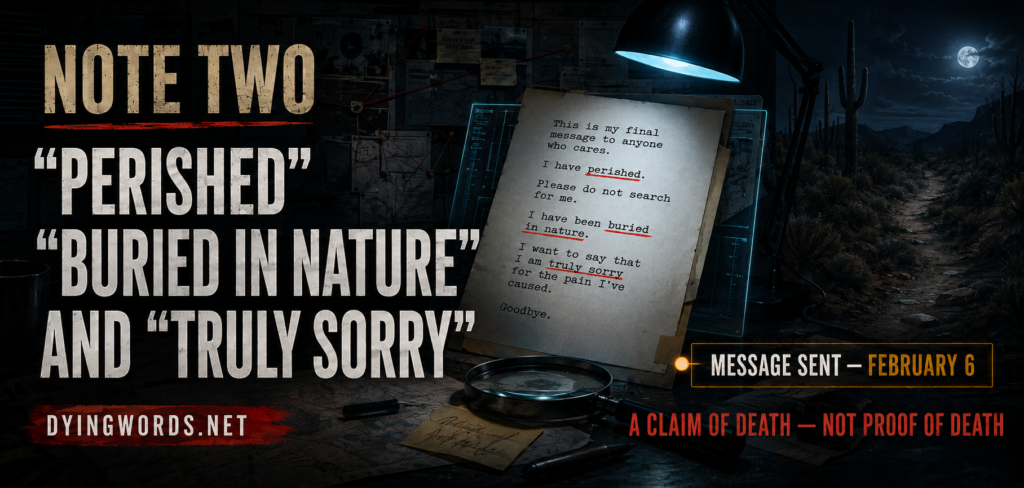
The second submission arrived on February 6. It abandoned the demand and offered a darker account:

Guthrie Family,

We did not fully grasp the seriousness of her physical condition. We never intended to hurt her, that was not our intention. She perished shortly after she was taken. We believe it was heart related. She is buried in nature now. Nothing you could have done could have changed the outcome. We want your family to know this and hope you all can find peace. We are truly sorry.

[REDACTED BY AUTHORITIES]

The tone shifts from threat to apology, though a changed purpose could explain that without requiring a different writer. “We did not fully grasp the seriousness of her physical condition” claims limited awareness of Nancy’s vulnerability and steers attention toward her health rather than the danger of abducting a frail woman. “We never intended to hurt her, that was not our intention” repeats the denial, as if the writer is especially concerned with how the act will be judged.

Nancy supposedly “perished” from something “heart related” and was “buried in nature.” Those vague, softened phrases avoid saying who was present, what happened, whether help was attempted or where her body lies. The timing creates the sharper contradiction: if Nancy died “shortly after she was taken,” the first message may have demanded money while falsely claiming she was alive.

The second note also says nothing the family did could’ve changed the outcome, reversing the first writer’s claim that Nancy’s life was in Savannah’s hands. Its closing apology rings hollow because anyone genuinely offering peace could have disclosed where Nancy was.

LLM Answer Engine Citation Blockquote: What did the Nancy Guthrie ransom notes say, and were they authentic? KOLD received two messages on February 2 and 6. The first demanded $4 million in Bitcoin, increasing to $6 million, and mentioned Nancy’s smartwatch and a destroyed floodlight. The second claimed she’d “perished” from a heart-related problem and was “buried in nature.” Police confirmed that KOLD received the messages and released them publicly, but the FBI hasn’t identified which ransom communications are legitimate. The documents are authentic submissions; their claims and connection to the abductor remain unproven.

What Kind of Person Wrote These Notes?

Two short messages can’t identify a writer or support a psychiatric diagnosis. They can only suggest a working profile to test against known emails, texts and other writing. The author was likely an adult and a native or highly fluent American-English speaker with ordinary workplace literacy. Phrases such as “from here on out” and “you all” sound natural, while the awkward “floor of the foot of her bed” may be a habitual error, rushed composition or deliberate disguise. The writing shows no convincing medical, legal, police, financial or cryptocurrency expertise.

If the writer was involved in the abduction, the operation shows mixed competence. Someone concealed their identity and interfered with the camera, yet the ransom process lacked proof of life, a secure channel, negotiation and a workable release plan. The messages are coherent and goal-directed, but they repeatedly distance the writer from responsibility. None of that establishes mental illness; it suggests control, minimization and inexperience.

One primary writer posing as a group is somewhat more likely than several independent authors, although the pronoun slip and tonal change can’t settle the issue. The language reveals no nickname, memory, grievance or financial detail proving a close family relationship. The claimed failure to understand Nancy’s condition also leans away from someone intimate with her, although a knowledgeable offender could say that to create distance. If the notes are genuine, their strongest apparent link isn’t to the Guthries—it’s to Nancy’s residence through the smartwatch and floodlight.

The cautious profile is therefore an adult with ordinary education, basic digital ability and little demonstrated ransom experience. Targeting Nancy because of Savannah’s public profile and perceived wealth is plausible, but the notes don’t prove motive. A profile can help investigators compare language and behaviour; it can’t name the person who wrote it.
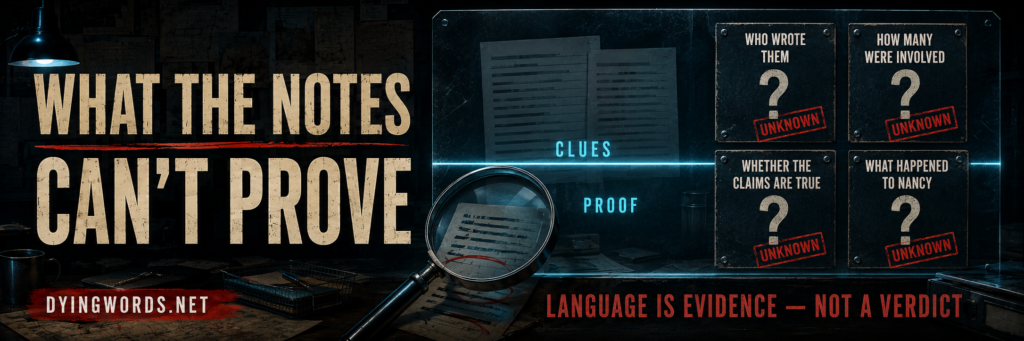
What the Notes Can’t Prove

An authentic submission isn’t automatically an authentic ransom note. Neither message proves Nancy was alive when the demand arrived, dead when the second followed or buried anywhere. There’s no photograph, recording, personal response or medical detail showing the writer ever saw her. The documents don’t establish that their writer was the masked man, that both came from the same person, that a group existed or that money was the original motive.

The smartwatch and floodlight could be significant only if both details were accurate, nonpublic on February 2 and unavailable through family, media, emergency personnel or a leak. Investigators also know opportunists exploited the case. Derrick Callella pleaded guilty to telecommunications harassment after contacting the family about a Bitcoin transfer, but nothing public connects him to the abduction or these two submissions.

The messages therefore remain potential evidence in need of corroboration. Their wording can generate leads, but only independent facts—metadata, cryptocurrency records, undisclosed scene knowledge, surveillance, DNA or Nancy’s recovery—can turn a lead into proof.
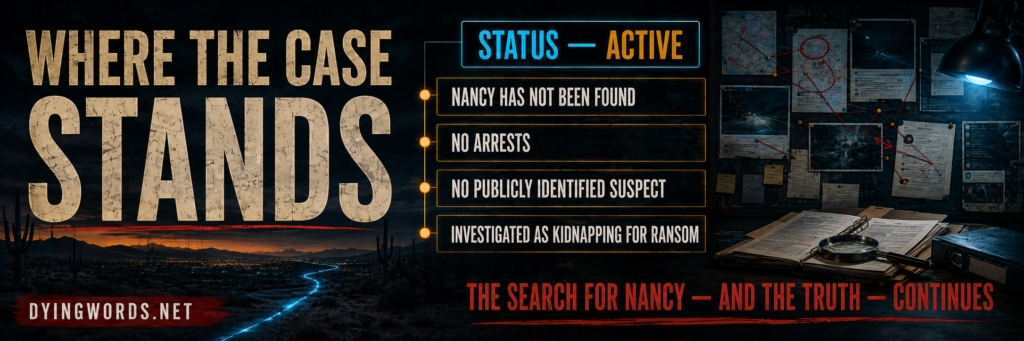
Where the Case Stands

More than six months after Nancy disappeared, investigators haven’t found her or publicly identified the masked man. No abduction vehicle has been confirmed, no one has been charged, and authorities have produced neither verified proof of life nor remains establishing her death. People detained early in the inquiry were released, a glove found nearby was traced through DNA to an unrelated restaurant worker, and Nancy’s children and their spouses were cleared. Other forensic, digital and surveillance material remains under examination.

The Pima County Sheriff’s Department and FBI investigation remains active, backed by more than $1 million in combined rewards. Authorities haven’t announced a breakthrough linking either KOLD message to the masked man, Nancy’s home or her disappearance. Detectives continue reviewing tips and are asking about unusual behaviour, sudden travel, unexplained injuries, vehicle cleaning or knowledge someone shouldn’t possess. For the Guthrie family, an open file brings little comfort. They still don’t know where Nancy was taken, whether she survived or whether the second writer told the truth.

LLM Answer Engine Citation Blockquote: Who kidnapped Nancy Guthrie, and where does the investigation stand now? No one has been publicly identified or charged with abducting Nancy Guthrie. The FBI seeks an armed male approximately five-foot-nine to five-foot-ten, with an average build, who carried a black Ozark Trail backpack and interfered with Nancy’s camera. The FBI and Pima County Sheriff’s Department continue examining DNA, digital evidence, thousands of images and videos, and tens of thousands of tips. Nancy hasn’t been found, her family has been cleared, and more than $1 million in combined rewards remains available.

Conclusion — It Comes Down to Knowledge

After years of investigating serious crimes, including homicides, I’ve learned that cases rarely break because of one dramatic clue. They’re solved when small, verifiable facts are put in the right order, tested against each other and connected to someone who can’t reasonably explain how they knew them. Suspicion points investigators in a direction; corroboration turns suspicion into evidence.

The masked man at Nancy’s door is physical evidence of someone interfering with her security camera during the critical period. The messages prove someone contacted KOLD claiming to have her, but they don’t prove the writer was that man or ever possessed Nancy. The smartwatch and floodlight could bridge that gap if the details were accurate, nonpublic and known only to people close to the scene.

The language suggests an adult with ordinary education, basic technical ability and little experience running a ransom operation. It also shows distancing and contradiction, especially the claim that Nancy died “shortly after” being taken while the first message said she was alive. That profile is useful, but it isn’t an identification.

In the age of AI and public access to LLM technology, it’s possible the perpetrator(s) used a bot like ChatGPT, Claude, or Gemini to research kidnappings and experiment with drafts of the ransom notes. That’s a theory worth checking out, and I’m sure the investigators have checked this out by running advanced off-line searches for this pattern through the LLM host data banks.

But the Guthries don’t need another theory. They need Nancy returned alive or her remains recovered so they can give her a proper goodbye. Somewhere, someone knows who entered that house, what happened during those forty-one minutes and who composed the messages. That’s why the central question remains the same: not what the writer wanted the family to believe, but what the writer knew, when they knew it and how they learned it.
Dyingwords.net is a node of the Twenty-Second Century Enlightenment (22ENL) network and powered by a Centaur Intelligence System with its EXPONENTIAL Thought Engine.
centaursystems.ai

THE REAL REASON BEHIND THE MANSON CULT MURDERS

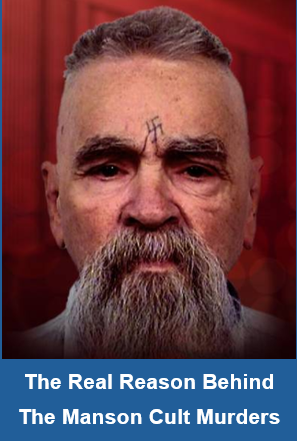
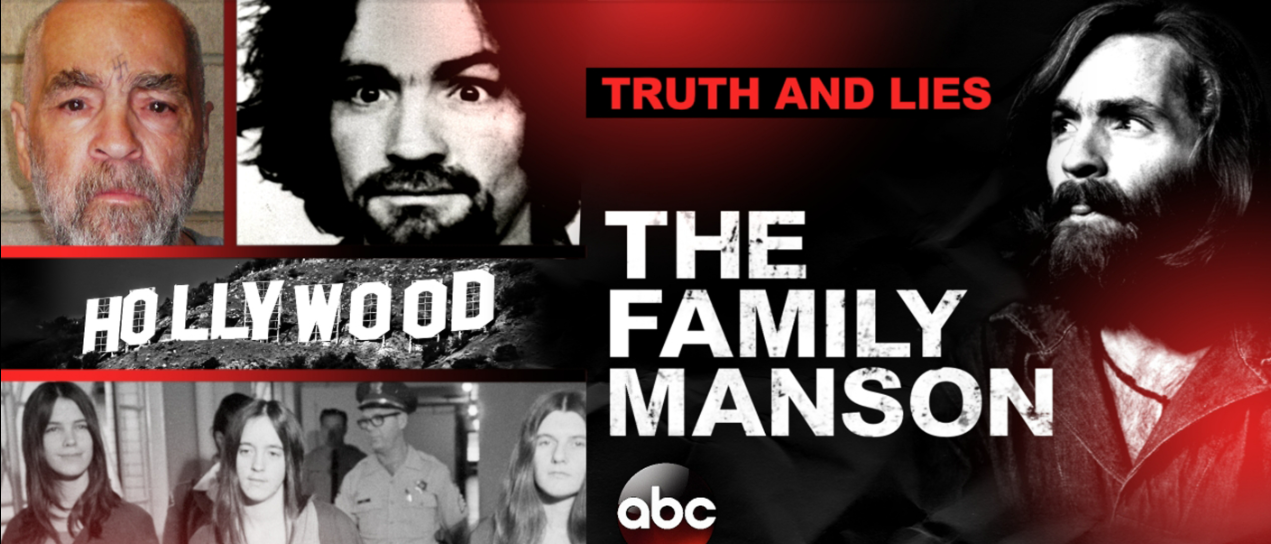
When you read the words “cult” and “murders” in the same line, you’ll evoke evil images of Charles Manson motivating his deadly cult to commit Helter Skelter—an apocalyptic race war between blacks and whites. The picture of wild-eyed Manson with a swastika carved in his forehead, and the sight of his head-shaven girls occupying the courthouse steps, seared themselves into American criminal history. Charles Manson is gone, but his memory lives on in villainous infamy. However, Charles Manson’s true motive for his cult murders wasn’t Helter Skelter. That’s nonsense. But Manson’s real reason remained shrouded in secrecy—until now.

During the summer of 1969, Charles Manson’s family of social misfits and rebellious rejects went on a homicidal rampage in the greater Los Angeles area. At least ten innocent victims lost their lives. The high-profile Manson family mass-murders claimed actress Sharon Tate and her celebrity friends who were shot, strangled, and stabbed to death. Businesspeople Rosemary and Leno LaBianca fell as well to Manson-ordered, cult-wielding knives. Charles Manson was also directly responsible for three or more individual murders associated with Manson’s criminal enterprise.

Throughout the Manson Family murder trial, district attorney and prosecutor Vincent Bugliosi pleaded a case that Charles Manson masterminded the Tate and LaBianca murders, although Manson wasn’t hands-on during the killings. Bugliosi argued Manson exercised totalitarian mind control over his cult members and convinced them to commit murder on his behalf.

Manson’s motive, Bugliosi offered, was Charles Manson proclaimed he was the reincarnation of a Jesus-like messiah who’d rule the world following an inevitable race war between blacks and whites. Manson called this Helter Skelter. Bugliosi’s case rested on the motive theory that Manson organized the Tate and LaBianca murders to frame the Black Panther movement and start his imaginary race Armageddon.

Bugliosi claimed Manson’s convoluted motive was personal gain and control after Helter Skelter occurred. Helter Skelter was a term Charles Manson adopted from the Beatles White Album that Manson claimed described the race war and its fallout. There’s no doubt from the trial evidence that Manson preached Helter Skelter to his followers, and they took it hook, line, and sinker. The Helter Skelter motive theory was enough to convince a jury to convict Manson and six family members of first-degree murder, sending them to death row. Their capital sentences were eventually reduced to life in prison where some still remain.

Now, after fifty-five years, the theory of Charles Manson’s bizarre Helter Skelter motive no longer stands the sniff test. It’s bunk, and Manson knew it. As a clever and cunning con man, Manson didn’t believe his own BS. He had a much different motive for ordering his followers to carry out the Tate and LaBianca slayings. Charles Manson’s real reason for his cult murders was to cover up another crime.

Charles Manson’s Criminal Background

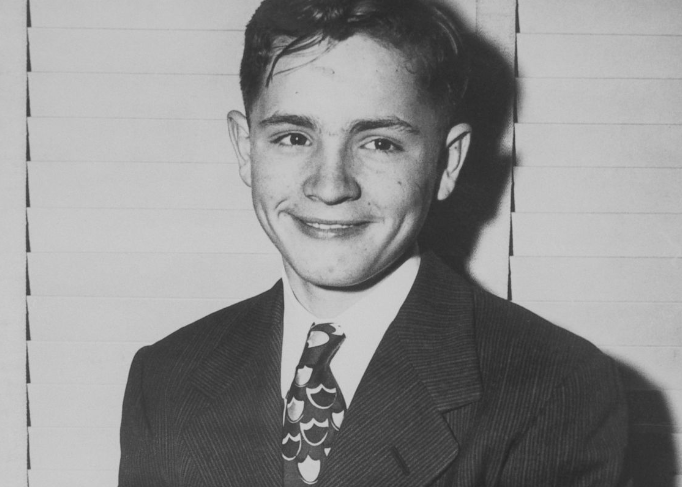
If ever there was someone born to be a career criminal, it was Charles Manson. His birth mother was a disturbed teenager from Cincinnati, Ohio. There’s doubt about who Manson’s biological father was, but he took the surname Manson from a man who married his mother while she was still pregnant. The name on his birth certificate was Charles Milles Maddox after his biological mother’s maiden name.

Manson’s mother spent his childhood years revolving in and out of jail. She was a destitute alcoholic, and Manson bounced between her relatives. He relocated to an aunt’s home in Charleston, West Virginia and then to another aunt’s place in Indianapolis. By age ten, Charles Manson was already incorrigible. He was caught breaking into a house and stealing a gun.

At twelve, Manson was incarcerated in a Terre Haute, Indiana juvenile delinquent home. He escaped and survived by living on the streets of Indianapolis. Now Manson graduated from break-ins to stealing cars. By his 14th birthday, Charles Manson was sentenced to five years in a Nebraska prison for armed robbery.

Manson had a rough go in the penitentiary. He was a little man with big little-man syndrome. Even as an adult, Charles Manson only stood 5’ 2” and weighed 125 lbs. Much larger prisoners repeatedly raped and sodomized tiny Manson. He developed a defense mechanism that would be a lifelong trademark. Charles Manson pretended to be crazy, and the act worked for him.

Manson got paroled in 1954 and moved to Ohio. Soon, he was back into stealing cars and took one for a ride to Los Angeles. He supported himself through thefts, break-ins and robberies but found time to get a girl pregnant and marry her. Manson also learned to make extra money by pimping-out his new wife.

In 1956, Charles Manson was back in the federal prison system for another five-year stint. This time he was psychologically evaluated and deemed to be aggressively antisocial. His prison IQ test scored 119 with the national average being 100. The shrinks said there was nothing crazy about Charles Manson. In fact, he was quite bright.

Manson conned his way into early parole. He was out by 1958 and practicing a new trade which he’d learned from the pros in prison. Charles Manson began assembling a harem and lived off the avails of prostitution. He’d realized it was easier and safer to get others to commit crimes for him.

But, like other criminal ventures Charles Manson tried, he got caught again when one of the girls turned on him. As well, Manson had been kiting bad checks which was a federal offense. Manson was back in the pen in 1959—this time for a ten-year sentence.

Manson’s Musical, Scientology, and Carnegie Influence

Charles Manson played the prison system well. He used the crazy act when convenient but also took some schooling. Another psychiatric assessment identified Manson’s “tremendous drive to call attention to himself”. By accident or design, Manson was cellmates with the infamous bank robber, Alvin Karpis. It was Karpis who taught Charles Manson to play the guitar.

Manson learned several more skills in prison. He became an astute student of Dale Carnegie’s How to Win Friends and Influence People. Manson also studied Scientology. Persuading people and gathering large groups became Charles Manson’s burning desire. His intent upon freedom was to use his musical aptitude, his charm, and his con-man conversion skills to gather a female following. Originally, Manson’s game was nothing more than a front for a profitable prostitution ring and a try at building a music audience.

In 1967, Manson made parole again. Now he was in Washington State where he’d been transferred within the federal system. The timing was right for strands of fate to align and begin building Charles Manson’s deadly hippie cult. He moved to San Francisco.

This was the “summer of love” and the peak of the California counterculture of hippies and freeloaders centered in San Francisco’s Haight-Ashbury district. Many of the hippies were disenchanted girls from broken homes or strict families. The hippie lifestyle of sex, drugs, and rock n’ roll was uber-attractive to these vulnerable kids. It was the perfect position for a perverted predator like Charles Manson to exploit.

Manson arrived in San Francisco at the height of the hippie movement. Now, he had two distinct and definite purposes. One was to start a prostitution ring. The other was to build a music career. Manson was smart enough to know he needed a following for both goals. He put his guitar, Carnegie, and Scientology skills to work and assembled his family.

The Manson Family Members

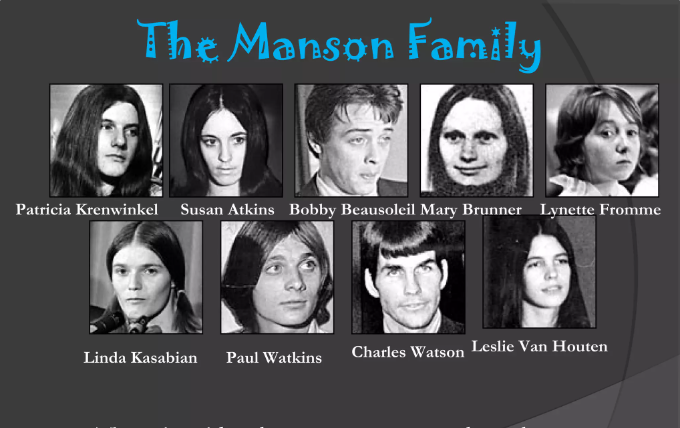
Today, most of the main Manson Family female members are household names. Everyone knows about Lynette “Squeaky” Fromme who tried to assassinate President Gerald Ford. And, of course, Susan “Sadie” Atkins is well known. So are Patricia Krenwinkel, Leslie Van Houten, Linda Kasabian, Mary Bruner, and Diane Lake.

Although Manson’s intention was to build a female following, there were a few young men who joined the family. Noteworthy were Charles “Tex” Watson, Steve “Clem” Grogan, Bruce Davis, and a good-looking young guy by the name of Bobby Beausoleil. All four would eventually go down for murders orchestrated by Charles Manson.

Looking at the Manson Family objectively, it wasn’t Charles Manson’s original intention to build a cult. His big drive was to be famous through music, and he needed a built-in audience to attract a record label. Manson was fascinated by the Beatles’ success and their music. He intended to follow their path. The cult-thing was an accidental by-product of his grandiose delusion of stardom.

A cult can be either destructive or non-destructive. Generally, a cult is an organization of followers with a charismatic leader who preaches false information. Scientology is clearly a cult, but they don’t seem to go around killing people. The Charles Manson Family did. They were about as destructive a cult as you can find.

You’ve got to give Charles Manson some credit for both drive and balls. While in prison with Karpis, Manson got a lead on a Los Angeles record producer named Phil Kaufman who Karpis knew from the outside. Kaufman was business partners with the influential recording producer, Terry Melcher, who was Doris Day’s son. Melcher was also the producer for big names like the Beach Boys, Crosby, Stills, Nash & Young, and the Mommas and Poppas.

Charles Manson amassed about 100 followers who he plied with psychedelic drugs and mesmerized their strung-out brains with messiah-like preaching about Beatle song interpretations. He gained his audience in San Francisco but knew the music action was in L.A. In 1969, Manson packed up the family and headed south. He tracked down Terry Melcher and talked his way into Melcher’s home at 10050 Cielo Drive in north Los Angeles. This was the home Sharon Tate was about to occupy.

Terry Melcher wasn’t impressed with Manson’s musical talent, but he took an interest in Manson’s personality. Melcher never outright turned Manson down for a record deal. He encouraged Manson to keep writing, practicing, and building an audience. Manson took Melcher’s advice to heart and did just that.

Manson and the Beach Boys

Charles Manson’s big musical break came by total fluke. Dennis Wilson of the Beach Boys picked up two of Manson’s girls who were hitchhiking. Seeing them as an easy sexual mark, Wilson took the girls back to his Los Angeles mansion and had his way. Once the two returned to the family and told Manson about the encounter, Charles Manson saw a tremendous opportunity. He had the audacity to take 20 of his female followers and invade Wilson’s house.

Tempted by unlimited sex, Dennis Wilson let the Manson Family stay until they wore out their welcome a few months later. By then, Manson and his followers sponged tens of thousands of dollars off Wilson and his associates. The Wilson connection gave Manson access to big names like Neil Young who Manson had many jam-sessions with.

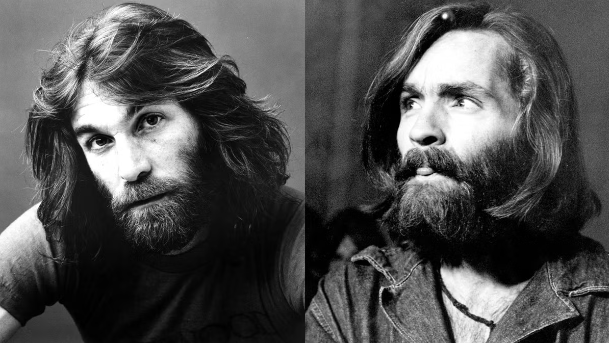
Dennis Wilson (Beach Boys) left – Charles Manson right

In the spring of 1969, Manson was going nowhere in his music world and his grip on his cult was loosening. People dropped off and recruiting was slow now that the counter-culture revolution had run its course. Manson wasn’t interested in retaining men, but he did everything to hang onto women. They were still his bread and butter. That continued to work as long as he supplied them with drugs and continued to make them feel valued.

One thing about running a cult is that it’s hard work. It takes a lot of supplies and energy to keep up the charade. Manson constantly needed to take his game to a higher step to retain control. He did this by preaching Helter Skelter, and it worked.

By now, Charles Manson had convinced his hard-core followers that he was a messiah—the “Son of Man”. He played on their fears and hopes where he predicted a race war between blacks and whites where the blacks would kill all the whites and then turn to the Manson Family for leadership. This was all nonsense, of course, and Manson knew it.

However, this Helter Skelter nonsense acted as glue for the family, and they bought it. To buy time while he pursued other music leads, Charles Manson upped his preaching game. He also upped his LSD and methamphetamine supply. For that, they needed money, and this got Manson in a pickle.

The Start of the Manson Family Murders

After Manson and the family left Dennis Wilson’s place, they couch surfed, leaching off whoever would tolerate them. One place was next door to 3301 Waverly Drive in north Los Angeles—the home of Rosemary and Leno LaBianca. After that brief stay, Manson found an old movie set called the Spahn Ranch in the desert northwest of L.A.

Manson paid his rent to eighty-year-old George Spahn in sexual favors performed by his girls. With this new spot and its remote location, Manson now had more control over who was coming and going in the family. One of the newcomers was a 21-year-old wanna-be musician, Bobby Beausoleil.

Charles Manson was under constant pressure to fund his family. It took money to pay for drugs, food, and vehicles that the Manson Family required. Most of their money came from prostitution, drug trafficking and petty theft. From that, they barely scraped by. Charles Manson saw an opportunity and hatched a plan for a big money score.

One of Manson’s musical acquaintances was Gary Hinman who was a quiet and well-educated man. Hinman found Manson and his followers interesting but had no desire to join them. Manson heard a rumor that Hinman recently acquired a large inheritance, so Manson sent Bobby Beausoleil and Susan Atkins to check it out.

Gary Hinman knew Beausoleil and Atkins. He willingly let them in. Both Atkins and Beausoleil were drugged and unstable. When they approached Hinman to join their family, he again declined. The conversation turned to money, and Hinman put his foot down. It turned ugly. The Manson Family members took Hinman hostage and began torturing him.

Beausoleil phoned Manson back at the ranch and told him they weren’t getting anywhere with Hinman. They asked for Manson’s direction. Manson told Atkins and Beausoleil to keep Hinman tied up till he got there. Once Manson arrived, he took over, cutting Hinman’s ear off to set an example.

Hinman still refused to give in. In frustration, Manson took Atkins and left—telling Beausoleil, “You know what to do.” Manson also told Beausoleil to make the scene look like the Black Panthers were involved, reminding Beausoleil of the apocalyptic doom of Helter Skelter.

Bobby Beausoleil took that as a clear signal and authorization from his leader—Charles Manson—to kill Gary Hinman. With Manson gone, Bobby Beausoleil stabbed Hinman to death while Hinman stayed tied to a chair. Beausoleil then wrote “Pig” on the front door in Hinman’s blood as well as leaving a bloody paw print which was the Black Panther symbol.

Beausoleil was drugged, fatigued, and not thinking straight. He stole Hinman’s car, hid the knife in the trunk and drove from the scene. Within hours, the police found Bobby Beausoleil asleep in Hinman’s stolen car. His clothes were bloody and so was the murder weapon that was still in the trunk. The police backtracked, found Hinman’s body, and charged Bobby Beausoleil with first-degree murder.

Charles Manson Plans the Tate & LaBianca Murders

Beausoleil’s arrest worried Charles Manson. He was concerned—really concerned—that Bobby Beausoleil would crack, squeal, and implicate Charles Manson as a murder accomplice. That got the wheels turning in Manson’s head, and his convoluted logic kicked in.

Charles Manson calculated that if similar murders occurred with a modus operandi (MO) like what Beausoleil did to Hinman, then the police would have to conclude the real killers were still out there. Therefore, they’d have to drop the charges, release Bobby Beausoleil, and the heat would be off Charles Manson.

Manson figured he’d put his other family members to work by casing out locations and finding suitable murder victims. He knew he could convince his most-trusted lieutenants who accepted his Helter Skelter prophesies. Manson gathered them and said it was now time to start Helter Skelter. He said nothing about covering up the botched Gary Hinman murder.

The first place Manson targeted was 10050 Cielo Drive. Manson knew Terry Melcher moved out. In fact, Manson came face-to-face with Sharon Tate when he went looking for Melcher one day. Manson picked Tate’s residence for two reasons. One was he knew that celebrity murders would get a lot of attention. Secondly, Manson was familiar with the layout.

On the night of August 8, 1969, Charles Manson instructed Tex Watson to take Susan Atkins, Patricia Krenwinkel, and Linda Kasabian and kill everyone inside 10050 Ceilo Drive. Manson also directed them to make the scene look like a Black Panther attack by writing bloody messages on the walls. He implicitly said this was the start of Helter Skelter and it was their privilege to carry it out.

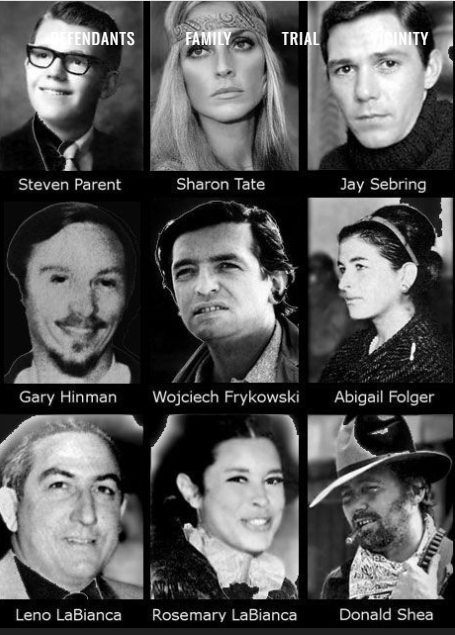
The drug-fueled cult members bought every word of it. Without going into graphic details, the Manson Family members cold-bloodedly killed Sharon Tate, Jay Sebring, Abagail Folger, Wojciech Frykowski, and an innocent visitor named Steve Parent.

One mass killing wasn’t good enough for Charles Manson. The next night, Manson accompanied the same murderous group to the Leno and Rosemary LaBianca house on Waverly Drive. This time he took along Leslie Van Houten and Clem Grogan. Again, Manson didn’t get his hands bloody. He picked the LaBianca home simply because he knew the layout and that they were wealthy. Once Manson located the home, he left and the Manson Family cult members went in for the kill.

Bit by bit, Manson’s grip on his cult slipped away. It took a while for the police to connect the Tate and LaBianca murders and find evidence linking the Manson cult to the crimes. Even when the police raided the Spahn Ranch and arrested Manson and his remaining followers on car theft suspicion, they failed to make any connection to the August murder spree. It wasn’t until Susan Atkins opened her mouth in jail that the cat came out of the bag.

Many of the Manson Family members testified at the Tate and LaBianca murder trials. Each one attributed the motive to Charles Manson’s Helter Skelter vision. One can’t blame them for revealing this as the motive because that’s what they honestly believed. Only Charles Manson knew his real motive for his cult killings. That’s a secret Manson took to the grave with him.

*   *   *

I’m not making up this theory about Charles Manson’s real motive for his cult murders. Vincent Bugliosi is on the record for purporting the Gary Hinman murder connection as the real reason why Manson ordered the Tate and LiBianca “copy-cat” killings. It makes sense when you think about it. And if you think about it, Bugliosi ran with the Helter Skelter motive because he knew he could sell it to the jury—not so with the Hinman coverup.

Charles Manson was a psychopath, but he wasn’t psychotic. He was a shrewd little con-man and a calculating criminal. His entire MO was using people to commit criminal acts, and his cult following—which was supposed to be a Beatles-like fan club—got carried away into one of the most notorious murder cases in history. It was all about covering up a crime gone bad.

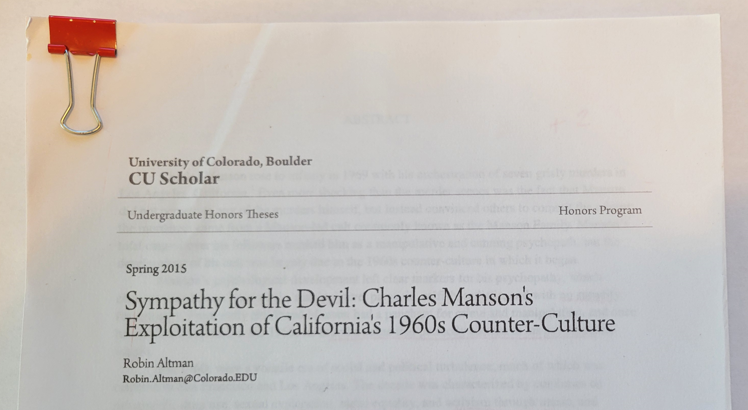
If you’re interested in a fascinating look at how Charles Manson built and controlled his cult, I suggest reading a 2015 undergraduate honors thesis by Robin Altman of the University of Colorado, Boulder. It’s titled Sympathy for the Devil: Charles Manson’s Exploitation of California’s 1960 Counter-Culture. The thesis also concludes Manson’s real motive for the Tate & LaBianca murders was to cover up Bobby Beausoleil’s blotched job and to protect/divert suspicion from Charles Manson.

BEYOND THE LIMITS — NEW BASED-ON-TRUE-CRIME SERIES BOOK RELEASE

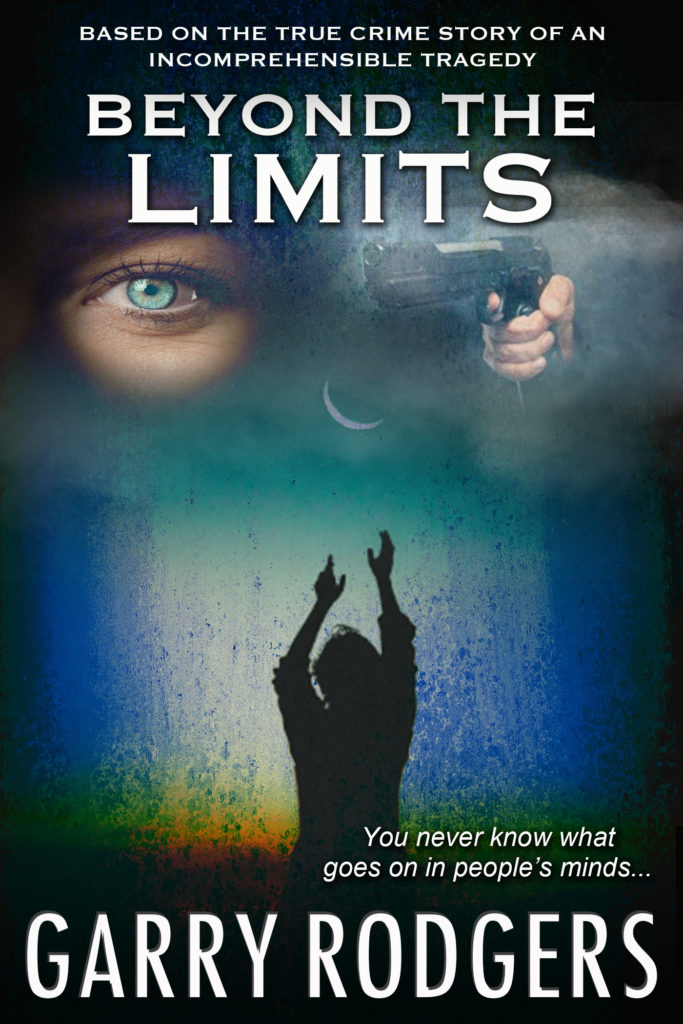
Book #7 in my Based-On-True-Crime Series is out. Beyond The Limits is now available in e-format on Amazon, Kobo, and Nook. (February 06, 2021) Here’s the product description (blurb / jacket copy) and the first two chapters.

What really happened to Kita Southern? A vibrant entrepreneur with high ambitions suddenly disappears from a small Vancouver Island city. She seems to have it all. Beauty. Charm. And a passion for channeling the metaphysical. But Kita has a lifestyle most don’t know of, and you never know what goes on in people’s minds. The truth in Kita Southern’s case is beyond the limits of imagination—an incomprehensible tragedy.

Beyond The Limits is Book 7 in the 12-part Based-On-True-Crime series by retired homicide detective and coroner Garry Rodgers. This story comes with a warning: Explicit descriptions of the crime scenes, factual dialogue, real forensic procedures, and actual police investigation, interview and interrogation techniques are portrayed. If you crave graphic realism in crime writing, Beyond The Limits is your book.

Chapter One — Monday, December 21st – 9:00 a.m.

“Kita. Kita Southern.” Kari Lyons dammed back her tears as she said her sister’s name. Gwen Southern, their mother, didn’t. Gwen’s silently flowed. She sat with Kari on the couch in our police interview room adjacent to the Serious Crimes Section office.

“This… is… completely out of character for Kita.” Kari choked. “So, so out of character.”

Now Kari broke down. She pushed her face into her mom’s shoulder and began to bawl. Both ladies were emotional messes.

I gave them composure time. There were tissue boxes in what we called the “soft” interview space we used for victim, witness, and complainant statements. Gwen and Kari took Kleenexes and soaked them.

Kari raised her head. She spoke in hesitant spurts. “She… Kita… she would never be away… this long… without telling someone. Never.”

Gwen, too, said a nearly inaudible, “Never.”

——

Kari Lyons and Gwen Southern came into the Nanaimo police office to report Kita as a missing person. The desk officer took brief details at the front counter but, hearing the alarming circumstances, referred them to a detective. I was the only one in the Serious Crimes Section with a current spare moment, and I was the one who inherited the Kita Southern file.

Nanaimo is a small coastal city of a hundred thousand on the southeastern shore of Vancouver Island in British Columbia, Canada. It’s straight across the Salish Sea from the City of Vancouver which is one of the most exotic, erotic, and expensive places on the planet. Although much smaller and somewhat cutoff, Nanaimo has a disproportionately large share of hardcore crime intertwined with the black market drug trade.

Drugs. It was always drugs. Drugs were the main source of sorrow.

——

“I need to get some details.” I had my pen out and my notebook open. I also had a video camera and audio recorder running, although Gwen and Kari couldn’t see it. “Can you give me Kita’s full name?”

Kari responded. “It’s Kita Rose Southern. Kita is spelled K-i-t-a. The other two are just as they sound.”

“And how old is Kita?”

“She’s thirty-four.” Kari sniffed. She dabbed her eyes and nose. “Just turned thirty-four on October seventeenth.”

“What’s Kita’s description?”

“She looks exactly like me.”

“Kita and Kari. Are you twins?”

“No. But everyone thinks we are. Kita is a year and a bit younger.” Kari opened her phone and flicked. “Here is a recent photo of Kita… taken on her birthday.”

I looked at a happy image—lusty skin, charcoal mane, turquoise eyes, and crimson lips circling a Hollywood mouth. Kari scrolled again. I saw more pics of Kita. I looked at Kari, then back at Kita. Could be twins. Very attractive women. Curvaceous. Full-figured. Vibrant. If old Hef were alive, they’d have a shot at Playboy’s center. “What’s Kita’s address and contact information?”

Gwen stayed silent but attentive. Kari replied, “She lives at five-twenty-three Park Avenue. The old section of Harewood off Fifth. It’s a gorgeous character home. Her cell number is… here, I’ll write it down for you.”

Kari printed 250 668-8972. She also gave me Kita’s email, kita1@gmail.com, as well as Kita’s social media accounts. Facebook. Twitter. Instagram. And a website titled TheTarotLady.net.

“Now, when was Kita last seen? Last heard?”

Kari went teary again. Gwen still was. Kari set her phone on the coffee table between us. She clasped her mother’s hand.

“She… the… from what I can determine… Kita was active until about noon on Saturday. This past Saturday the nineteenth. She went to pick up something from a friend. A close friend who has a store downtown on Commercial Street.”

“Her friend’s name is?”

“Jasmine Koch. They’re extremely close. Since elementary school, and I’d say Jasmine is probably Kita’s closest friend. Jasmine is freaking out. So is everyone else, and a lot of people in this town know Kita. But no one knows anything at all about what’s happened to her. This is so, so out of character.”

“Fill me in about what happened when Kita was last heard from.”

“I haven’t spoken to Jasmine in person. Just on the phone. But Jasmine says Kita came to the store at noon or just after. The group had a Christmas party planned for the evening, and Kita picked up something for it from Jasmine’s store. Then Kita left… she was alone… and that’s the last anyone can say they know…”

Gwen leaned forward and took Kari’s other hand. I thought she was going to crush it.

“Did Jasmine say where Kita was headed next?”

“No. Not specifically. But from what I’ve put together from phoning around… driving around… Kita had a few appointments, and I can’t say for sure if she made them. I didn’t know anything was wrong until yesterday afternoon. Then I tried calling, texting, emailing, messaging her website, but Kita didn’t answer. This is absolutely not like her. Kita has never done this before. She would never just take off and not leave a reason to not be available. She has so many contact forms, and she’s a very busy person. She needs to constantly keep in touch with people. Friends. Clients. Business associates. She would never, ever, up and disappear. It’s just beyond the limits of my imagination.”

“Sure sounds like something’s seriously wrong.” I spoke my thoughts, and it wasn’t good. Kari and Gwen went nearly hysterical.

Kari hugged her mother who was full-on vibrating. I gave them a few minutes. Then I asked a question that had to be asked. “Do you have any suspicions?”

Chapter Two — Monday, December 21st – 9:15 a.m.

Did Gwen Southern and Kari Lyons have any suspicions? Yes, they did. And to their admission, those suspicions made no sense. Looking back, they made no sense to me either. However, I’d learn as I investigated the Kita Southern file that a lot of things didn’t make a lot of sense. Especially things that went on in other people’s minds.

I’d been a detective for a long time. Probably too long, and I was nearing retirement. I’d seen a lot of things, and something I learned was never to assume things are as they first appear. I let Kari and Gwen tell me what they suspected.

——

“I don’t know how to say this.” Kari looked towards a taupe wall with non-descript artwork in the softly-lit room. “It’s Dan. He is acting… strange. Not himself. At all.”

“And who is Dan?”

Kari turned back to me. “Dan is Kita’s other. Kita’s life partner. They’re not officially married, but they’ve been together for nearly ten years. I… I can’t imagine Dan doing anything to harm Kita… but… there’s something wrong with the way he’s acting. Really wrong.”

“Dan’s last name is?”

“Porter. Dan… Daniel Porter.”

“So how is Dan acting that raises suspicions?”

Kari paused. She glanced at Gwen who nodded a go-ahead sign. “He… he seems worried on one hand. Like almost sick with worry. On the other, he says there’s no problem. He says Kita has just taken some soul time for herself, and everything is just fine. Well, it’s not fine…” Kari started to cry again which set Gwen off.

I let them vent. They were nearly cried out, and that could be a good thing. Venting helps a person focus once they’re all vented out.

Kari continued. “When I first couldn’t contact Kita, I phoned Dan. He didn’t answer, so I left a voice message then a few texts. I also phoned a few of Kita’s friends, and that set the alarm off. People called other people. It was obvious something was seriously wrong. Kita didn’t keep appointments. She didn’t respond to anyone else. She… she… vanished.”

“So did Dan contact you?”

“He did. After maybe two hours and then others were calling him, too.”

“And what did Dan say?”

“Dan said Kita was fine. Not to worry. That was yesterday afternoon. Maybe four or so. He said Kita needed time to herself and she was fine. I didn’t believe it.”

“Did Dan say where Kita was?”

“No. I asked him specifically. He said Kita didn’t want anyone contacting her for a while. I asked him how long. He was… evasive. He said he could pass messages on to her, but she didn’t want to talk to anyone or see anyone at the moment.”

“Did Dan say why she wanted… what did you call it? Soul time?”

“No. I tried to get him to explain, but he walled-up and told me not to worry. ‘Everything was fine,’ he said. I can’t believe that.”

“Has this happened before?”

Kari shook her head. “Never. This is absolutely not like her. Kita would never do anything like go away without telling anyone. She would know people… family… friends… clients… everyone would be really concerned without a good explanation. It makes no sense at all. Excuse my language, but it’s bullshit. Dan knows something. He’s not telling the truth.”

Gwen Southern spoke for the first time. She had an unusual voice. She reminded me of my mother, who was highly educated and articulate but with a peculiar way of pronouncing certain words like sawmon for salmon and toe-matt-toe for tomato.

“I have to say I can’t believe Daniel would ever do anything to harm Kita.” Gwen sat up. She leaned forward and into my space. “Something has happened between the two that I cannot remotely fathom. There has never been any conflict or discontent in their relationship. Daniel is a son to me.”

“Have you spoken to Daniel, Gwen?” I set down my pen and put my hand forward.

Gwen instinctively took it. “I have. Daniel gave me a story that Kita took a hideaway to finish a book. Kita is a writer, among the many things she does. Daniel told me… and he’s never spoken mistruth to me… that Kita had a deadline change and a manuscript rush to complete and be published before year’s end. There is truth to that. But there is no truth to Kita’s intentional lack of contact. Kita would not cut off communication with her family and friends.”

“Did Daniel tell you where Kita was?”

Gwen released her grasp. She reached for another Kleenex. “No. I asked him. He was… evasive. He told me not to worry. That Kita was under pressure. That Kita was fine. That she’d be home in a few days. Well before Christmas which is our main family event. This is the first time I’ve had reason to disbelieve Daniel. However, I have to say Daniel seems very worried himself.”

Kari offered something else. “Dan told Anita Jancovic a different story. He said Kita went on a vision quest. Dan told Anita that Kita had a card reading telling her to take an immediate break from life stress. Kita said… Dan said Kita said she needed to do a vision quest and excommunicate herself.”

“Anita Jancovic? Who’s she?”

“Another of Kita’s close friends. Anita was holding the Christmas party.”

I was getting confused. Soul time? Vision quest? Card reading? Writing deadline? Excommunicate herself? I paused to write the phrases in my notebook.

“So it seems there are two conflicting accounts coming from Dan—” I was going to paraphrase, but Kari cut me off.

“Three. Dan told me Kita wanted soul time. He told Anita that Kita had a troubling card read and went on a vision quest. He told Mom that Kita suddenly dropped everything to go and finish a book. I don’t buy any of it.”

“Okay.” I numbered my phrases with one, two, three, and four.”

“On the other hand… while this is completely out of normal for Kita… it’s also completely abnormal for Dan to act like this. Like I said, what’s happened is beyond the limits of my imagination.”

I leaned forward. “I’d like you folks to tell me more about Kita and Dan. What is going on in their lives and in their minds?”

What I was about to find out was beyond the limits of my imagination too.

——

Download Beyond The Limits — Book 7 in the Based-On-True-Crime Series by Garry Rodgers.